AI Overviews didn't replace SEO. It raised the stakes.
In our dataset, 80% of all AI Overviews citations come from pages ranking in the top 3 organic SERP positions for that query. Position 1 alone accounts for 37.5% of citations. Position 2 takes another 31.8%.
If you're not on the first page, you're not in the conversation. If you're not in the top 3, you're barely in it.
Google is stealing your content more than ever (direct answers etc.). We researched how to spread your message across sources — and found really actionable insights.
~ Michał Suski, Head of Innovation and co-founder at Positive Surfer
Here's what that means for how you should actually optimize — and what to do once ranking alone stops being enough.
The part nobody wants to hear: You still have to rank
There's a popular idea going around that AI search is a separate game — that you can skip the grind of organic rankings and optimize your way directly into AI answers.
For AI Overviews, the data says otherwise.
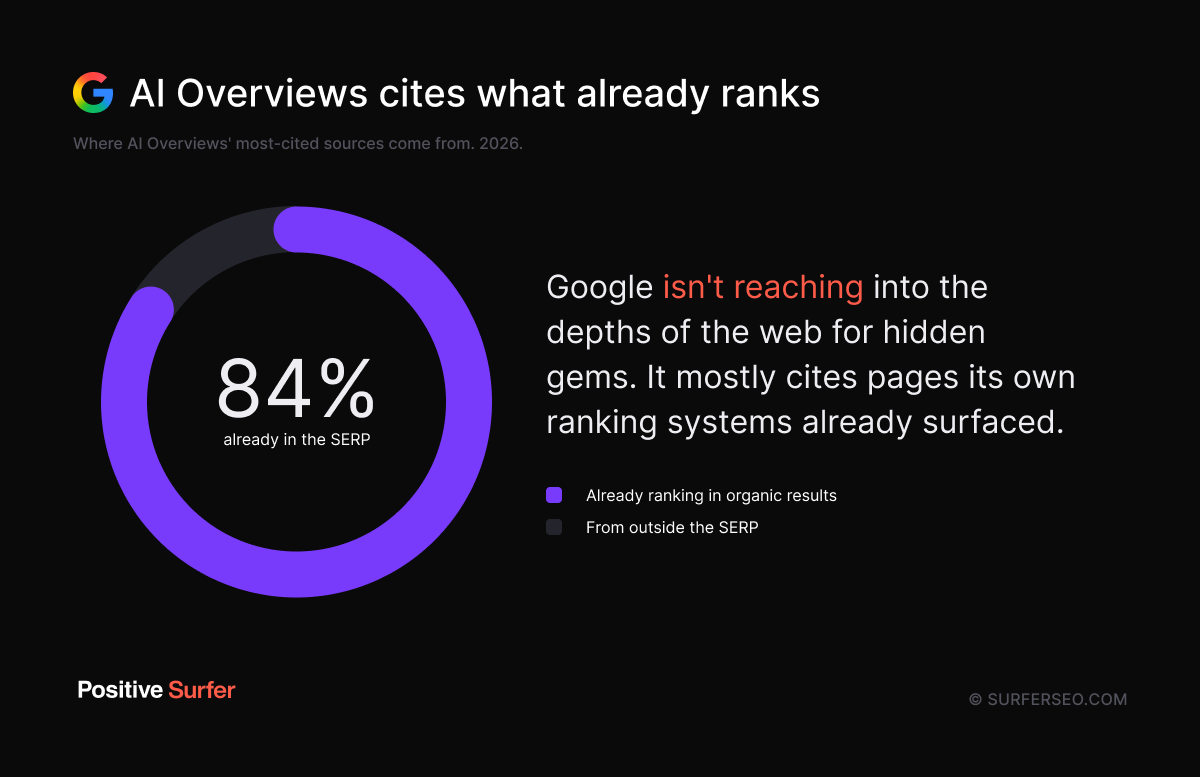
84% of the sources AI Overviews cites most heavily are already sitting in the organic search results for that query. Only 16% come from outside the SERP. Google isn't reaching into the depths of the web to find hidden gems. It's mostly choosing from the pages that its own ranking systems have already surfaced.
Think of it like a casting call where the shortlist is already made. AI Overviews isn't auditioning the whole internet — it's picking from the actors Google already invited into the room. Your first job is getting into the room, and for that, you can watch our YouTube tutorials or use Surfer. Everything else in this article is about what happens after that.
Why getting cited is harder than ranking
Here's the number that changes the math: AI Overviews cite an average of just 3–4 sources per query.
A traditional results page gives you ten organic spots, plus more below. An AI Overview gives you three or four. That's the whole visible surface.
So even inside the top 3 — where 80% of citations come from — there's still a selection happening. Ranking gets you considered. It doesn't get you cited.
What decides the rest is the content itself.
What the data shows about how AI overviews choose sources
From Surfer's AI Tracker — 650,000+ AI-generated answers scored across a 20-factor content rubric, April 2026:
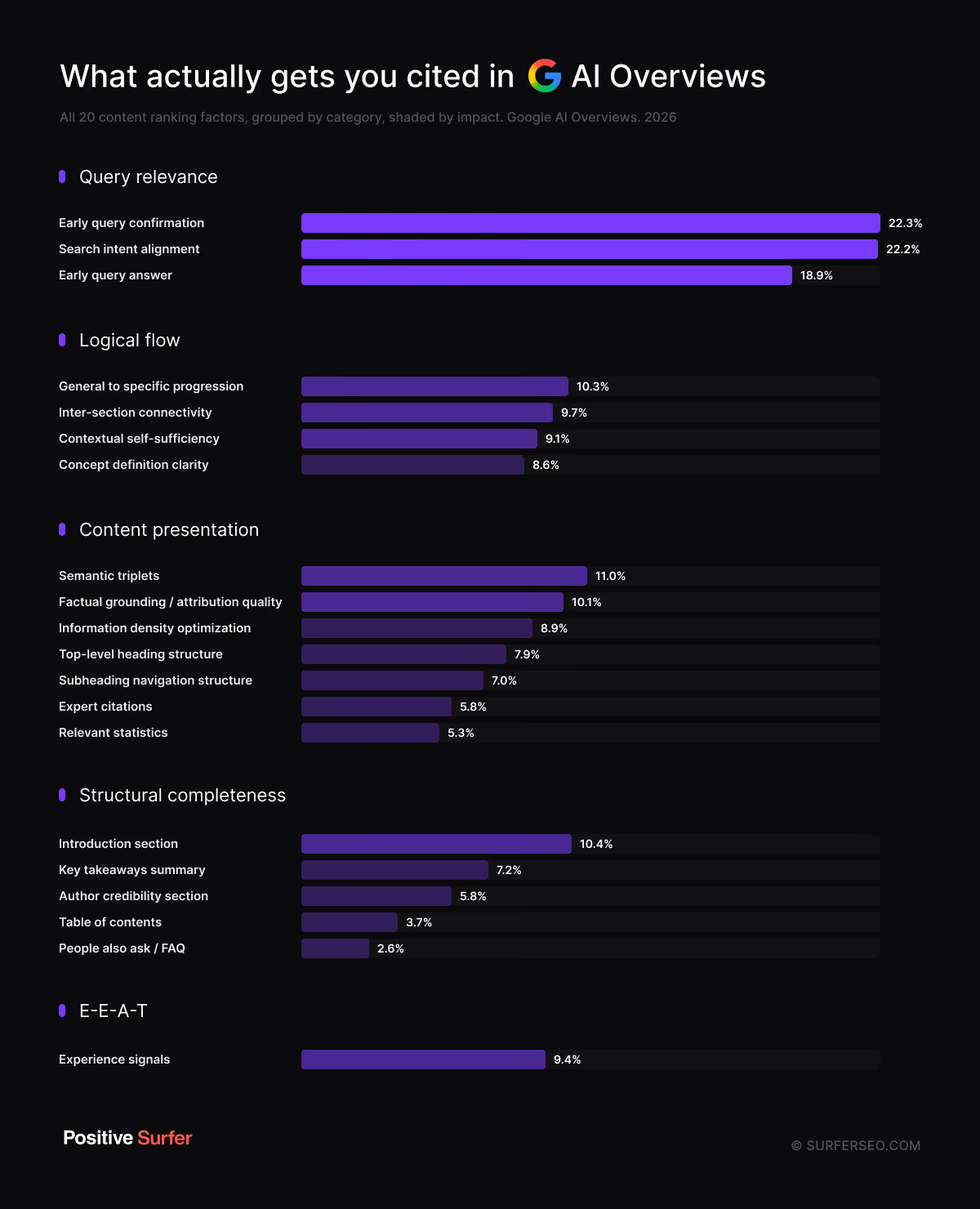
AI Overviews follows the same pattern we see across every model in the 2026 citation run: the top three factors all measure what your first paragraph does. The fourth-place factor doesn't even reach half this weight.
But when we compare pages that got cited against pages that ranked but didn't, three factors separate winners from losers more than anything else — and they all live in the same place:
- Early Query Confirmation (22.3%). Does your first paragraph clearly signal that you're answering the question the person asked? Think of it as the "am I in the right place?" check AI Overviews runs before committing to a citation. Pages that pass it get cited 22.3% more often than pages that don't.
- Search Intent Alignment (22.2%). Does your content address why someone is asking, not just the literal words of their query? A person searching "email marketing cost" is usually pricing a decision, not collecting trivia — content that serves the decision wins over content that defines the term.
- Early Query Answer (18.9%). Do you give the short version of the answer before you start elaborating? The rest of the article is proof and detail. The first paragraph is the claim.
All three are measuring your first paragraph. Not your credentials, not your formatting, not your site — the opening hundred-or-so words of the page.
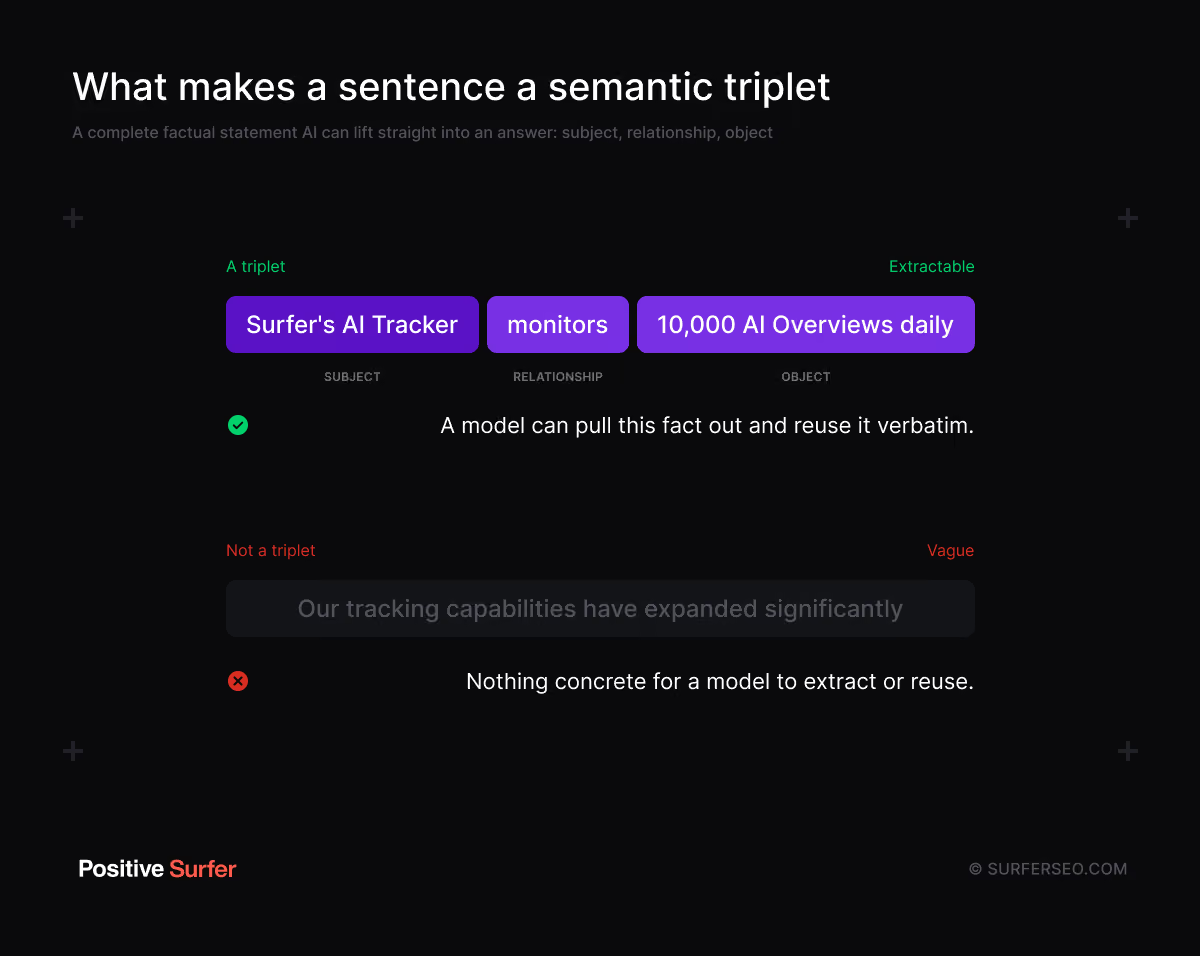
One more factor is worth knowing about, sitting just below the trio: Semantic Triplets (11%) — clear, complete statements a model can quote directly. "Surfer's AI Tracker monitors 10,000 AI Overviews daily" is one. "Our tracking capabilities have expanded significantly" is not — there's nothing in it to extract. It's the strongest factor for AI Overviews that isn't about your first paragraph.
Notice what's at the bottom of the table: author bios (5.8%), tables of contents (3.7%), FAQ sections (2.6%). The difference between getting cited and getting skipped isn't who wrote the page or what widgets you added to it. It's whether the page confirms, matches, and answers the query — fast.
Where in your content AI overviews actually look
I've written separately about how almost 40% of all AI citations come from the first 100 words of a page — and that finding comes from AI Overviews data specifically.
Citations concentrate heavily at the top of the document. Your introduction and first few sections carry most of the citation opportunity; everything past the halfway point is working with scraps.
Now put the two findings together. The factors that decide citations measure your first paragraph. The citations themselves come from your first hundred words. This isn't two separate insights — it's the same behavior measured from two angles, and both point at the exact same spot on your page.
One finding worth knowing if you generate content with AI
We ran a side experiment: identical topics, one version generated with Gemini, one with GPT — then measured which got picked up by AI Overviews.
AI Overviews showed a consistent preference for the Gemini-generated versions, across every ranking position we tested.
I'll be honest about the size of this effect: it's a consistent edge, not a landslide. Both versions got cited at high rates. But if you're producing content at scale specifically for AI Overviews visibility, the model choice isn't neutral — and Google's AI preferring content written by Google's AI is at least worth a raised eyebrow.
What to do with all this
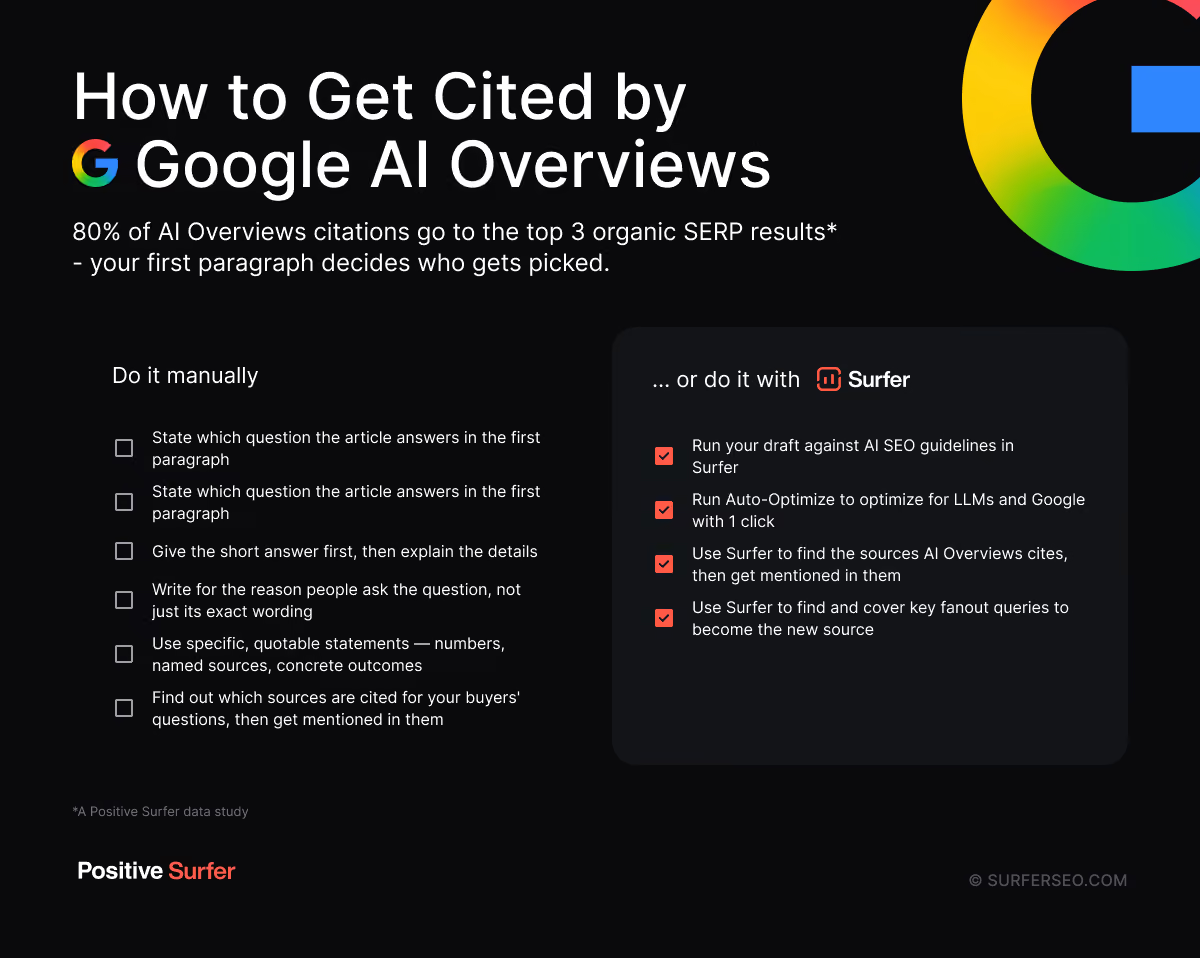
The AI Overviews playbook, in order of priority:
1. Rank first. Nothing else in this article matters if you're not in the top 3–5 organic positions. Your existing SEO work isn't obsolete — it's the entry ticket.
2. Confirm and answer the query in your first paragraph. State the topic in sentence one, give the short answer before you elaborate. This is where the three heaviest factors in our data are decided — by the time AI Overviews is a hundred words into your page, your citation odds are mostly set.
3. Write for the intent, not just the query. Ask yourself why someone types that question, and serve that. A comparison query wants a verdict, a cost query wants numbers, a how-to query wants steps — not a definition of the category.
4. Make your claims quotable. Write complete, specific statements a model can lift directly: a number, a named source, a concrete outcome. If a sentence can't stand alone as a fact, AI Overviews can't cite it as one.
5. Front-load everything else too. The key point at the top of each section, the data before the discussion. Citations concentrate at the top of the document — and at the top of each section within it.
Optimize for AI overviews with Surfer
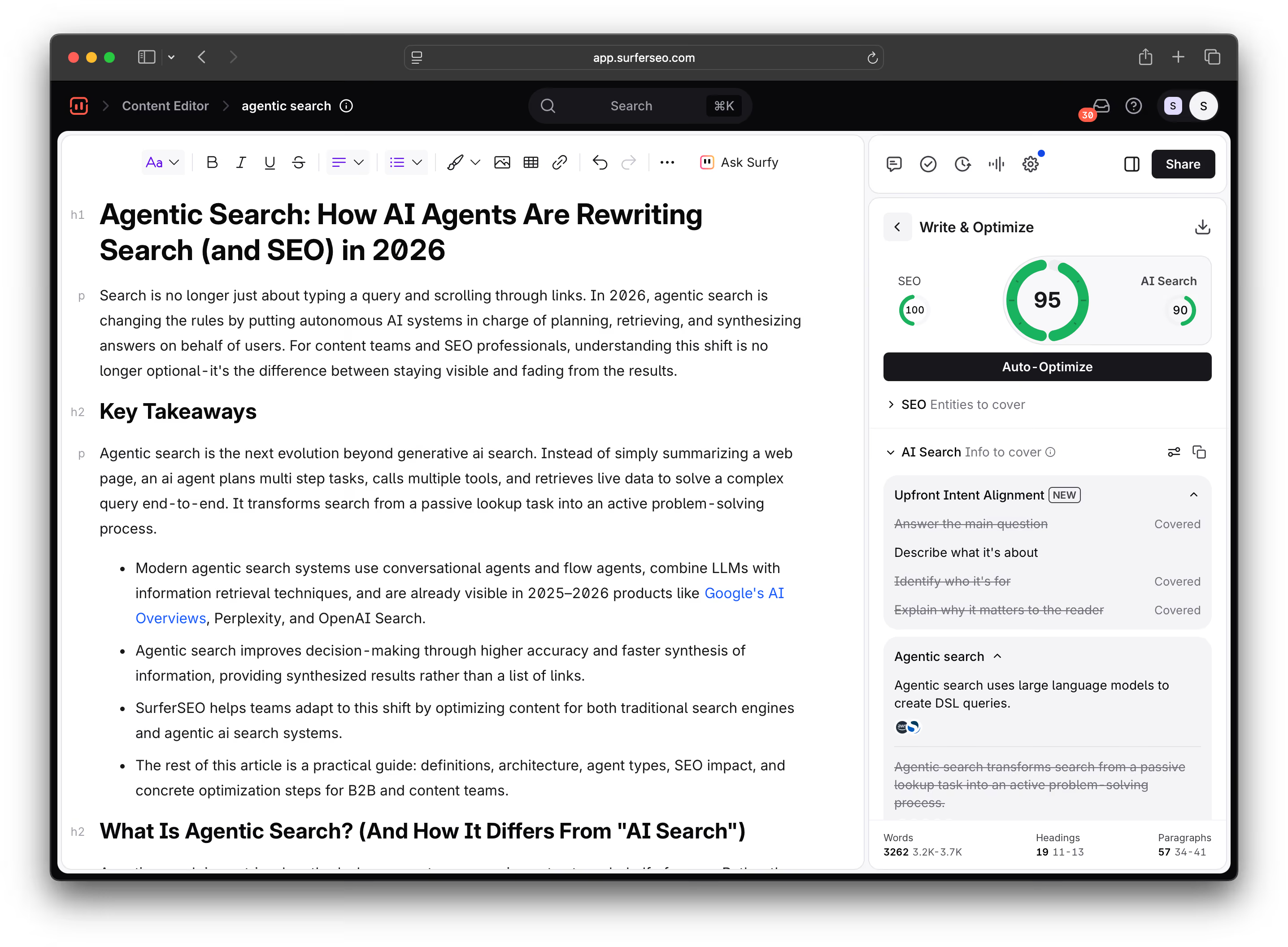
This is exactly why we built the AI SEO Content Score in Surfer's Content Editor the way we did — it combines SEO and AI search guidelines in one score, because for AI Overviews, they're one game. Ranking gets you shortlisted. Your first paragraph gets you cited. You need both, and optimizing them separately never made much sense.
The guideline doing the heaviest lifting here is Upfront Intent Alignment — it checks whether your intro names the topic in sentence one, includes a factual anchor, and delivers the answer before the elaboration. Exactly the pattern behind AI Overviews' three heaviest factors.
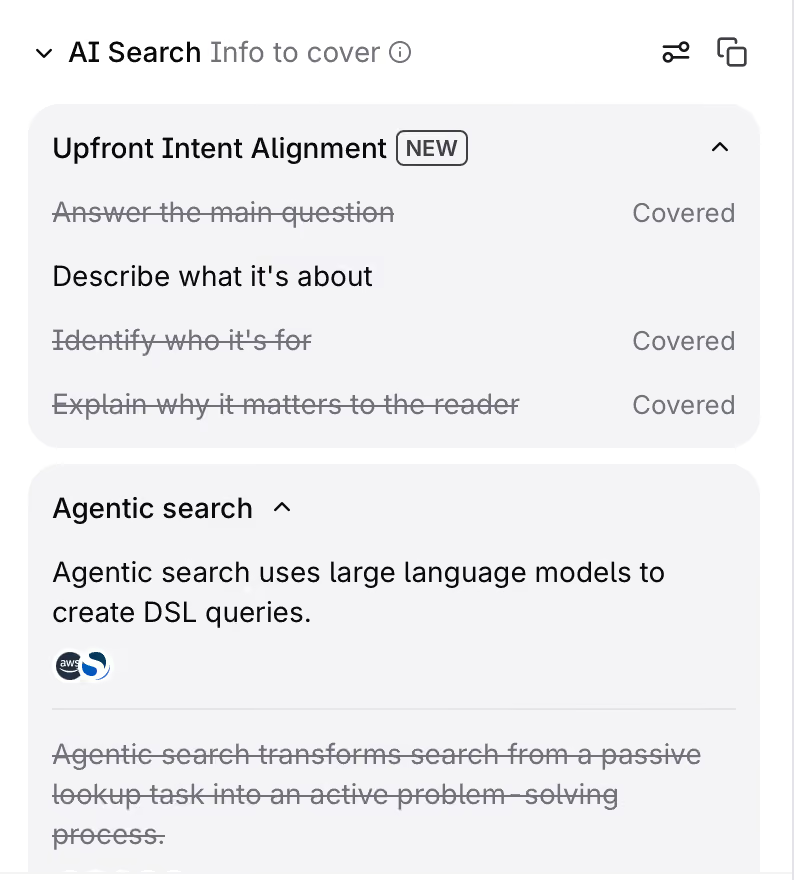
Alongside it, information to cite from Agentic Search lists the specific facts AI models look for when answering questions in your topic — and given that AI Overviews picks just 3–4 sources per query, showing up with the facts it needs is often what separates the cited page from the ranked-but-ignored one.
You can apply the suggestions manually, ask Surfy to handle them selectively in your tone of voice, or use Auto-Optimize to fix your SEO and AI search guidelines — introduction rewrites included — in one pass (my preferred approach).
Step two: Find out who's getting cited instead of you
Then, head over to AI Tracker and set up prompts organized into the topics you want to track — for us, that's things like AI visibility, AI SEO tools, and content optimization:
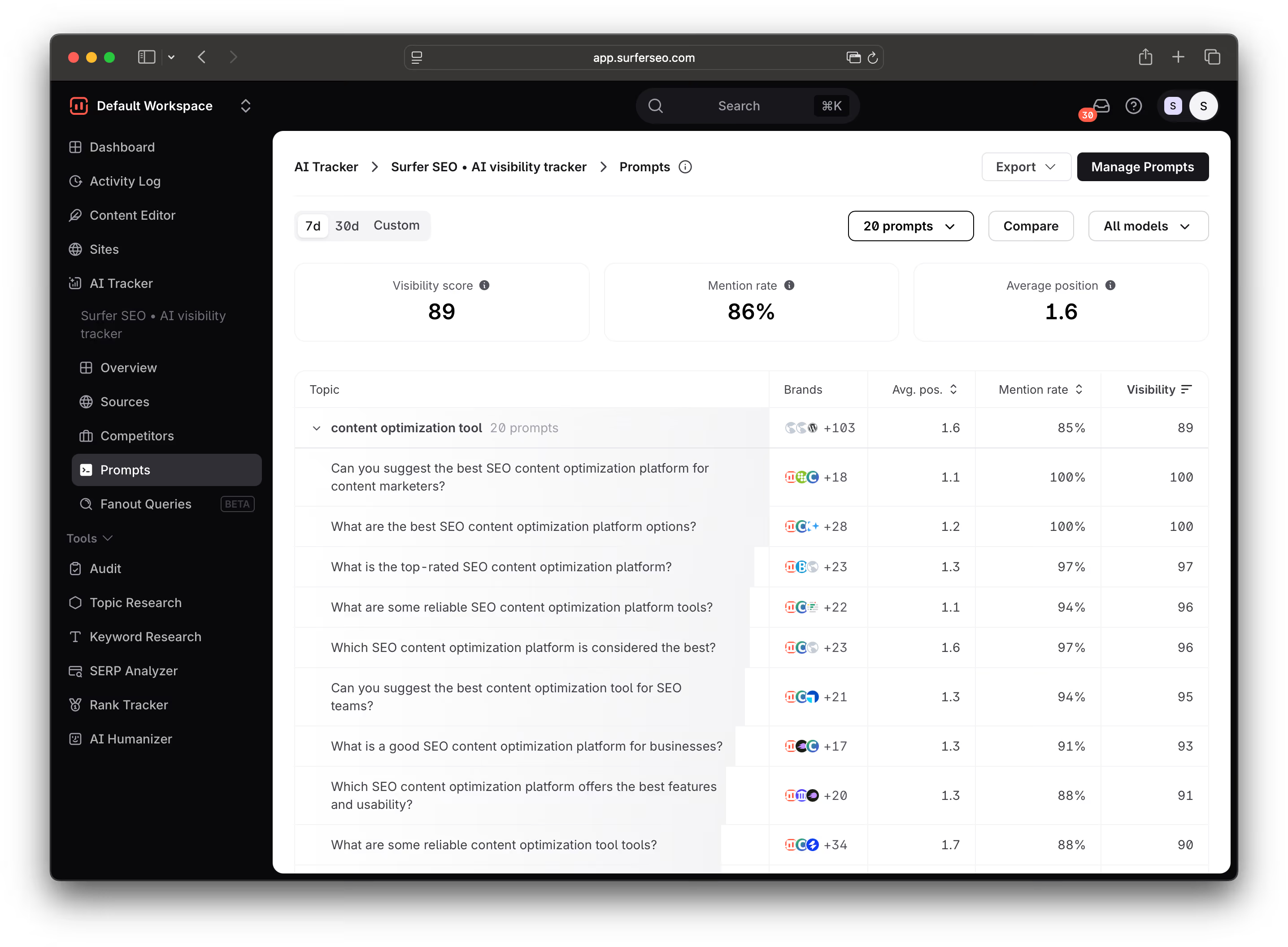
This shows you who's currently being cited for the most important questions your buyers ask about your niche. Every answer falls into one of three buckets: you, your competitors, or third-party content you could get into.
That third bucket is where the opportunity usually is.
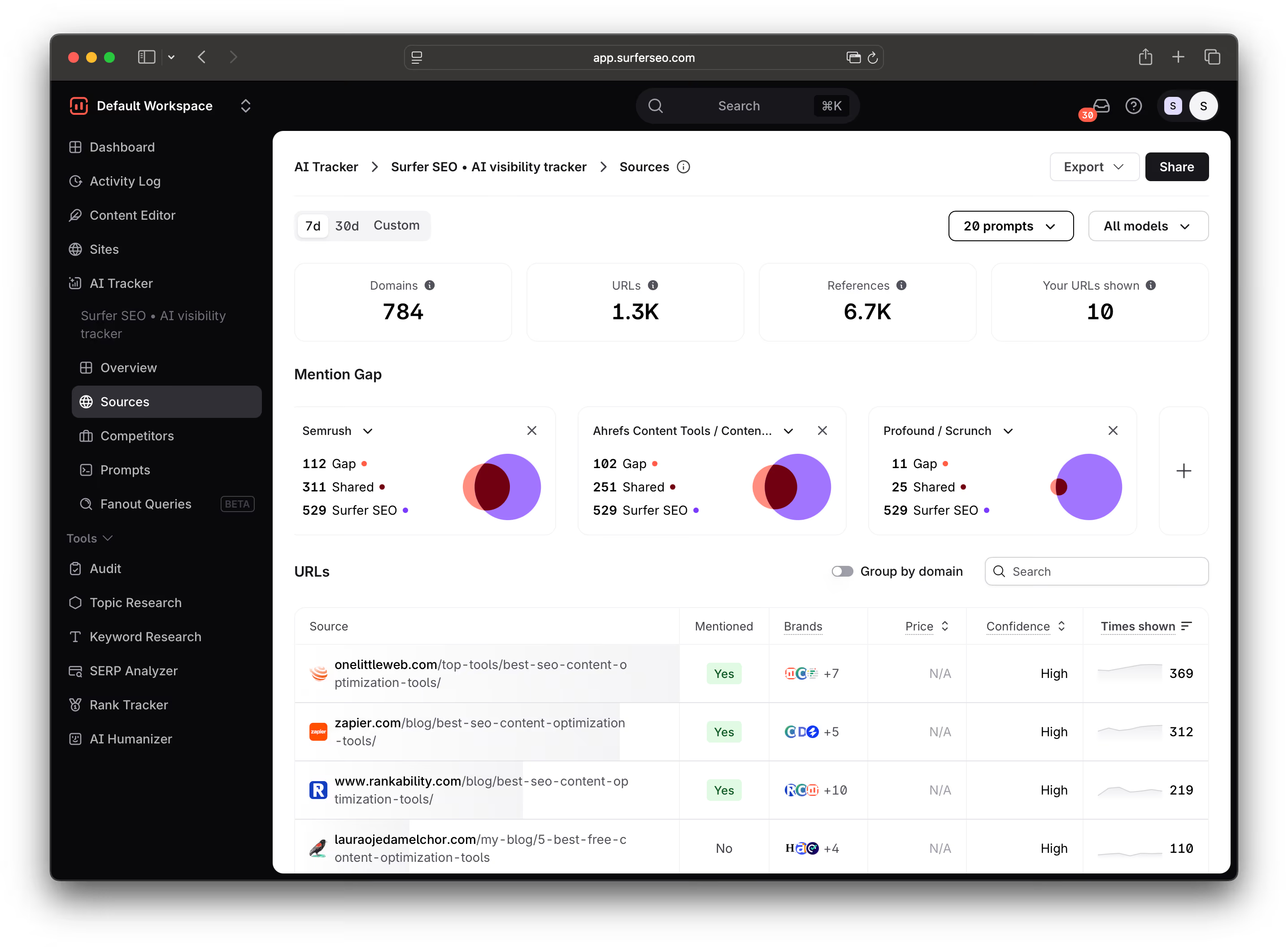
Your job from there: get mentioned in as many of the top sources as possible — as high as possible if it's a listicle, and always in a positive light.
How you get there depends on your time and budget. If you're short on time but have AI visibility budget to spend, use paid insertions: whenever a source is covered by one of our current backlink providers, you'll see a price and an option to buy the placement directly in AI Tracker; you can also always use your own providers.
If not — or for the sources no providers cover — I recommend a more personalized approach: outbound.
Make it personal, offer something in return — a unique content exchange, data they can't get elsewhere, free access — and write like a human. You're asking someone to go out of their day to edit a published article and add you to it. Your odds go up dramatically when the request doesn't read like the two hundred other template emails they got that week.
One more thing while you're in AI Tracker: check the fanout tab.
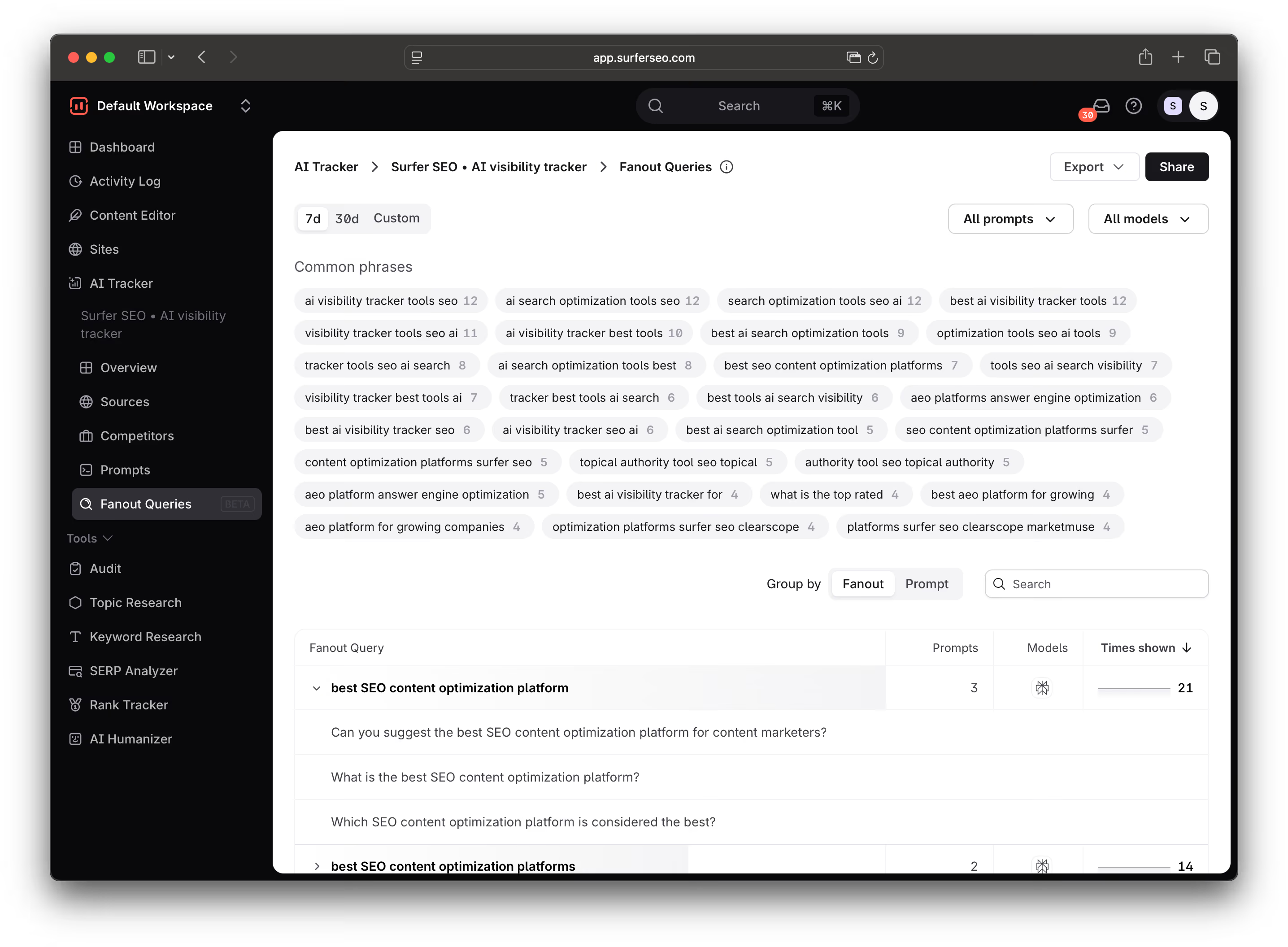
AI models don't answer your buyers' questions from a single query — they quietly run several related searches and stitch the results together. The fanout tab shows you those related queries, and they're a map for expanding your content clusters around the core topics you track.
If you want to go beyond monitoring who gets cited and become the source yourself, those are the prompts your blog should be answering directly.
Data: 650,000+ AI-generated answers from real user interfaces — not API responses (we've written about why that distinction matters here). Every cited source was scored against a 20-factor content rubric across ChatGPT, Google AI Overviews, AI Mode, and Perplexity. Data collection: April 2026. Analysis: Michał Suski, Positive Surfer Head of Innovation, and Maciej Gruszczyński, Data Scientist at Positive Surfer.
This is correlational data — we can show what content that gets cited by AI Overviews looks like, not definitively why it gets chosen over something else.
One more thing. This is one of several model-specific studies — and yes, a bigger one is coming that pulls it all together: our full approach, plus what's changed in the data over time. I published the actionable parts first, because that's the order in which they're useful to you ;)