- AI crawlers process pages under a token budget – what sits at the top gets extracted, everything below that line is at risk of being skipped
- BLUF (Bottom Line Up Front) is a writing method that leads with conclusions and follows with reasoning
- A focused 2,000-word post structured this way outperforms a padded 4,000-word one in AI retrieval
- Your intro is the brief AI systems use to describe you in conversations you're not part of
- Deep subtopics earn their own URL, internally linked back to the hub
- Manually check a few SERPs before writing anything crucial – tools show patterns, the SERP shows reality
The above is an example of BLUF. Read on.
My brother gave a talk at Surfer's Visibility Club in Berlin a few weeks ago. Around seventy people in the room – CMOs, heads of SEO, marketing leads, all working on AI search in some capacity.
.avif)
A closed-door session focused on what's actually moving the needle, including original data from Surfer's 365 days of reverse-engineering AI search results. Practitioner-level conversation, which is rarer than it sounds at industry events.
His point – the one that stuck – was simpler than most of what gets written about AI search. AI crawlers operate under token budgets. They process a page from the top, and at some point they stop. What's above that cutoff gets extracted. What's below it might as well live on a page nobody visits.
That observation reframes a lot of conventional content advice. It also has a name, and the name predates AI by about a century.
BLUF isn't new
BLUF – Bottom Line Up Front – is a principle from U.S. military writing. The logic is simple: decision-makers under pressure need the conclusion first. So you lead with the decision, the finding, the recommendation – and then you provide the evidence that supports it.
Journalists call this the inverted pyramid. Lawyers call it the executive summary.
The underlying logic is the same. State what matters, then explain why.
For years, SEO content built toward the point. You provided context, established the problem, walked the reader through your reasoning, and arrived at the answer somewhere around the third heading. This felt thorough. It also assumed readers would stay long enough to reach it.
AI crawlers are exposing how often that assumption was wrong.
What happens when a crawler visits your page
Token budgets are a hard constraint on how much content any AI system processes in a single pass. The crawler visits your URL, starts from the top, and works its way down until it's used its allocation. A three-paragraph preamble that establishes historical context before getting to the actual claim spends tokens on content that answers nothing.
By the time your key point appears, the budget may already be closed.
Surfer's research into AI Overview citations found that cited pages had roughly 31% fact coverage compared to 24% for pages that were never cited – and pages with 10 or more key facts were cited at more than double the rate of pages with fewer than five. The implication is that facts need to be surfaceable, and surfaceable means early.
A fact the crawler doesn’t see doesn’t get extracted. This means hallucinations. And incorrect information. Or even information that’s actively harming your business.
The data your potential customer sees plain as day in their “AI SERP”.
BLUF solves this structurally. If your key claim is in the first paragraph, it gets extracted regardless of where the crawler stops. Or at least it has a better chance of proper extraction, rearrangement, and presentation. Ideally one that displays you in a positive light. Everything after that is supporting detail – valuable, but BLUF should be able to stand on its own.
You might be worried this changes how you write.
It does, and for the better.
The common concern is that leading with the conclusion removes the narrative – that readers need context before they can absorb the point. Reading behavior data has been contradicting this for a long time.
Most people who land on a blog post scan the first paragraph, look at the headings, and read a few sentences that catch their eye. Full reads are a small fraction of total visits. The majority of your traffic gets the gist or leaves. BLUF serves both groups: the scanner gets the point immediately, and the thorough reader still gets a complete piece underneath it.
What changes is the structure. The reasoning, the examples, the nuance – all of that stays in the body where it belongs. The introduction simply stops doing the work the body was always meant to do. Your best readers get everything. Everyone else gets the essentials, which is what they wanted anyway.
Your intro is writing your AI brand summary
Here's where this becomes a business problem rather than a craft problem. When someone asks an AI about your company, your product, your area of expertise – the answer it generates comes from what it extracted from your content. If the extraction happened on a token budget and your intro spent that budget on scene-setting, the AI's answer about you will be generic.
Lead with your actual positioning – what you do, who you do it for, what makes it worth choosing – and that's what ends up in the AI's representation of you. You're writing the brief that AI systems use to describe you in conversations you're never in the room for.
The 2X AI Visibility Index from April 2026 found that 96% of B2B companies are effectively invisible during the earliest stages of AI-driven buyer discovery. Most of those companies have content. The gap is that the content leads with the wrong things.
Ask yourself this: how confident are you, even if you’re that 4% of companies, that the information served about you is correct?
I’m not at all. And you should give it a good think, too.
Make upfront intent alignment part of the workflow
Enforcing the introduction across every draft requires changes within your workflow.
This is where Surfer turns BLUF from plain writing advice into a tool that supports correct information retrieval.
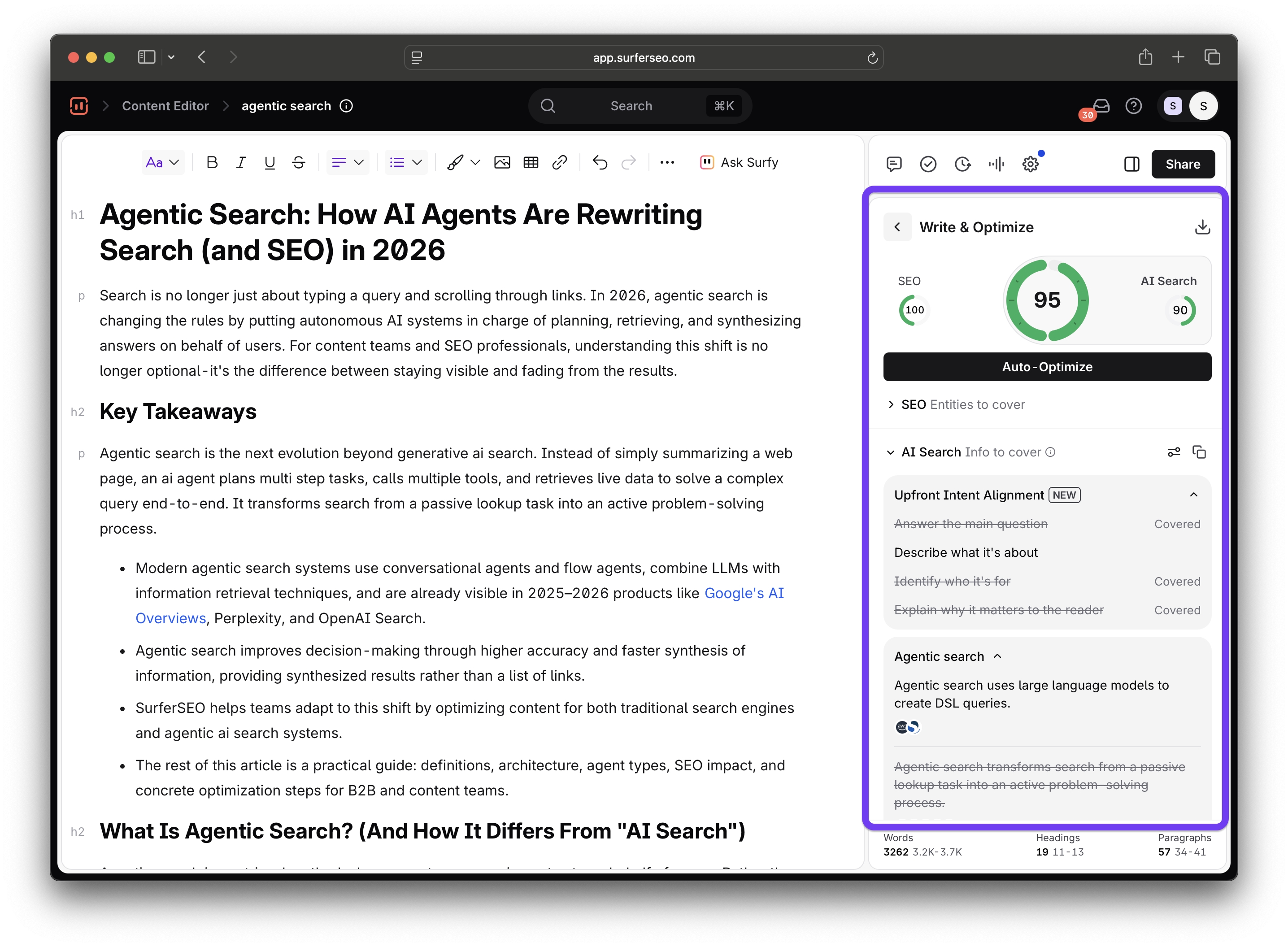
In Content Editor, the Upfront Intent Alignment section checks whether the opening of the piece does the work AI systems need it to do: answer the main question, explain what the page is about, identify who it is for, and make clear why it matters to the reader.
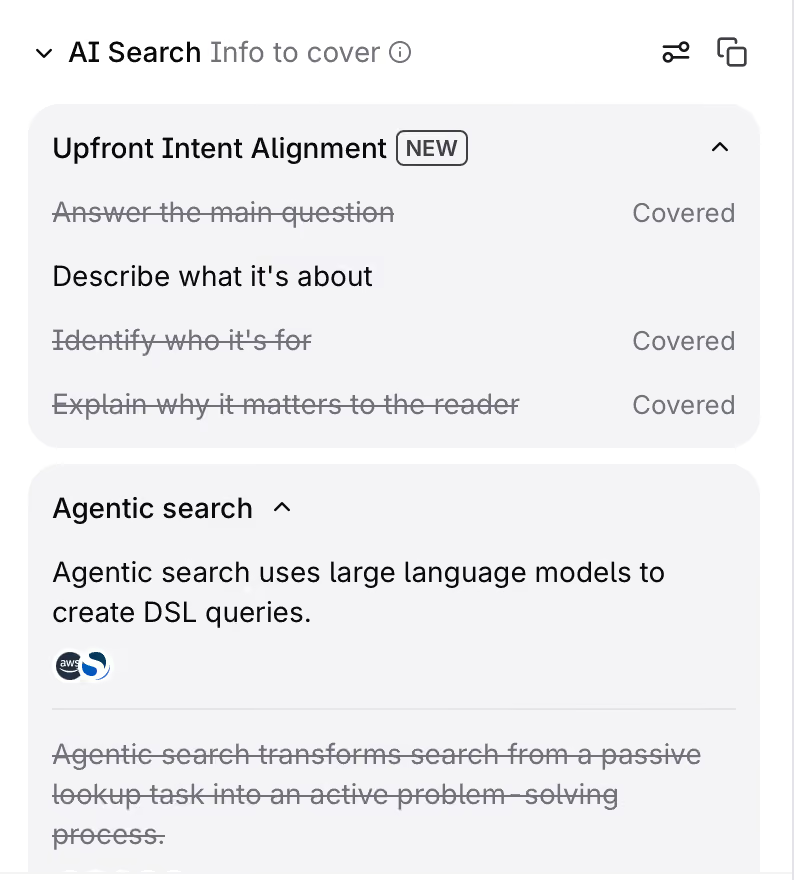
In AI search, upfront intent alignment is becoming one of the practical factors behind whether a page is easy to retrieve, understand, and cite. If the crawler only processes the top part of the page, then the top part has to carry the answer.
Surfer’s citation-position research supports this. Most citations are pulled from the beginning of the source text, and citation probability drops sharply as the referenced information appears deeper in the article.
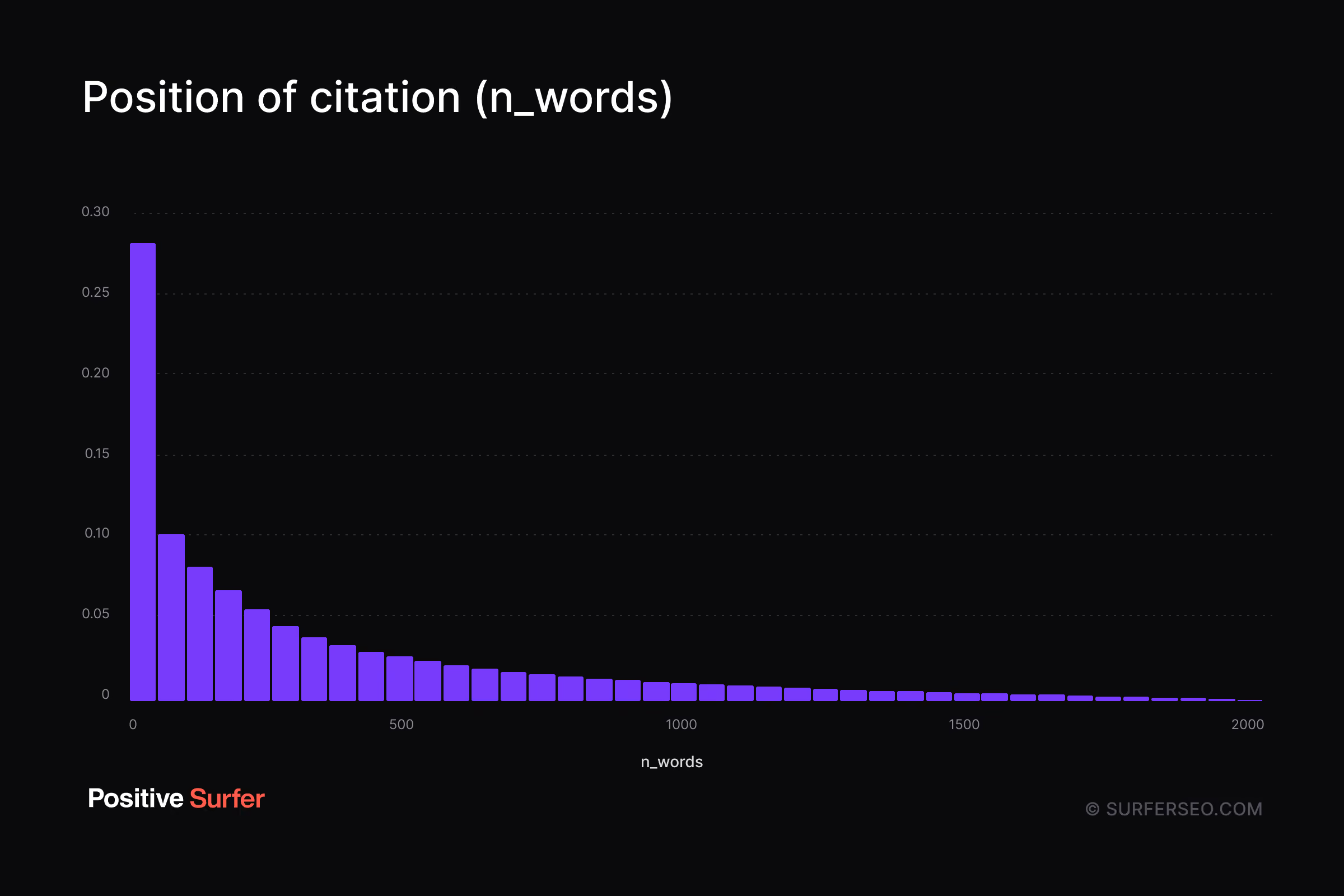
The pattern holds whether you measure position by raw word count or by percentage of the page.
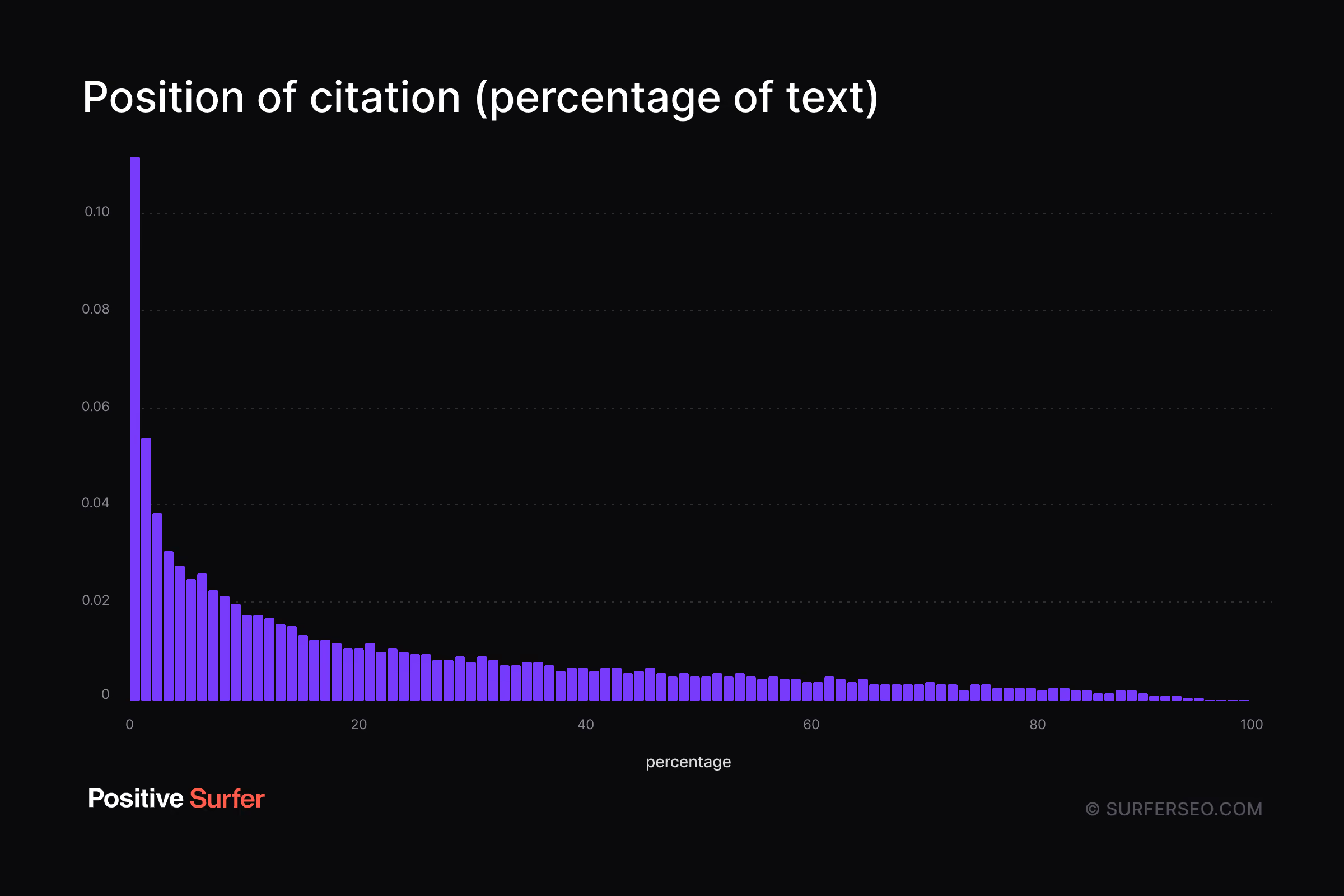
That means the first screen of content is doing more ranking work than most teams assume. It is where you “hook the reader.” It is also where you give AI systems the cleanest possible brief: this is the answer, this is the context, this is who it helps, and this is why it matters.
Surfer’s Auto Optimize can handle this automatically as part of the optimization process. Instead of asking every writer to remember BLUF, intent alignment, AI retrieval constraints, and citation behavior on every draft, the workflow pushes the content toward that structure inside the app.
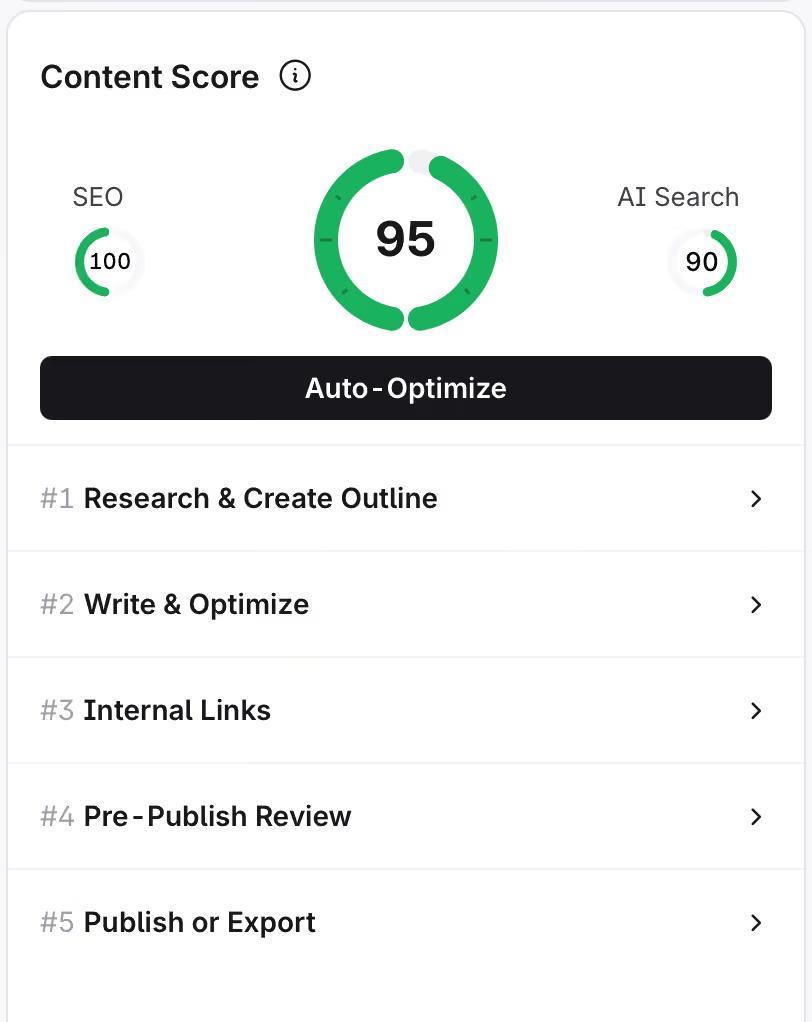
The point is to make sure the part of the article AI systems are most likely to process is also the part that contains the answer you actually want them to use.
Write until you've covered the facts. Then stop.
There's an ingrained assumption in content marketing that longer equals more thorough, and more thorough equals better performance. It's becoming less accurate by the quarter.
Surfer's analysis of over 57,000 URLs found that the likelihood of being cited in AI Overviews peaks at around 12 verifiable key facts per page. Beyond that, the signal-to-noise ratio drops. Additional content after you've made your case dilutes the signal rather than reinforcing it.
This is a hard habit to break because the incentives for a long time pointed the other way – word count targets, content tools, pillar page frameworks all rewarded length. Write until you've said what needs to be said. If you find yourself adding paragraphs to hit a number, that's the place to stop.
Depth belongs on its own URL
Some topics genuinely need more space. The answer is a dedicated piece, internally linked, rather than an ever-expanding section within a larger post.
A 500-word post that covers one concept thoroughly, leads with its own BLUF, and links to related pieces does more work than a buried subsection that a crawler may never reach. Readers who want that specific information find it cleanly. Readers on the hub post get a pointer and can choose whether to follow it.
The structure that works: a focused hub post of around 1,500 to 2,000 words that makes the central argument, supported by 4–6 shorter pieces that go deep on each major idea. The hub surfaces in retrieval. The spokes provide citation depth that signals topical authority. Internal links bind them into a cluster that serves both AI systems and human readers navigating the topic.
Check the SERP yourself before you write
For any topic that matters to your business, open a browser and look at what's actually ranking. Tools are excellent for identifying patterns across large data sets. The SERP tells you what's happening on a specific query for your specific audience today.
The word count recommendations, content score benchmarks, and keyword averages in your tool of choice are aggregates across many different queries and contexts. And they’re not perfect. What you want to know is whether the top results are short or long, whether they lead with conclusions or build toward them, whether AI is generating a direct answer that changes the dynamics entirely. That takes three minutes of manual checking.
Make it part of your process before writing anything central to your business. The tool output is a starting point, and yes, it’s still important and valuable. But the SERP is the evidence.
Addendum
As I’m rereading what I’ve written on the topic, it becomes very apparent to me that “thought leaders” have been trying to reinvent the wheel ever since AI came to be. To sow panic among business owners. To get more clients because of fearmongering. While I agree this is a business model that has worked for years, in any industry, I also think that it’s disingenuous. And the industry gets a bad rep.
Sure, clicks dropped. Sure, information is being served differently. Sure, the customer is lazier than ever. But isn’t that what has happened with each search engine update in the past? The customer looking for information is not doing it for the sake of “learning”. Or, at least, the paying customer isn’t. Instead, they do it because they’re looking for a solution. And you can be that solution still – but the information about you has to be grounded in reality.
Don’t believe the panic. Don’t listen to grifters. Avoid bandwagons. Look at the data in your niche. Get informed straight from the source. Work your way into the SERP based on what works.
Try BLUF in a few articles. I’d be glad to know if it had made any difference.