- ChatGPT behaves like a search engine for most users; the technical differences matter mainly because they tell you where your optimization effort should go
- LLMs query Google and Bing in the background, then rephrase what they find – ranking in Google's index remains the prerequisite for AI visibility
- Brand mentions on cited source pages correlate with AI recommendation strength at 0.41 (Spearman) across 289,000 URLs studied by Surfer – stronger than any link metric
- Domain authority shows near-zero correlation with AI citation frequency across 5 million citations and four AI models
- Directories and third-party listicles are back as meaningful placements – LLMs pull from them consistently for recommendation queries
- On-page: lead with the answer, write in self-contained paragraphs, hit at least ten verifiable facts per page, use exact-match anchors in internal links
- Backlinks still matter, indirectly – they determine your Google rankings, and LLMs query Google. But they don’t use a PageRank equivalent themselves
Every few years, SEO gets a new name.
In the mid-2010s it was "content marketing." A few years later, "digital PR." Now the same circuit of LinkedIn influencers is selling GEO, AEO, and LLMO – Generative Engine Optimization, Answer Engine Optimization, Large Language Model Optimization – each with its own framework, its own acronym, and its own course priced somewhere north of $900.
The rebranding happens for a reason that has nothing to do with the work changing. A new name creates a new market. It lets someone be the first mover on a term nobody has heard yet. It gives agencies something to upsell.
What actually changed is narrower: there's a new surface where your content either appears or doesn't, and the mechanics of appearing on it are slightly different from what you've been doing. The fundamentals underneath – be findable, be cited, answer questions directly – are identical. That's what this article covers.
Is ChatGPT a search engine?
For users, ChatGPT functions like a search engine. Or at the very least it serves a similar purpose. For anyone optimizing content, the mechanics underneath are different enough to matter.
Well, the truth is as follows: it depends on what you mean by search engine. As usual, it comes down to semantics.
| Arguments for | Arguments against |
|---|---|
| Users arrive with a query and get a direct answer – functionally identical to what Google does | It generates answers rather than returning a ranked list of source links |
| ChatGPT Search now indexes the web in real time and returns citations | It queries Google and Bing in the background using its OAI-SearchBot crawler |
| It's displaced Google as the first stop for millions of informational queries | Responses aren't deterministic – the same query returns different answers on different runs |
| It handles follow-up questions and query reformulation within a session | It has no independent index; it can only surface what's already indexed elsewhere |
| It returns source links in many responses, similar to a results page | The blue link – the defining output of a traditional search engine – is largely absent |
What this means for optimization: the distinction matters because it tells you where the pipeline starts. LLMs query existing indexes, primarily Google's. Rank on Google, and you enter the pool from which AI systems draw. The AI visibility conversation starts there.
Is Perplexity a search engine?
Perplexity is the most explicitly search-like of the major AI tools. It crawls the web in real time, surfaces source citations prominently in every response, and was built for research queries where users want to verify claims, for instance when trying to pick market intelligence tools ideal for their use case.
Surfer's citation analysis found that Perplexity is slightly less aggressive about deprioritizing high-authority domains than other models – though even Perplexity doesn't actively reward domain authority.
The content fundamentals apply equally here. Where Perplexity differs is in its source distribution: it tends to cite more academic and editorial sources, so niche authority publications carry more weight than they do in ChatGPT.
Is Google Gemini a search engine?
Gemini is the most direct extension of traditional SEO of any model here. It's Google's product running on Google's index – AI Overviews, expanded.
For practitioners, this is the simplest case. Ranking in organic search is the same thing as optimizing for Gemini's source pool. The signals that move you up in organic results move you into Gemini's citation set. No separate playbook required.
Is Microsoft Copilot a search engine?
Copilot runs on GPT infrastructure with Bing's index underneath. Traditional web indexing signals apply directly, and real-time coverage is strong.
Bing is consistently undercompeted relative to Google. If you've invested in Google indexing and backlink acquisition, a fraction of that same effort toward Bing – submitting your sitemap, checking Bing Webmaster Tools, confirming your pages are indexed – tends to produce outsized returns. Copilot queries that index. Most SEOs ignore it.
How to show up in AI results
The tactics below come from two sources: Surfer's published research and what you can verify by running your target queries in ChatGPT and Perplexity and reading what gets cited.
Off-page
Brand mentions
Surfer ran 26,573 AI calls across ChatGPT, AI Overviews, AI Mode, and Perplexity, pulling responses to 922 unique prompts across 12 industries and extracting all brands and source pages – 289,105 URLs in total.
The correlation between how often a brand appeared on cited source pages and how strongly AI recommended that brand came out at 0.41 Spearman. Consistent across all four models.
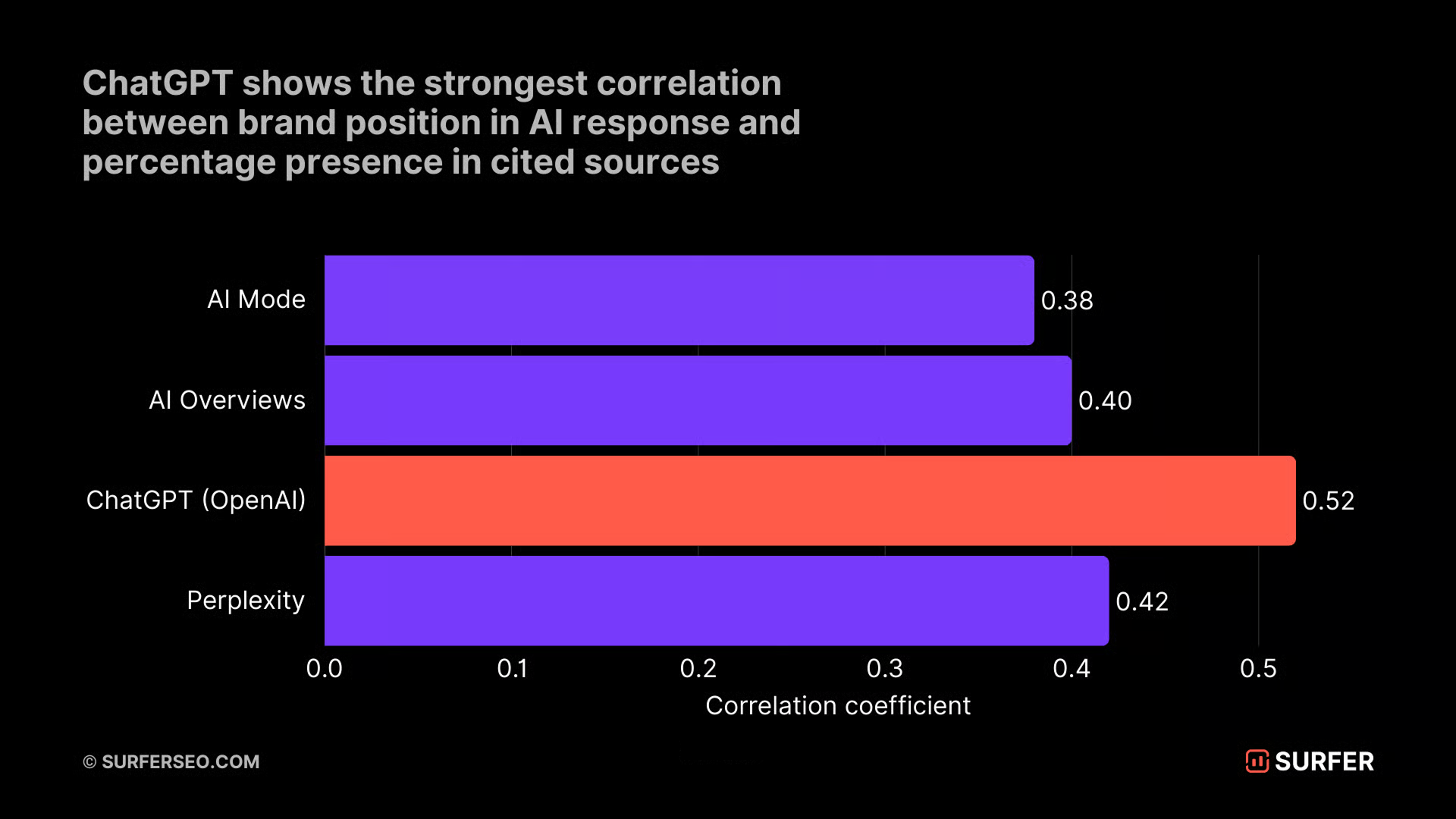
ChatGPT showed the strongest correlation between brand presence on cited pages and recommendation strength. It also cites by far the most sources per response: 84.7% more than AI Mode and 129.7% more than AI Overviews. More citations to compete within, but brand presence on those citations predicts recommendation rank most reliably.
The content type with the strongest correlation was blog posts – specifically brand-owned blogs, followed by third-party blog mentions, which outperformed reviews and news articles.
The practical implication: editorial placements on third-party blogs that rank in Google are the highest-signal path into AI recommendation sets. Guest posts, contributed articles, roundup inclusions – the formats that have always been central to manual link building remain the most valuable placements. As long as they appear among cited sources or in the SERP, it’s safe to say it’s a placement worth getting.
Directories
The devaluation of directories as an SEO tactic was largely deserved – by 2015, most directory links were either ignored or penalized. AI skewed the calculation in their favor.
LLMs consistently cite directories for "best X in [category]" and "top [tool type]" queries. They're a clean, structured source for recommendation answers.
Run your target recommendation queries in ChatGPT and Perplexity. Note which directories appear in the cited sources. Complete, accurate, and up-to-date profiles on those specific directories – prioritized over volume.
Listicles and roundups
Same logic as directories. A third-party roundup that ranks on Google for "best [product category]" feeds directly into AI answers on that topic.
Identify which roundups rank, then pursue inclusion through outreach, product updates, or PR coverage that gets the authors' attention.
Backlinks
Surfer analyzed roughly 5 million unique citation source URLs across AI Mode, AI Overviews, ChatGPT, and Perplexity, measuring citation likelihood against PageRank, Harmonic Centrality, and Domain Score. Domain authority barely correlated with AI citation frequency across all four models – close enough to zero to be noise.
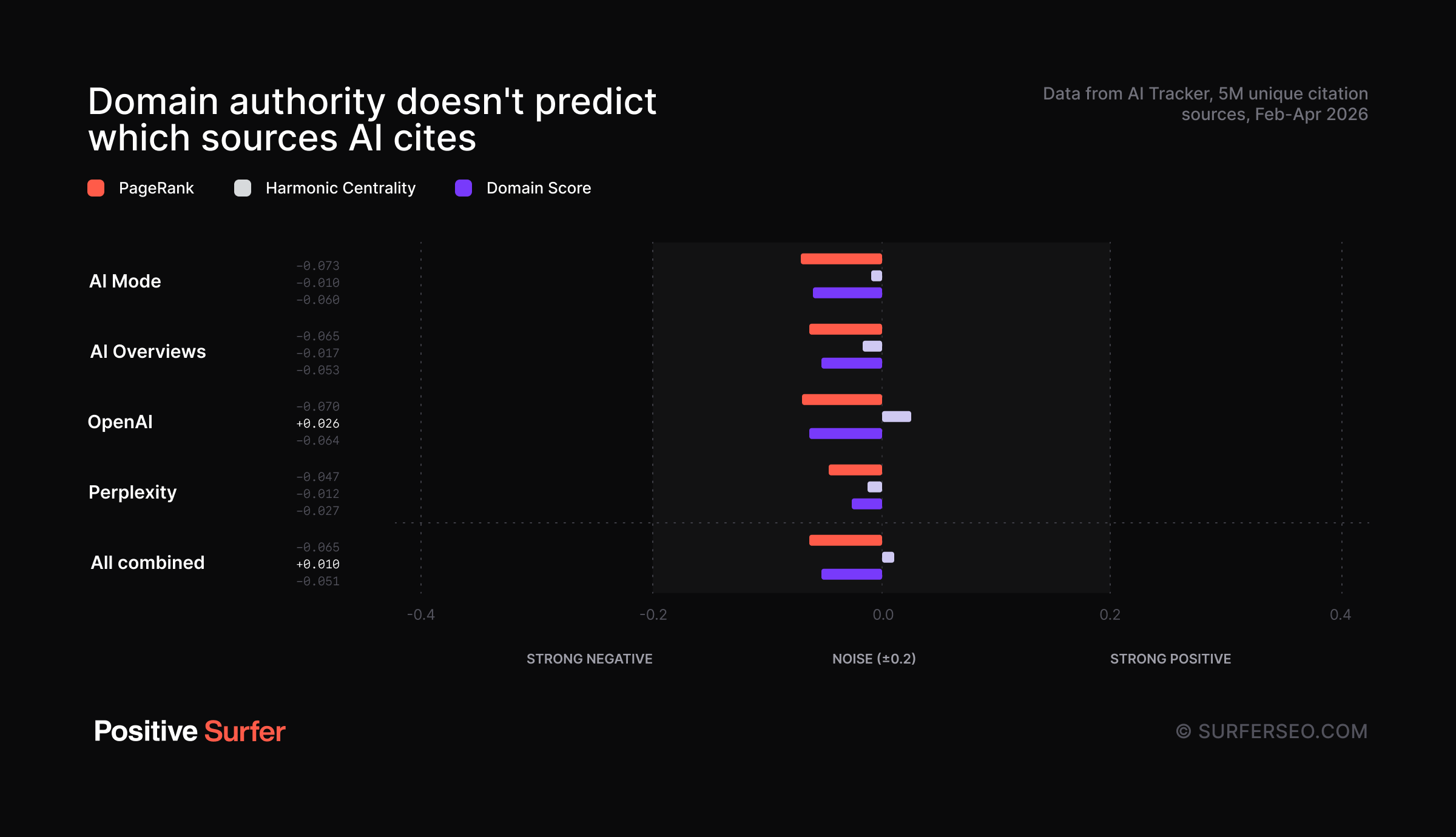
When the top 5% of highest-authority domains were removed, the correlations collapsed even further toward zero. Surfer's interpretation: AI search engines may be actively deprioritizing the strongest domains to diversify sources away from mega-publishers like Reddit and Wikipedia.
Backlinks don't predict AI citations directly. They still matter because they determine where you rank in Google, and LLMs are querying Google. Indirect, but the chain is real.
Manual niche research
Before you build a targeting list from any tool, run your ten most important queries in ChatGPT and Perplexity and read through the cited sources.
Those URLs are your actual target placements. A tool shows you what's ranking on Google. The AI result shows you what's being pulled into AI answers. While the two lists overlap, they aren't identical.
On-page
BLUF structure
Lead with the answer. The key claim, the core recommendation, the direct response to the query – all in the first paragraph. AI systems process pages under token budgets. What sits at the top gets extracted; everything after is supporting detail that may or may not be pulled. Read the full breakdown of the BLUF method.
Self-contained paragraph answers
Write paragraphs that answer a specific question completely, without requiring surrounding context to make sense.
An AI system extracting a single paragraph from your article should be able to use it as a standalone answer. That means restating necessary context within the paragraph rather than relying on what came before.
Fact coverage and density
Surfer's citation research found that pages with ten or more verifiable key facts were cited at more than double the rate of pages with fewer than five. Cited pages averaged 31% fact coverage versus 24% for pages that were never cited.
Fact density is the ratio of verifiable claims to total word count. A 2,000-word article with twelve well-sourced facts outperforms a 4,000-word article with the same twelve facts diluted across twice the prose.
Write for density. Cover the facts that matter to the query, then stop. This is also why the hub-and-spoke model works well in the AI context – a focused hub with high fact density per word serves retrieval better than a sprawling pillar post where the fact-to-filler ratio drops as the word count climbs.
After you do start showing up in LLM answers, you can move into optimizing for follow up questions. When a user wants to learn a bit more about you in particular, your website is going to be the primary source of information. And it’s where you need to be favorable, informative, and truthful. In other words – you’ve got to glaze yourself like there’s no tomorrow. Avoid guile and dishonesty, but don’t hold back too much – it’s your website after all.
Internal linking with exact-match anchors
Link related pieces to each other using the keyword as anchor text. "B2B content strategy" and "manual link building" carry signal. "Click here" and "learn more" carry none.
Exact-match anchors tell crawlers – human and AI – what the linked page is about, and help AI systems map your topical coverage when they follow your internal link structure.
Where Surfer fits in
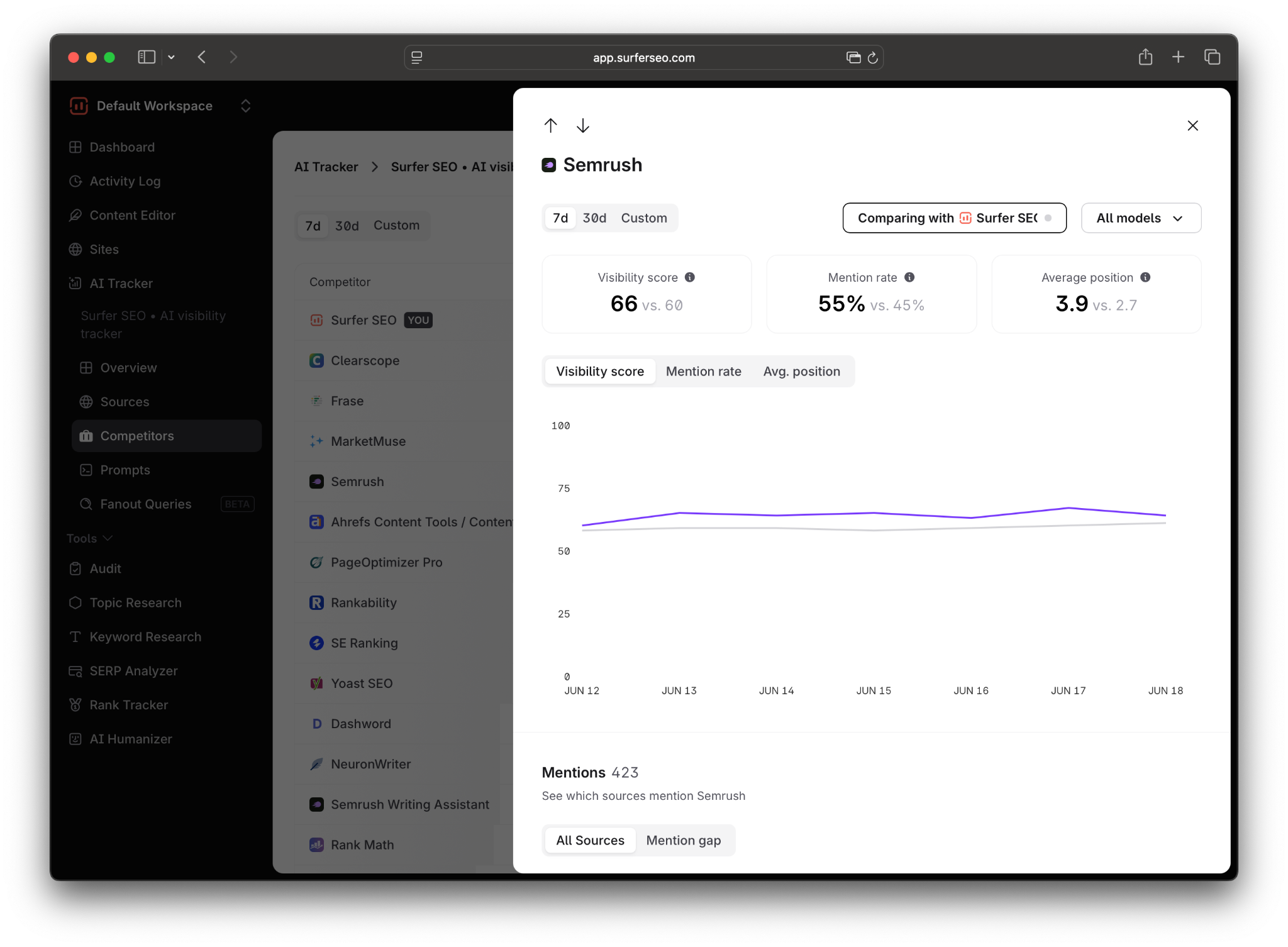
Surfer AI Tracker monitors brand and competitor appearance across ChatGPT, Perplexity, AI Overviews, and AI Mode. It runs queries through the regular UI, not the API – because API outputs and UI outputs diverge. What real users see in ChatGPT is not always what you get from a programmatic call. The data reflects actual user-facing results.
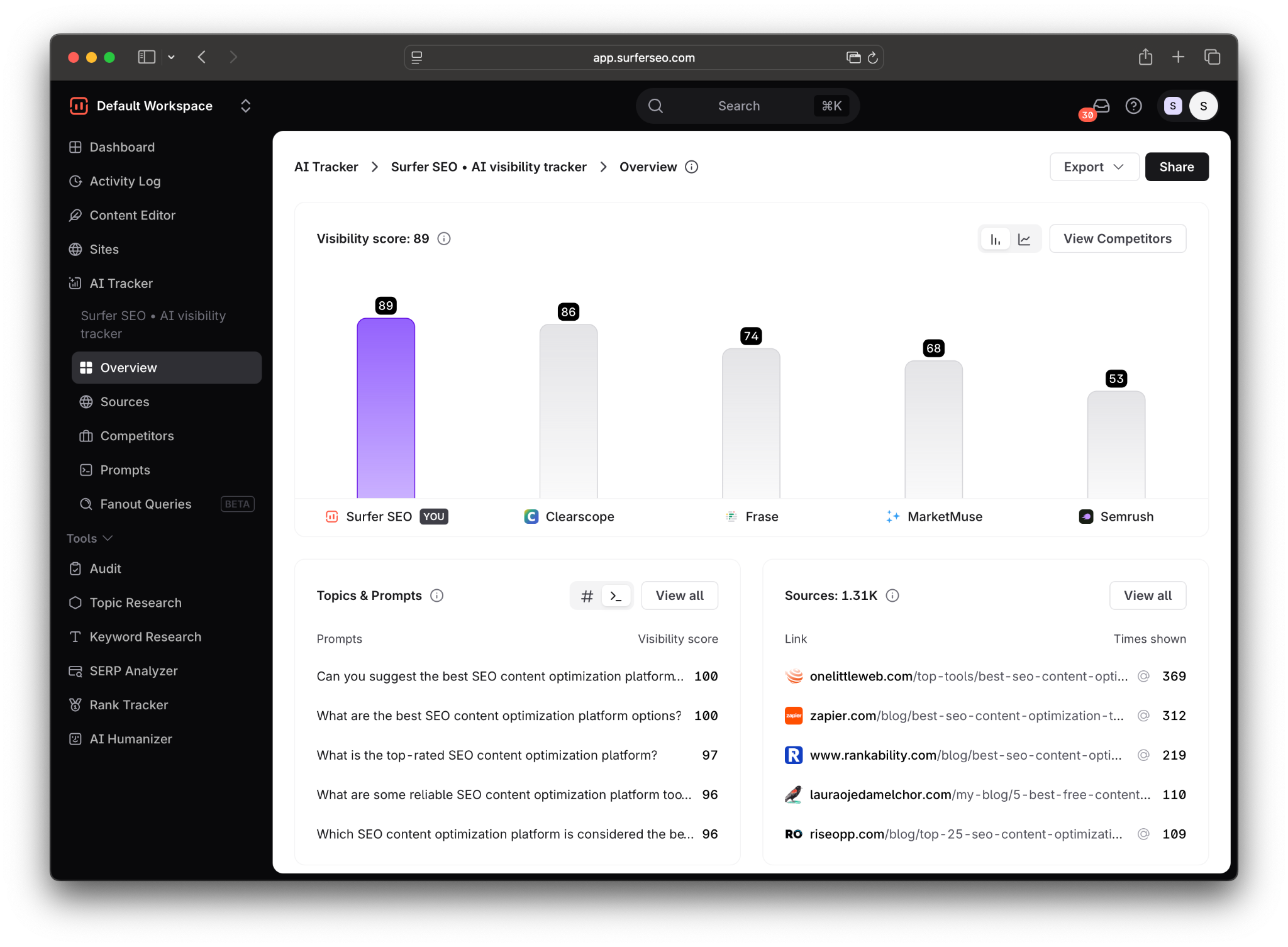
Citation and source analysis turns that data into a targeting list. Surfer shows which pages are being cited for your tracked queries – your link building and mention outreach hit list, built from what's working in the AI results you care about.
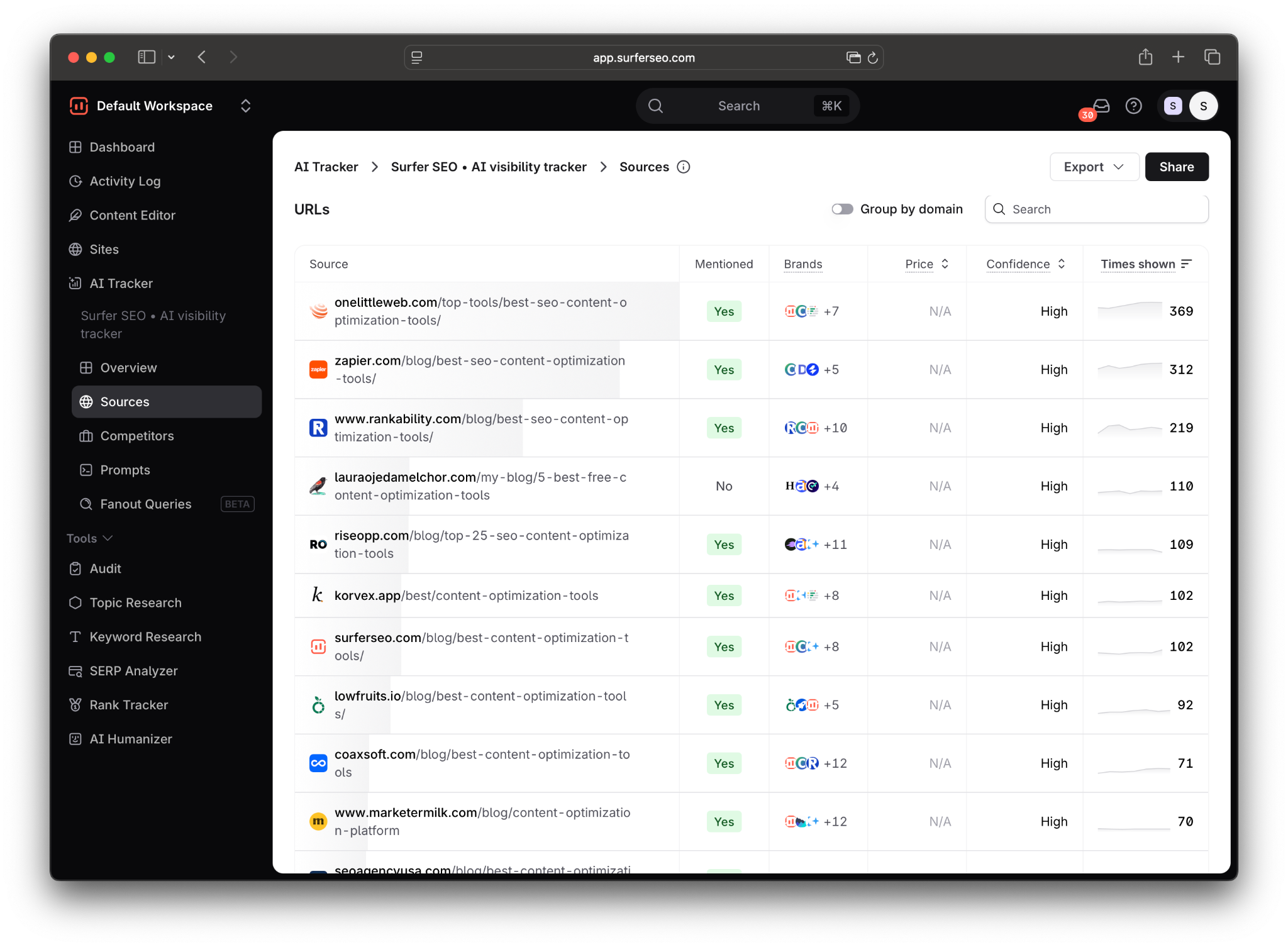
Competitor research uses the same data offensively. Which competitors appear in AI answers for your target queries, how often, and on what topics. Tells you where the gaps are and which placements you're missing.
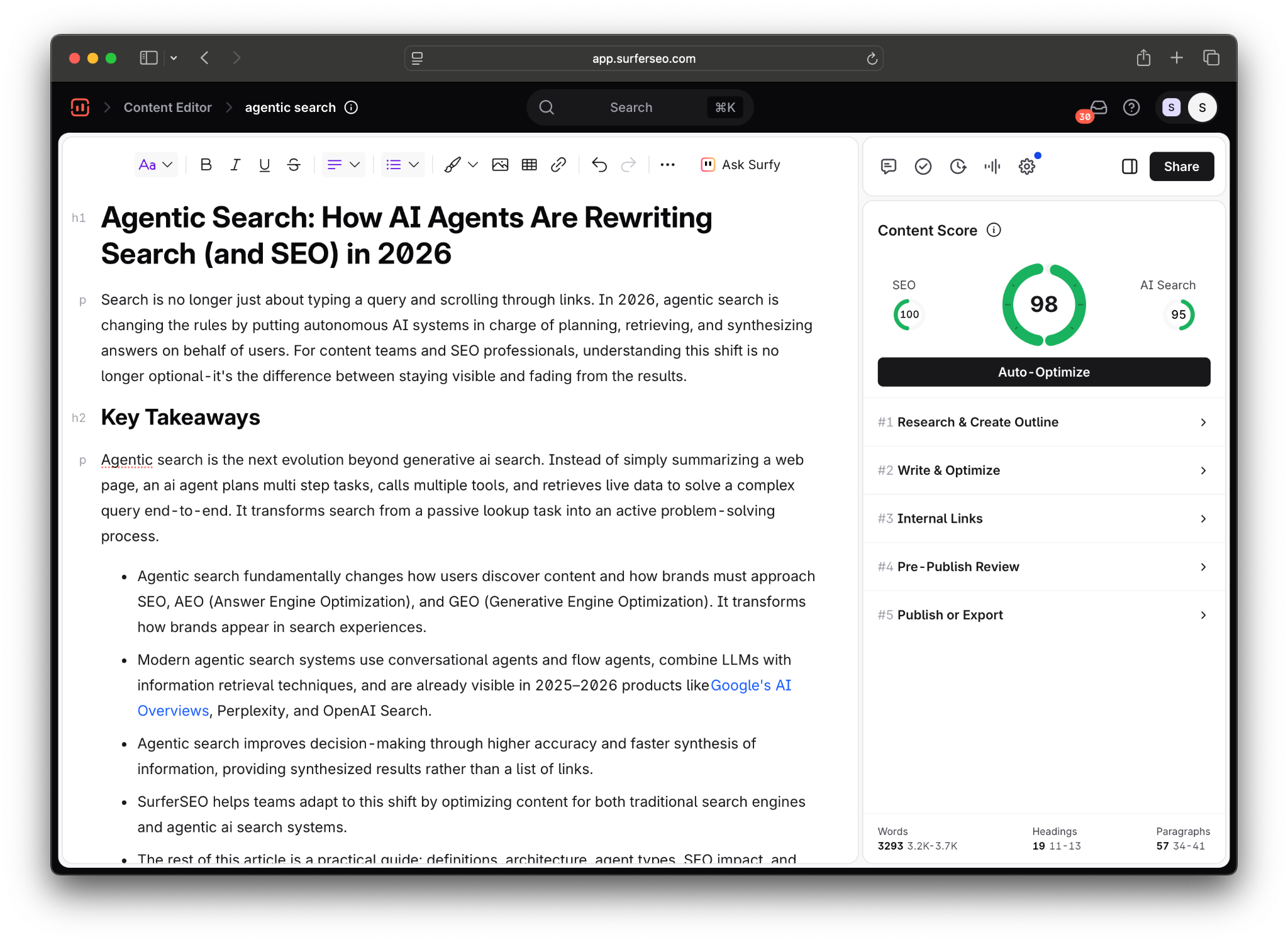
Content Editor helps you hit the fact density and coverage thresholds that predict citation, surfaces internal linking opportunities, and structures articles so the key facts are extractable.
What changed in SEO? Spoiler: not as much as you think
Clicks dropped on a lot of queries. The blue link is largely gone for informational searches – the AI answer replaced it. Customers still land somewhere: on a product page they recognized, a comparison article that showed up in citations, a brand that appeared in enough AI answers to feel familiar before they ever clicked anything.
What usually happens next: they open a new tab and visit your homepage. Impossible to attribute with automated systems. However, self-attribution models work fairly well and can give you a good idea of where you stand in your niche.
What earns trust on the surface is the same work it has always been. The optimization is nearly identical. Or rather – there’s a huge overlap. You still need the fundamentals, except with a couple of easily implementable changes to your workflow.