You can see the industry already accepts that AI visibility is becoming its own layer of distribution. That explains why marketers, publishers, and SEO teams consider getting AI citations as part of their daily responsibilities and services.
The important thing, though, is that AI search engines are not randomly choosing sources. There's a retrieval and summarization pipeline behind what gets surfaced. Models don't read the web the way humans do. They retrieve chunks, assess relevance, compress information, compare sources, and decide which content is sufficiently reliable to cite in the final response.
So if you want to understand why certain articles keep showing up inside AI-generated answers while others disappear completely, you have to understand how AI search engines find, summarize, and cite content in the first place.
How AI search engines retrieve content
AI search engines retrieve content by breaking a query into multiple related searches, gathering relevant information from each, and combining it into a single answer.
If you ask a broad or complex question, the system splits it into smaller parts, searches for answers to each one, gathers useful information from different places, compares and sorts the results, and then creates a response using all that combined information.
Each search engine looks at a different part of the web. For example, ChatGPT uses Bing's index, Perplexity has its own web crawler, and Gemini uses Google Search. Today's systems do more than check if a page matches your question. They also consider whether the page helps make the final answer better.
This is why ChatGPT, Perplexity, and Gemini might answer the same question using different sources.
How queries become searches
When you send a prompt, these AI tools first break it down into smaller sub-queries, called query fan-outs, each targeting a different part of what the question needs.
ChatGPT, for example, typically generates three to five of these sub-queries per prompt and fires them simultaneously using its backend web browsing capabilities. This process is what Google called "query fan-out" when they described how Google AI Mode works at I/O 2025.
"AI Mode uses our query fan-out technique, breaking down your question into subtopics and issuing a multitude of queries simultaneously on your behalf. This enables Search to dive deeper into the web than a traditional search on Google, helping you discover even more of what the web has to offer and find incredible, hyper-relevant content that matches your question."
What comes back from those searches then goes through several stages: documents get retrieved, split into passages, embedded and compared for relevance, reranked, and finally fed into the generation model. It's a multi-hop pipeline.
And retrieval is getting smarter too. Newer systems like SetR from LG AI Research don't just rank documents individually and pick the top ones. They use chain-of-thought reasoning to figure out what information the query collectively needs, then select passages that together satisfy those needs.
Some even go further by estimating each document's contribution to the final answer quality, rather than just its surface-level relevance score.
This is also part of why the same question can return completely different sources depending on where you ask it. You can see this play out pretty clearly when you run the same query across different platforms.
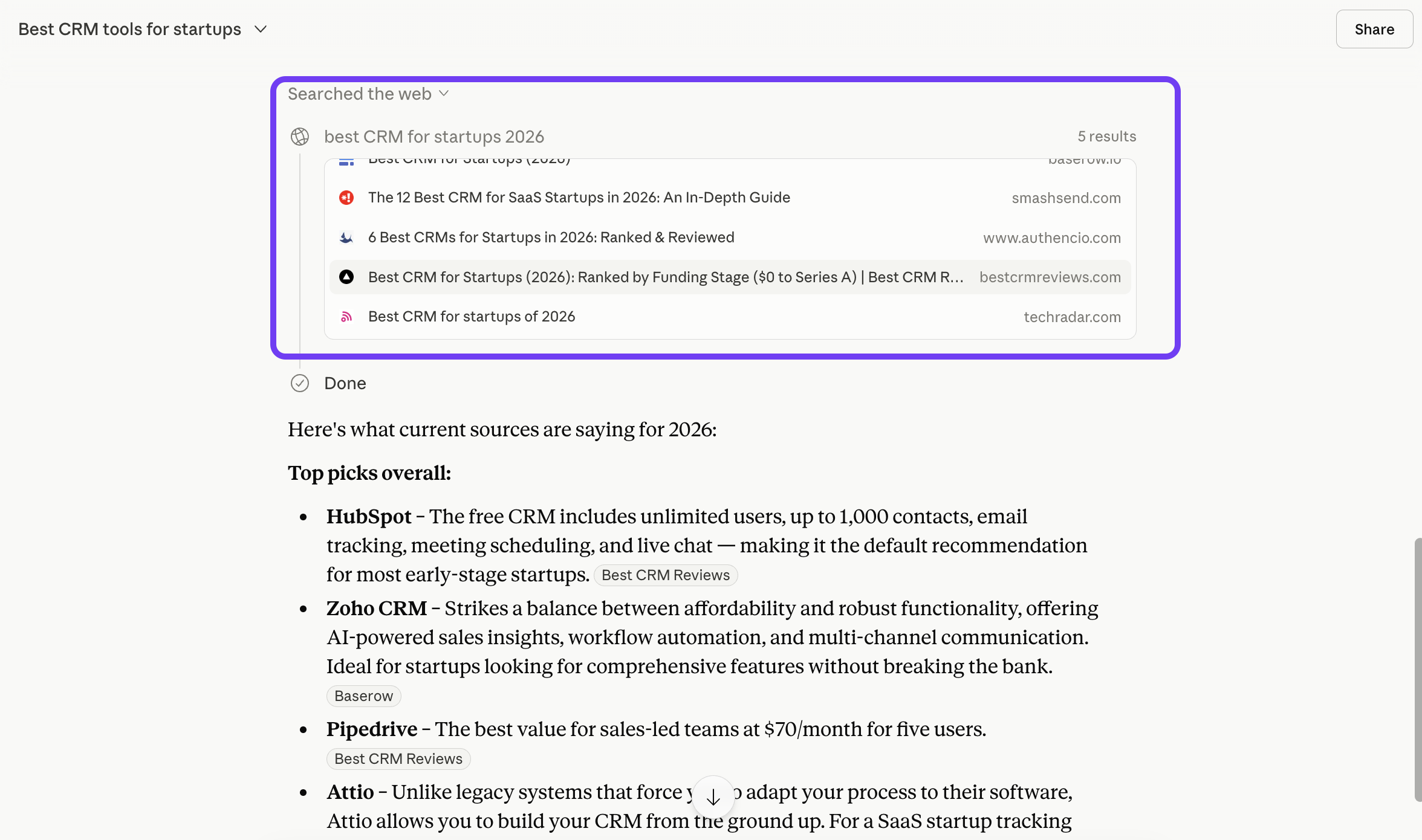
For example, I asked both ChatGPT and Claude what the best CRM tools for startups are. While ChatGPT cited sites like Clarify and AuthenCIO,
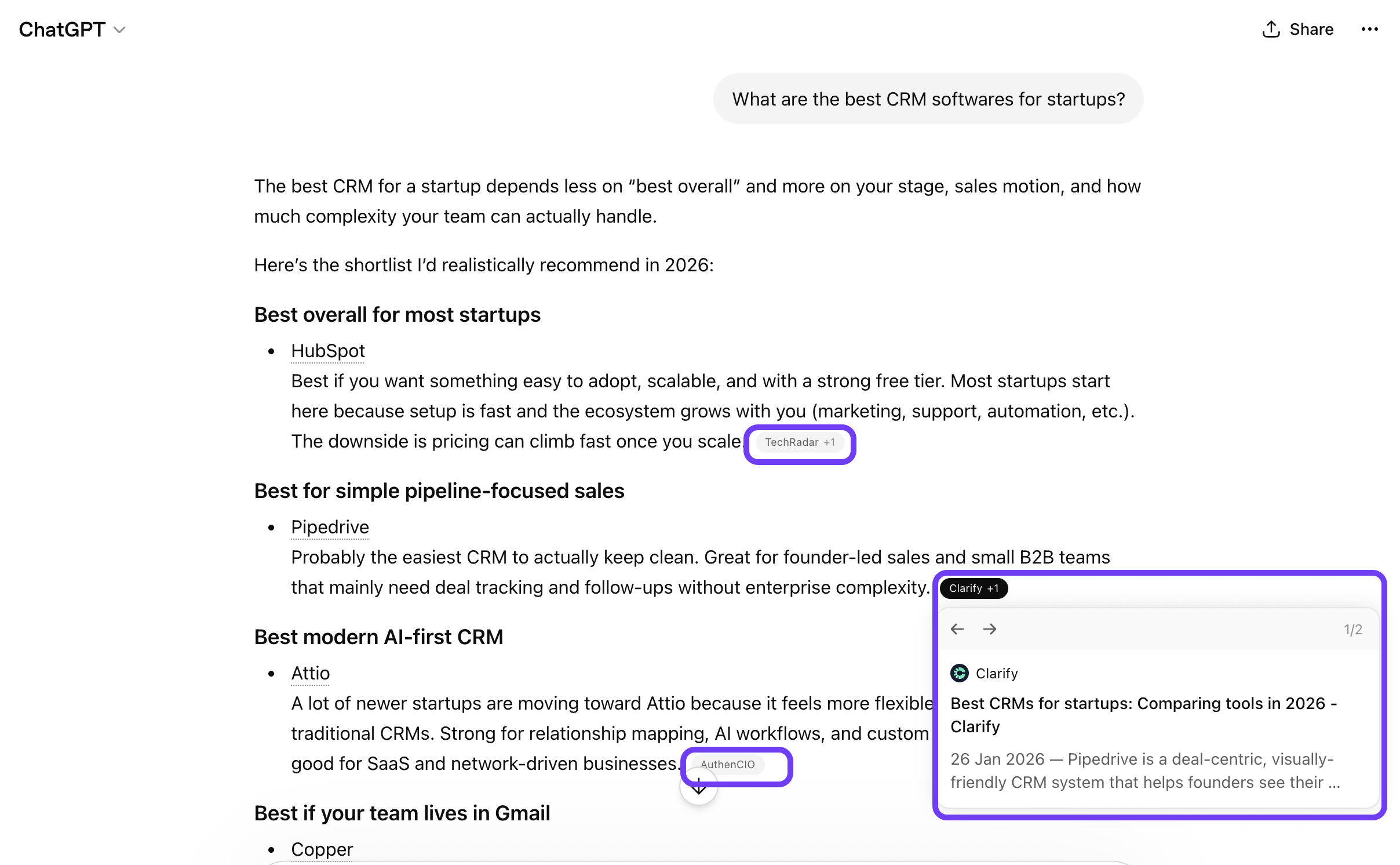
Claude pulled from Baserow, SmashSend, BestCRMReviews, and TechRadar.
Where each platform pulls from
Once you understand the retrieval pipeline, the next thing to know is how each AI search engine chooses to feed. They're not all searching the same web. More specifically:
- ChatGPT runs its live web search through Bing's index. When Seer Interactive matched 500+ ChatGPT citations against search results, 87% of them lined up with Bing's top results. When web search is off, ChatGPT falls back on training data instead. For GPT-5.2, that knowledge cutoff is August 2025, so anything more recent than that simply isn't there unless it goes and searches.
- Perplexity runs its own retrieval pipeline and its own crawler, PerplexityBot. It isn't tied to Google's index, so it doesn't really matter if you're new to the SEO game on Google. A page that ranks poorly on Google can still get cited by Perplexity, because Perplexity never looked at Google's rankings to begin with.
- Claude runs its web search through Brave Search. So the sources Claude surfaces tend to mirror what Brave ranks, which is a different index again from Bing or Google.
- Gemini and Google AI Overviews pull from Google's own index. But this is also changing. For a long time, the assumption was that AI Overview citations mostly came from page-one results. Surfer pulled the SERPs for 10,000 keywords and found that 67.82% of AI Overview citations didn't rank in Google's top 10 — not for the main query, and not for any of its fan-out queries. Even among the top three citations, 45.86% didn't rank on page one. Ranking on page one helps, but it's no longer the ticket it used to be.
Because each platform pulls from a different index, a page that's invisible on one engine can be highly visible on another. That's exactly why AI search results vary so dramatically depending on where you ask. There's no single optimization strategy that covers all of them.
How AI engines filter and select sources
AI engines filter retrieved pages aggressively, and the signals they use have almost nothing to do with traditional SEO authority. What drives selection is content quality, topical relevance, brand clarity, and freshness, not how big or well-linked a domain is.
There's an ugly truth here: many of the pages an engine pulls up never get cited. Ahrefs analysed 1.4 million ChatGPT prompts and found that only about half of the URLs it retrieved appeared in the final response. Being retrieved just gives your page a shot at being used, but it doesn't guarantee a citation.
The question is what are these AI engines' filtering decisions?
So we ran a study to find out. The specific question we wanted to answer was whether off-page factors actually correlate with a page's chance of becoming an AI source, and we pulled a pretty massive dataset to test it: 20,000 unique prompts, around 5 million unique sources, and roughly 9 million total citations collected between February and April 2026.
From there, we looked at signals like PageRank, Harmonic Centrality, and Domain Score at both the domain and host level, fully expecting to find that stronger domain authority plays a significant role.
We never found that relevance signal. The strongest correlation any off-page metric produced was 0.02, which is close enough to zero to mean nothing, and the most negative was -0.07 for Domain PageRank Magnitude.
So link-based authority, the thing SEO has leaned on for two decades, doesn't help a page get cited by AI, and if anything, it tips very slightly the other way.
What's more interesting is what gets pushed down. Our research suggests AI search engines apply some kind of devaluation to too-strong domains, the Facebook and Reddit tier, alongside non-blog pages.
That's somehow in line with a SIGIR 2026 study, which found that generative search engines are significantly less likely to retrieve sources from popular websites compared to traditional search engines. So being huge doesn't earn a citation the way it might earn a Google ranking.
This brings us to the obvious next question. If domain authority isn't the lever, what is?
Semantic similarity to fan-out queries
AI engines don't just match content to your original keyword. They match it to all the related sub-queries they generated to answer it.
Our own analysis at Surfer of 1,600 fan-out runs found that most fan-outs sit between 0.75 and 0.95 cosine similarity to the original query, which means they're closely related but not identical.
The biggest issue with fan-outs is that they are unstable. Only about 27% stay consistent across repeated runs. So chasing individual fan-out keywords doesn't really work. What does work is cluster-level coverage.
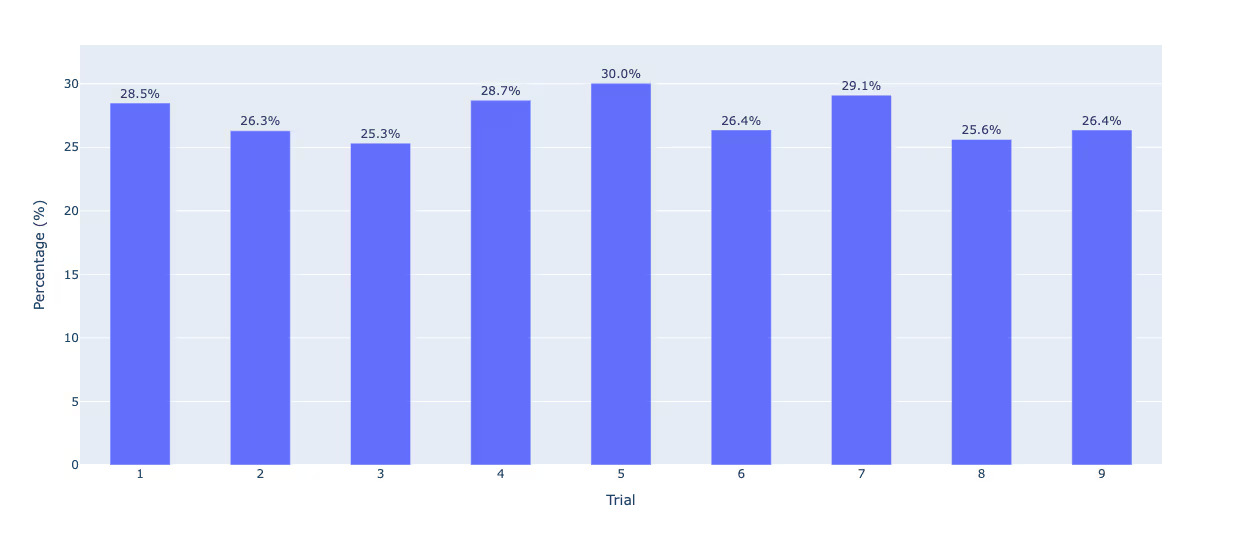
We found that 84% of fan-outs share at least one URL with the original query's top 20, and around 90% of fan-outs can be grouped into 4 clusters or fewer.
So if your content strategy covers the cluster, you're likely to surface across many of the fan-outs the AI generates, even as the specific wording shifts.
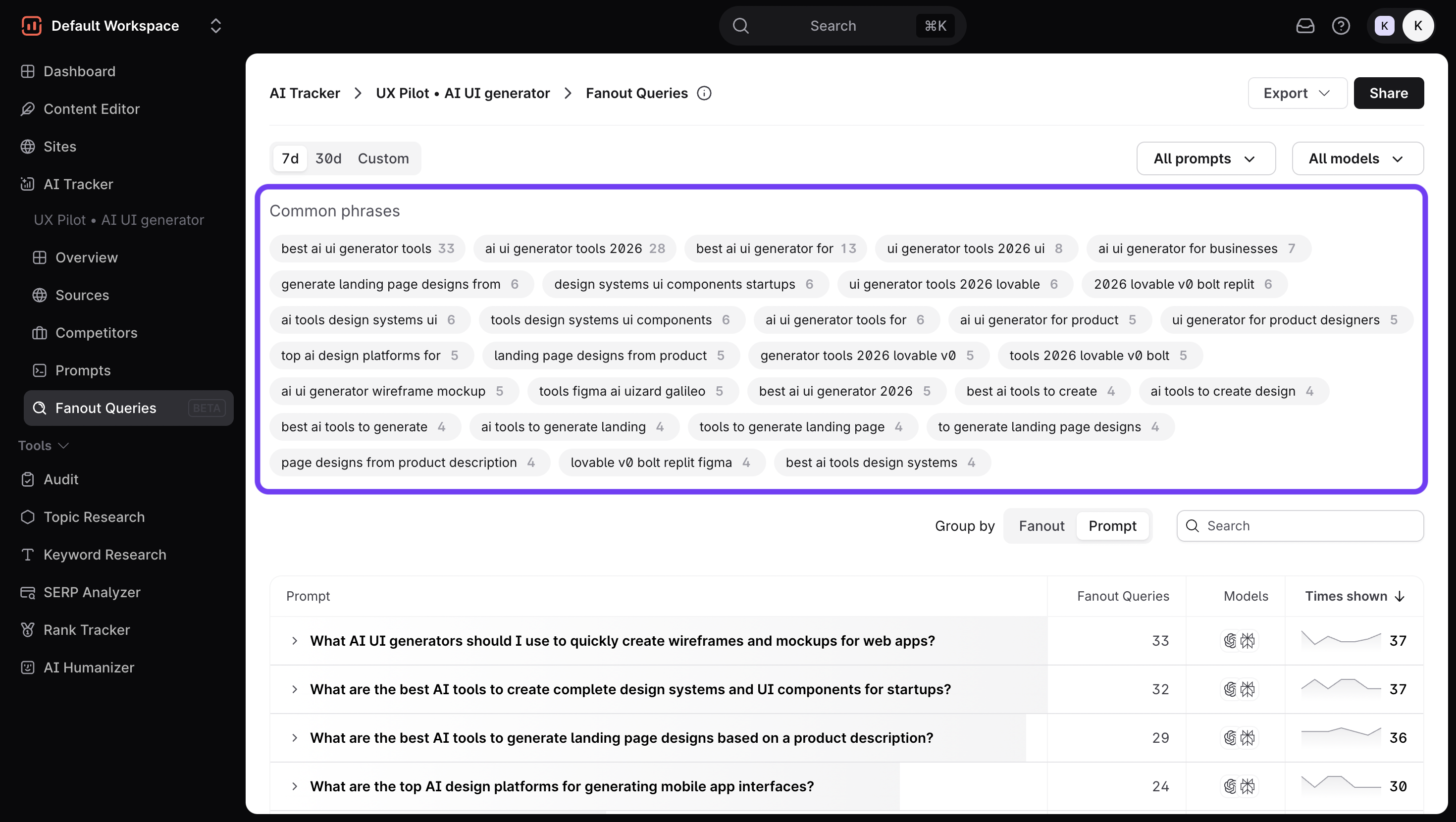
You can use Surfer's AI Tracker for this.
Track a prompt you want to be cited for or referenced as a source, and it shows you the actual fan-out queries AI generates to answer it. From there, you can see what AI is searching for and write to those clusters directly.
Brand entity recognition
AI engines need to understand who you are before they cite you, and they build that understanding from what you publish about yourself first.
It also follows that a dedicated, well-structured page answering the common questions about your brand and product is one of the most reliable citation assets you can own. It gives engines a clean, attributable source about who you are, exactly what they need to cite you with confidence.
That means investing in brand mentions across third-party sources matters, but your own site still does most of the heavy lifting.
So I think it's worth ensuring your site describes your brand thoroughly with clear About pages, consistent entity references, structured data with Organization and Person schema markup, and listings that match what's on your site.
Content freshness
Keeping your content up to date is another recommended practice. Research indicates that AI-generated answers increasingly favor pages updated within the last 12 months, as freshness signals significantly impact citation likelihood.
An Ahrefs study found AI-cited content averages 1,064 days old, compared to 1,432 days for organic Google results. That's 25.7% fresher on average.
Nevertheless, the effect is uneven across platforms. ChatGPT shows the strongest recency bias, and Perplexity and ChatGPT both order their in-text citations from newest to oldest. Google AI Overviews lean older, closer to traditional organic.
So if you're trying to win citations on ChatGPT or Perplexity, an evergreen page from 2022 is at a structural disadvantage to the same page updated last month.
How AI engines extract and summarize passages
AI engines don't paraphrase your content. They lift exact sentences from it and stitch those sentences together into an answer. So whether your specific words show up depends on how well you've written them, and where on the page you've placed them.
- The space available is limited. Dan Petrovic at DEJAN AI reverse-engineered Gemini's grounding pipeline across 883,262 snippets and found something he calls a "grounding budget" of around 2,000 words per query. The median allocation is 1,929 words, split across the cited sources based on ranking. The #1 source gets around 531 words on average, or 28% of the total budget. By the time you get to the 5th source, you're down to 266 words, just 13%. So sources basically compete for word allocation inside a finite space.
- Extraction happens at the sentence level. AI takes your page, breaks it into sentences, scores each one against the query, and pulls the highest-scoring ones into the snippet it feeds the model. So your sentences are competing on their own, not as part of the page. Some platforms even combine extracted sentences from multiple sources with AI-generated transitions to create a more natural answer. That's why a single AI response can contain claims attributed to several different websites.
- Position changes everything. Kevin Indig's analysis shows that across 1.2 million ChatGPT responses, 44.2% of citations come from the first 30% of a page, 31.1% from the middle, and just 24.7% from the final third. He calls it the "ski ramp effect." If your best insight is sitting in paragraph 12, you're roughly 2.5 times less likely to be cited than if it were in your intro. That said, within paragraphs, 53% of citations come from the middle sentences, not the opening one. So front-loading happens at the page level, not the paragraph level.
The implication for you as a content creator is pretty direct. Your key claims, definitions, data points, and direct answers need to appear early on the page. The minute you bury them beneath long introductions, background context, or filler, you're cutting your own chances of getting extracted.
It's a good idea to check your current pages, not just new ones. Surfer's Content Editor has an AI Readability Score that shows how easily AI can read and pull information from your page. This helps you optimize answers for AI engines.
How AI engines decide what to cite
AI engines choose what to cite by looking at how confident they are in the source, how unique the source is, how they retrieve information, and the preferences of each platform.
There is a difference between a source being used and being cited. An engine might find a page, use its information in an answer, but never link back to it. A citation only happens when the model is sure enough to name a specific source for a specific claim. This usually favours pages that clearly state verifiable facts or offer something unique.
Each platform weighs these signals in its own way. As a result, the same question can lead to very different citations in ChatGPT, Gemini, Perplexity, or AI Overviews, even if the answers are basically the same.
What's the difference between using a source and citing it?
There are really two separate outcomes.
A source can be used, meaning the AI retrieved it, read it, and incorporated information from it into the answer. Or it can be cited, meaning the AI explicitly links back to that source, so the user can see where the information came from.
In other words, being part of these AI engines' research process doesn't guarantee you'll get credit for it. In fact, this happens a lot.
An analysis of roughly 14,000 real-world search conversations found that search-enabled LLMs routinely consume more pages than they credit in their AI generated response, creating what researchers call an attribution gap.
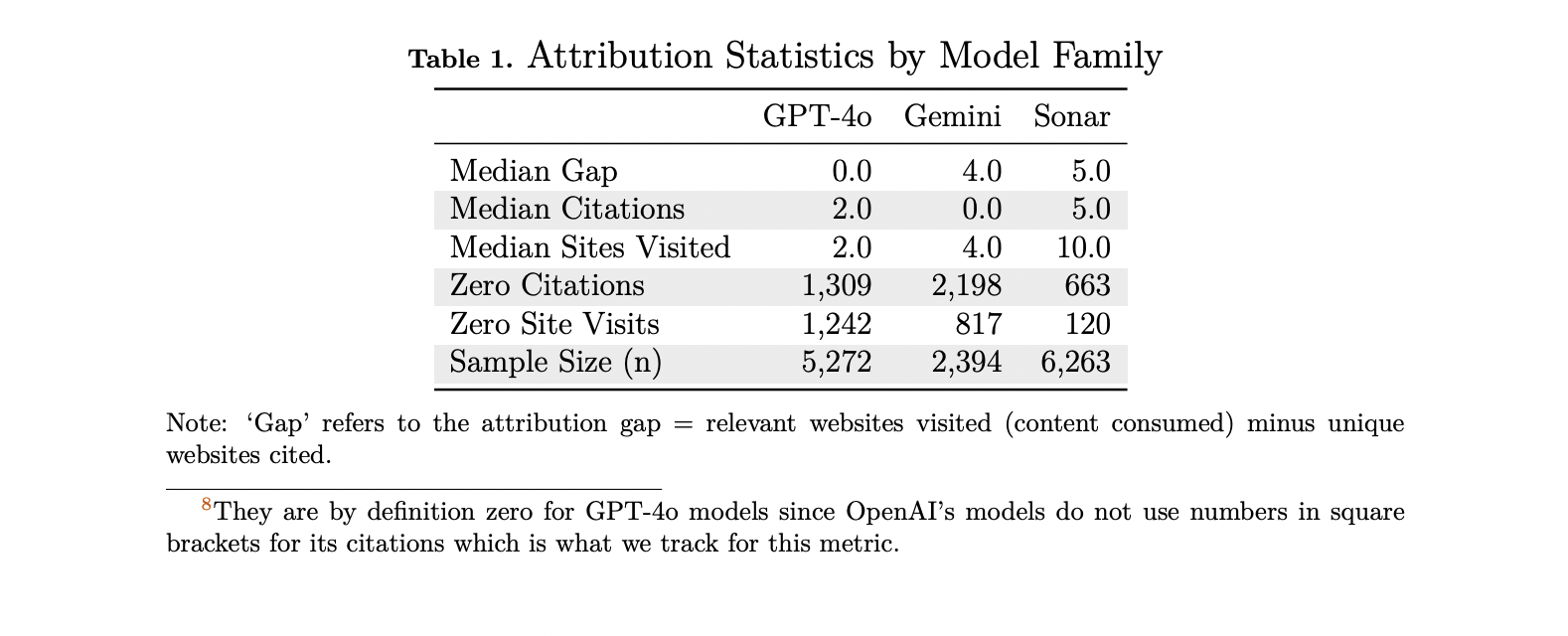
Perplexity's Sonar models, for example, visited a median of 10 websites per query but cited only around 5, while Gemini frequently retrieved information without providing citations at all. Across all AI models studied, 61% of answers showed some degree of this attribution gap between sources used and sources credited.
I'd say the reason comes down to attribution.
Once an AI has gathered information from multiple sources, it doesn't need to cite every page that contributed to the answer. It only needs to cite the sources that it can clearly connect to a specific claim, fact, or insight.
Web pages with distinct facts, original statistics, proprietary research, named frameworks, expert commentary, or unique data points have a much easier path to being cited because the AI can confidently associate a specific claim with a specific source. If your content could have been written by anyone, the engine has little reason to cite you specifically.
To sum up:
- To get retrieved, you need strong topical coverage so your page is relevant to the query and the fan-out searches AI systems generate behind the scenes.
- To get cited, you need information worth attributing.
If you're trying to increase AI citations, ask yourself a simple question: what on this page could only have come from us?
The easier that question is to answer, the easier it is for an AI engine to cite you.
Why platforms cite different sources
AI search engines cite different websites because they gather information in their own ways and focus on different types of content. There is no single list of 'trusted' sources to aim for, since what gets cited changes depending on the engine and the topic.
When we looked at 46 million AI citations, we found that YouTube made up about 23%, Wikipedia about 18%, and Google.com about 16% of all citations.
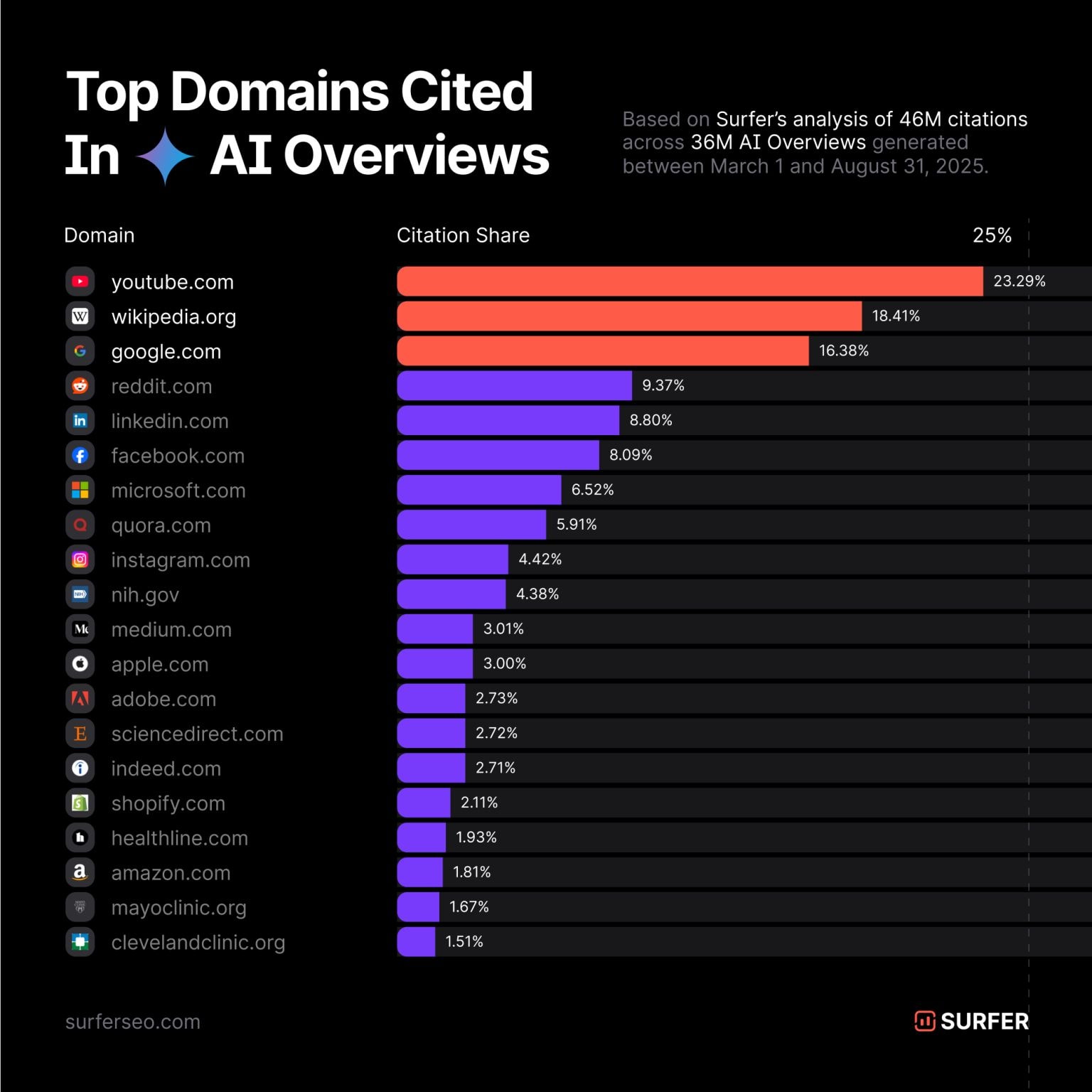
However, this mix changed a lot by industry. For example, health answers relied on NIH for about 39% of citations, while gaming answers mostly came from YouTube (about 93%) and Reddit (about 78%).
In short, AI engines often answer the same question using very different websites, and the best source depends on both the platform and the topic. Part of the reason is architecture.
- Perplexity is retrieval-first. It performs live web search for every query, which tends to surface a broader, more varied set of sources per response.
- ChatGPT and Gemini are parametric models that can draw on both their training data and live web retrieval, which may explain why they overlap more with each other than with Perplexity.
The other reason is source preference.
Our Core Source Categories research at Surfer, which tracked four AI models across 600 prompts per model and approximately 30,000 unique sources, found that:
- Blog content and landing pages dominate the sources that repeatedly appear in AI answers
- Forums and listicles were overrepresented among these "core" sources
- Meanwhile, video content like Youtube videos appeared far less frequently than in the broader web ecosystem
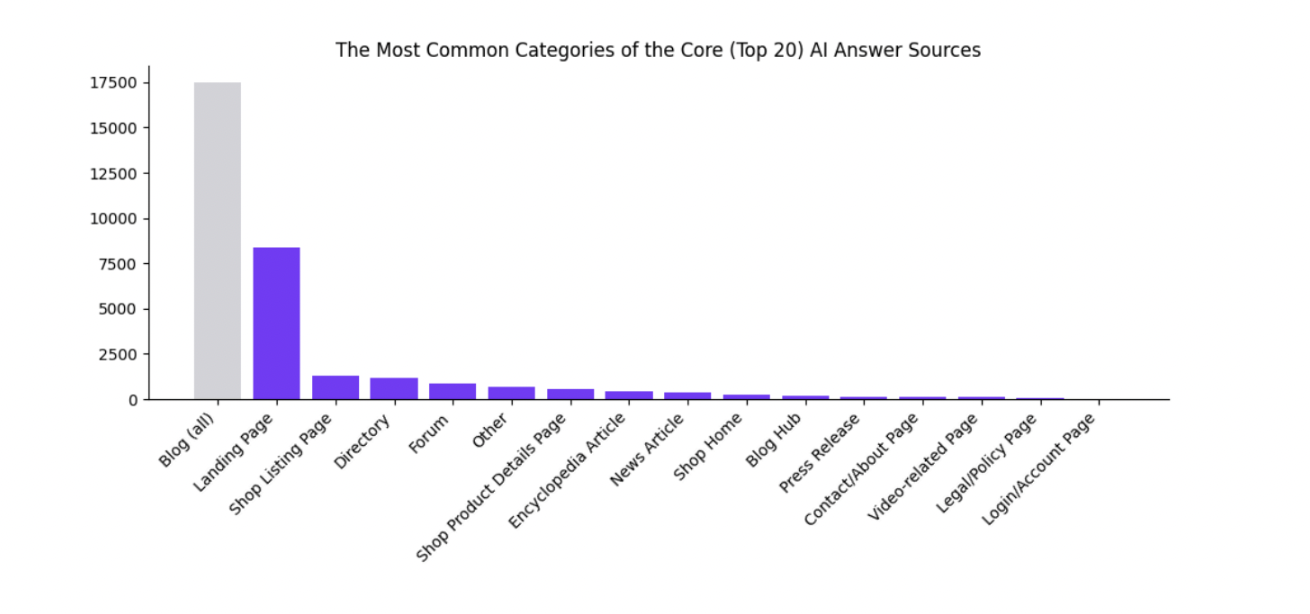
When aggregated, blog content and landing pages account for the overwhelming majority of top-10 source positions across all tested models. This suggests that long-form written content with clear structure remains the dominant format for AI citation, even as video and social media dominate user attention elsewhere.
What content structure earns citations
Across multiple studies, well structured content with clear headings is more likely to be cited and absorbed into AI-generated answers.
Research from Junwei Yu and colleagues at the University of Tokyo found that structural optimization alone without changing the underlying content improved citation performance by an average of 17.3% across six generative engines. The improvement came from changes to content architecture, information organization, and formatting rather than rewriting the substance of the page.
The researching team break well-structured content into three levels:
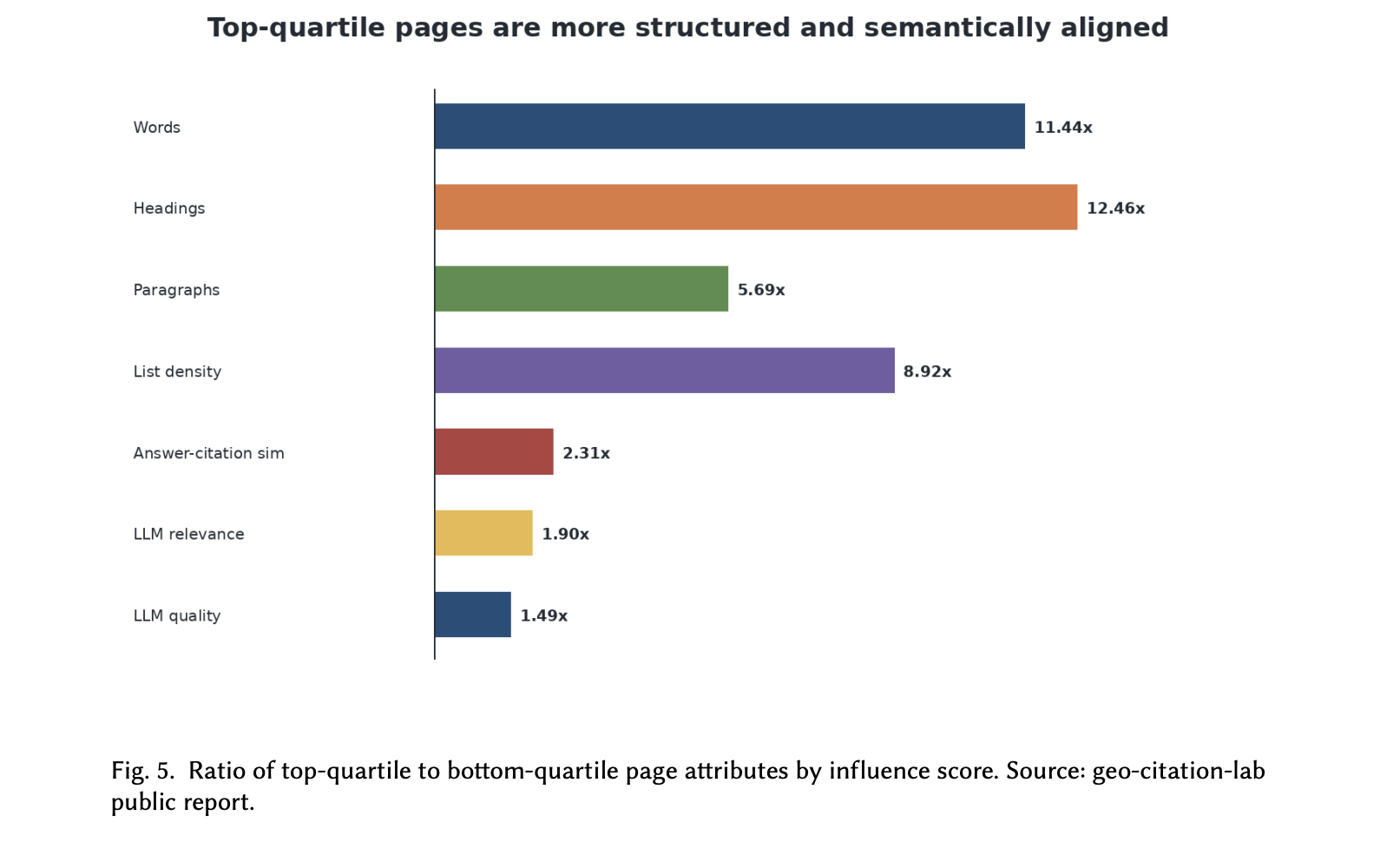
- Macro-structure (document architecture): the overall organization of the page, including heading hierarchy, section order, and topic coverage. This aligns closely with another study that analyzed more than 21,000 AI citations. The pages with the highest citation influence weren't just slightly better structured. They averaged 1,943 words, 10.6 headings, nearly nine times the list density, and over five times as many paragraphs as pages in the lowest influence group. The takeaway is that highly cited pages tend to break information into clear, navigable sections that AI systems can understand.
- Meso-structure (information chunking): how information is divided into passages, sections, lists, and tables. According to the GEO-SFE framework, paragraph organization, list structures, and format diversity all play a role because they help AI engines extract a clean, self-contained piece of information instead of parsing an entire section to find the answer.
- Micro-structure (extraction signals): sentence-level features that help AI identify important information. It concerns visual emphasis, strategic keyword placement, and recognizable patterns such as definitions and direct-answer statements as cues that attract model attention during retrieval and synthesis
This also helps explain the citation pattern we saw earlier in our analysis of roughly 30,000 unique AI-cited sources. Blog posts, landing pages, listicles, and how-to content dominate AI citations. That's probably not a coincidence.
AI search engines like ChatGPT and Perplexity really prioritize content that is easy to extract, verify, and summarize, which means that clarity and direct answers are more important than traditional SEO metrics like page rank.
You should go for content formats that naturally create strong meso-structure through numbered steps, distinct sections, concise explanations, comparison tables, and scannable formatting.
Position your content for AI-driven discovery
Brand visibility in AI isn't just about authority anymore. The engines consistently reward content that's relevant to the question, easy to understand, and easy to pull information from.
So based on everything we've covered so far, here's what matters most for AI search optimization:
- Semantic relevance to queries in your space. Your content needs to directly address the questions people are asking, using language that aligns with how those questions are phrased.
- Clear structure that enables clean extraction. Heading hierarchy, short paragraphs, lists, and definition-style sentences make your content machine-readable in the way that matters now.
- Unique data or claims that give AI a reason to cite you specifically. Original research, proprietary statistics, named frameworks, and specific examples create attributable content that generic advice cannot replicate.
- Freshness. Content that is updated regularly, particularly within the last 12 months, is favored by AI engines, as they tend to skip outdated information to avoid inaccuracies.
- Presence across multiple retrieval indexes. With only 1 to 12% citation overlap between engines, visibility requires being findable across Bing, Brave, and Google. Relying on a single index means being invisible to most AI platforms.
The era of single-channel SEO is over for AI-driven discovery. The engines have diverged, their selection criteria have changed, and the content that wins is not the content with the most links. It is the content with the clearest, most extractable answers to the questions being asked.