Neither AI content nor human content is better for SEO by default. Google treats both the same way: content that is helpful, original, and satisfies E-E-A-T can rank no matter how it was produced, and a 2025 study of 600,000 ranking pages found effectively zero correlation between AI use and position. In practice, the strongest results come from combining the two: AI for speed and scale, humans for accuracy, expertise, and voice.
The debate has raged since ChatGPT's release, so we'll tackle it from every angle in this article: what Google says about AI text, how the quality compares, and when to use AI tools, human writers, or both together.
What is AI content?
AI content is content generated by artificial intelligence programs like ChatGPT and Google Gemini (formerly Bard). These AI applications create content based on user-supplied input, such as keywords, templates, and human-readable queries, or prompts. The label covers everything from fully machine-written articles to drafts that a person substantially rewrites, and Google treats all of it like any other content: judged on quality, not on how it was produced. Most publishers now use AI content in some form, usually with human editing and fact-checking layered on top.
Google renamed its Bard chatbot to Gemini in February 2024, so older references to Bard describe the same tool.
Because it is generated by computers, AI text is much quicker to produce than human-written articles. That makes artificial intelligence a powerful tool for scaling content creation and a potential boon for any business interested in boosting its online publishing pace.
But there are limitations, as we'll see later in this article when we examine AI content vs. human content.
And there are concerns about how well AI-generated content can perform in terms of search engine optimization and Google rankings.
So let's address that question right upfront.
What does Google say about AI text?
Google says AI content is treated like any other content: it can rank if it is helpful, original, and satisfies E-E-A-T, and it counts as spam only when it is produced primarily to manipulate rankings. That position has been consistent since early 2023 and was formalized in the March 2024 scaled content abuse spam policy. In short, Google cares about the quality and intent of a page, not whether a human or a machine wrote it. The company's own statements below spell out both halves of that stance.
The primary purpose of Google's ranking system is to put high-quality, helpful, and authoritative content in front of users to answer the questions they're asking.
For the most part, Google doesn't care how that content is produced, even if that means it's AI-generated.
And that's exactly the message Google puts forth in its official guidance on AI-generated content:
"Using AI doesn't give content any special gains. It's just content. If it is useful, helpful, original, and satisfies aspects of E-E-A-T, it might do well in Search. If it doesn't, it might not."
So basically, Google views AI content as it does any other content. If the content is good, it has a strong chance to rank well.
If it's not so good, it's not going anywhere.
On the other hand, if Google thinks content (AI-generated or not) has been created simply to manipulate search rankings, they're probably going to levy a penalty:
"When it comes to automatically generated content, our guidance has been consistent for years. Using automation—including AI—to generate content with the primary purpose of manipulating ranking in search results is a violation of our spam policies."
Google formalized this position in March 2024 with its scaled content abuse spam policy, which targets publishing many pages primarily to manipulate rankings, whether they are produced with AI, by humans, or by scraping. The company's current position lives in its official documentation on AI-generated content.
So again, AI content is really just content as far as Google is concerned.
And, as proof of that, there are plenty of companies who have been vocal about leveraging AI to generate content that ranks.
For example, Bankrate.com publishes a lot of AI posts, and they tell us so at the bottom of each article:
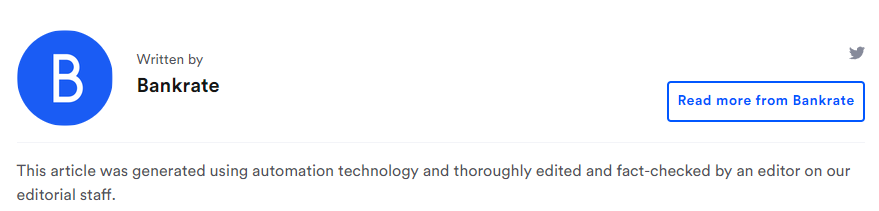
To get an idea for just how many AI posts Bankrate.com has published, you can use the Google "site:" search operator and search for the string "this article was generated using automation":
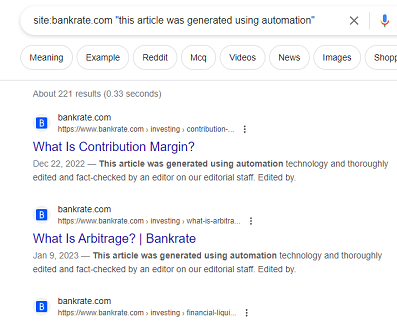
With more than 200 posts generated using AI at the time of this writing, it's clear that Bankrate.com believes AI-created content can rank.
And there is proof to back that up.
When I checked the overall Google search results for "contribution margin" while doing research for this article, the Bankrate.com post shown above was in the top 10.
And it's not just Bankrate.com.
Buzzfeed, one of the largest content producers in the world, made a very public announcement in January of 2023 about their intention to use AI content. They're all-in on AI, saying, in part,
"We’ll build the best platform for creators. We’ll lead the future of AI-powered content."
Bankrate.com, Buzzfeed, and many other high-profile companies believe Google will treat their AI-generated content just like they do any other good articles.
Can AI-generated content rank well?
Yes, AI content can rank well on Google as long as it is helpful, original, and satisfies E-E-A-T requirements. Large-scale studies of top-ranking pages show that most now contain at least some AI-generated material, and that the amount of AI involved has effectively no correlation with position. Ranking success comes down to the same things it always has: matching search intent, covering the topic thoroughly, and demonstrating real expertise. Pages that do that rank, whether a human, a machine, or both produced them.
We saw a good example of that above with the Bankrate.com article about contribution margins.
Large-scale data backs this up. Ahrefs analyzed 600,000 top-20 ranking pages in 2025 and found that 86.5% contained at least some AI-generated content, while the correlation between how much AI a page used and its position was effectively zero (0.011). Pure AI pages were rare at 4.6% of the sample, and the very top results skewed slightly more human, but the data shows Google is not filtering AI-assisted pages out of search.
But there are plenty of smaller publishers making gains with AI content, too. For example, Cody Schneider from Swell AI Tweeted about a blog that he's building:
While those aren't huge numbers, he's published 100 articles at a total cost of about seven cents and is starting to pull in organic traffic in the course of a few months
But not just any old AI article will rank well, just as not any old piece of human-created content will rank well.
If you want to rank well on Google, then you need to focus on creating content that meets user search intent while hitting all the important ranking factors.
That advice applies whether you're using an AI tool to write your posts or publishing only human-generated content.
And AI might even have an advantage in that regard. Specifically, it can take advantage of natural language processing (NLP) to figure out which keywords are semantically similar to your target phrases.
If you can incorporate those naturally in your posts, you'll have a leg up on the competition.
Ranking well also means more than blue links now. Google's AI Overviews appeared in 47% of the searches analyzed in Surfer's study of 405,576 SERPs, and Google's AI optimization guide states that optimizing for generative AI search is still SEO. The same quality signals that decide rankings also decide whether your page gets cited in AI answers, regardless of who or what wrote it.
AI content quality versus human content quality
AI content quality now matches human content quality on technical execution: spelling, grammar, and clean first drafts. Where human writing still wins is passion, voice, lived experience, and judgment about what a specific audience needs. AI text also tends to repeat itself and to structure information less readably than a good writer does. The practical conclusion is that neither side wins outright: the strongest content pairs AI's speed and consistency with human editing that adds personality and catches what the machine gets wrong.
Today's AI tools are capable of producing high-quality text that is technically solid when it comes to spelling and grammar.
In fact, there's not much difference in that regard between an AI writer and a human writer. The AI writer might even have an edge when it comes to generating error-free copy on the first draft.
And today's AI text generators are good enough that it often can be tough to distinguish between AI-generated content and human-written content.
For example, Surfer's CPO Michal Suski recently ran some experiments using AI detector Originality.ai and found that more than 20% of human-created articles were flagged as AI pieces:

But humans still have a big advantage over computers when it comes to writing with passion and delivering the voice, tone, and personality to fit specific audiences.
AI-generated text tends to get repetitive, too, and it's not always structured in a way that makes it as readable as it could be.
So the best approach to using AI for content marketing at this point involves combining today's powerful software with human intervention.
Tools like ChatGPT can help you scale your content creation quickly, but you still need humans to edit and fact-check the posts, inject some personality, and generally make sure it's up to your standards.
Actionable advice in AI content versus human content
Actionable advice is where AI content needs the most human oversight. AI models reproduce the biases and errors in their training data, so the recommendations they generate can be outdated, skewed, or simply wrong, and readers who act on bad advice pay a real price. The risk peaks in your-money-or-your-life topics like health and finance, where Google also expects verifiable expert authorship. Use AI to structure and draft advice content if you like, but have a qualified human verify every recommendation before it goes live.
It's especially important to monitor AI-produced content for accuracy when you're providing any sort of actionable advice to your readers.
Because AI tools are based on existing datasets, they're likely to generate text that reflects biases that might exist in that underlying data.
One infamous example is DALL-E 2, OpenAI's groundbreaking image generator. Not long after its release, users began to notice unsettling patterns when the software generated faces.
Maarten Sap, a member of the external team tasked with identifying potential problems before DALL-E 2 was released, gave some details in an interview with Wired:
There were a lot of non-white people whenever there was a negative adjective associated with the person.
So text (and images) generated by AI needs to be carefully monitored and edited to ensure you're not publishing offensive or incorrect information due to those underlying biases.
And AI can be especially problematic if your content offers medical or financial advice, the so-called "your money or your life" (YMYL) niches.
For starters, Google expects to see real, verifiable experts as the creators of any articles that could potentially affect readers' health or finances.
Their Experience-Expertise-Authority-Trustworthiness (E-E-A-T) guidelines make it clear that content in these niches won't rank without true expertise or real-life experience standing behind it:
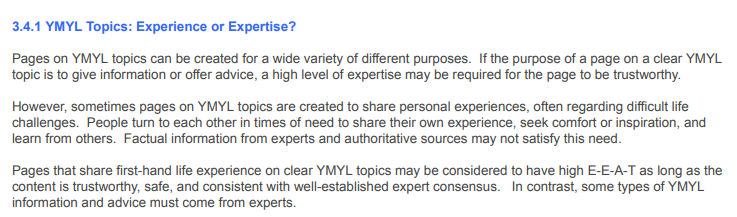
Content written entirely by AI without any human backing can't meet these requirements.
As a site owner, you also can't afford to take chances with your readers' well-being.
And, as we'll see below, AI content generators still have some work to do in terms of getting their facts straight.
That means AI is off-limits, or at least a dangerous proposition, when it comes to dolling out medical and financial advice.
Fact-checking in AI content versus human content
Fact-checking is non-negotiable for AI content in a way it rarely is for a trusted human writer. AI tools generate text from patterns in their training data, not from verified knowledge, so they can state falsehoods with full confidence, from trivial trivia mistakes to harmful medical misinformation. Human writers make errors too, but AI makes them at scale and without any awareness of doing so. Every AI-assisted piece needs a human fact-check before publishing, and the examples below show what happens when that step gets skipped.
Verifying the accuracy of the information in your posts is key when it comes to both AI and human-written content. Inaccuracies can result in a drop in rankings and a loss of trust in your site among readers and search engines.
The dependability of AI content generally hinges on the quality and freshness of the data and algorithms available to the tool used to write the text.
Early versions of ChatGPT had no knowledge of events after 2021. Current models come with much more recent training data and can browse the web, but they still miss or misstate recent developments often enough that human verification remains essential.
For the same reason, these tools also lack the sort of human creativity that allows us to dream up new worlds and inventions.
ChatGPT sometimes also has problems with math, like this interesting gaffe pointed out by AI researcher Abel Torres on Twitter:
🤷♂️😂 pic.twitter.com/kHg51RKseC
— Abel TM (@Abel_TorresM) December 2, 2022
And there have been plenty of instances where AI text generators report "facts" that simply are not true.
For example, ChatGPT told Fast Company's Global Technology Editor Harry McCracken that the first TV cartoon was The Flintstones.
That sounds like a reasonable answer to anyone who's watched Fred and Barney, but the first TV cartoon was actually a little-known syndicated show called Crusader Rabbit, according to McCracken's research.
That's a pretty trivial example, but there have also been cases where the misinformation has potentially more serious consequences.
For instance, Men's Journal published their first AI-generated article in February of 2023. It was a piece on low testosterone that immediately drew backlash from readers for many inaccuracies.
In an interview with Futurism, Bradley Anawalt, chief of medicine at the University of Washington Medical Center, gave an overview of the problems:
This article has many inaccuracies and falsehoods. It lacks many of the nuances that are crucial to understand normal male health.
In all, Anawalt said he found 18 specific errors in the Men's Journal article, which the magazine subsequently corrected.
To avoid publishing these types of inaccuracies, it's vitally important for humans to fact-check all AI content and make any necessary corrections before it goes live.
With the right type of human oversight in place, though, you can feel more confident in making the most of the advantages that AI offers relative to human content.
Advantages of AI content over human written content
AI content has two main advantages over human written content: speed and scale. An AI tool can produce a usable draft in minutes at a fraction of the cost of an article written from scratch, and because each piece needs less human time, you can publish far more content in the same period. Human editing and fact-checking still matter, but reviewing a draft is much faster than writing one. For a business, that means a lower cost per article, a faster publishing pace, and a realistic way to close the content gap with much larger publishers. The two categories below show how this plays out.
Speed of generating content
There is no doubt that AI can generate content much faster than a writer can produce that same content.
A recent Twitter thread gives us a good idea of just how fast publishers can generate content with AI:
The site that @jsvxc calls out in this example is ranking for nearly 150,000 new keywords every month on the back of AI content.
And, while humans still need to spend time editing and fact-checking AI-generated text, that's generally a much faster process than writing an article from scratch. The less time humans need to spend on a piece of content, the cheaper that content is to produce.
That means AI tools can save businesses money.
And, since each piece of content is faster to produce, that also means you can generate many posts in the time it takes a human to write one post from scratch.
Scaling content creation
Scaling up content creation can be a real game-changer for your business when you're trying to improve your digital marketing efforts.
The more articles you can publish that meet your target audience's search intent, the more web traffic and business you can generate.
And AI lets you scale up your content creation more efficiently than ever before.
For instance, veteran SEO Charles Floate responded to the thread mentioned above to cite a publisher making huge gains by publishing AI content :
Pretty sure the owner has multiple sites going right now using the same autogenerated content method. pic.twitter.com/leq3XeLyBj
— Charles Floate 📈 (@Charles_SEO) September 8, 2021
In about six months, they took this site from scratch to ranking for nearly 750,000 keywords and drawing about 150,000 pageviews per month.
And AI tools can help scale content creation even if humans are still doing the actual writing.
For instance, you can use Surfer's free AI Article Outline Generator:
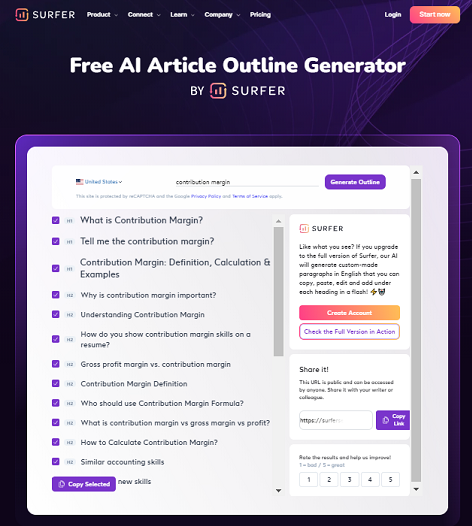
This tool allows you to type in a topic or keyword, and then it generates an optimized outline for an article. From there, you can either write the sections yourself or use the full version of Surfer to generate the paragraphs for you.
An example of a company who used AI tools to scale their content production while still retaining human writers is ClickUp, a relative newcomer to the product management and team communication space.
In 2021, ClickUp adopted SurferSEO to streamline their publication process and expand their SEO efforts.
The results?
Over 12 months of focused effort and iterating on their procedures, ClickUp published more than 150 articles and boosted their website traffic by 85%.
You can read the complete ClickUp case study here.
Using AI content versus hiring human writers
Whether to use AI content or hire human writers comes down to cost, management overhead, and the level of expertise your content needs. AI is dramatically cheaper per article and involves no contracts, hiring, or attrition, which makes it the economical choice for scaling output. Human writers earn their cost where subject-matter expertise, original experience, or a distinctive voice carries the piece. Most teams land on a mix: AI for volume and first drafts, people for editing and high-stakes content. The comparison below covers the numbers, the hiring risks, and what that means for competing with bigger publishers.
According to a study by Jasper.ai, freelance writers make anywhere from $0.01 to $2 per word of published content.
Even at the very low end of the scale, that translates to $20 for a 2000-word article. For publishers who produce several articles per week, the cost of paying writers adds up quickly.
And that cost only goes up if you need very high-quality content or serve a very specific niche audience that requires a certain level of expertise.
In contrast, Surfer's plans start at $49 per month with document allowances that cover drafting and optimizing articles, which works out far below typical freelance rates at any real publishing volume. So AI-generated content offers an obvious cost benefit right up front.
AI reduces the risks of attrition and bad hires
Beyond the cost of buying the content itself, AI can also help eliminate or reduce many of the headaches and hidden costs associated with hiring writers.
For starters, you generally need to have a contract in place with each writer you hire. And, while you can use the same template for most writers, it still costs time and money to draw up the initial contract and administer each agreement.
Obviously, AI-generated content doesn't require any contract beyond paying for whatever service you use.
The hiring process itself is also not free, and usually not easy. It takes time and effort to craft job postings, screen applicants, and administer writing assessments before you ever make a hire.
And you'll need to hire more and more writers over time to scale your content to any appreciable degree. Going back to our example of Bankrate.com, their editorial team page credits well over 100 writers:
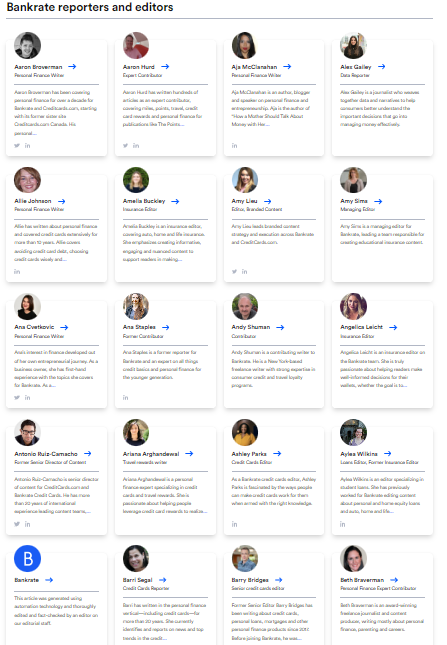
You can bet that a lot of time and effort went into bringing each one of those contributors into the fold.
And just because a writer clears all the hurdles and comes on board, that doesn't mean they'll work out.
Some writers don't ever really show up and end up not producing any usable content. Others just may not be able to produce at the level or volume you need.
And, even writers who do great work and produce plenty of content eventually move on.
Either way, as a publisher you'll be left to go back to the hiring process to get your content output moving forward again.
AI tools, of course, aren't subject to this kind of attrition, so they save you the time, hassle, and cost of dipping back into the hiring cycle time and again.
AI can help you compete with bigger publishers
As we discussed earlier, AI can help you scale your content creation much faster and more cheaply than relying solely on human writers.
And scaling your content output helps you compete more directly with bigger publishers than would have previously been possible.
A small blog owner may never be able to hire the same number of writers as a powerful company like Bankrate.com, but AI can help close the content gap.
Brett Malinowski of WGMI Media provided a striking example of the impact that AI can make on website performance in a recent Tweet:
We have become the most Ai optimized media company possible
— Brett Malinowski (@thebrettway) May 9, 2023
In the last 3 months our Ai systems have 5x'd our organic website traffic
Ai is drastically improving our content's quality and quantity
All while going from a 12 person team to a 4 person team saving us $10k+/month pic.twitter.com/ZQo4denUej
Over the course of three months, WGMI increased their traffic by a factor of five while cutting the size of their content team by tw0-thirds.
All of those achievements were made possible by a focused commitment to using AI to hone their content writing processes.
Will AI content replace human writers?
No, AI content will not replace human writers anytime soon. AI can generate huge volumes of text, but it cannot supply the talent, taste, and lived experience that make content stand out, and it still needs human editing, fact-checking, and direction. What is changing is the writer's job: more editing, more prompt design, and more oversight of AI output. Writers who adopt these tools outcompete both the writers who ignore them and the publishers who rely on AI alone.
That may be a surprising answer given all of the advantages that AI can offer content publishers.
But as former Facebook research data scientist Rachel Woods Tweets, humans still have distinct advantages over AI, too:
Yes AI can generate content at a huge scale. But it lacks is talent. The touch, the eye, the vibe.
— Rachel Woods (@rachel_l_woods) May 17, 2023
I believe a creative with talent will outcompete AI.
But a creative with talent that adopts AI also outcompetes the one who doesn’t.
As Woods notes, though, AI is definitely changing how writers do their work. The ones who adapt will thrive, while those who don't will struggle.
In some fields, AI software allows writers to create content faster and more cost-effectively and then focus on editing and fact-checking the final product.
But AI may not be the best fit for all types of content writing, where specific expertise or a particular style of writing is required. In those cases, AI can still help plan and outline content.
And, as we have discussed, human content writers are vital for adding the voice, tone, and personal touches that set your content apart from your competitors.
So, can AI replace content writers eventually?
Maybe, but in the short to medium term, more and more writers will take on editing roles while also learning more about how to construct powerful AI prompts.
Combine AI and human content for SEO that ranks
The AI versus human content debate has a practical answer: use both. Google rewards helpful, original content no matter how it was produced, so let AI handle the speed and scale while human writers and editors supply the fact-checking, subject-matter expertise, and voice that keep quality high.
Start by auditing where your content pipeline spends the most time. Hand the repetitive drafting work to AI, reserve your writers for pieces where experience and originality decide the winner, and keep a human review step on everything. Teams that get that split right publish more, spend less, and give up nothing on quality or SEO performance.