To use Surfer AI, open Surfer Content Editor, enter your target keyword along with the country and device you want to rank in, pick a content format and tone, review the outline it generates, then let it write the full draft. From there you edit against Surfer's on-page suggestions, fact check it, and publish. Because Surfer analyzes the pages already ranking for your keyword before it writes a word, the draft arrives carrying the terms, structure and topical coverage that make it search engine optimized.
Whether you're a content editor at a large company or running your own affiliate site, the bottleneck is the same: publishing high quality content at scale. Here's the whole workflow, step by step.
What is Surfer AI?
Surfer AI is a generative text software that uses Surfer's algorithms to write complete articles that are optimized for both traditional search and AI answers in a single pass. It is designed to receive user instructions in the form of an article outline and a primary topic that it creates an article for, based on the top ranking pages for that topic. It isn't a separate app: it lives inside Surfer Content Editor, so the draft it produces arrives already measured against the terms, entities and structure that the pages ranking for your keyword use. You supply a keyword, a country and a device, and you get back a complete, editable article with a Content Score attached rather than a wall of unoptimized text.
Think of Surfer AI as an AI assisted content writer for your website that delivers search engine optimized content in the time it takes to make and drink a coffee.
Unless you're chugging them. Which you shouldn't be.
With Surfer AI, you are able to quickly generate drafts, optimize for search engine rankings, and publish articles with ease.
Surfer's AI articles are written by analyzing pages that are ranking well for the primary keyword you select, to ensure that the AI generated article is on par with your competitors.
Who is Surfer AI for?
Surfer AI is for content marketers, SEOs and in-house editors who need search engine optimized articles quickly and at scale, without hiring a large writing team to get them. It suits a solo operator publishing on a personal or affiliate site as well as it suits a content team working across millions of page views, because the workflow is identical at any volume: one keyword in, one optimized draft out. It's a poor fit only where the article has to carry something a model cannot supply, such as original research, proprietary data or first-hand expert testimony. Those still come from a person.
Well, are you trying to rank on search engines?
Surfer AI is for content marketers and SEO's who want to create high quality articles that rank well in search engine results for their target keyword.
And want to do it quickly, and at scale.
Surfer AI is designed to provide a comprehensive SEO content writing solution for businesses of all sizes. That could be you writing content for your personal website, or a larger content cartel with millions of page views.
What can I do with Surfer AI?
Surfer AI can help you write search engine optimized articles based on content outlines and a primary topic that you provide. You can instruct the tool to write your article in several ways. In practice you control five things: the country you want to rank in, the tone of voice the article uses, the outline it follows, the organic competitors it studies, and whether Surfer writes the draft or you write it yourself. Everything else, the term coverage, the headings and the length, comes out of Surfer's analysis of the pages already ranking for your keyword. What you get back is a first draft to edit rather than a blank page to fill.
Select a target market
You can select the country you want your article to be optimized for. This is especially important because ranking pages for the same keyword sometimes differ by geography, so telling Surfer AI where to optimize is a good idea.
Choose tone of voice
You can select the tone of voice you want your article to be written in, to ensure that it matches your brand's personality and guidelines for content.
Edit article outlines
Article outlines are essential to covering relevant points in your content, and can be edited inside Surfer AI to guide the writing software's direction.
Select organic competitors
Surfer's AI algorithm will research and analyze the competitors you select to write your article to ensure that it is optimized for search engine rankings.
Generate high quality drafts
And of course, write a complete article for you that you can then adjust for your website before publishing.
As an AI powered writer, Surfer AI can streamline your article writing process to make it more efficient and 10x your output.
How is Surfer AI different from other AI content tools?
The main difference between Surfer AI and other AI generative tools is that Surfer AI can create a complete article from scratch with minimal prompts, optimized for Google and for AI answers in the same draft. General purpose writing tools start from your prompt and nothing else. Surfer starts from the search results: it analyzes the pages already ranking for your keyword, extracts the terms, entities and questions they cover, and writes to that brief. The draft then lands inside Surfer Content Editor with a blended Content Score attached, covering traditional search and AI search, so optimization happens as part of generation instead of as a separate pass afterwards. There's also no practical word ceiling, which matters when the deliverable is a full article rather than a few paragraphs.
Here are some more ways that Surfer AI is different to other AI content tools:
GPT 4 32k
Surfer AI uses the highest tier of the GPT model to process AI content enabling a higher quality of text with lower repetitions.
Content quality
Surfer AI employs a comprehensive approach to understanding why other pages rank for a given keyword and then relies on extracted insights to write content based on its analysis.
This level of detail means content can be effectively optimized for search engine rankings while still holding value for readers.
Search intent
The articles written by Surfer AI are meant to satisfy search intent, and not just generate a wall of text that covers related keywords for search engine visibility.
Article length
Surfer AI isn't restricted by word count like say, ChatGPT so you can use it to write complete articles. A word limit would defeat its purpose as a blogging tool for content writers.
Search engine optimized
The articles generated by Surfer AI include semantically relevant keywords for your targeted topic, unlike other tools that may generate content but still require work for search engine optimization. Because Surfer AI analyzes top ranking pages for your target keyword before creating an article, you receive content that is already favored by search engines.
Minimal Prompts
Surfer AI will write your blog post based on a primary keyword and the article outline you suggest so you don't have to worry about constantly feeding it information.
Algorithmic excellence
Surfer AI leverages natural language processing models to analyze the top SERPs, extracting reliable insights for content optimization. This data driven approach gives Surfer AI an edge over other AI content tools, as it provides more accurate information to help the writing process.
Flexibility
With Surfer AI, you can edit your content outlines and the tone of voice for your generated articles, as well as select your primary competitors. Other SEO writing tools don't offer the same level of convenience to adapt your articles.
SEO suite
Since Surfer AI includes Content Editor, you will have access to CE's keyword suggestions, and can add Surfer Topical Map to help you streamline every stage of the SEO workflow.
How to use Surfer AI
Using Surfer AI is a five stage run inside Surfer Content Editor. You enter your target keyword with the country and device you want to rank in. You then set the article up: choose the content format, pick a tone of voice, and decide whether you want to edit the outline yourself. Surfer researches the pages ranking for that keyword and generates an outline you can rearrange or rewrite. Once you approve it, Surfer writes the full draft. The last stage is yours: work through the on-page term suggestions, add the internal links and examples the piece needs, fact check every claim, then publish. Budget minutes, not days.
Surfer AI resides inside Surfer Content Editor, which creates and optimizes content for both traditional search and AI answers in one workflow.
Head over to Surfer Content Editor and ensure that you select the Write with AI tab to start writing articles with Surfer AI.
.png)
Select your target keywords
This is the step where you will enter your main topic or keywords that your article is about. You can use Surfer Topical Map if you're not sure which keyword to pick. Follow these steps to start writing.
- Enter between 1-5 primary keywords
- Select your country and device preferences
- Click the Create button
Here's an example.
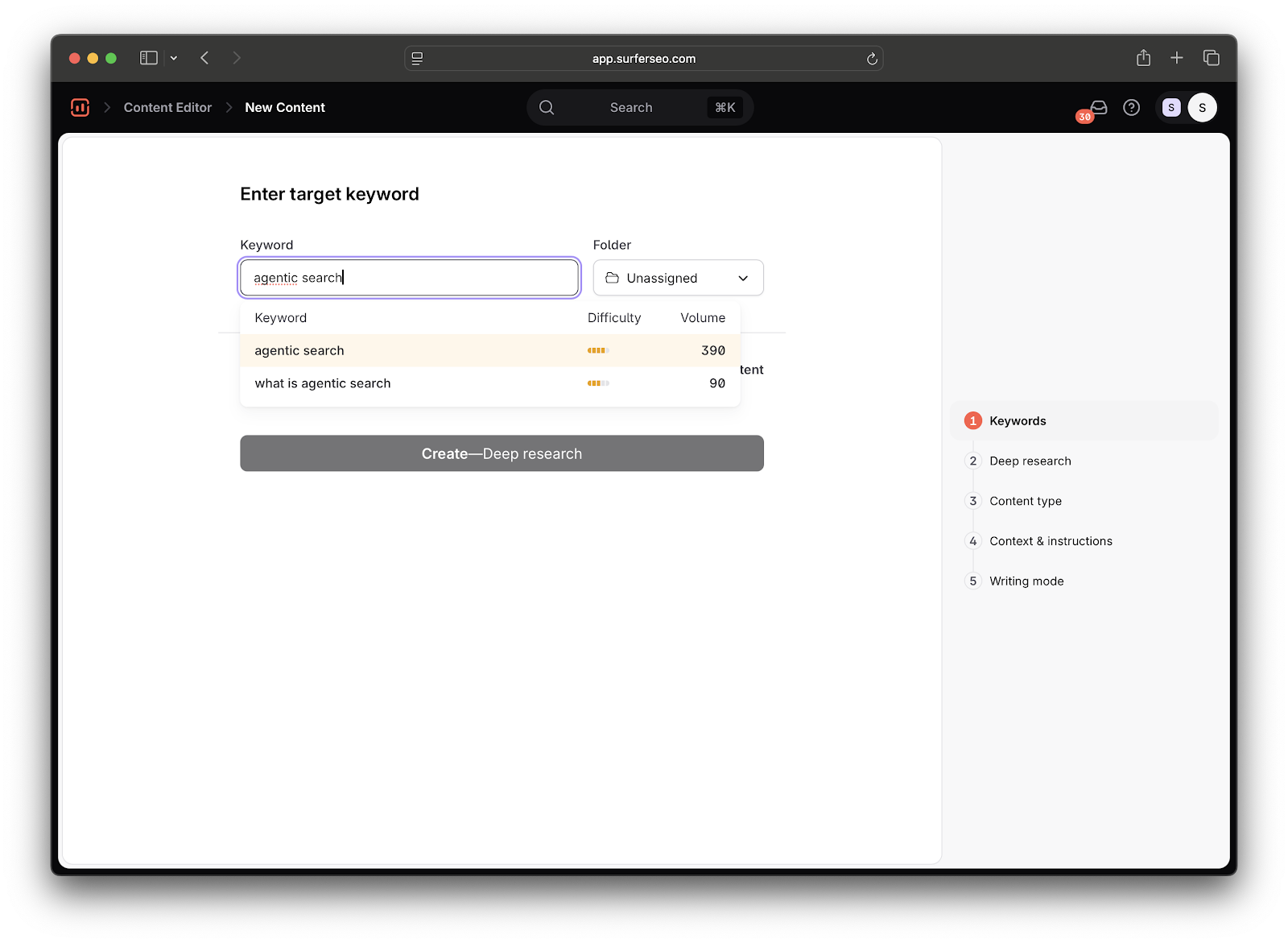
The Content Editor's interface will load on the next page where you will be invited to select settings for your content.
It should look like this.

A new 4 part window will walk you through the settings to choose for your article before it is written by Surfer AI. Your chosen keyword and geography will be on top.
Select your content format
Surfer AI will offer you three options to choose from.

Blog Post
Select this if you would like your content to be generated in a blog post format.
Product Roundup
Select this option if your article is a listicle on tools or products. For example, if you’re writing an article on “best books to learn about investing,” you may want to select a few and leave the rest for Surfer to pick up from analyzing the SERPs.

Single Product Review
Use this template if you want Surfer AI to write a review about something.

Select your tone of voice
Click on the dropdown to select from a bunch of voices for your content. This will tell Surfer AI how to approach your blog post and can help match your brand's personality. You also have the option of leaving it on Auto which will then tell Surfer AI to mimic the top SERP pages in voice and tonality.

Edit your outline
Surfer AI will generate an article outline in the next step by itself, but you can edit the outline to add your own talking points and guide the structure of your article. If you want to edit the outline, select the checkbox like I have.

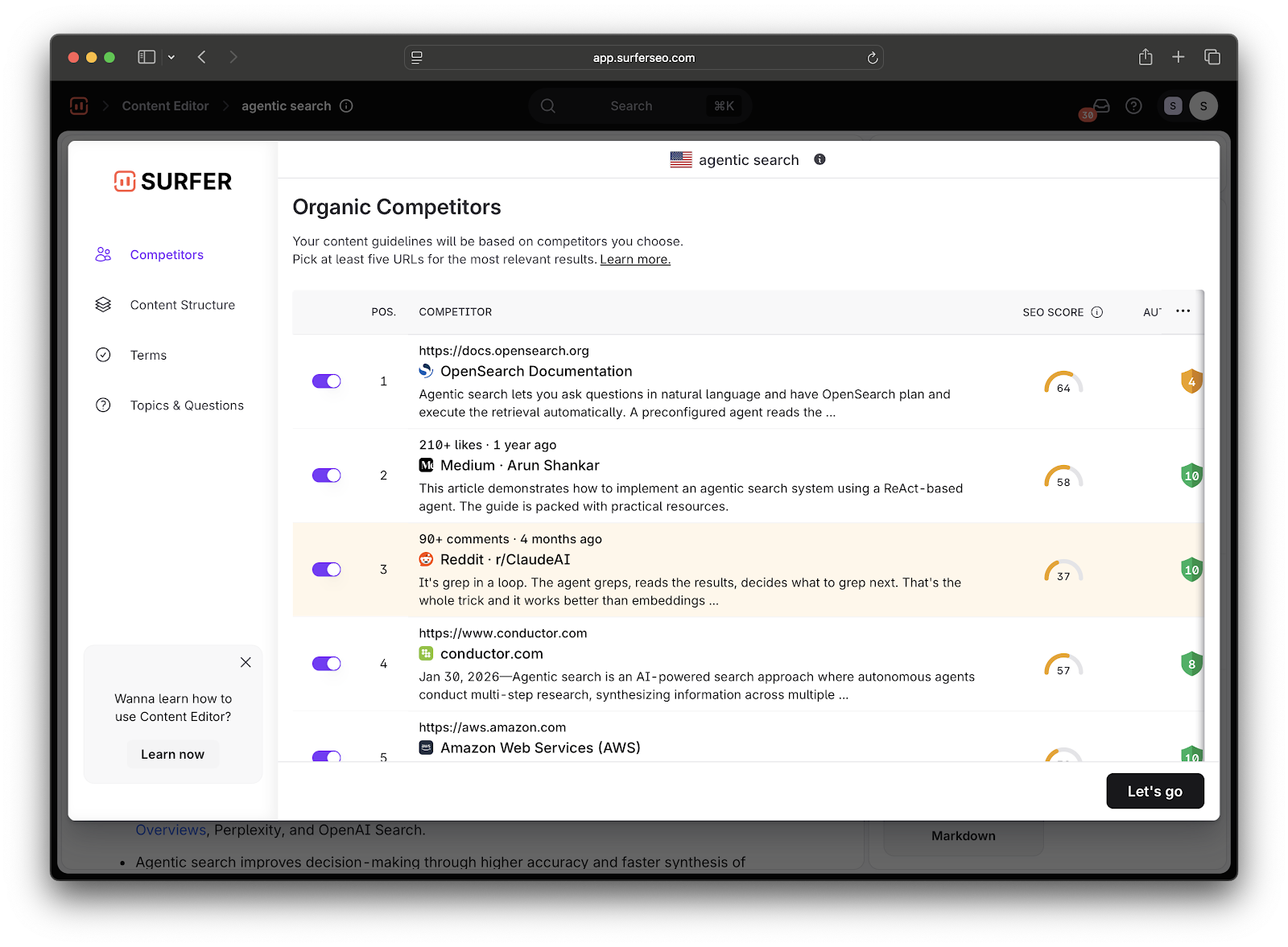
Pick organic competitors
This setting allows you to select the top pages ranking for your keyword that you want your article to compete against. You will find that Surfer's algorithm has already selected the most relevant blog posts but you can make the final decision.
We recommend picking at least 5 organic competitors.
Avoiding AI content detection
We recommend keeping this setting off for the simple reason that Google embraces AI content as much as it does human content, as long as your articles provide value. Add to that, the questionable algorithms used by content detector tools that are often wrong, there's no real benefit to hiding AI generated content.
Leaving this setting on can sometimes force Surfer AI to use unnatural language and negatively affect your keyword optimization.

Click on the Create outline button at the bottom when you're happy with your settings.

This will then instruct Surfer AI to generate your article's outline, so you can have the chance to edit it before it is written.
Give it a couple of minutes and you will see a screen like this with an outline generated for your topic.

Review the AI generated outline and edit your article's headers until you're satisfied with the content structure.
Create your draft
When ready, click on the Let's write button. Surfer AI will then take into consideration all the your preferences and combine them with insights for your target topic to create SEO optimized content for your blog post.
And that's it. It shouldn't take more than 20 minutes for your article to be ready.

In a few minutes, you should see a fully optimized article, complete with the headers you chose, a short summary at the top and even FAQs to help you win the People Also Ask section in Google's search results.
Take a look.
Here's a snippet of what my article looks like along with the Content score.

You can see that Surfer AI wrote 1986 words for your blog post, which falls within the suggested range of 1766-2031 words, and achieved a content score of 89 inside the Content Editor. Additionally, Surfer AI added an AI-generated photo to enhance the visual appeal of your article. While your results may vary based on your settings and target keyword, this provides a solid foundation for your content.
Optimize your article for keywords
While it's entirely possible to publish the article Surfer AI generated for you, directly onto your website, we recommend spending some time editing the article to enhance on-page SEO factors and improve your chances of climbing the search rankings.
On the right panel, you will find a list of suggested keywords and phrases to insert in your article.
These are semantically relevant keywords for search engines to understand and categorize your website content correctly so you can rank better. The suggestions are arranged in order of importance, so the highest terms are more important than those below.
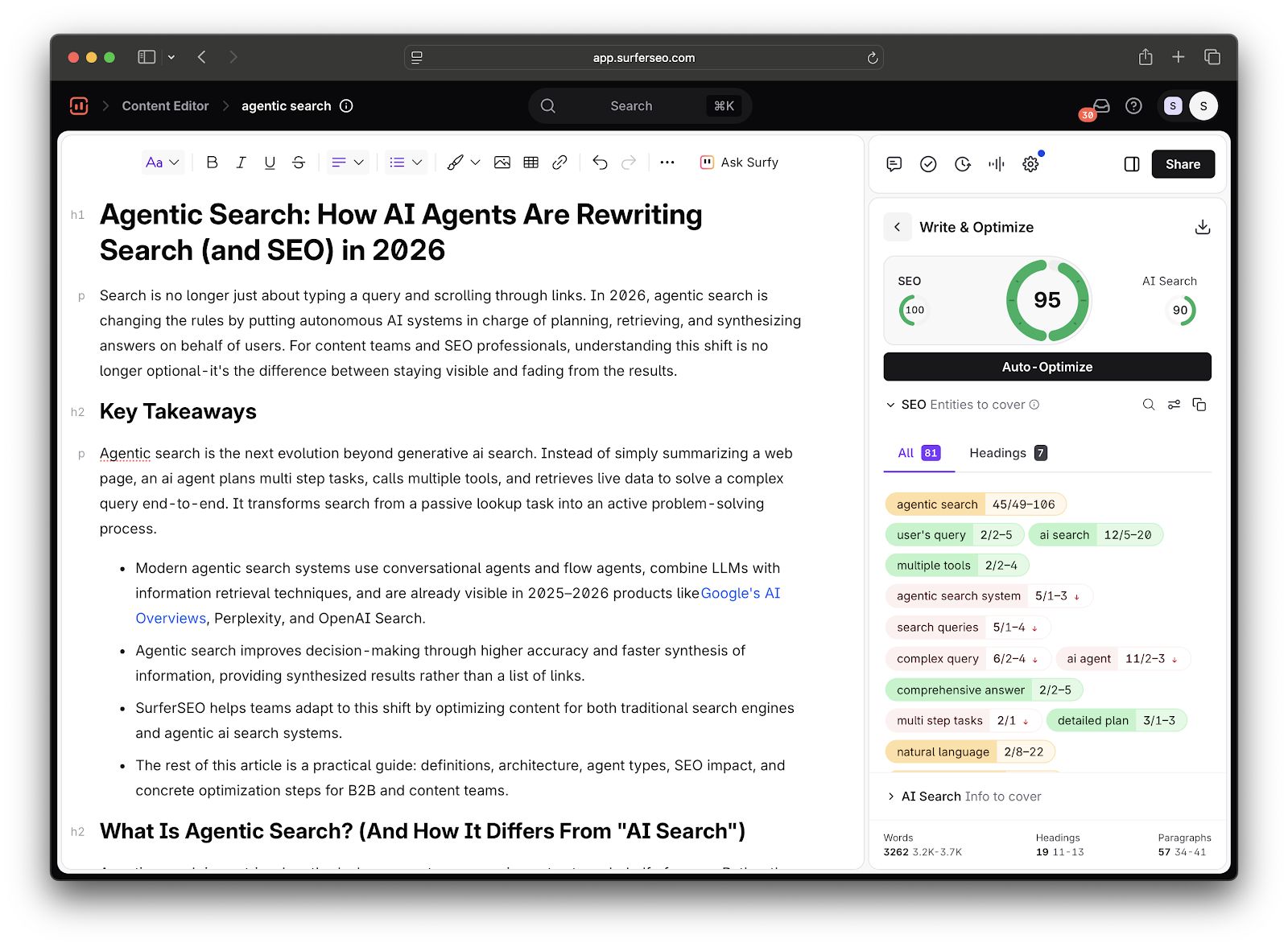
You can either add these keywords manually or use the Auto-Optimize feature to handle it for you.

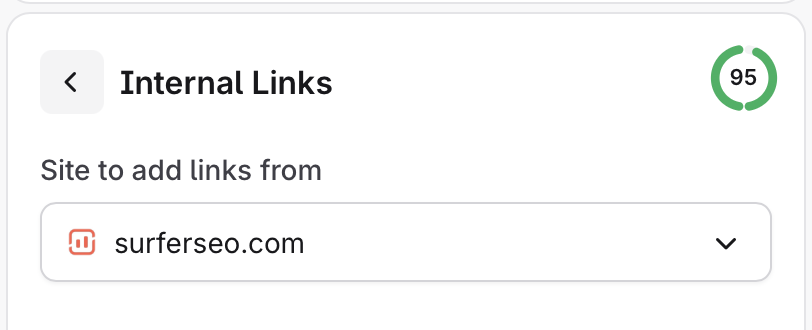
Likewise, the Insert Internal Links feature allows you to automatically connect your content to other relevant pages on your site with a single click.
Edit your content with Surfy
Surfy is your AI powered editing assistant inside Content Editor.
It can speed up your editing process and aid subject research.
You can use Surfy for a number of tasks with simple, or detailed prompts:
- Adopt a different tone of voice
- Support your content with examples
- Elaborate on existing content, or trim it down
- Link to other articles
- Research from within the article
Just highlight a paragraph and select what you want it to do.
Rephrasing, for example.
Just select the paragraph or sentence you want to edit, and click on the Rephrase option.

Or a more detailed prompt asking for examples and internal links.
AI content on website

Here’s a snapshot of the content Surfy edited for me.

You can then accept the newly written content, or start over.
Cover relevant questions and topics
Inside the Outline tab in Content Editor, you will find a list of topics and questions for your content that have been extracted from Google's People Also Ask section, SERP competitors and our own insights.
It can be helpful to ensure that you didn't leave out anything important in your article. You can also use the displayed titles, headings and questions to help build an outline and cover talking points before you generate an article with Surfer AI
I like checking the Topics and Questions section to see if any of the suggestions make sense and could help me snag a People Also Ask question.

Fact check your content
Before you publish your article, ensure that you review it for facts, statistics and claims so you know that your content is 100% accurate. AI generated content can sometimes be inconsistent when it comes to facts and studies.
You may also want to remove any biases from your content, and make sure your claims and examples are accurate, and upto date.
There are several tools to check for AI hallucination, Google's fact checker being one of them.
Include a content brief
You can use the Notes section under the Brief tab to include your content brief for your content editor so that they can refer to it while editing the Surfer AI generated article rather than having to continually check for instructions.
To do so, click on the Customize gear icon with the blinking blue dot in the top right.

Scroll down to the Notes item in the left menu and paste your brief here for your writers.
You can also help you writers with references by including competitors that Surfer has identified for your target keyword. Just click on the Insert Competitors option.

This way, your writers understand the minimum quality of content you expect to compete against websites aiming to rank for the same search query. You can also add additional instructions in the Brief window like timelines and feedback.
Collaborate with content editors
Surfer Content Editor enables you to share your editing window with other users to streamline your content workflow.
This can be handy in a couple of scenarios.
- You can use Surfer AI to write your article and then hand it over to an editor or content writer to bring it up to your preferences by sharing the link with them
- You can cross collaborate across content teams while simultaneously editing and fact checking your content
To do so, click on the Share button on the top right.

Copy the link and send it to your writer. The Reset link is a good feature to have if you need to change writers and don't want your previous writer to still have access to your content.
You can also use Google Docs with Surfer's Content Editor as well as integrate with our Wordpress plugin.
Check for plagiarism
When you're done editing your article, Surfer Content Editor offers you the option of checking your content for plagiarism. Surfer leverages advanced algorithms and natural language processing to examine content for originality, quality, and accuracy.
You can run a plagiarism check by clicking on the Mark as done check icon in the top right.

Click Scan content on the dialog box that appears.

Surfer will take a couple of seconds to scan your article for plagiarism and notify you of any issues.

If you're in the clear, you should see a notification like this in the right panel.

Once you're satisfied with how your article is looking, you can go ahead and publish it on your website.
Depending on how much additional information you want to add to your blog post, writing articles with Surfer AI can save you 20-80% of time you would normally spend in SEO content writing, from article outlines to fully completed drafts.
But what about search engine policies around AI generated articles?
What does Google say about Surfer AI?
Google says nothing about Surfer AI specifically, or about any other writing tool. Its guidance is aimed at intent rather than production method: content made primarily to manipulate search rankings is against Google's guidance however it was produced, and content made to help people is fine however it was produced. Publishing pages at scale purely to win rankings is treated as spam whether a person, a model or a scraper produced them. Appropriate use of AI or automation is not a violation on its own. So the question Google asks of a Surfer AI draft isn't whether a machine wrote it, but whether a reader is better off for having read it.
Well, here's Google stance about using artificial intelligence in content for the web.
As said before when asked about AI, content created primarily for search engine rankings, however it is done, is against our guidance. If content is helpful & created for people first, that's not an issue.https://t.co/3rs3Yrrrk1https://t.co/TlFEbdXGAphttps://t.co/Yl9XWr5CANpic.twitter.com/gFTE2C2wq1
— Google SearchLiaison (@searchliaison) January 12, 2023
And here's a longer explanation from Google on AI content if you want one. Google doesn't care how you're creating content as long as it's not meant to manipulate search engines.
That position has since been written into policy and into the documentation. Google's Search Central guidance on AI-generated content is now the canonical reference, and it states plainly that appropriate use of AI or automation is not against Google's guidelines. The March 2024 core and spam update added a scaled content abuse policy that makes the same point from the enforcement side: producing many pages primarily to manipulate rankings breaks the rules regardless of whether they were written by a model, a human or a scraper.
What does that mean?
Well, it's the same thing to hire a 100 writers or employ AI content tools, to churn out hundreds of low quality pages just to rank sites in search engines.
Instead, Google wants you to provide value with your content for the web. High quality content has long been crucial to search engine rankings and the inclusion of AI powered writing tools won't change this.
Focus on publishing helpful content that puts your reader first and demonstrates E-EAT principles - experience, expertise, authoritativeness and trust.
Cost of using Surfer AI versus hiring writers
Surfer AI and freelance writers are priced on completely different models, so there is no single per-article comparison to draw. Surfer is sold as a monthly subscription that carries an allowance of documents: entry level plans start at $49 a month on yearly billing, the middle tiers raise the document allowance sharply, and the top tiers move to unlimited documents under a fair usage policy. Freelance writers are usually paid per word, so their cost climbs with every article and every extra word you commission. Which arrangement works out cheaper depends entirely on how much you publish, because a plan costs the same whether you draft two articles in a month or fifty.
In our study of content marketers, we found that on average, content writers charge 9 cents per word with the average article being 2253 words.
Surfer isn't priced that way at all. There is no per-article fee. Access is sold as a monthly plan with a document allowance: Discovery is $49 a month for 120 documents, Standard is $99 a month for 360, and Peace of Mind is $299 a month for unlimited documents under fair usage, with Enterprise plans from $999. Those figures are for yearly billing, which the pricing page describes as up to 17% cheaper than paying month to month.
Because you're paying for a plan rather than for words, the cost of a draft doesn't change when the article gets longer.
While Surfer AI is not mean to be a replacement for your content team, being able to generate first drafts inside a plan you're already paying for means you will no longer need large content teams or budgets to continually create content at scale.
Especially when most content on the web doesn't reach enough eyeballs either due to competing websites, or low search volume.
Instead, you could write several drafts in a day with Surfer AI and spend the rest of the week editing and publishing them.
The potential content ROI with Surfer AI can help you allocate resources to other areas of your business.
Does Surfer AI pass AI content detection tools?
There's no reliable yes or no here, because the detectors themselves are unreliable. Classifier based tools work on statistical probability rather than evidence, and they misclassify genuinely human writing often enough that OpenAI withdrew its own detector for poor accuracy within months of launching it. The one form of detection that does work is watermarking, where a model embeds an imperceptible signal in the text it generates that a matching detector can read back, and that only covers output from the models carrying the watermark. More to the point, neither Google nor Bing penalizes content for being AI assisted, so passing a detector was never a ranking requirement in the first place.
Even though there are several tools that claim to accurately detect AI content, they've been proven to not always correctly assess AI vs human content. We've experienced this fairly often ourselves, even with 100% human content.
OpenAI is the clearest example. It launched a classifier for AI written text in early 2023 and withdrew it that July, citing a low rate of accuracy: it correctly flagged only around 26% of AI written English text, while labeling human text as AI roughly 9% of the time. Academic work found the same fragility from the opposite direction. A study published in Patterns in July 2023 put TOEFL essays written by non-native English speakers through seven GPT detectors, which flagged 61.22% of them as AI generated while classifying native speaker essays correctly almost every time.
One kind of detection is more than guesswork, and it isn't a classifier. Google DeepMind's SynthID watermarks the text Google's own models produce, embedding a signal in the model's word choices that a matching detector can read back. It was published in Nature in October 2024 and Google has since opened a public SynthID Detector portal. The limitation is built in: watermarking only identifies output from the models that carry the watermark, so it tells you nothing about text produced by any other tool.
Outside watermarking, AI detection is guesswork. And since Google and Bing judge content on its value rather than its authorship, very little rides on the guess.
Since search engines only want us to focus on creating valuable content that helps readers, it doesn't matter how you write content.
You could write it yourself or use an SEO tool, and it will be treated equally as long as your content is informative and delivers value to readers.
The only reason you may want to detect AI content, is if you're paying a human writer per word and have a very specific need for human expertise. Even then, you can't wholly rely on AI detection tools.
In our opinion, you shouldn't worry too much about human versus AI generated text.
Scale your search engine optimized content with Surfer AI
The workflow above is one keyword in, one optimized draft out, and it repeats. That's where the leverage sits: Surfer AI removes the blank page and the research pass, which leaves you the part only a person can do, namely judgment, real examples, first-hand experience and a proper fact check before anything goes live. Treat every generated draft as a strong first version rather than a finished article, and the quality bar Google asks for stays reachable even at volume. Surfer also connects your Google Search Console data, so the same account that drafts the article can show you which of your existing pages are under-optimized and which topics to cover next. Pick one keyword you've been putting off, run it through Surfer Content Editor, and spend the time you save editing instead of drafting.