AI Mode has surpassed 1 billion monthly users, and the number of queries has doubled every quarter since its launch to reach an all-time high in Q1 2026.
These milestones were announced at Google I/O 2026 alongside what could be the biggest changes to Google Search since AI Overviews. And there's already a fiery debate on whether those changes are exciting or scary.
As someone who doesn't miss a Google keynote, I'd like to share my two cents. I'll give you a rundown of the features you should care about and explain what they mean for marketers, publishers, and site owners in terms of clicks and general visibility.
The I/O 2026 features that reshape how clicks happen
Each feature announced at I/O 2026 takes users slightly further away from the 10 blue links we're used to and changes user behavior. Here's how:
The new search box nudges users toward longer, AI-first queries
Google has fully embraced the trend of longer, conversational queries that ChatGPT gave life to. The company reported that average AI Mode searches are already three times longer than traditional searches, and the Google search box has been updated accordingly.
Instead of a static search bar, Google introduced an intelligent search box that dynamically expands to accommodate longer queries. As you type the query, you get AI-powered suggestions that go beyond traditional autocomplete.
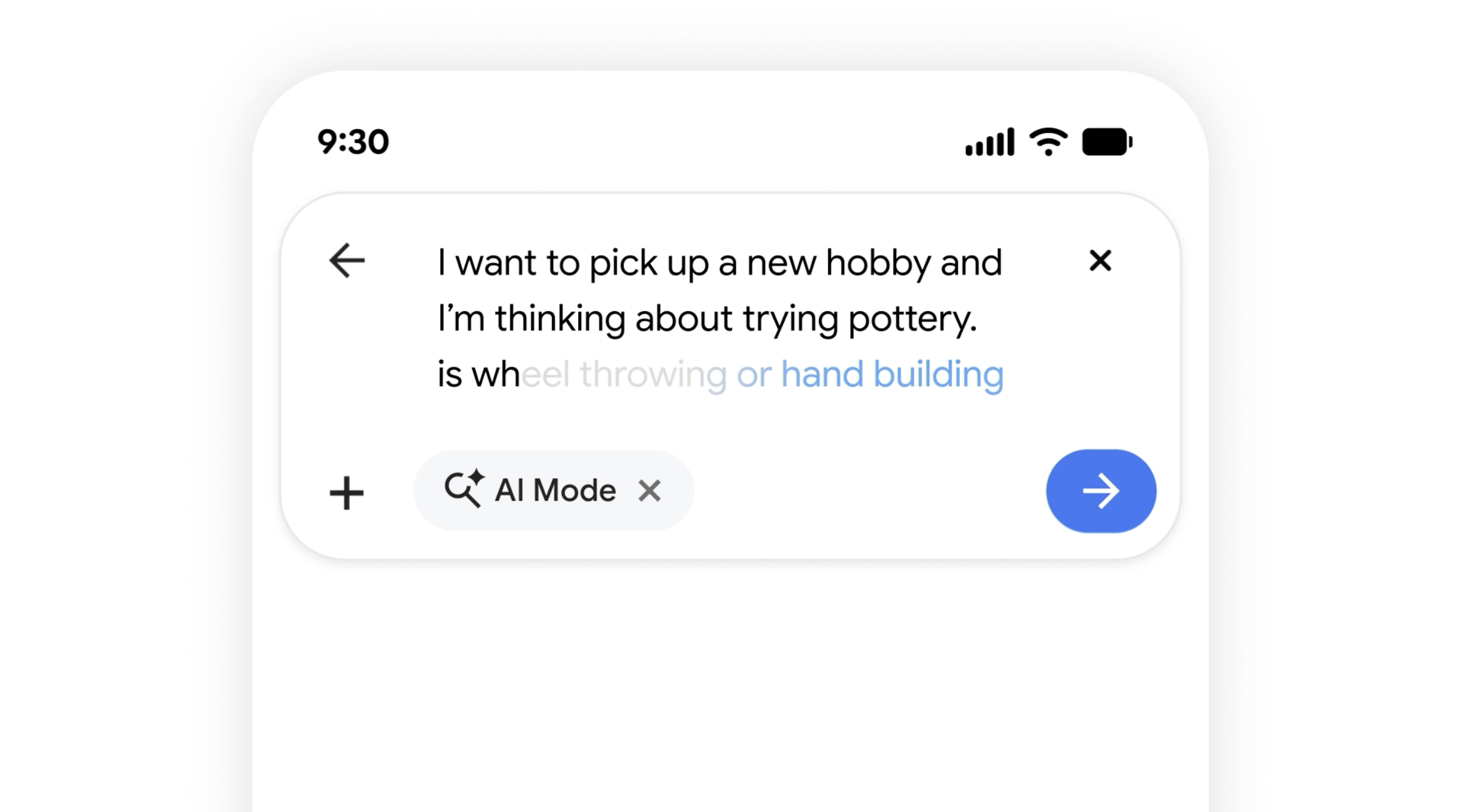
The goal is to anticipate your search intent instead of just responding to it. This drastically changes search behavior by basically coaching you to use queries that are longer, more conversational, and more specific.
For a comprehensive search, the new search box accepts multimodal input. You can use text, images, files, and videos, and you'll keep getting recommendations that directly shape the query.
The effect of these updates is obvious:
Longer queries > more AI Mode answers > fewer clicks
The new AI Overview > AI Mode flow supports this trend. You can now ask follow-up questions directly from an AI Overview and enter a conversational session with AI Mode. Context carries across the conversation, which eliminates friction between the traditional SERP and the AI-first experience, making it easier for users to stay inside Google's answer layer.
Needless to say, publishers aren't happy with the new search experience. Just last night I stumbled upon an X post that perfectly summarizes what many of them are going through:
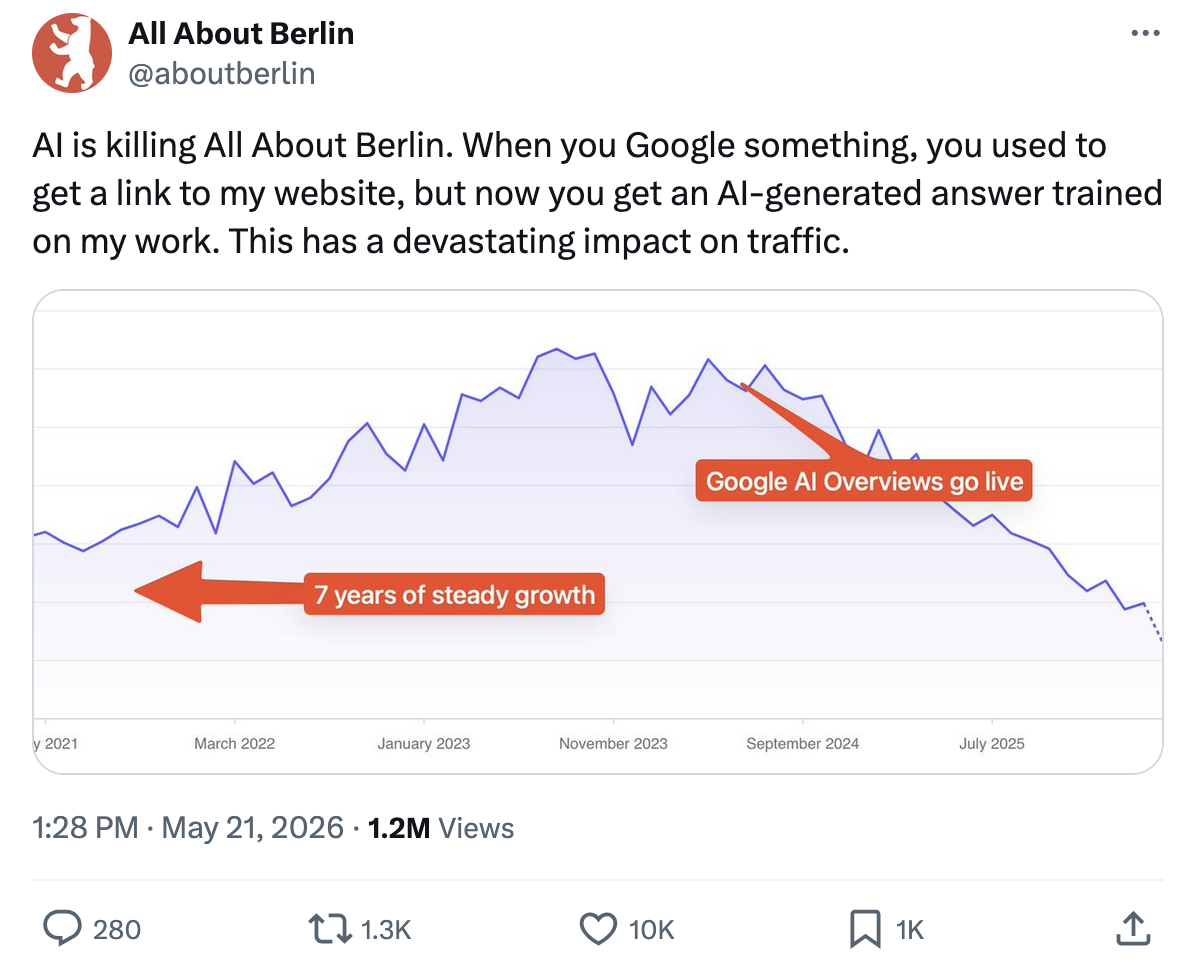
So does this mean it's over for publishers? I wouldn't go that far just yet.
All these AI features directly depend on content being published online. Actively discouraging publishers from doing so by killing organic traffic would basically mean that Google is destroying its golden goose and sabotaging its own engine. Unless we go to the dystopian extreme of purely synthetic content (which is a bit of a stretch), there will have to be some sort of reward system that will keep publishers motivated to create.
But until this is figured out, those who mainly depend on traffic volume to profit (e.g., through Google Ads or affiliate marketing) will undoubtedly go through a rough patch.
On the other hand, businesses that are actually selling something and whose blogs serve as knowledge bases and authority builders instead of sole revenue generators should be alive and well with a few changes. I'll explain why that's the case in a bit because it relates to other search updates.
Generative UI creates interactive experiences in AI Overviews
We all know about rich results, which match the user query with the right response format (charts, images, etc.). At I/O 2026, Google announced the integration of Gemini 3.5 Flash and its coding capabilities into Search to take it a step further.
When you type in a query that can benefit from visual representation, you won't just get static images. Instead, you'll get a whole "mini app" built in real time. You'll see it alongside the response in the AI Overview, and you can interact with it directly.
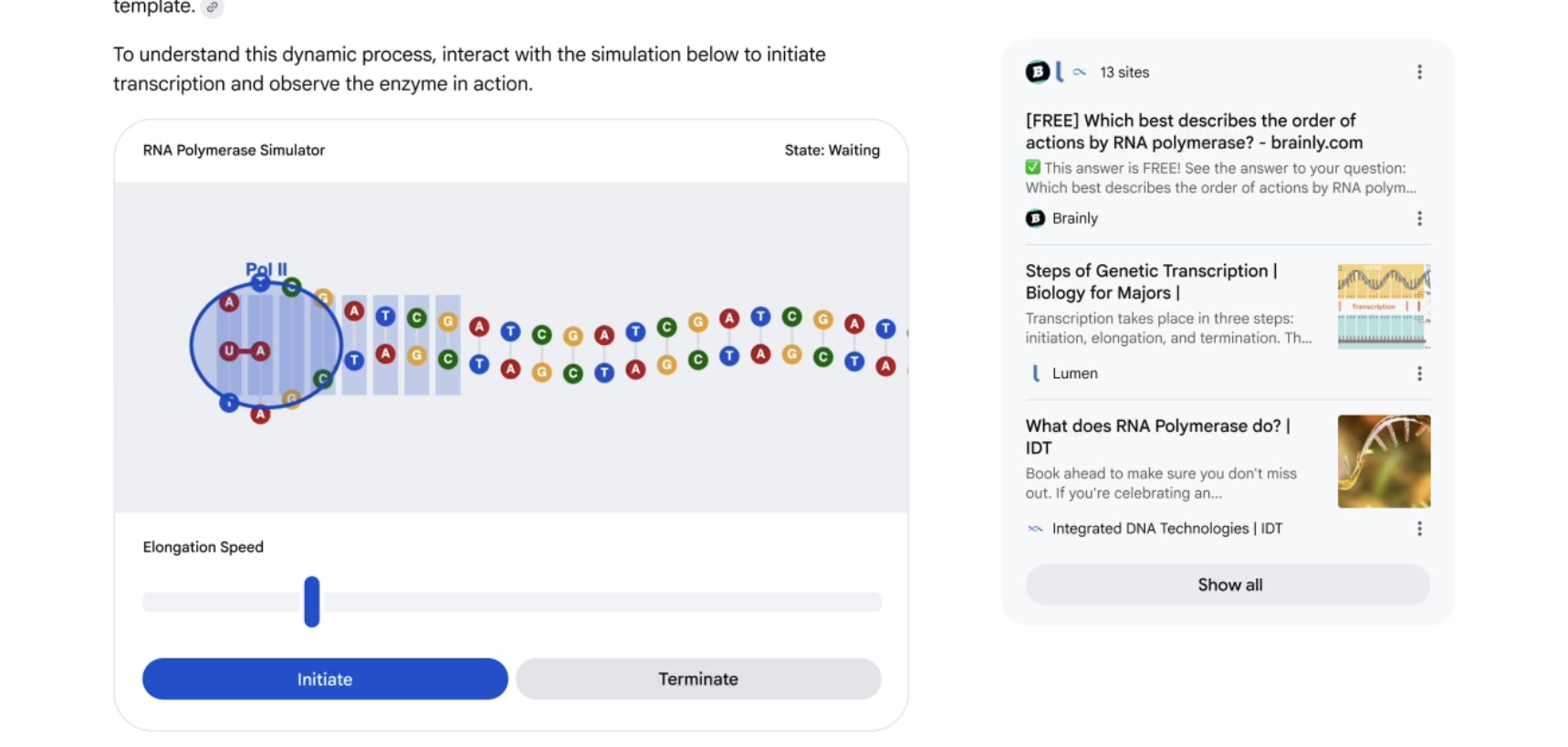
When generative UI rolls out this summer, it should be able to accommodate billions of different searches, further reducing the need to go beyond the AI Overview for answers. And that means fewer clicks to sources.
But as you can see in the above image, the AI Overview still cites its sources. So while there'll undoubtedly be fewer clicks, organic traffic won't disappear completely.
If you ask me, this is just a logical continuation of what we've been seeing since AI Overviews showed up in the first place — the number of clicks is down, but the traffic is much more qualified.
The AI Overview basically filters out those who just need surface-level info, sending users who truly want to know more or take action to your site. So instead of playing the numbers game, we'll double down on the user intent game (more on that later).
Search agents and agentic booking bypass the SERP entirely
Agentic search is officially taking shape as a mainstream feature, completely changing how we browse. Google announced its information agents, which can monitor the web 24/7 on your behalf and provide updates related to your query.
For example, you can set up information agents for:
Monitoring stock prices
Tracking price changes of specific products
Staying on the lookout for product announcements
When an update is available, you'll get a notification with the relevant details.
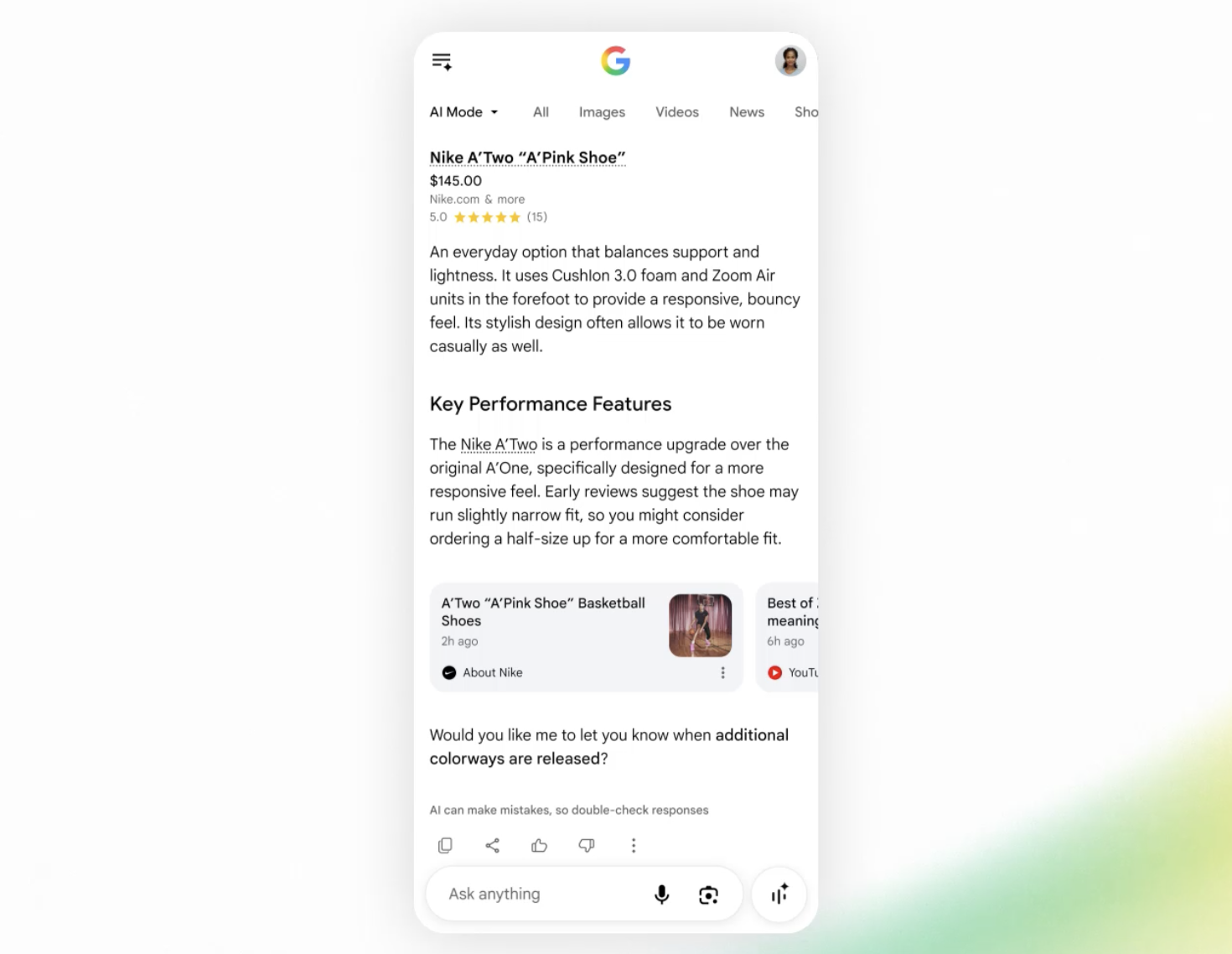
Because agents handle all the work, the user never has to perform a search at all. They just need to set up the agent, and that's it.
Naturally, this cuts organic traffic at its roots by eliminating the very first step necessary to generate it. But it still doesn't mean everyone will lose.
As you can see in the above image, reports provided by information agents include links to sources used to generate the report. If the information agent finds your content relevant and authoritative enough, it will include a link to your page. This means that well-optimized sites can potentially unlock a new traffic channel.
Besides information agents, Google also expanded the capabilities of its booking agents. Autonomous task execution allows the system to perform actions like booking reservations and looking up ticket inventory. Here's how it works:
The user describes the specific criteria of the venue
Search puts together pricing, availability, and direct booking links
For categories like home repair, beauty, and pet care, Google can even call businesses on the user's behalf
Agentic Search even integrates with tools like Google Pay to complete transactions automatically. The system can break complex objectives into smaller, logical sub-tasks to facilitate task completion in these more elaborate processes.
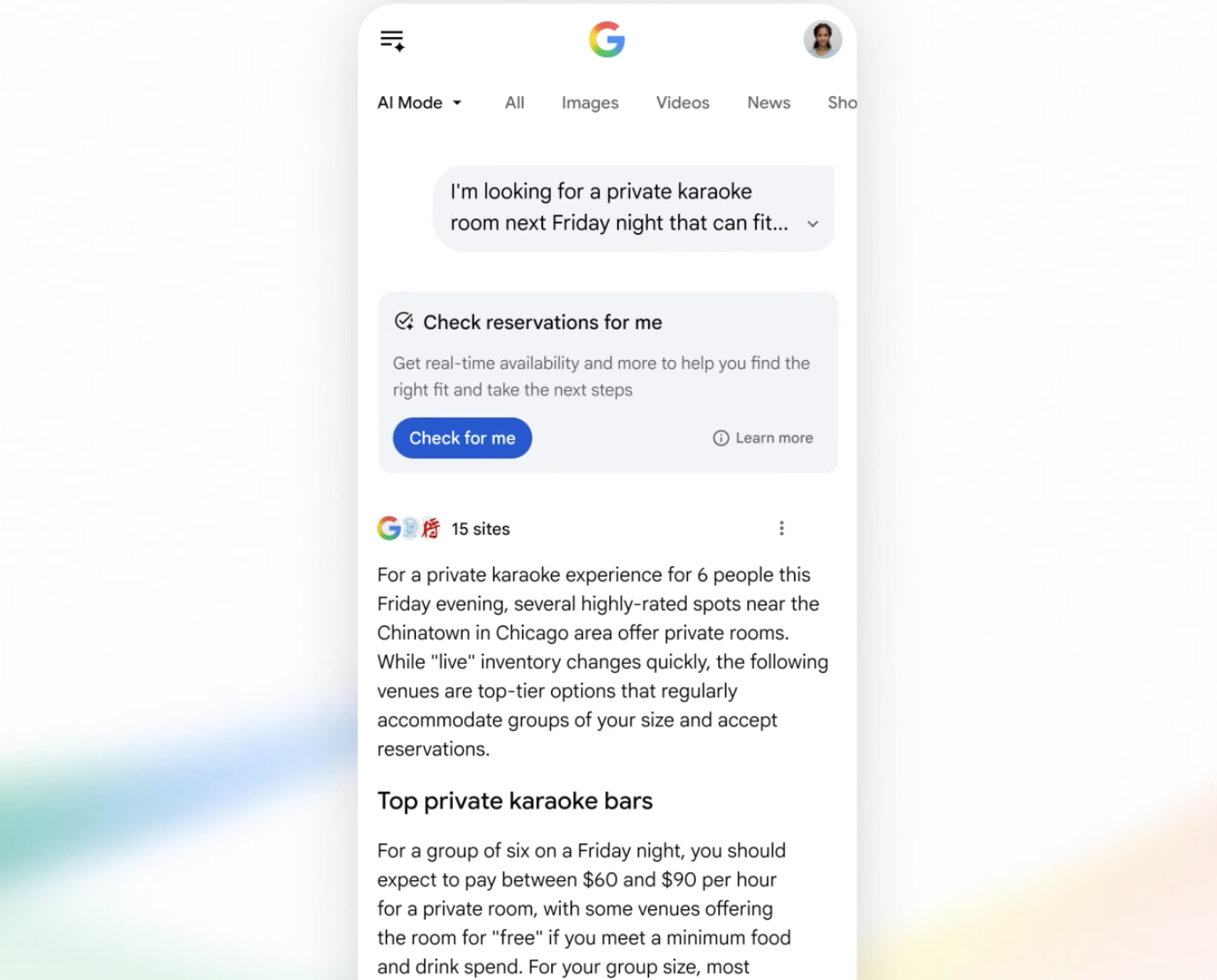
Similarly to information agents, you never really see a SERP while using a booking agent. This means that there are no AI Overviews or blue links at all, so there's nowhere to rank.
Still, there is an opportunity to be among the businesses that the agent recommends, which again can create a new traffic source.
Still, it's too early to know any of this because agentic search is still in its infancy. Information agents launch in summer 2026 for Google AI Pro and Ultra subscribers only, and agentic booking is U.S.-only and limited to specific categories. These aren't mass-market features yet, but they signal the direction Google is building toward, letting us prepare for the new era of search.
Personal Intelligence makes every results page different
Personal Intelligence connects your Google apps (Gmail, Calendar, Photos, etc.) with AI Mode in Search to provide an entirely personalized search experience. When you search for something, it draws from the connected apps to determine context (email confirmations, travel bookings, shopping preferences, etc.) and provide individual results accordingly.
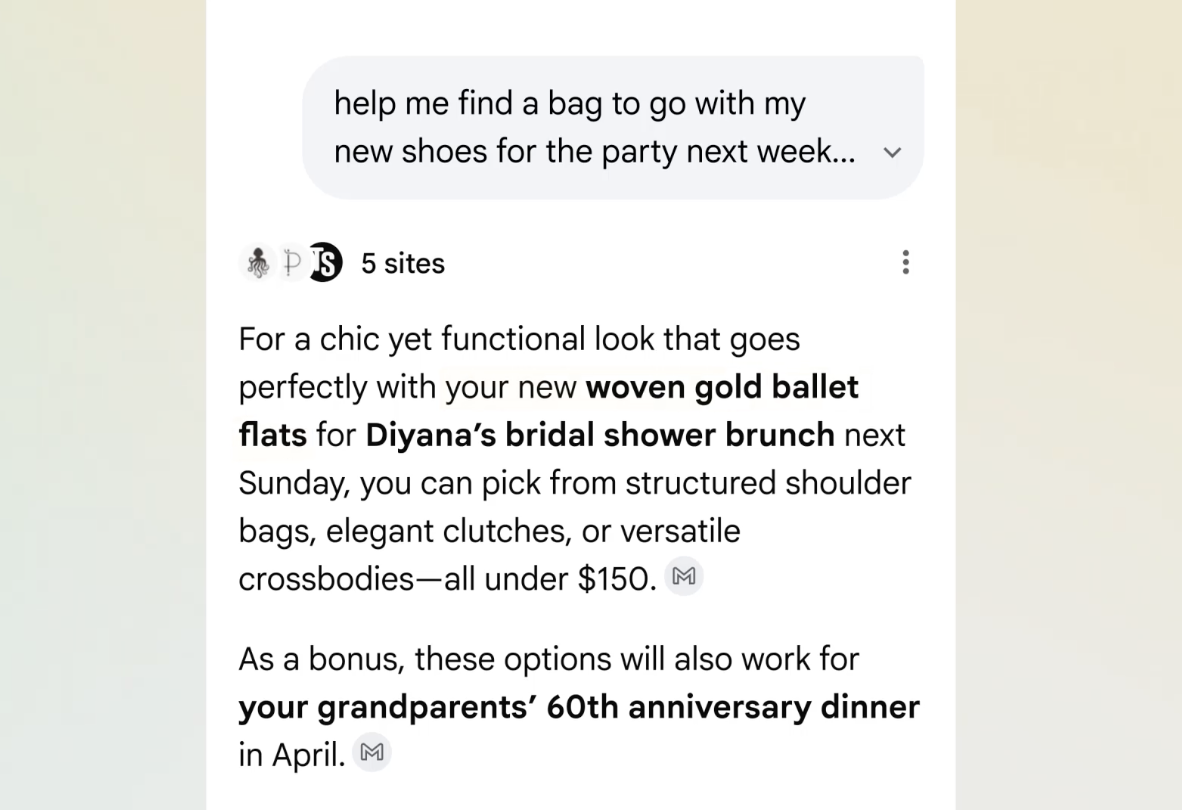
This means that two users can see entirely different results for the exact same query. The websites that appear in one user's AI response may not appear in another's, which fragments the organic results page in a way that traditional ranking never did.
As a result, pretty much all predictability goes out the window, making organic performance harder to replicate, audit, or forecast. Ranking reports and position tracking tools show one version of reality, but individual users may see a different one based on their personal data connections.
We're yet to see the practical impact of Personal Intelligence, but it'll start to show sooner rather than later. The feature rolled out to free-tier users in nearly 200 countries and 98 languages, so even though it's off by default (you must explicitly opt in to connect apps), we should expect adoption to grow significantly over the next few months.
What the click data shows so far
Agentic features and other Google updates haven't launched at scale yet, so we'll need to wait a bit before seeing their impact on organic traffic. Still, existing data covering AI Mode and AI Overviews has confirmed that they've surely affected clicks and CTR.
A study by Carnegie Mellon University and the Indian School of Business found that AI Overviews reduced organic clicks by 38% on queries where they appear, with zero-click searches jumping from 54% to 72%. Another research found a 58% CTR reduction for top-ranking pages when AI Overviews showed up.
Still, this reduction isn't uniform. While standard information queries result in the highest CTR drops, branded queries actually saw an increase of 18%.
And when clicks do happen, they tend to be much more valuable. I mentioned that traffic coming from AI search is typically more qualified, and Adobe's Q2 2026 AI Traffic Report confirms this. It found that AI-referred traffic converted 42% better than non-AI traffic, which isn't a surprise considering the more focused intent.
Also, the declining CTR isn't really the endless downward spiral that it's made out to be. A Seer Interactive analysis of 5.47 million queries from 53 brands found that organic CTR on AIO SERPs increased from 1.3% in December 2025 to 2.4% in February 2026. Seer describes this as a leveling off, not a full recovery, and warns against drawing big conclusions from just two months of data. Still, the trend is promising.
So there are plenty of reasons to stay optimistic and not give up on SEO — especially since Google seems to be encouraging users to keep clicking around...
Google's position on clicks and traffic
Google's search liaison, Danny Sullivan, has repeatedly said that "SEO for AI is still SEO" and that foundational optimization practices remain relevant. Google's May 2026 AI search guide explicitly states that "optimizing for generative AI search is optimizing for the search experience, and thus still SEO."
I felt validated when I saw this because it's what I've been saying all along — it doesn't matter what you want to call it (AEO, GEO, etc.); you're still optimizing for search engines, be they AI-powered or not.
Besides clarifying that SEO isn't going anywhere, Google has announced five AI Overview updates designed to increase traffic back to publishers:
Further Exploration links: A new section at the end of AI Overviews with curated links to articles, case studies, and reports
Subscription labels: Links from users' subscribed news publications are highlighted to encourage them to click, and Google's early testing showed that users were "significantly more likely" to do so
Inline link context: Hovering over links on desktop now shows the website name or page title
Forum perspectives: AI responses surface previews from Reddit, social media, and firsthand sources with creator info and clickable links
Enhanced shopping features: Expanded product review cards and comparison features with more retailer links
This goes in line with what I mentioned earlier — Google won't just leave publishers out to dry. Not out of the goodness of their heart, but out of the need for content that fuels AI features (and the anti-trust lawsuits filed by the European Publishers Council and Penske Media probably had something to do with it).
So instead of being simple product improvements, these features are at least partly a response to legal and public pressure. They're still in phased rollout, so you should start seeing them in the coming months.
Google also seems to be working on improved analytics to help publishers measure the impact of AI on traffic and act accordingly. At the Search Central Live event in Toronto, Danny Sullivan confirmed that the Google Search Relations team is aware of traffic impacts from AI Overviews and is working on improved tracking solutions in Google Search Console, though he provided no specific timeline for the updates.
How Google-Extended blocking and fanouts work
Google knows that many publishers are frustrated by their content being used to train AI features, so it gives them the opportunity to opt out of it. By blocking the Google-Extended crawler, you can stop your content from being used to train AI models or ground AI responses.
But there are a few caveats here.
First, blocking Google-Extended doesn't remove your site from AI Overviews or AI Mode. Because the site's content is already in Google's search index, Google can still use that indexed data in fanouts — the process where AI features pull from indexed content to generate more detailed answers by covering the related subtopics.
In other words, blocking the crawlers prevents your site from being used for direct grounding and linked citations, but Google still uses the information.
Also, blocking Google-Extended comes with a trade-off: the loss of the citation link (and therefore the click opportunity).
So you basically have two options:
Leave the crawler so you can get cited while allowing Google to train its AI on your data
Block the crawler to restrict Google's access and sacrifice the link
I don't have a blanket recommendation here because it all comes down to what matters most to you. If you're adamant about shielding your content, it would make sense to block the crawler.
But if you prioritize SEO and don't mind Google accessing your content, you can leave it as is. Your content can still appear in Google's AI search even if you block Google-Extended, so you might as well get clicks from it.
If you want to block Google-Extended, add the rule to your robots.txt file. This stops the crawler from using your content for AI training or grounding.
Google also has a data-nosnippet HTML attribute that lets you control what shows up in search snippets, including those made by AI. However, data-nosnippet does not replace blocking Google-Extended, since each tool has a different use. Remember, using data-nosnippet can affect your SEO, such as featured snippets, so consider the pros and cons before using it.
How to earn clicks when search completes tasks for users
Every time Google announces new features, our job is to adapt — and agentic search is no different. Here's what you can do to prepare for it:
Create content that agents need to cite, not just summarize
AI can summarize generic content so effectively that it doesn't need to cite its sources. The content that actually earns clicks is information that AI can't fully replicate in its answer, such as:
Proprietary data
Original research
Firsthand experience
Specific case studies
That's why you need to shift from basic explainers to non-commodity content. Instead of publishing something that anyone can write, create content that's specific, experience-based, and verifiable.
This advice is echoing across the SEO expert community. At Google Search Central Live, Cyrus Shepard noted that proprietary data was a top correlated variable for success in recent Google updates. Indeed's Gus Pelogia also explained that brands building databases of unique data will have the greatest opportunity to differentiate.
So next time you publish something, ask a simple question:
Could this have been written by someone who quickly researched the topic online?
If the answer is "yes," AI can probably summarize it without linking to it. But if it contains data, experience, or analysis that only your organization has, it will almost surely have to be cited.
Invest in the post-click experience for visibility
Because organic clicks are declining in volume but increasing in intent, every click that does come through is more valuable and has a higher business potential.
This potential will be wasted if a high-intent click ends up on a poor landing page (or a badly structured page, in general).
Even if you show up in AI search, this visibility is useless without a strong post-click conversion experience. That's why experts like Swarali Bhakre argue for focusing on UX once the click is earned.
From the SEO perspective, good UX means:
High page load speed
Value propositions above the fold
Clear conversion paths without hunting around for CTAs
But maybe most importantly, your content needs to deliver on the specific promise of the AI citation that drove the click. So if AI cited you as a source of valuable data, you need solid research. If it recommended your product, the landing page should justify the recommendation.
Post-click UX will be critical when AI agents start roaming around sites at scale. When an information agent sends the user a notification with a link, that click is highly targeted because the user asked the agent to find exactly that type of content. If the landing page doesn't immediately validate that match, the user bounces, and the agent may deprioritize that source in future recommendations.
Track presence and citation share, not just position
Considering Google's consistent shift away from SERPs, traditional rank tracking that tells you where you appear on a results page won't do the trick on its own. In AI Mode and agentic search, there's no numbered position; you're either cited in the AI answer, or you're not.
That's why the key metric you should monitor is citation share: the percentage of AI answers in your topic space that cite your domain. As Adewumi Nurudeen puts it, we must track when we rank, not just what we rank for, because of high volatility in AI answers.
The problem here is that Google still hasn't given us a reliable way of tracking citations. Until we see any official tools in Google's ecosystem, third-party citation tracking tools are the best available proxy.
Surfer's AI Tracker is a great example. It gives you detailed insights into your brand's performance across AI models, including AI Mode and AI Overviews.
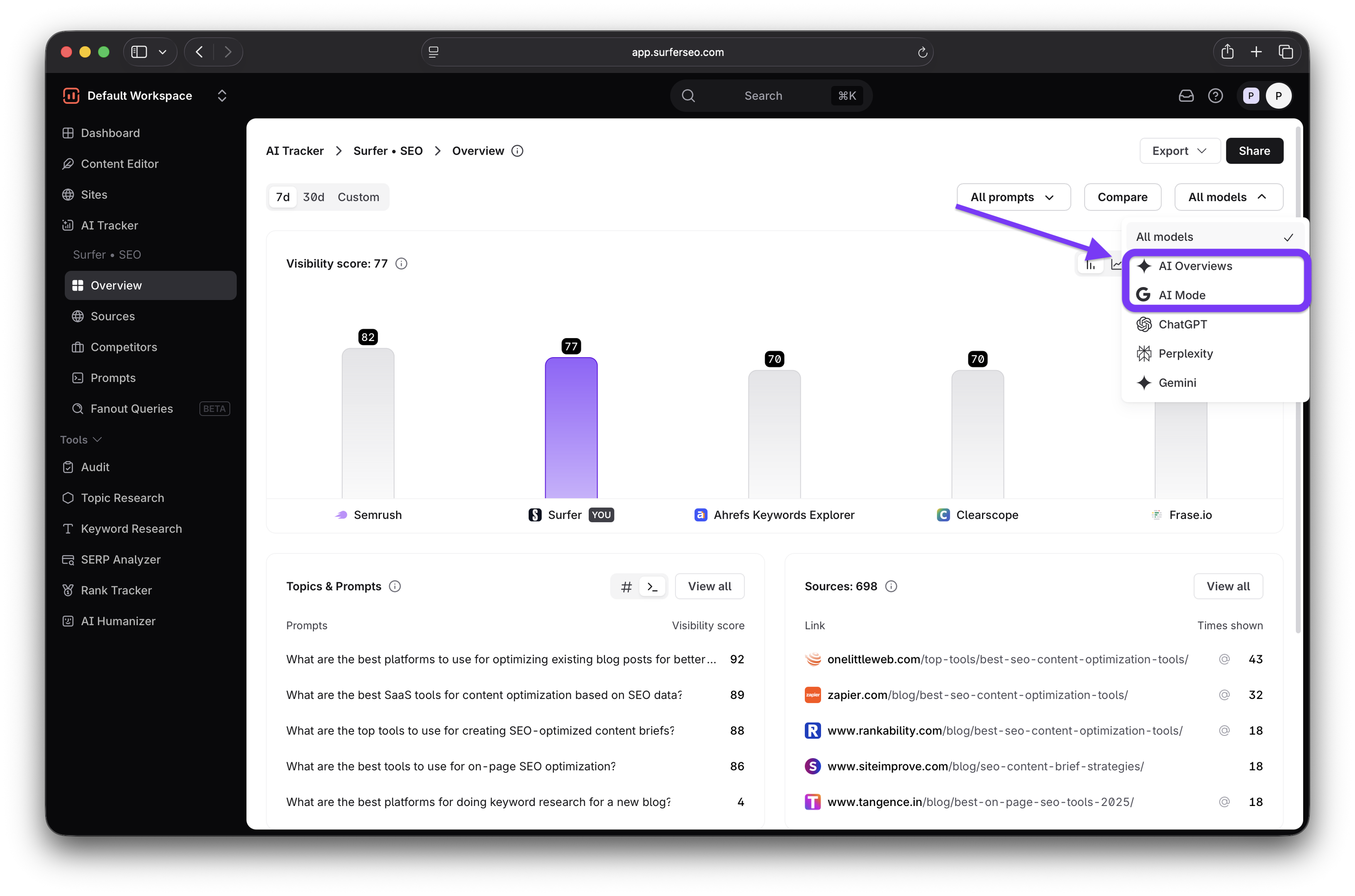
You can import the prompts for which you want to show up, and AI Tracker will tell you:
Whether you appear in Google AI features (and standalone platforms like ChatGPT, Gemini app, etc.)
Which other brands are included in the response
Your mention rate and overall position in the response
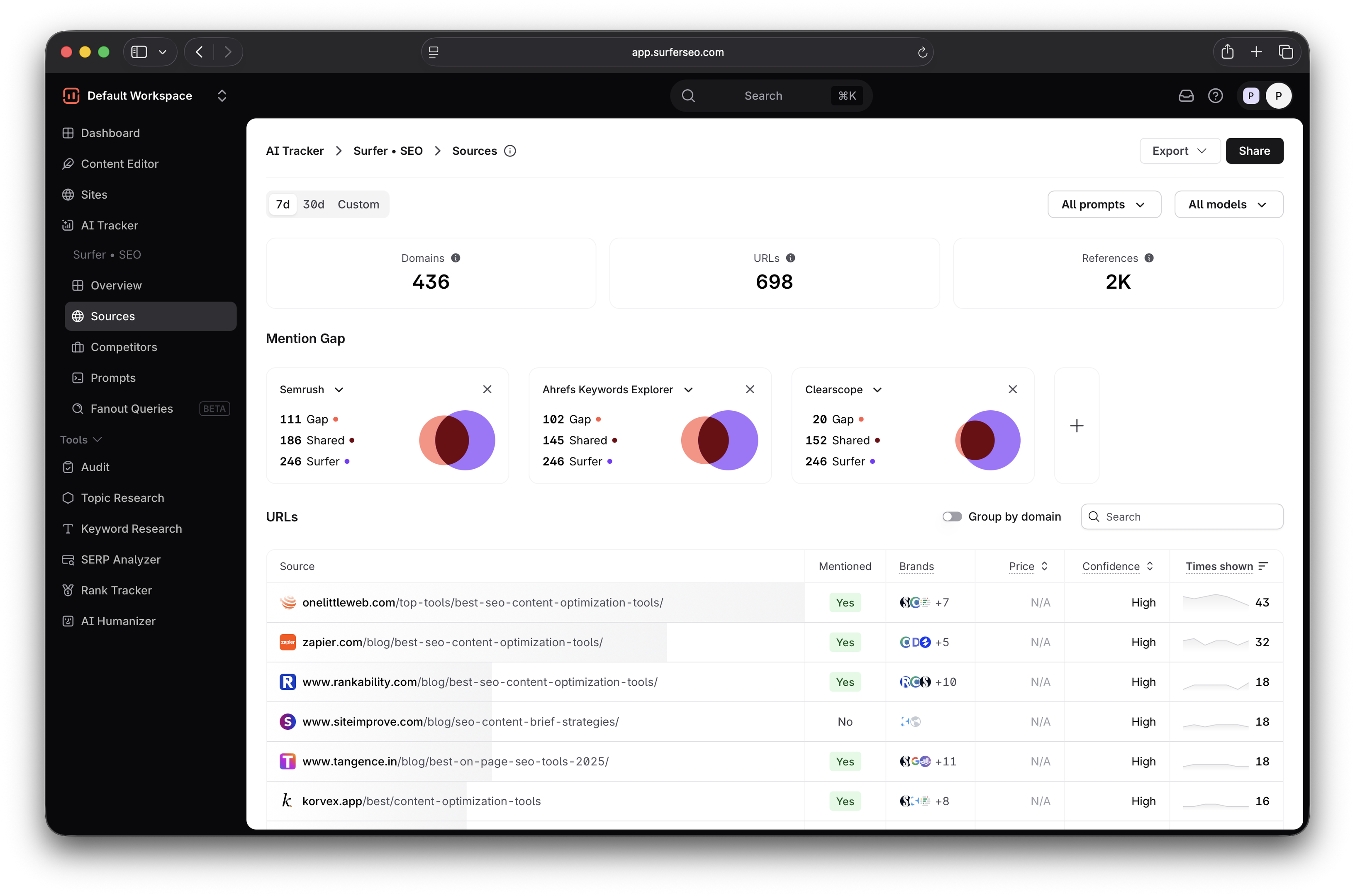
You also get insights into the sources that AI platforms cite for your selected prompts. You can see:
If specific sources mention you
How many times they're cited by AI
How frequently they show up in the response when the same prompt is used multiple times
For competitive analysis, you can give AI Tracker your key competitors, and it will show you the mention gap so that you can target the sources your competitors appear in but you don't.
With insights from tools like Surfer's AI Tracker, you can build an effective three-step tracking workflow:
Monitor which queries trigger AI Overviews and AI Mode in your space
Track whether your domain appears in those answers
Measure the click-through rate from citations
Adapt your click strategy for Google’s new search
Organic clicks aren't going away — they're just being redistributed from purely informational content to the more specific, citeable pieces. And while AI Overviews and AI Mode have compressed CTR, the clicks they send to your website are much more intent-rich and valuable for business results.
This means that all you have to do is plan your content strategy around Google's new features. Information agents, agentic booking, and generative UI mini-apps launch for subscribers this summer, with broader availability expected to follow. There's still time to prepare for these features by publishing cite-worthy content.
Experts agree that the websites that will thrive are those producing content that AI summaries can't replace and deliver landing experiences that convert high-intent AI traffic. Stay updated on the feature roll-outs in the coming months, and adjust your strategy accordingly.


.avif)