The SEO vs. AI search debate has been going on for months now. Is traditional SEO dead? Should you optimize for LLMs instead of Google? Should you do both separately?
Here's our answer: one score. Both fronts. One click to optimize.
We shipped 5 updates this month — and the through-line is simple: less switching between strategies, more content that wins everywhere buyers search.
Want the summary? Watch the video:
Prefer to read? Scroll down!
🔥 TL;DR — What Matters Most This Month
- Unified AI SEO Content Score — one number, two fronts: SEO on the left, AI Search on the right. Fix both with one Auto-Optimize click.
- Upfront Intent Alignment — new AI Search guidelines that tell you exactly how to write your intro so AI confirms relevance fast — and picks you as the source.
- Smarter Auto-Optimize — fewer edits, better output. It now knows when to stop adding entities and shift to AI Search instead.
- New Surfer API — more Content Editor endpoints, AI SEO Content Score, and standalone outline generation via API. Plus: Surfer MCP and Agentic Surfy are coming.
Is there more? Yes. But these will move the needle fastest.
If you do only one thing:
👉 Open Content Editor, pull up any article, and check the new split score bar. Then hit Auto-Optimize and watch it handle both.
One Score to Rule Both: The Unified AI SEO Content Score
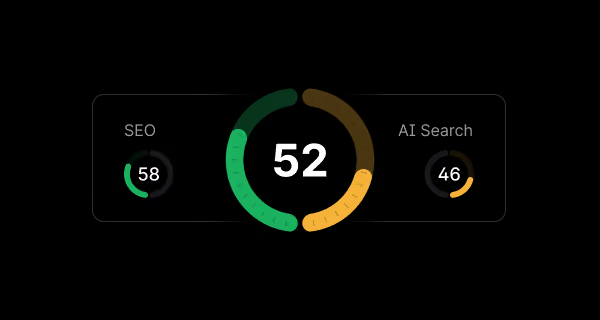
The Content Score has always told you how well your content ranks.
As of today, it also tells you how well it gets cited in AI answers.
The new Content Score reflects both SEO and AI Search recommendations in a single unified number. A bar split on both sides shows you exactly where you stand — SEO optimization on the left, AI Search optimization on the right — so you can see what's pulling your score down and act on it.
- Click SEO guidelines to check which entities you should be using
- Click AI Search guidelines to see which information to add to increase citation probability
- Hit Auto-Optimize to instantly implement both — better ranking AND citation probability, one click
Why does a unified AI SEO content score matter?
Google said it themselves: AI Search is an evolution of SEO, not a replacement. Most of what makes content rank well also makes it more likely to get cited. A unified score reflects that reality.
You don't need two strategies. You need one, done right.
Win More Citations: Upfront Intent Alignment Guidelines
AI doesn't read your article the way a human does. It scans — fast — looking for signals that your content actually answers the query before committing you as a source. If your intro doesn't confirm relevance in the first few lines, it moves on. Someone with a clearer introduction gets cited instead. You don't.
Upfront Intent Alignment is a new set of AI Search guidelines — available now in the AI Search guidelines panel in Content Editor — that tell you exactly how to structure your introduction so AI can confirm intent alignment immediately and select you as a citation source.
Apply them one by one, or use Surfy to rewrite your intro with the recommendations already built in.
Why does upfront intent alignment matter?
Our own research across 650,000+ AI-generated answers shows that citations concentrate heavily in the first ~500 words of content (data study coming out soon!). Front-loading matters — not just for readers, but because it's where AI makes its sourcing decision. A strong introduction isn't just good writing anymore. It's a ranking signal for AI answers.
Coming soon: Upfront Intent Alignment will be added to Auto-Optimize, so it's applied automatically alongside your other SEO and AI Search improvements.
Auto-Optimize: Smarter Edits, Better Results
Auto-Optimize just got a significant upgrade. And in this case, "better" means it does less.
Thanks to user feedback, Auto-Optimize now makes fewer, more targeted changes — intervening only where it actually moves the needle. Your content stays closer to your original voice while still hitting the score improvements that matter, including AI Search requirements.
The biggest change was under the hood: Auto-Optimize now knows when your SEO score is already strong and shifts focus to AI Search improvements instead of piling on more entities. The output reads better, restructures less, and achieves stronger results post-publishing.
- Smarter SEO vs. AI Search balance — entities covered? It focuses on facts and formatting instead
- Fewer, more relevant changes — no more bloated rewrites that break your flow
- Simplified UI — fewer clicks, easier to review changes
New Surfer API: Built for Automation — and the Future
The Surfer API got its biggest upgrade yet. The newest version brings the full power of the Content Editor to teams building on top of Surfer — everything you can do from the setup through generation and publishing, now accessible programmatically.
What's new in Surfer API?
- Full Content Editor customization — brand knowledge, custom voice, templates, word count, custom instructions — all configurable via API
- Standalone outline generation — generate comprehensive outlines based on what’s ranking in Google and AI answers
- AI Search Content Score — the new unified AI SEO score and its guidelines, now available as an API endpoint
- LLM-specific documentation — written for machine consumption, so your agents and integrations work with Surfer without friction
- AI Tracker reporting — coming soon
Why does the new Surfer API change?
Automation is the obvious win. But this release is also the foundation for two things we're actively building: Surfer MCPand Agentic Surfy. No release dates yet — but they're in the works and already looking amazing.
API is available only on Peace of Mind and Enterprise plans. To get your API key: Settings > API > "Contact Support."
Gradual rollout — testing in a closed user group now. Want early access? annajagiello@surferseo.com
Longer Reporting History + Activity Log: Track Team's Progress in One Place
Two updates for anyone managing a team — or just trying to get an honest picture of output vs. effort.
Longer Reporting History is now extended for all plans — for free:
- Standard: 1 month
- Pro: 1 year
- Peace of Mind & Enterprise: 16 months
Added automatically to all active subscriptions. No action needed.
Activity Log gives workspace admins a single feed of everything happening across the team — content created, optimized, and tracked — all in one place.
- Content Editor events — all standalone documents created
- Sites events — new topics from Topical Map, pages refreshed from Content Audit
- Filter by user, date, or event type — find what you need without scrolling through everything
Members see their own activity; Admins and Owners see it all.
Why does the Activity Log matter?
If you manage a team, you know how hard it is to get a clear picture of effort vs. output without chasing people for updates. Now you don't have to.
A real-time view for managers. A clean work log for team members. A ready-made report for clients.
Have something you'd like to see added to the Activity Log? Drop Jakub a note: jakub.sadowski@surferseo.com
Auto-Linked Sources: Publish-Ready Drafts From the Start
Getting from "Surfer AI finished writing" to "ready to publish" was quick but still meant a few manual steps after the draft lands. External references especially — a manual job, until now.
In Writing Mode, enable internal links, external links, or both before generating content — and Surfer AI will insert them as it writes, not after.
- Internal links — relevant pages from your site, linked inline, no separate step needed
- External links — authoritative sources automatically referenced within the content to back up claims
Why it does the auto-linking of sources matter?
External linking isn't just convenience. Referencing credible sources is an active quality signal for both SEO and AI Search — especially for YMYL topics (health, finance, legal) where E-E-A-T matters a lot. Google's own guidelines reference outbound linking to authoritative sources.
Surfer AI now handles it by default. Publish-ready from draft one.
One More Thing — Surfer Visibility Club: Berlin 🇩🇪
After Warsaw, we're heading to Berlin on June 17th.
Same format: a closed-door conversation with marketers and SEOs about what AI search actually means for their work in practice. No slide decks, no pitches — just the conversations that don't happen in comment sections.
Learn with Surfer Academy
ChatGPT, Claude & Gemini Built My SEO Strategy. Here's What Actually Worked
Can ChatGPT, Claude, or Gemini actually build a winning SEO strategy? Matt Kenyon put all three AI assistants to the test with the exact same SEO challenge: create a complete SEO and AI Visibility strategy for a fictional SaaS company. Then he graded every response for accuracy, strategic thinking, execution quality, and whether he'd trust it for a real client. The results are surprising!
How to Get ChatGPT to Recommend Your Brand Over Competitors
ChatGPT SEO is changing how brands get discovered online – and these 5 small companies are already beating industry giants in AI search using smart content strategy, comparison pages, and category positioning. In this video, Matt Kenyon breaks down real examples of small B2B brands dominating ChatGPT recommendations, Gemini results, and Perplexity visibility ahead of competitors with 10x their budget.
How to Write SEO Content That Ranks in Google and AI Search (Content Writing for SEO 2026 Guide)
Want to learn how to write SEO content that ranks in Google and AI search? In this step-by-step tutorial, Matt Kenyon walks you through the complete process of turning a single keyword into a fully optimized blog post using Surfer’s Content Editor – from search intent and outlining to optimization, internal linking, and publishing.You’ll see the exact workflow used to create content that performs in traditional search results and gets cited in AI tools like ChatGPT, Perplexity, and Google AI Overviews.
The Complete SEO & AI SEO Course for 2026 (Full Beginner’s Guide)
Learn SEO in 2026 and rank on Google + AI search (ChatGPT, AI Overviews, and more). Full step-by-step tutorial + 30-day action plan.
That's a wrap for June!
In case you missed it — we joined the Positive portfolio and launched Positive Surfer, the AI Visibility Platform. Not a rebrand. A ground-up rebuild: one platform, one workflow, Google rankings, and AI citations, together.
This month's updates are part of that. The unified Content Score, the smarter Auto-Optimize, the API groundwork — they all point in the same direction.
And we're not done. Very soon, Surfer won't just tell you what to fix. It will do it for you. Agentic workflows and MCP integration are coming this year, connecting Surfer directly to the tools you already use. The API release you saw this month is the foundation.
You (fellow Surfers) will be the first to know.
In the meantime, the numbers speak for themselves — pages updated with Surfer are 25% more likely to be cited in AI answers. In 2025, Surfer users grew their AI visibility by 423% on average.
If you’re not with Surfer yet, those results are still up for grabs.