
Does AI content rank in Google? Yes, AI-generated content can rank well in Google search results if it meets quality and relevance standards. In this article, we will explore the factors affecting the ranking of AI content, Google’s guidelines, and best practices to ensure your AI content performs well.
Understanding Google’s guidelines on AI content
Google’s stance on AI-generated content has been clear since 2023 – it doesn’t matter how content is produced as long as it’s helpful to users.
By rewarding original, high-quality content, Google aims to deliver reliable results. They introduced the helpful content update in response to mass-produced, low-quality pages, while also providing better rankings for high-quality sites.
Despite common misconceptions, Google does not penalize AI content simply for being machine-generated. Instead, the focus is on the quality of the content. Here's exactly what Google says about AI content:
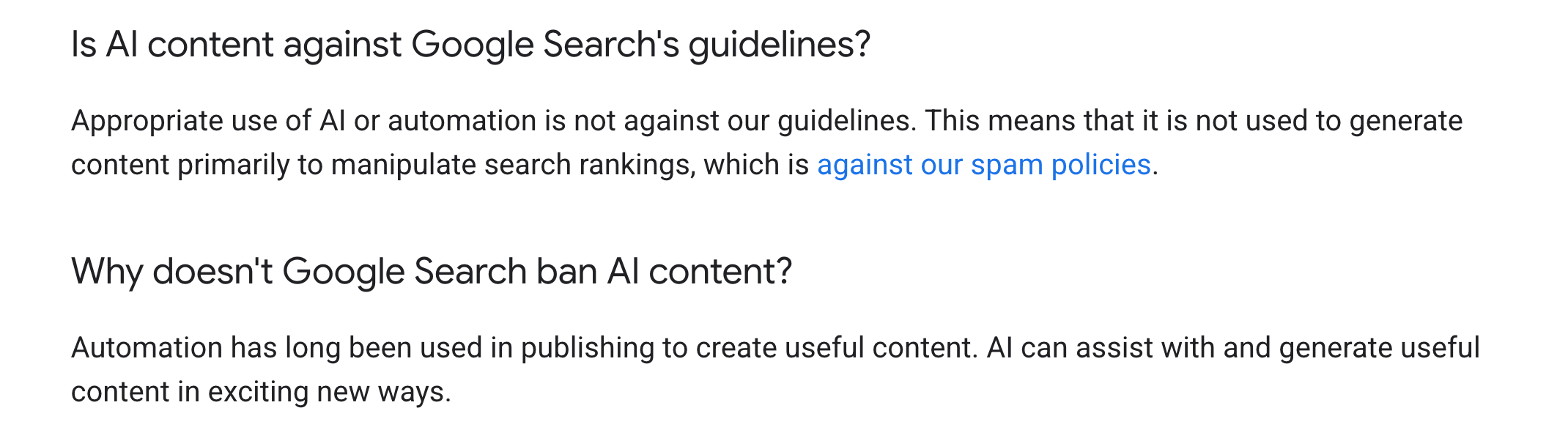
However, Google has been vocal about the fact that automation shouldn’t be used to manipulate search rankings. Misuse of AI can lead to low-quality outputs that negatively impact SEO performance. That’s why it’s crucial to use AI responsibly and make sure the content you create is both valuable and well-crafted.
Still, some marketers believe that Google has a built-in AI detector that penalizes AI-generated content in rankings. However, tools that detect AI content are not perfectly reliable or accurate; for example, they can mistakenly mark human-written content as AI-generated. Even OpenAI, the company behind ChatGPT, shut down its own AI detection software because of its poor accuracy.
Can AI content rank in Google?
You might have a valid question at this point – can AI-generated content compete with human content in search engine rankings? Yes, AI content can rank in Google just as well as human-generated content.
Analyzing the performance of AI-generated content provides valuable insights into its effectiveness in search engine rankings. AI content can indeed rank well, with a significant portion appearing in top search positions.
Semrush conducted a study in which 57% of the AI-generated content and 58% of the human-generated content analyzed ended up in the top 10. This means they have the same chance of ranking on the first page of Google.
Moreover, they asked marketers how AI-written content impacted their rankings – while 34% declared it didn’t make a difference, almost 39% said it increased.
This is possible because AI can help scale content operations and publish articles consistently, thereby building authority in the niche, which in turn translates to better rankings.
Comparing AI-generated content to human-created content reveals interesting insights:
- AI content performs almost as well as human-written content.
- 57% of AI content ranks in the top 10 positions, manipulating ranking performance.
- The difference in ranking performance for the top position is only 2.1 percentage points, favoring human content slightly.
Despite this, some marketers believe that AI content performs better than human-generated content, with 33% holding this view. However, AI-generated content can sometimes be less engaging than human-created content, highlighting the importance of human involvement in the content creation process.
In cases where AI-written content was enhanced with natural language processing and human writing, such as content for “SEO for dentists,” the short answer is that the performance improved significantly, demonstrating the power of large language models and a hybrid approach.
Ahrefs also conducted a study on the impact of AI on Google rankings. According to their findings, 81,9% of content in the top 20 results is a mix between human-generated content and AI-generated outputs. Here’s a detailed graph showing their findings:
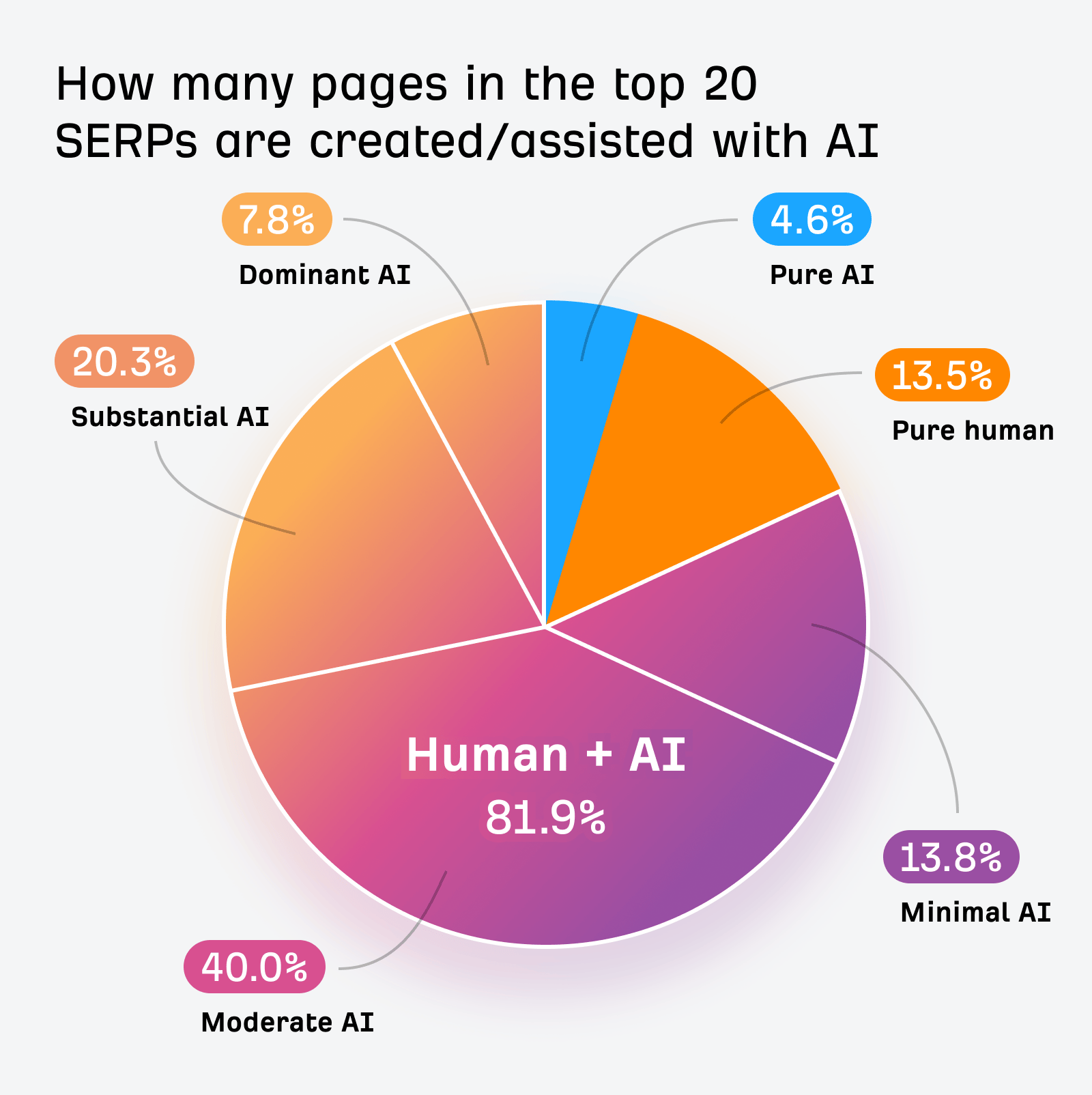
This would prove that AI content can rank in Google as long as it's edited to add a personal touch, original insights, or share reliable examples and data.
The role of E-E-A-T in AI content ranking
Google’s E-E-A-T principles, Experience, Expertise, Authoritativeness, and Trustworthiness, are key to making your content rank. For AI-generated content, that means it needs to be useful, credible, and engaging, not just factually accurate.
Here's what Google says about E-E-A-T:
Of these aspects, trust is most important. The others contribute to trust, but content doesn't necessarily have to demonstrate all of them. For example, some content might be helpful based on the experience it demonstrates, while other content might be helpful because of the expertise it shares.
Adding a real-world perspective or expert commentary can instantly boost the “Experience” and “Expertise” factors. Combining AI with expert input can earn you the engagement and rankings that pure AI content wouldn't.
Marketers seem to agree. In one Semrush survey, 73% of respondents use a combination of AI and human writing (whether by working with human writers or creating content themselves). That hybrid approach ensures the content aligns with Google’s guidelines while actually answering the questions users are asking.
Think of it this way: an AI can draft an article on “healthy eating,” but adding a nutritionist’s perspective, personal experience, or citing credible studies is what makes it authoritative. That’s what turns generic text into high-quality content that both readers and search engines trust.
How AI-generated content can help you rank
AI can help you publish consistently and scale your content operations without losing out on quality. You can cover more keywords and topical clusters without long delays in content production. It also allows you to maintain a steady output of high-quality content, supporting topical authority in your niche.
In Semrush survey they ask marketers how they use AI to improve their SEO operations and achieve great results. Here are the most popular ways they enhance AI-generated content:
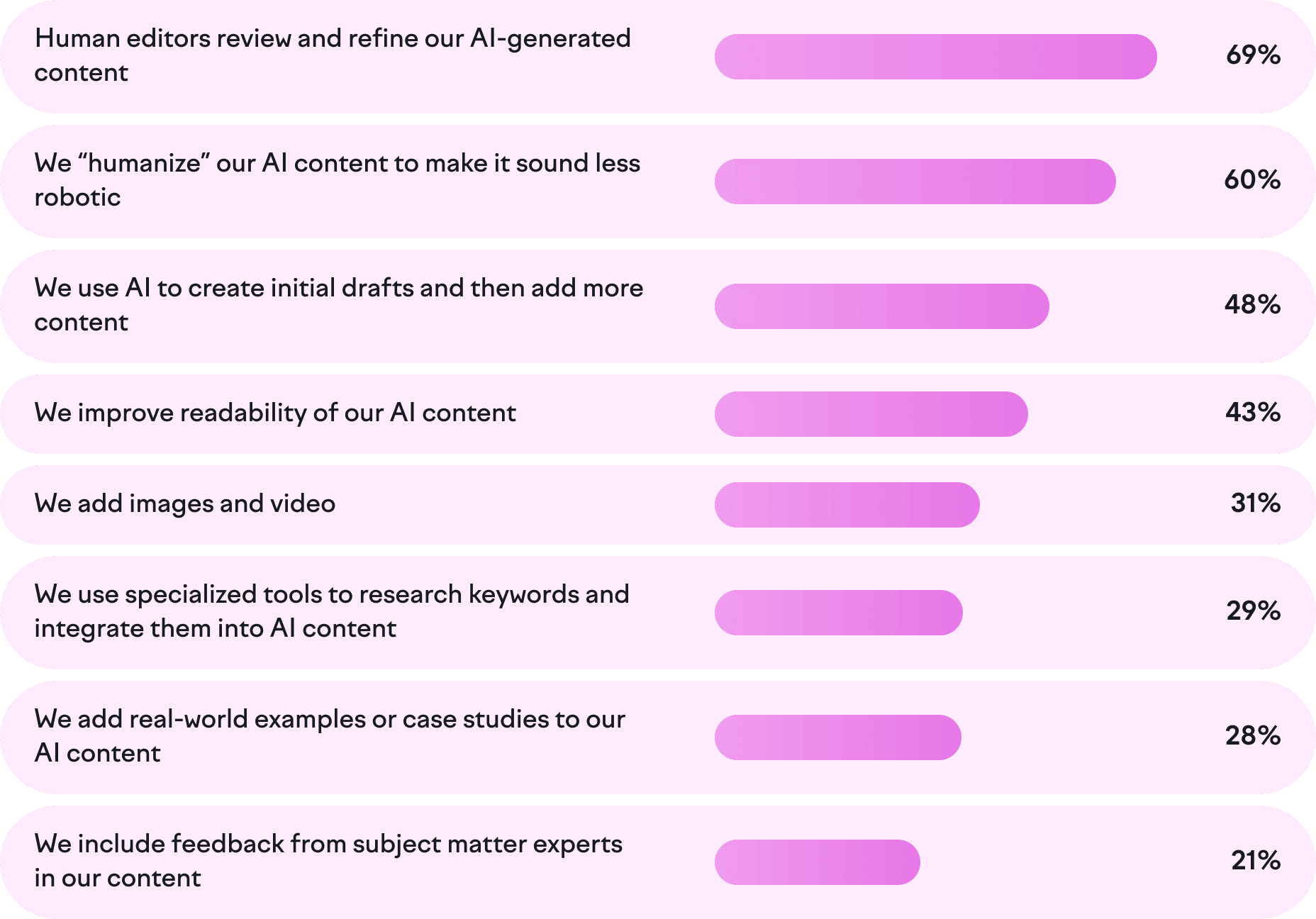
AI can also help you analyze search intent, competitor content, and related keywords. This way, you can naturally include important keywords, long-tail phrases, and semantic variations. AI-powered tools can analyze top-ranking competitors, identify content gaps, and help you publish content that fills those gaps, providing a competitive edge.
You can also use AI to optimize your content, ensuring it’s aligned with SEO best practices. AI can automatically generate engaging, keyword-rich meta titles and descriptions that encourage higher click-through rates from search results. With AI, you can create FAQ sections, how-to schemas, and featured snippet-friendly answers. These give search engines a clearer context and increase your chances of winning the “position zero” spot.
Best practices for creating high-ranking AI content
Now that you know you can compete in rankings using AI-generated content, let’s look at the best tips that will give you the best results.
Optimizing long-form content, technical writing, and copy creation while creating content using AI tools.
To effectively engage audiences, marketers must also write content that resonates with their target demographic and generate helpful content.
Always add human input
AI can generate drafts, but raw AI output often lacks nuance, personality, and real-world perspective. AI can be a great tool to research topics and organize information, but it doesn’t understand human emotion, humor, or metaphors. These are all elements of great storytelling that keep readers engaged and help them remember your message better.
For example, here’s a quote from an article by our CMO, Tom, who referenced a real-life situation highly relevant to the topic of his content.
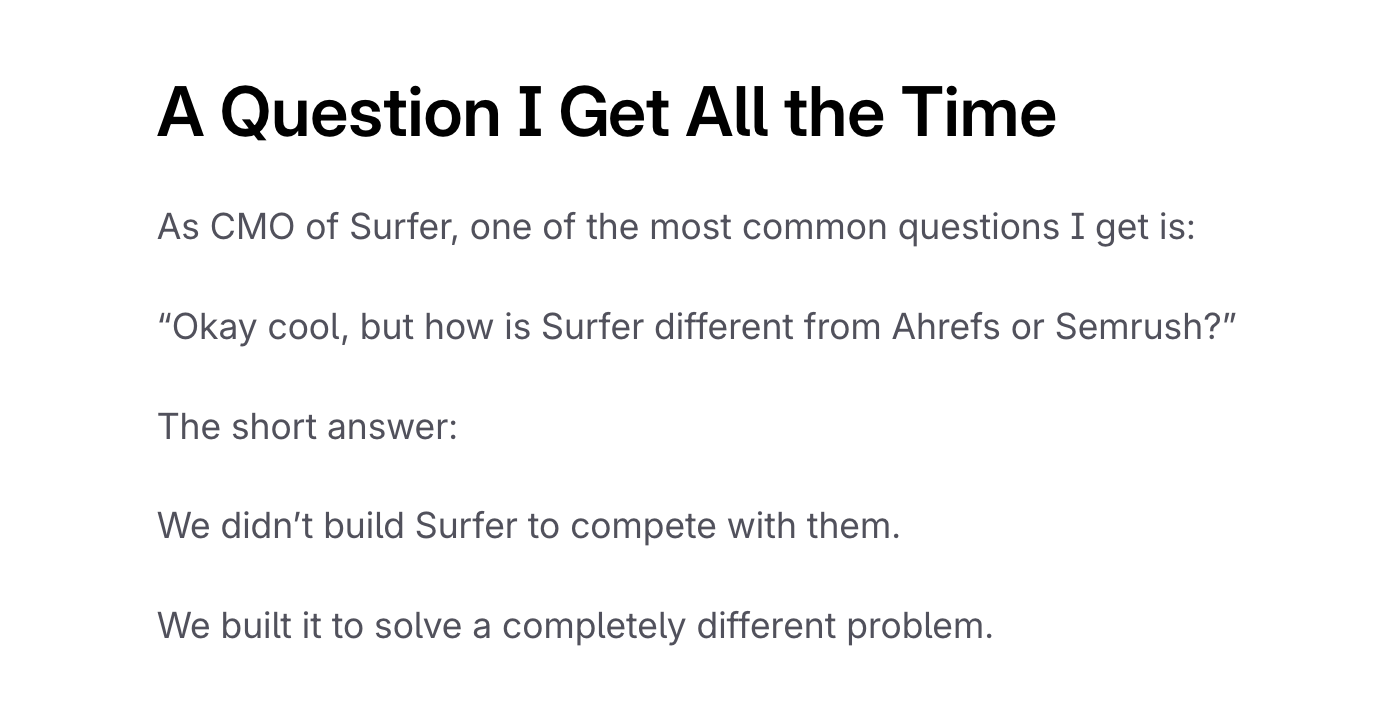
This describes a personal experience – a common question users had regarding Surfer – that AI couldn’t have replicated.
The original tone and voice are also important to search engines, as they can detect generic and repetitive writing. A unique voice, storytelling, and lived experiences make your content truly stand out.
To use AI effectively, treat AI as your co-writer. Let it handle first drafts, outlines, or repetitive tasks (e.g., meta titles or descriptions), and then add your own insights, voice, and formatting. Use real-life examples and figures of speech to make your writing unique. You can also add humor if it’s appropriate and consistent with your brand voice.
Create content that aligns with user intent and delivers value. This way, AI-generated content remains competitive and effective in search engine rankings. Create helpful content to enhance user experience and engagement, with the primary purpose of delivering value and resonating with your audience.
Fact-check everything
AI models generate text based on patterns, not real-time knowledge, which means they can provide outdated or inaccurate information. While you can use AI tools to help in basic research, remember to cross-check any studies or statistics the model references.
You can use the free Google Fact Check Explorer, where you can run a check on your own facts and statements, and you can also see recent fact searches.

Credibility is crucial in building authority online, and it can significantly impact search engine rankings. Misinformation can damage your site’s reputation and lead to users bouncing quickly due to incorrect content.
Always remember to fact-check AI content and verify stats, quotes, dates, and claims with trusted sources before publishing. Consider creating a checklist (e.g., verifying data freshness, confirming sources, updating links).
Follow E-E-A-T guidelines
Google rewards content that demonstrates Experience, Expertise, Authoritativeness, and Trustworthiness. These are the factors that Google uses to assess content quality, which include lived experiences, factual knowledge, and credible references.
For example, in this blog post about the best content writing tools, you can see the lived experience in the title. Trying something yourself is a great way to demonstrate E-E-A-T qualities to Google. You can also see that the first heading describes the exact criteria for choosing the writing tools, which shows transparency.
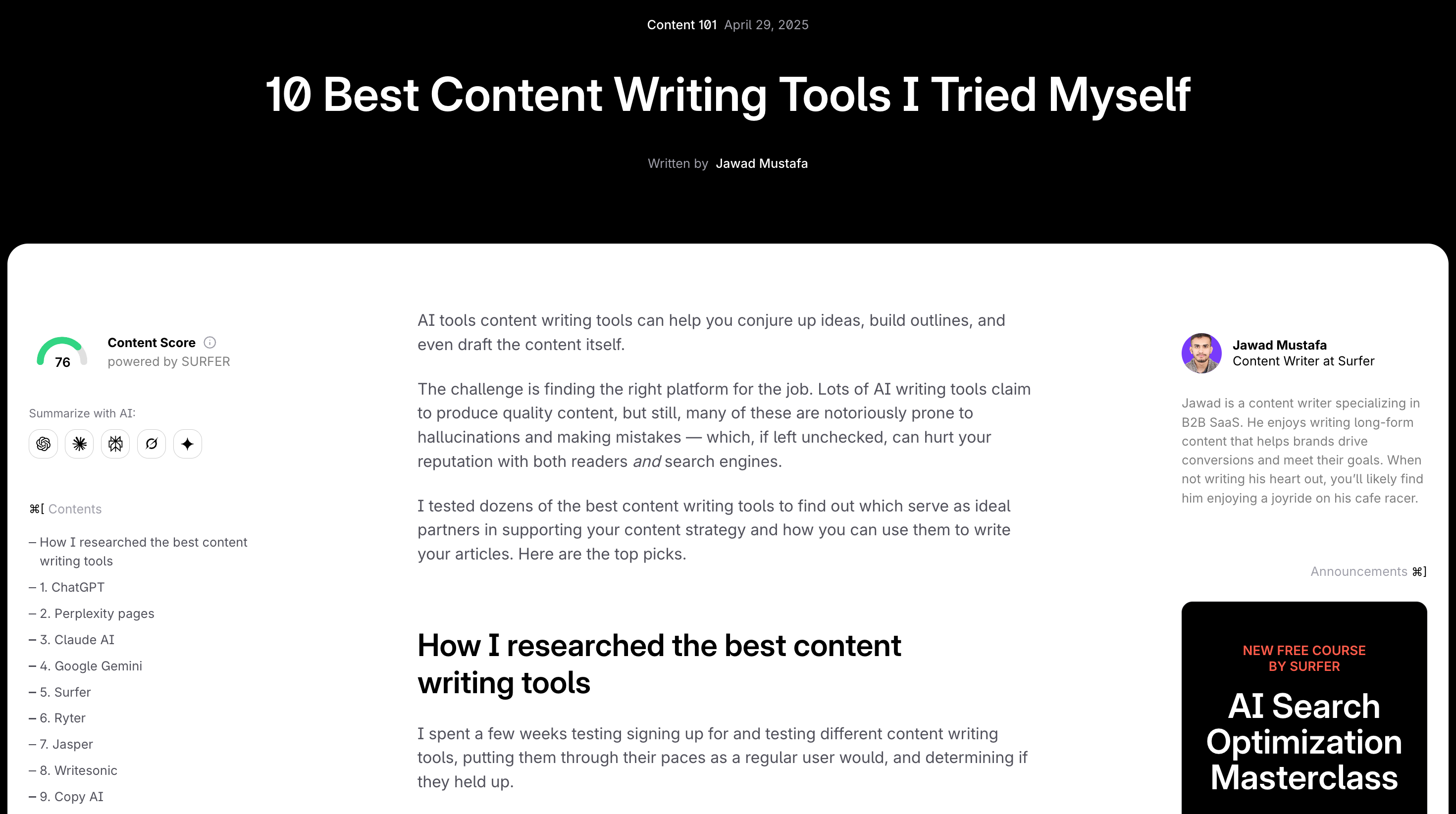
While AI can produce grammatically correct content, it lacks lived experience and authority. Without expanding on AI output, your content will seem generic and superficial.
Add expert commentary, case studies, real-life examples, or original research to AI-generated drafts. Make sure content is attributed to credible authors or reviewed by subject-matter experts.
Optimize AI content for SEO
Optimizing AI content for search engine optimization involves:
- Regular updates to enhance relevance and performance.
- Using advanced natural language processing algorithms to improve optimization for voice search.
- Leveraging predictive analytics powered by AI to anticipate shifts in search algorithms and user behavior, enabling proactive SEO strategy adjustments.
A great unoptimized AI draft might read well, but it won’t rank. AI can guess at keywords, but it won’t always target the right ones. Use a dedicated keyword research tool to find primary keywords, long-tail variations, and semantic keywords. Then, feed these into your AI prompt so the draft is naturally optimized.
AI drafts can also lack a logical structure that search engines rely on to understand content. That’s why it’s crucial to first ask AI to generate an outline with H1 for the title, H2s for main sections, and H3s for subtopics. Then you can ask the model to elaborate on each section. This reduces fluff and ensures logical flow.
Surfer AI is a great way to combine SEO optimization with AI content generation. It's a writing assistant that generates long-form, SEO-optimized drafts in minutes. It's built on live SERP data, not generic AI training. It allows you to scale content production while keeping brand consistency quickly.

Creating snippet-friendly content is also a key part of optimization that AI can help with. Ask AI to generate direct answers (40–60 words) to common questions in the form of a clear, concise definition at the top of a section. These answers can appear in search as featured snippets and People Also Ask boxes and drive massive traffic to help you achieve higher rankings.
You can also use AI to suggest SEO elements such as meta descriptions, FAQs, and alt text. However, remember to finalize with a human SEO review.
Scale your content strategically
AI can help you scale your content operations to produce more pages faster. But it’s crucial to be smart about it. Volume without quality can backfire. Search engines penalize thin, duplicate, or spammy content. As a result, overproduction of low-value AI pages can hurt your domain’s authority.
Instead, use AI to scale intelligently by:
- Generating FAQs and schema-rich snippets.
- Drafting content clusters around a topic.
- Producing supporting content that strengthens pillar pages.
- Balancing speed with depth and value.
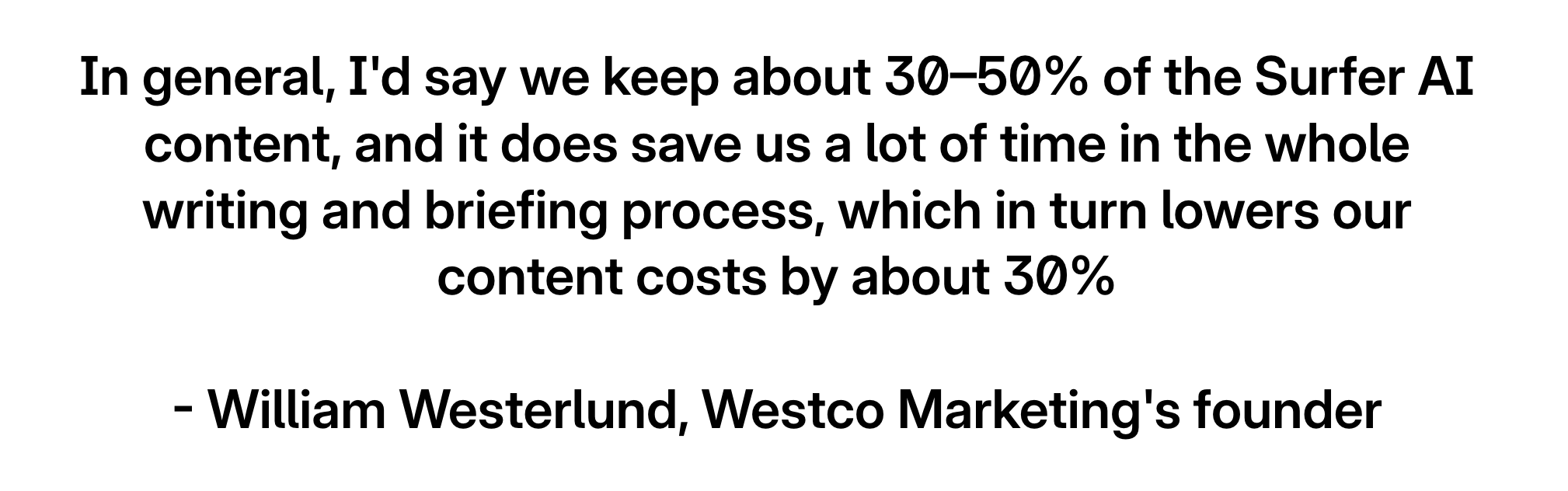
For example, in our case study about Westco Marketing using Surfer to drive sales growth, they say how they use it to create first drafts, then let their writers and experts refine and humanize the articles.
This approach freed up the team to focus on adding real value, experience, and trust, while still saving writing and briefing time. In the end, they cut content costs by 30% without losing quality, showing how AI works best when it supports, not replaces, people.
Integrating AI into content strategies can save time, speed up research, and unlock new opportunities for businesses. AI can streamline content research and planning, allowing businesses to focus on higher-level strategy and improve productivity.
Leveraging AI for content strategy enhances engagement and audience reach, ensuring content remains relevant and effective in a competitive digital landscape, allowing businesses to leverage AI effectively.
Use the right tools
The right AI content tools can make a big difference in how well your content ranks on Google. They don’t just speed up production—they also help keep quality high and ensure your content follows SEO best practices.
Some top picks for SEO-friendly content include:
- ChatGPT – great for drafting and brainstorming across content types.
- Jasper AI – handy for generating copy in different tones and styles.
- Gemini by Google – pulls in real-time insights to keep content accurate and optimized.
- Surfer SEO – fine-tunes your content with data on keywords, structure, and readability.
When used together, these tools help you create content that’s not only scalable but also competitive in search results.
Mistakes to avoid when creating AI content
While AI can save time and scale your content efforts, it’s easy to misuse. Here are the most common mistakes marketers make, and how to avoid them.
1. Publishing AI drafts without editing
Raw AI output often lacks nuance, brand personality, or accuracy. Publishing without review can make your content look generic or even untrustworthy. Avoiding spam content and inaccurate data can help you keep your rankings stable.
2. Skipping fact-checking
AI can invent statistics, cite outdated information, or misrepresent facts. Failing to verify details before publishing damages your authority and credibility.
3. Neglecting search intent
Just because a keyword is present doesn’t mean the content matches what the user actually wants. If your article doesn’t solve the problem or answer the question, users will bounce quickly.
4. Ignoring on-page SEO elements
Meta descriptions, alt text, internal links, and structured data are often left out of AI drafts. Without these, your content misses key ranking opportunities.
Key Takeaways
- AI content can rank as long as it’s high-quality, accurate, and useful. Low-value or spammy content won’t perform.
- Google doesn’t penalize AI content as long as it doesn’t manipulate search rankings.
- When creating content with AI fact-check, add context and maintain transparency.
- Best results come from a hybrid approach: AI for efficiency and scale, humans for depth, originality, and search intent.
- Quality beats quantity, so focus on valuable content, not just volume.
- Use AI to generate meta descriptions, FAQs, and structured snippets.
- Maintain structure and readability with clear headings (H1s, H2s, H3s).
- Refresh content regularly to keep it accurate and relevant.
- Keep your brand voice with human edits.
- E-E-A-T matters for helpful content because AI alone can’t establish expertise or authority.


.avif)

