According to Ahrefs, almost half of all Google searches are now branded.
For the last decade, search engine optimization (SEO) was about ranking for generic keywords like "best running shoes" or "cheap flights to paris." But that's not how people search anymore—they're increasingly replacing these searches with queries like "nike pegasus review" or "paris flights skyscanner."
In other words, users already know where they want to go. And if your brand is not the destination, you're leaving way too many leads for competitors.
In this guide, I'll show you how to make sure this doesn't happen by placing your brand in users' minds before they start a Google search.
What is brand SEO?
Brand SEO is the process of optimizing your website and off-page signals for queries that include your company or brand name to increase brand visibility and authority.
While standard SEO revolves around generic, high-volume keywords, brand SEO optimizes for how your brand appears, how it's perceived, and how it gets recommended across search surfaces—including AI platforms.
Let me give you an example.
A brand like Booking might optimize for broad keywords like "best hotels in barcelona" to climb search engine results pages (SERPs) and draw in more traffic. That's standard SEO in action.
But it can also target branded search terms that achieve specific goals like:
- Increased trust ("is booking.com reliable for flights")
- Accurate representation of features/ services ("does booking.com accept paypal")
- Improved loyalty ("booking genius discounts")
All of the examples are some of the many queries that pop up when you start searching for Booking, which shows that branded keywords offer plenty of optimization potential. But instead of focusing outward on the search landscape, the point is to take an inside look and optimize at the brand level.
Why is brand SEO important?
Brand SEO is crucial to adapting your marketing strategy to changes in search behavior. It helps bring back some of the traffic and leads you might've lost as click-through rates started plummeting across the board.
SimilarWeb's data shows that searches including Google's AI Overviews (AIOs) have an average zero-click rate of a whopping 80%. This means that most people who search for something won't even bother clicking on the results.
You may be right to blame AI for this, but only to an extent. The same analysis showed that when a search doesn't show an AIO, the median zero-click rate is still high at 60%.
So while AI surely contributes to the zero-click trend, it's not the main culprit. Many other search features support it, most notably:
- Featured snippets
- Rich results
- Google Business Profile (GBP) listings (especially for brick-and-mortar shops/brands)
Where AI does make a difference is in traffic sources. Plenty of brands are seeing a drop in traffic from traditional organic search in favor of AI-driven traffic. A perfect example is Tally, a form-building tool that reported AI search as their biggest acquisition channel, helping them grow from $2M to $3M ARR in four months.
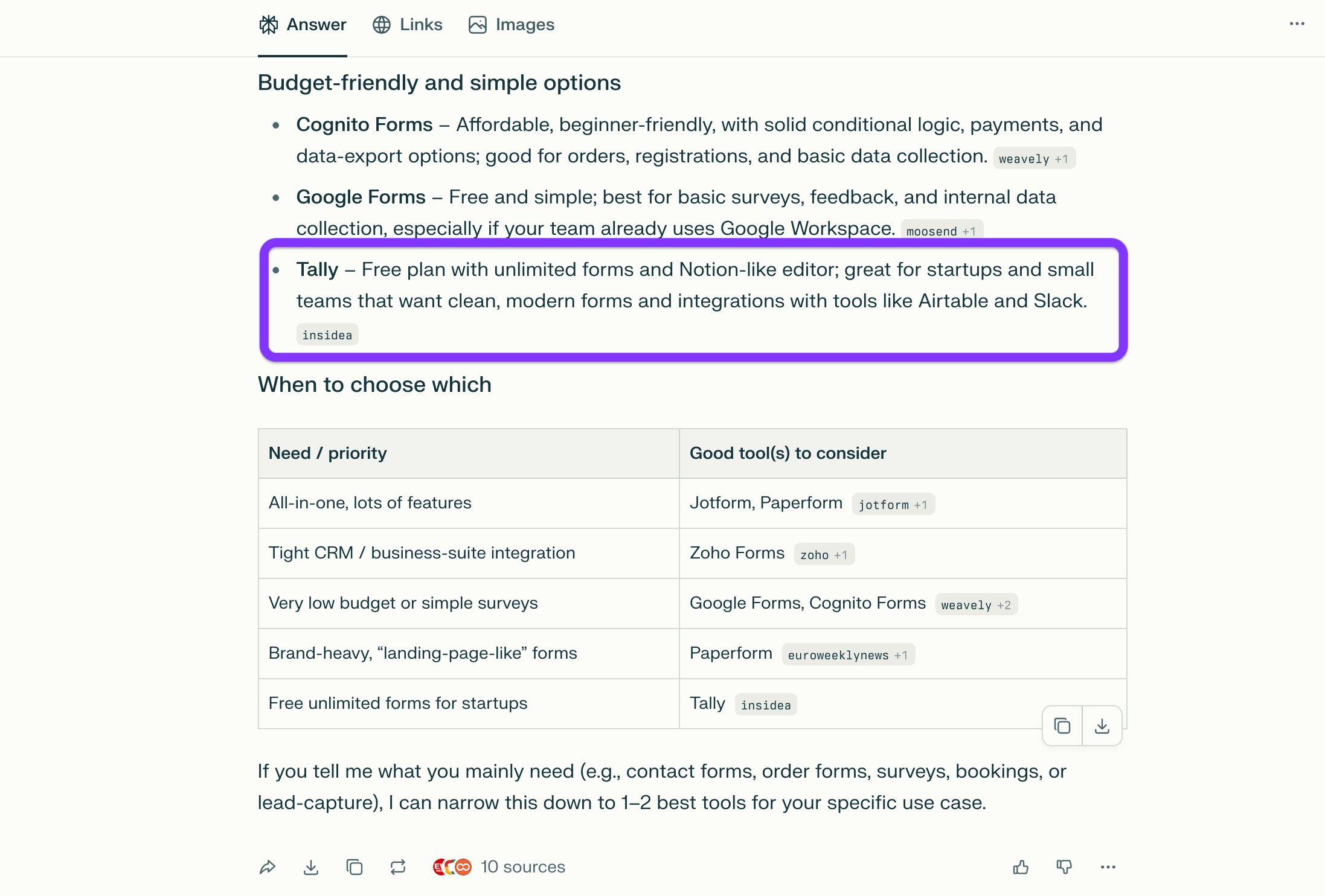
You can see this first-hand by playing around with AI tools. When I asked Perplexity about the best form builders for small businesses, it directly recommended Tally among big-name tools like Google Forms and Jotform.
At the same time, Tally ranks on page #1 of traditional SERPs for keywords like "best free form builders," so I'll be aware of it as a solution even if I don't click on any of the results. It's not buried in a well-ranking listicle but directly included in results, which buffers the zero-click issue.
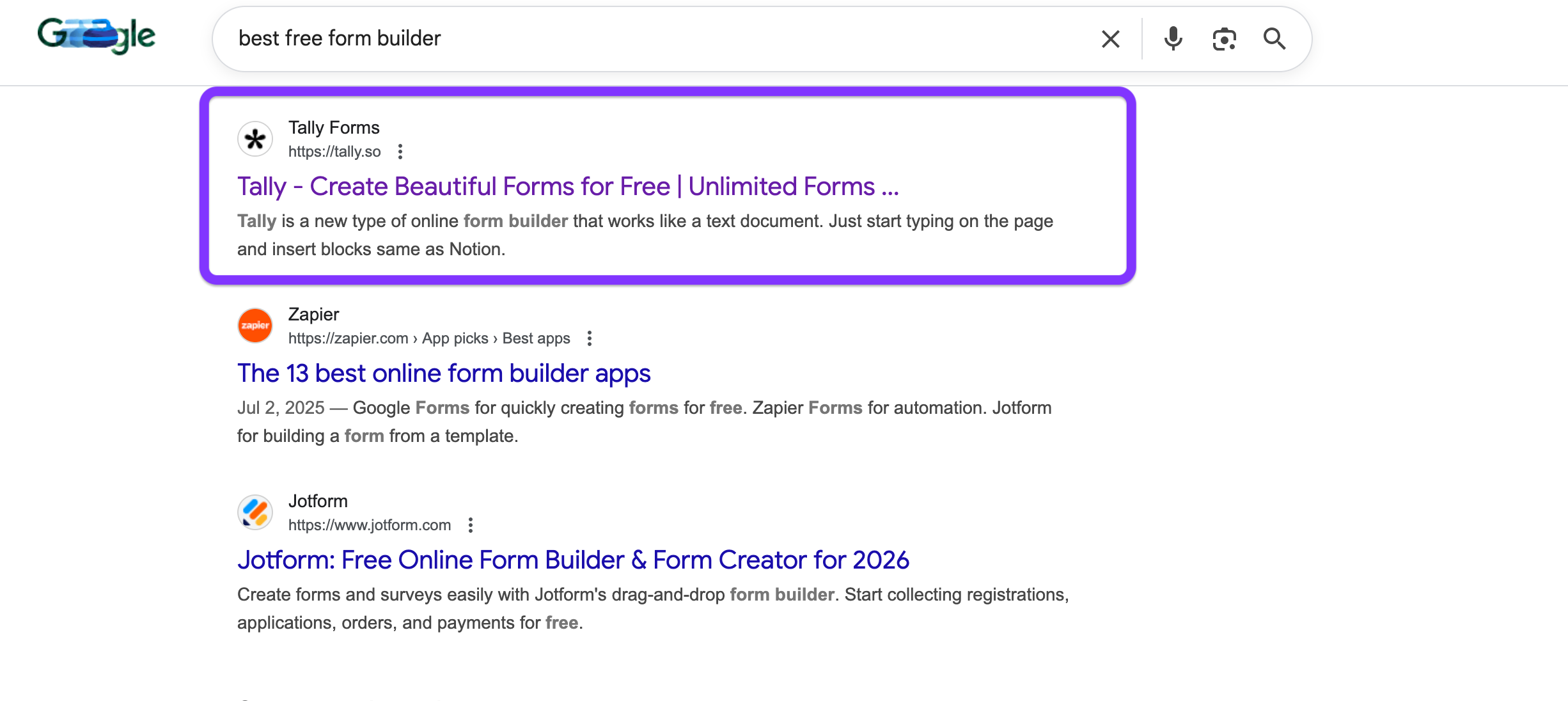
This is the value of brand SEO. It positions your solutions well in both traditional and AI search engines, helping your brand evolve ahead of the curve (or at least with it) as search behavior changes.
6 Steps for Brand SEO
Whether you're doing brand SEO from scratch or need to improve the narrative around your brand, here's what to do:
1. Own your branded SERP
Your brand's SERP is often the only thing a potential customer sees before they consider engaging with you, so that first impression is a deal-breaker. That's why you should ask yourself a simple question:
When someone Googles your brand, what do they see?
To make sure you like the answer to this question, you should do three things:
Audit what appears when someone searches your brand name
Google your company name, and scroll around to see what comes up. But don't do it while you're logged into Chrome or through a browser you typically use because Google will probably show you a personalized, flattering version of the results.
Instead, open a private browser window (or another browser) where Google has no history of you, no cookies, nothing—and then search your brand name.
As you go through the results, document everything:
- Which pages rank, and is your website actually ranking first?
- Are there any rich results (e.g., a Knowledge Panel)?
- What questions appear in People Also Asked? If the first suggested question is "Is [Brand Name] a scam?" or "Why is [Brand Name] so expensive?", that's a reputation landmine.
- Is a competitor running an ad for your name? This happens all the time—you search for Brand X, and the first result is "Brand Y: A Better Alternative." If you aren't bidding on your own name, they're poaching your traffic.
If you need a reference point as to what a branded SERP should look like, Google a brand like Zoom. You'll see plenty of signals of a stellar reputation and recognition, including:
- Domination of the top three SERP results (all of which are from Zoom)
- A Knowledge Panel
- Brand-focused related searches without competitors or a negative sentiment
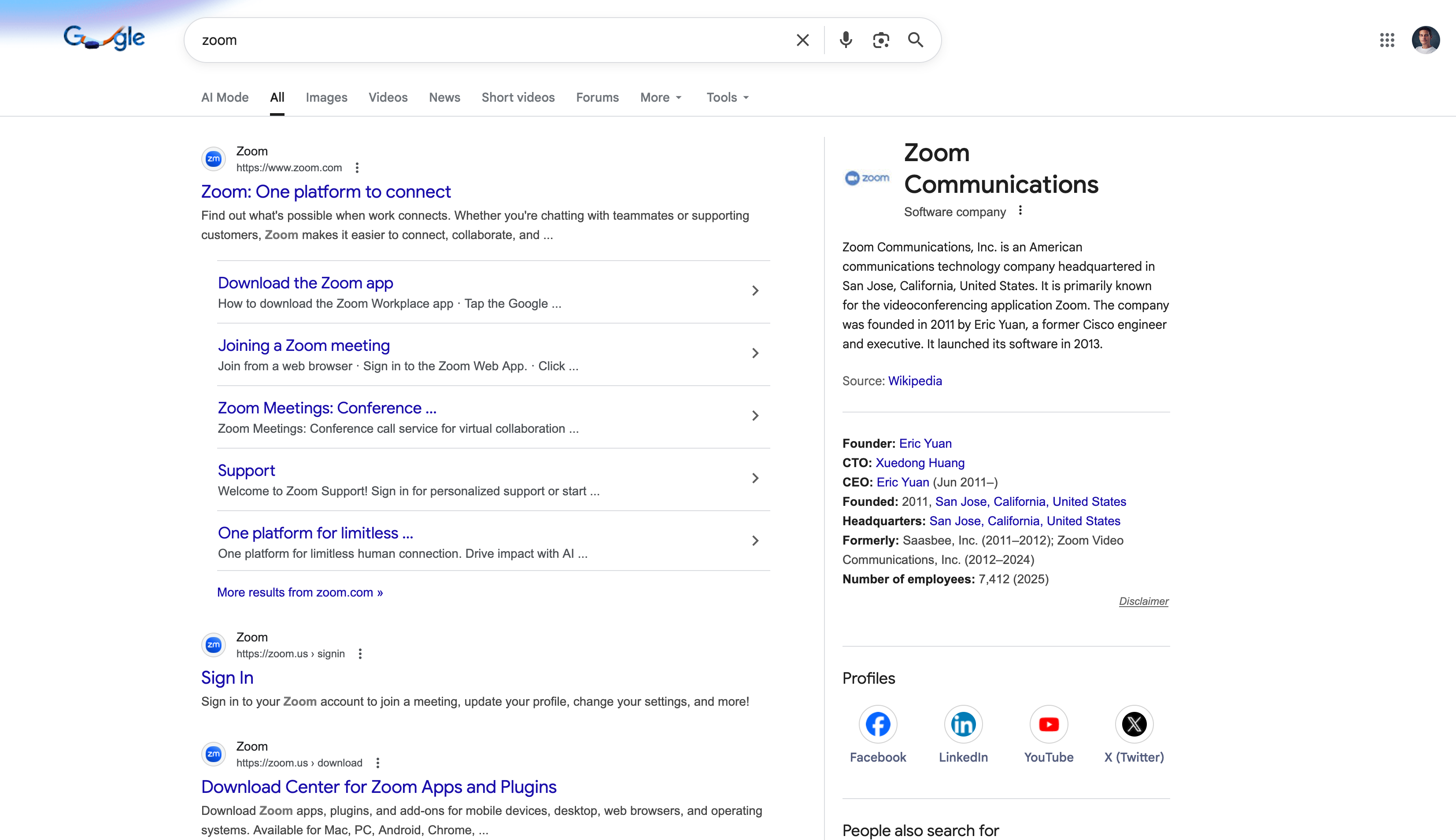
You should also check for common problems like negative reviews, outdated information, or third-party sites controlling your narrative. While independent sites talking about your brand is a sign of brand recognition, you'll always want to see owned assets above them.
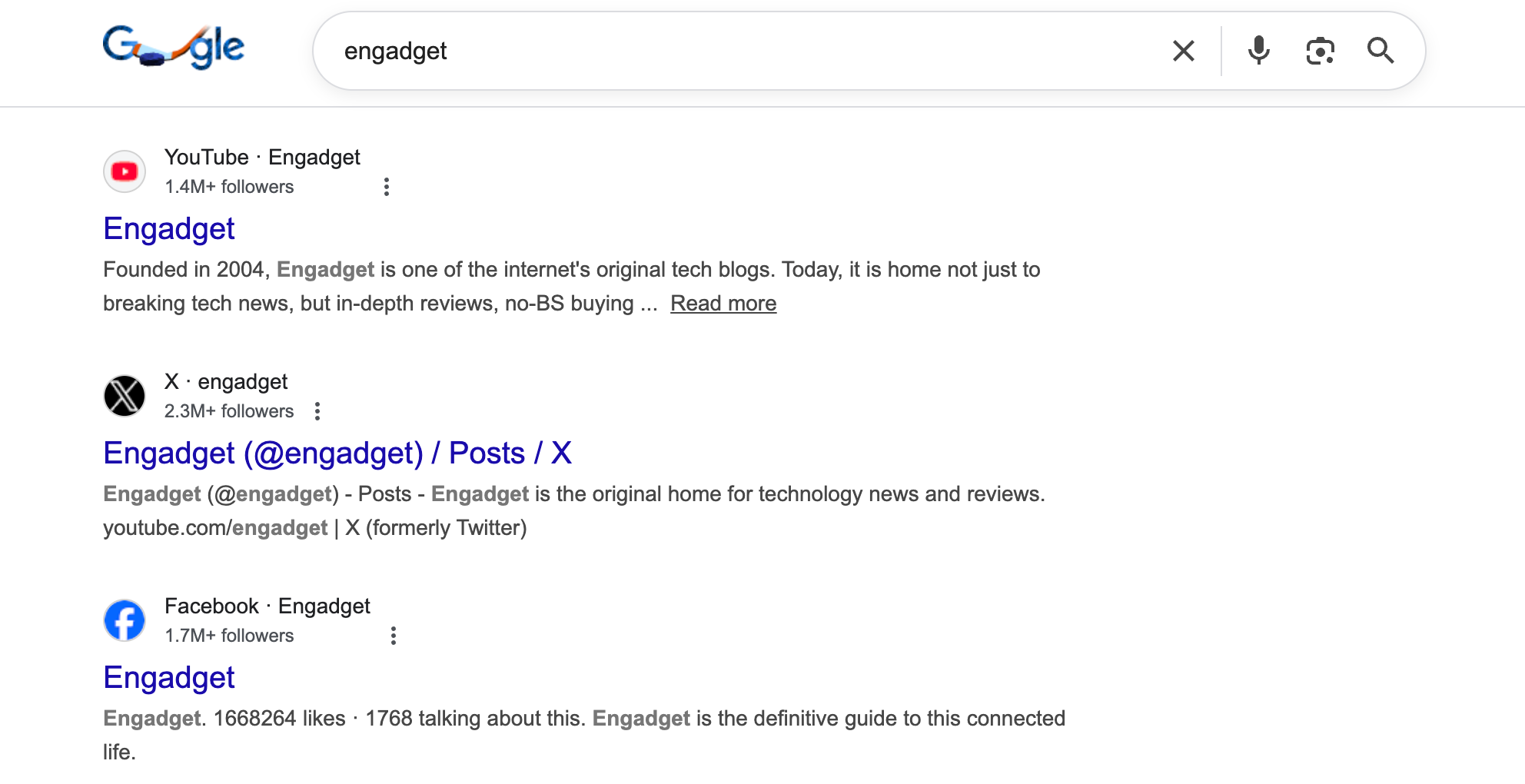
Ideally, your social profiles should make their way to SERPs because this is a clear sign of consistency. For example, Engadget's handles are all over page #1, so the brand gets to pull users into the places where they're in charge of the brand image.
Shape first brand impressions
Once you've seen how Google sees your brand, you need to tell search engines how you want it to be seen. And the good news is that there are plenty of direct ways to do this.
The easiest but most overlooked one is your site's About page. In the era of AI and entities, the About page is the main data source of credibility, so it should explicitly define your current expertise and why you are the solution to a user's problem.
Take Trello as an example. The About page doesn't beat around the bush or sell the brand short. Instead, it immediately communicates the software's value and USP.
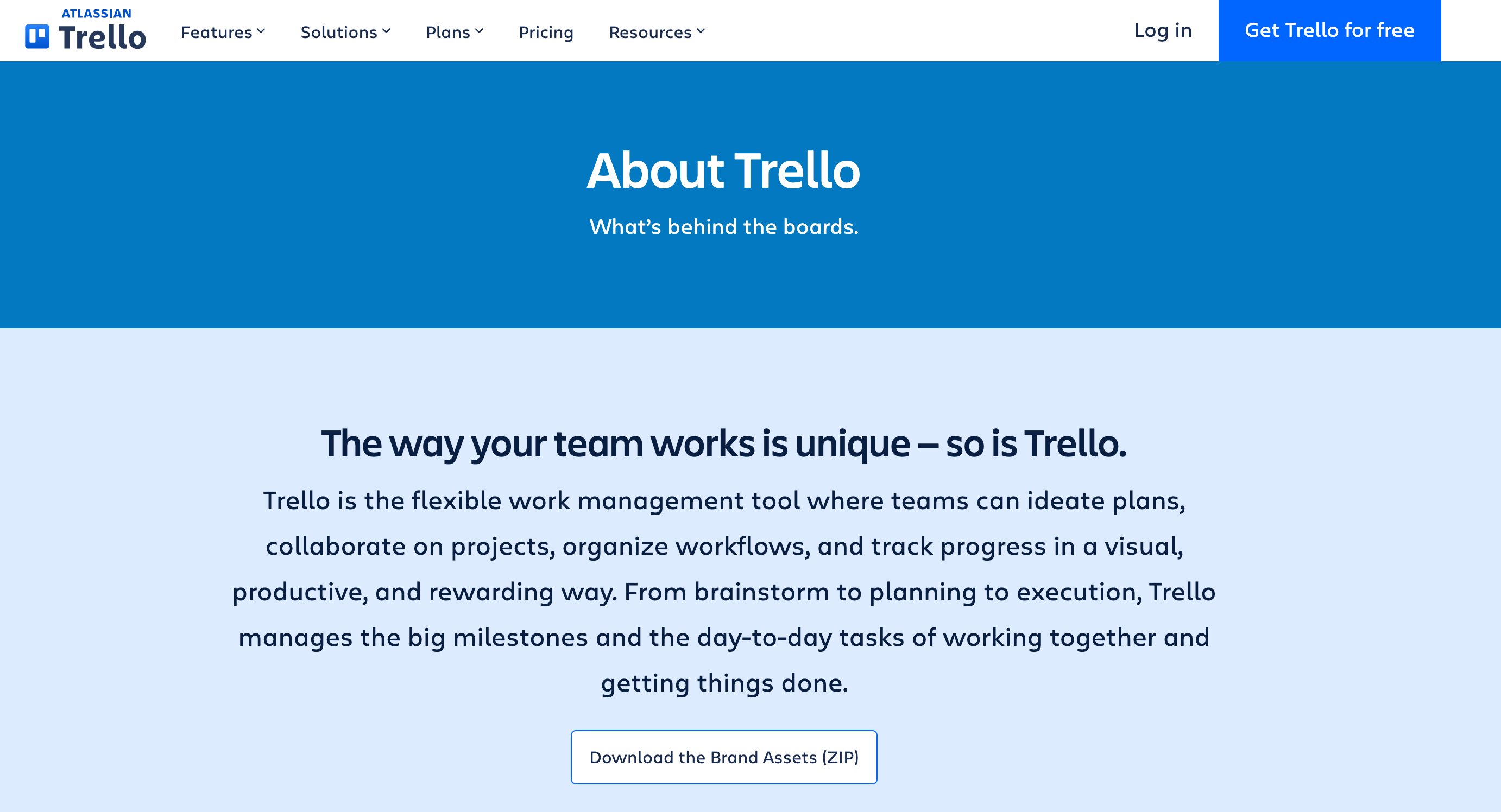
The page also includes what some of the most prominent names online have said about the platform, which further solidifies its expertise.
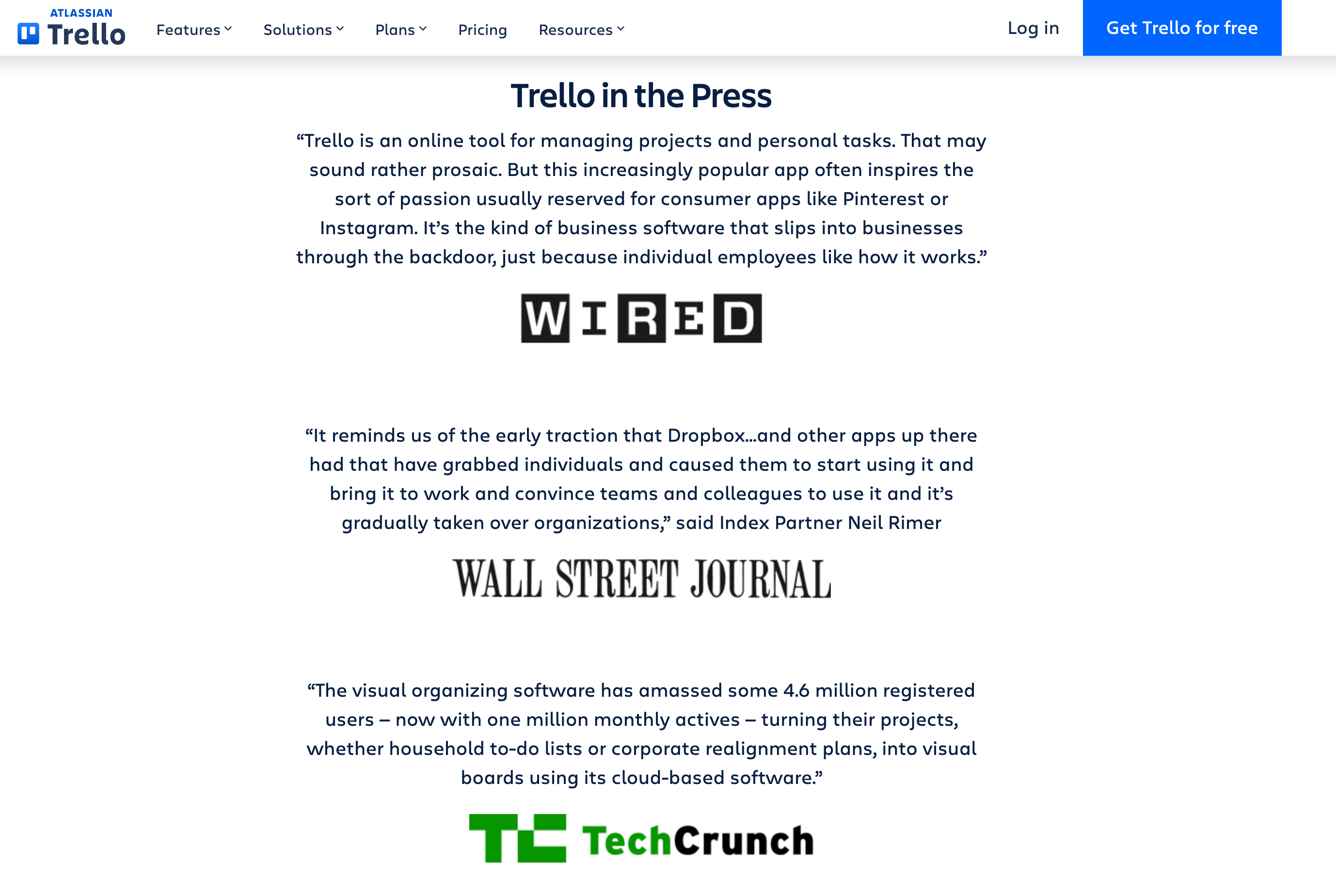
This brings me to my next point—the way others are talking about your brand directly impacts its SERP position and overall credibility.
While you may not be featured in Forbes, you can solicit and respond to reviews on Google Business Profile, Trustpilot, G2, and industry-specific platforms.
Reviews affect both traditional rankings and how AI systems perceive your brand's trustworthiness, so don't shy away from pursuing them. More importantly, actively engage with reviews to stay in the conversation and maintain a firm grasp of the brand narrative.
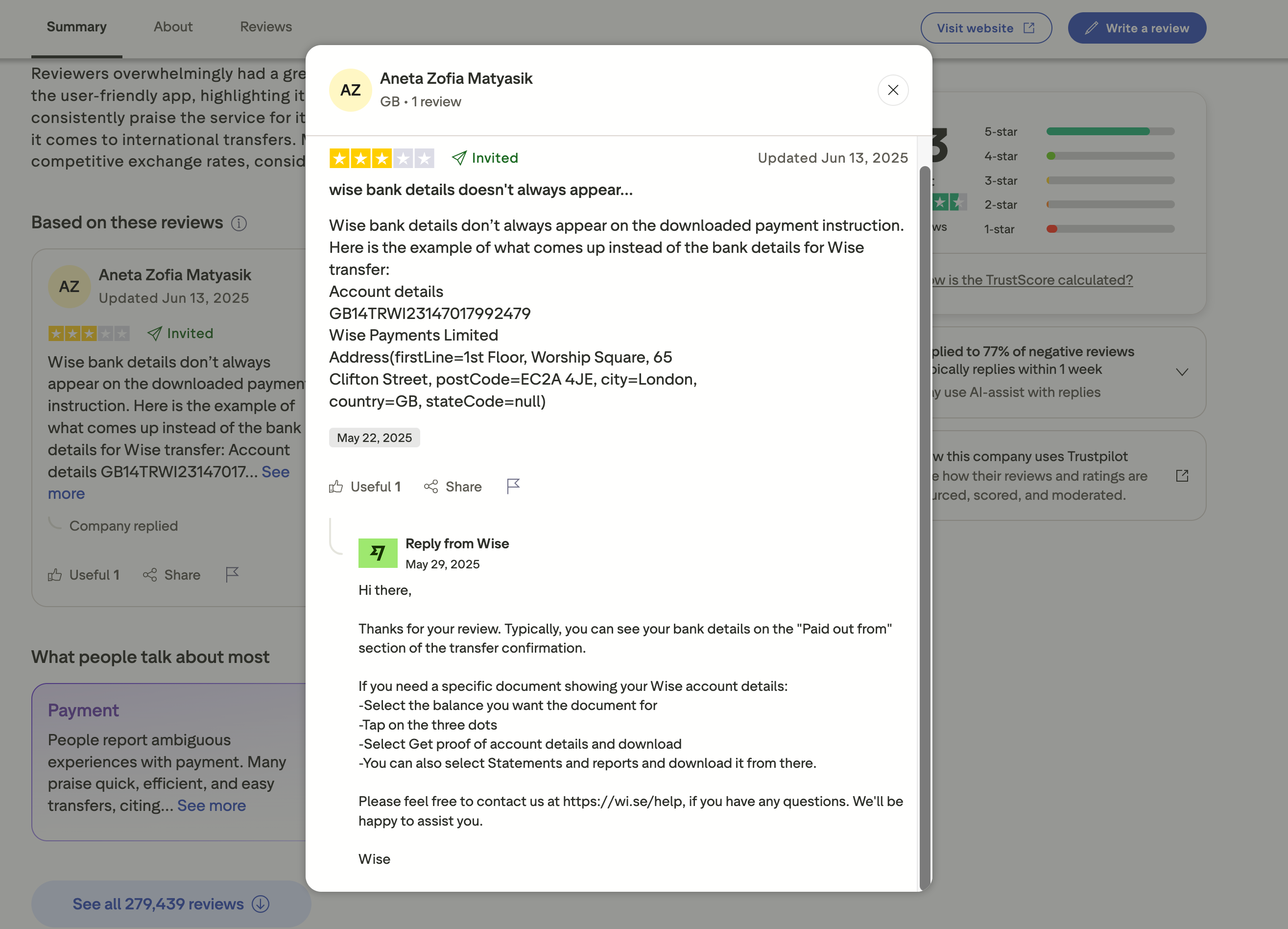
A good example of this is how Wise handled a bit of negative feedback. When a user pointed out an issue, the team acknowledged it and suggested a solution, which potentially resolved the problem while providing reassurance to someone who might read the review.
Manage your Knowledge Panel
The Knowledge Panel is Google's way of saying, "We know who you are, and we trust you." It looks official and seems like an encyclopedia entry instead of just a search result.
For example, Canva's Knowledge Panel makes its already impressive branded SERP that much more credible. It's filled with reputable info, so it's clear that Google is well acquainted with Canva.
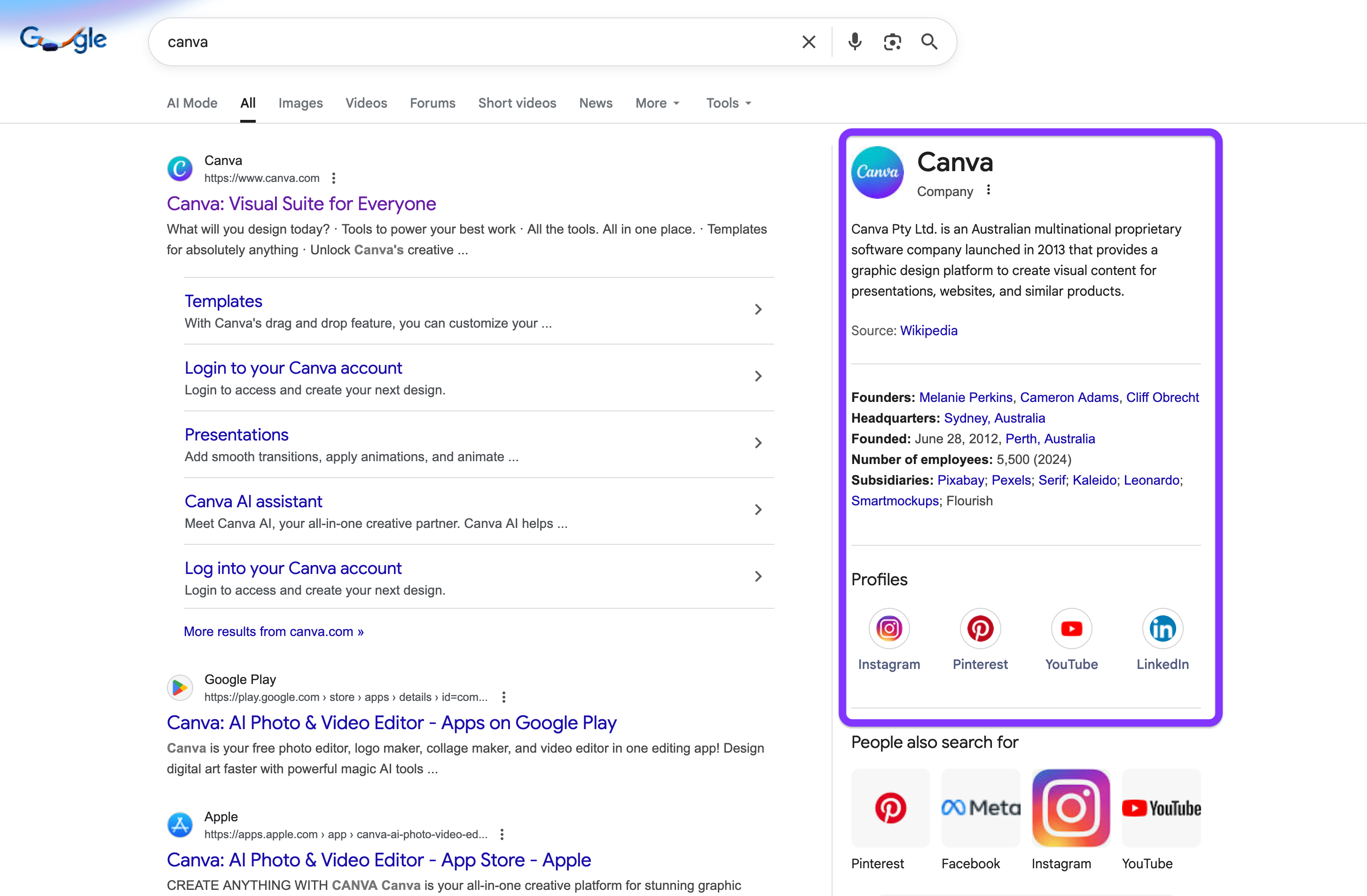
The Knowledge Panel takes up massive screen real estate, pushing competitors out of sight. It also appears in voice search responses and feeds the training data for generative AI results, so it can do wonders for your visibility and credibility across the board.
The sad part is that you can't just "get" a Knowledge Graph. It's generated automatically when Google thinks there's enough credible information about your brand on the web. Making this happen is a topic of its own, but here are some quick tips to at least get you started:
- Establish an entity home: This will usually be your homepage/About page as the single most authoritative source about your brand.
- Use structured data: Add schema markup to your site to help Google's algorithm retrieve and understand your data more easily.
- Build corroboration signals: Earn mentions and citations from authoritative sources. When Google sees consistent information everywhere, all linked via schema where needed, your confidence score goes way up.
- Ensure consistency: Make sure your name, social profiles, and facts are identical across authoritative sources like Wikidata, Crunchbase, or industry-specific databases.
2. Target branded keywords and related queries
Beyond your core brand name, you need to own the queries that include your brand, such as:
- "[Brand] reviews"
- "[Brand] pricing"
- "[Brand] vs [Competitor]"
This last one's especially important because if you don't create a page called "Your Brand vs Competitor," your competitor will create one called "Competitor vs Your Brand." And they will control the narrative, explaining exactly why they're better than you—on a page that ranks when people search for your name.
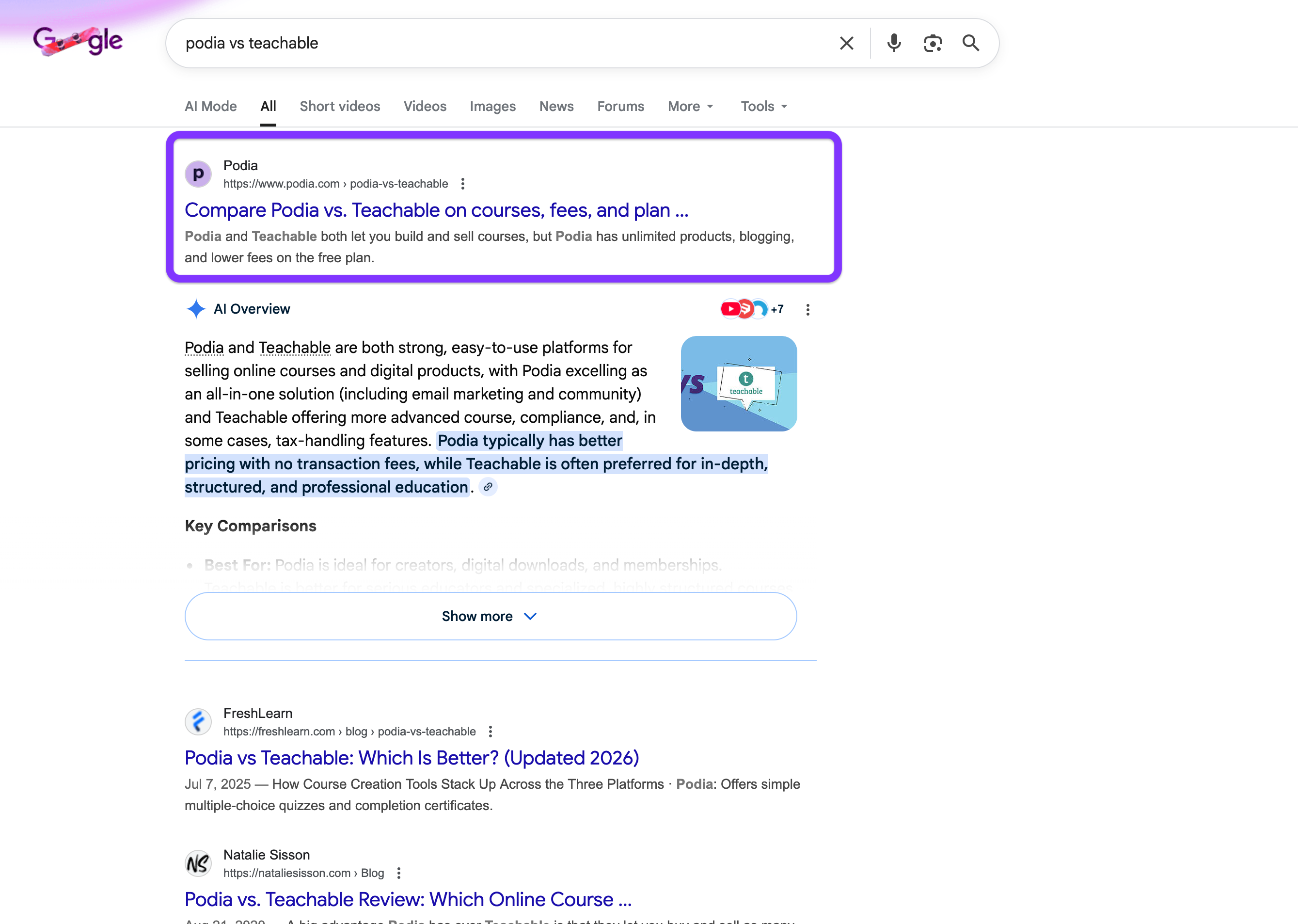
You can see this in action if you try comparing brands like Podia and Teachable. You'll notice that Podia has an article that ranks #1 for the relevant keywords, while Teachable is nowhere to be found in SERPs because it didn't target them.
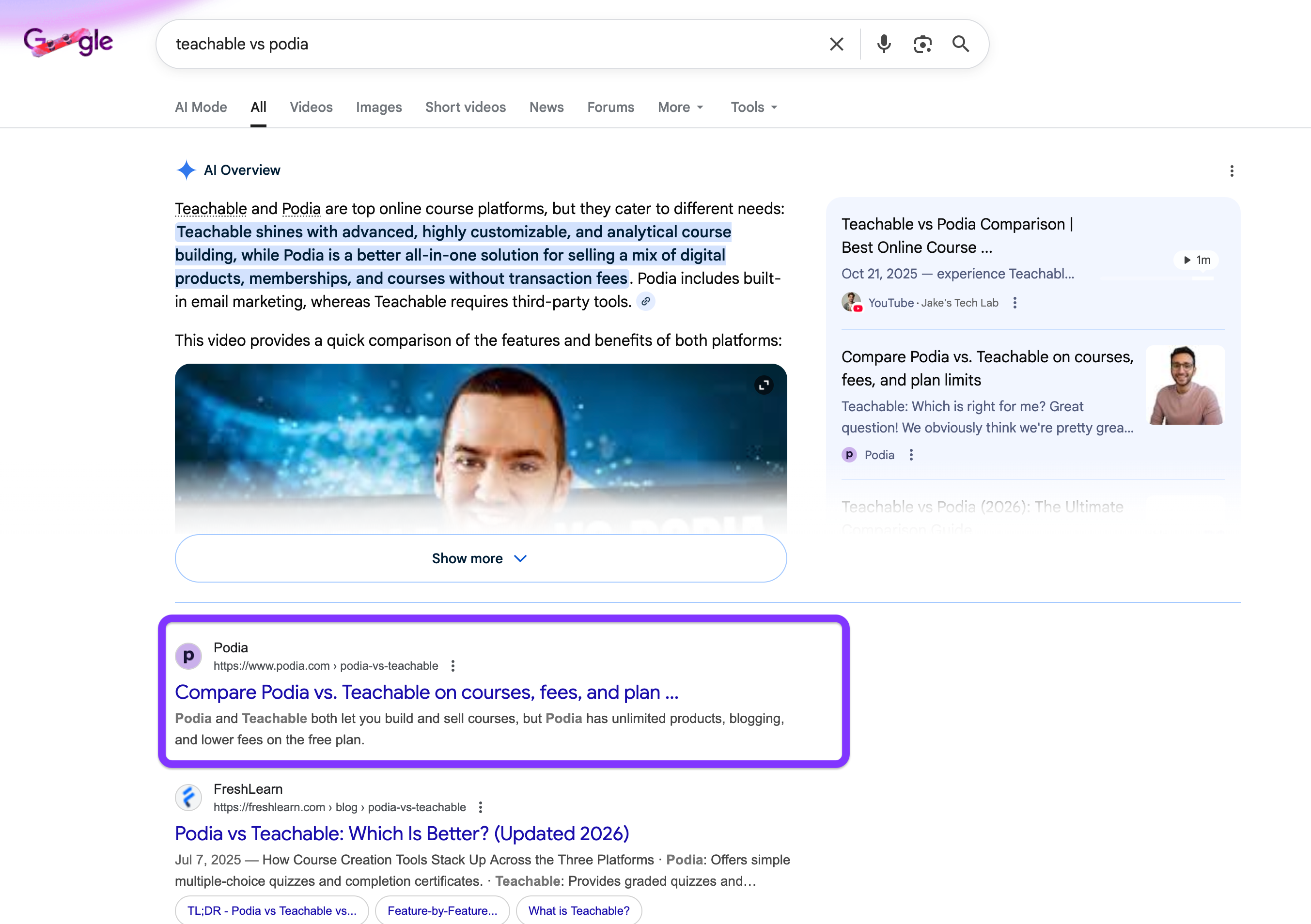
I even tried putting Teachable's name first to see if something would change, but it didn't—while the SERP was slightly different (mainly in terms of third-party review pages), Podia still dominated the keyword.
To avoid this costly mistake, create your own "[your brand] vs [competitor]" content so you control the narrative. While it may feel uncomfortable to talk about a competitor on your site, it doesn't have to be if you're transparent. Write an honest comparison, and don't hesitate to highlight where you win.
Besides comparisons, you should focus on several pages to target all the right terms:
- FAQ pages: Answer the questions that appear in People Also Ask for your brand name. These are the exact questions people are asking about you.
- Pricing pages: Transparent pricing pages rank for "[brand] pricing" and build trust.
- Review aggregation pages: Curate and respond to reviews in a dedicated testimonials page section. Show leads what existing customers say to boost their confidence and improve your credibility.
3. Build brand authority that search engines and LLMs recognize
Search engines and AI systems don't just look for keywords anymore. They evaluate if your brand is a recognized, trustworthy entity associated with specific topics.
For example, Pitchway, an AI presentation generator may be relevant for presentation related queries on search, but will need to optimize it's brand entity for AI SEO answers.
You need to build your company's brand awareness and position yourself as a credible source of information, which is mostly done through content.
Specifically, you need to:
- Create clear, well-structured content that directly answers real user questions.
- Use a clear information architecture that helps both humans and AI navigate your content.
- Develop complete topical authority over entire subject domains, not just individual keywords.
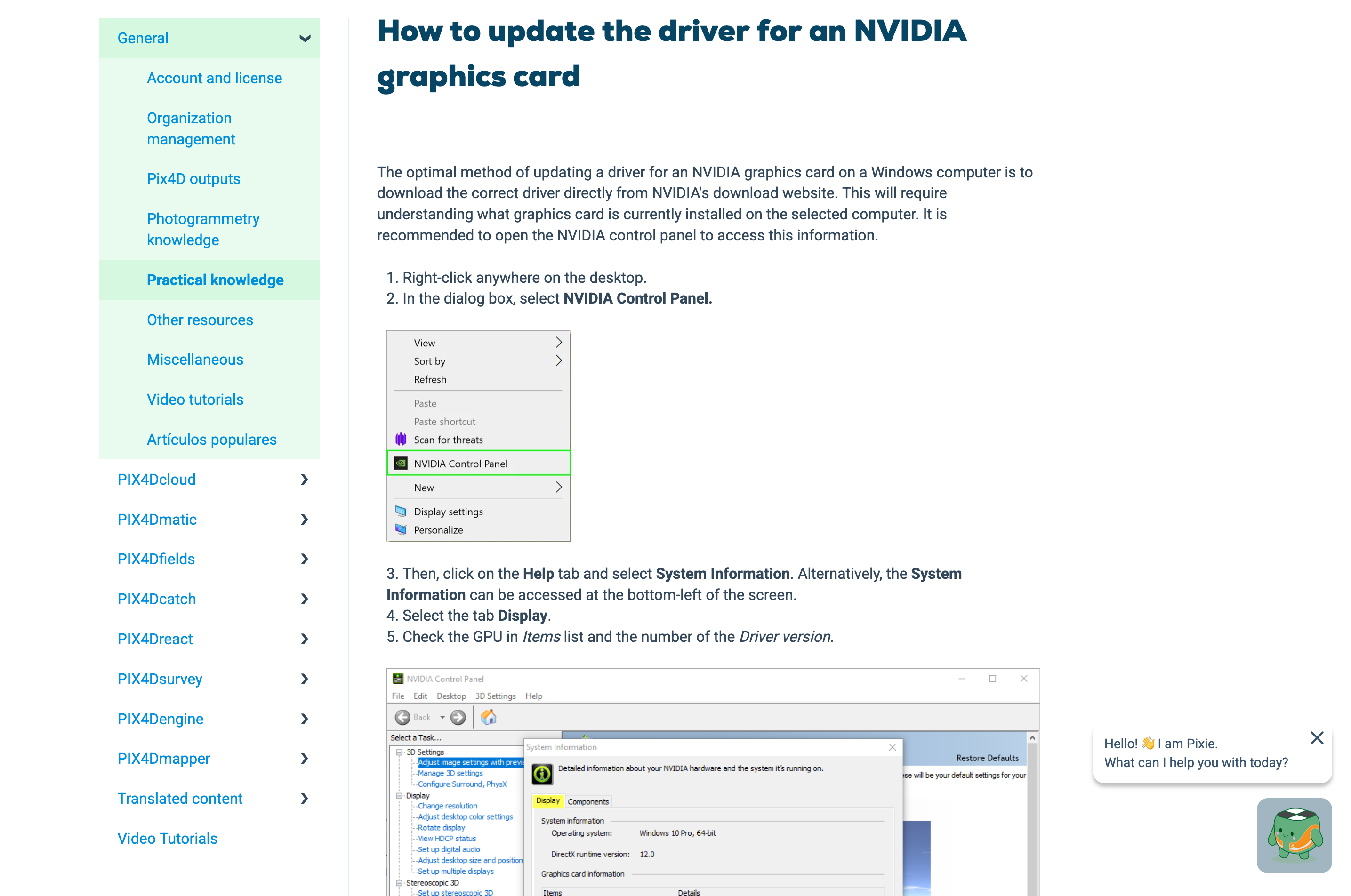
Pix4D is an excellent example of all of the above. If you ask a question like how to update an Nvidia driver, their article will pop up all across traditional and AI search.
You can see why this is the case as soon as you open the article. The H1 directly reflects a conversational query, and the article immediately jumps into the answer through a well-structured step-by-step guide.
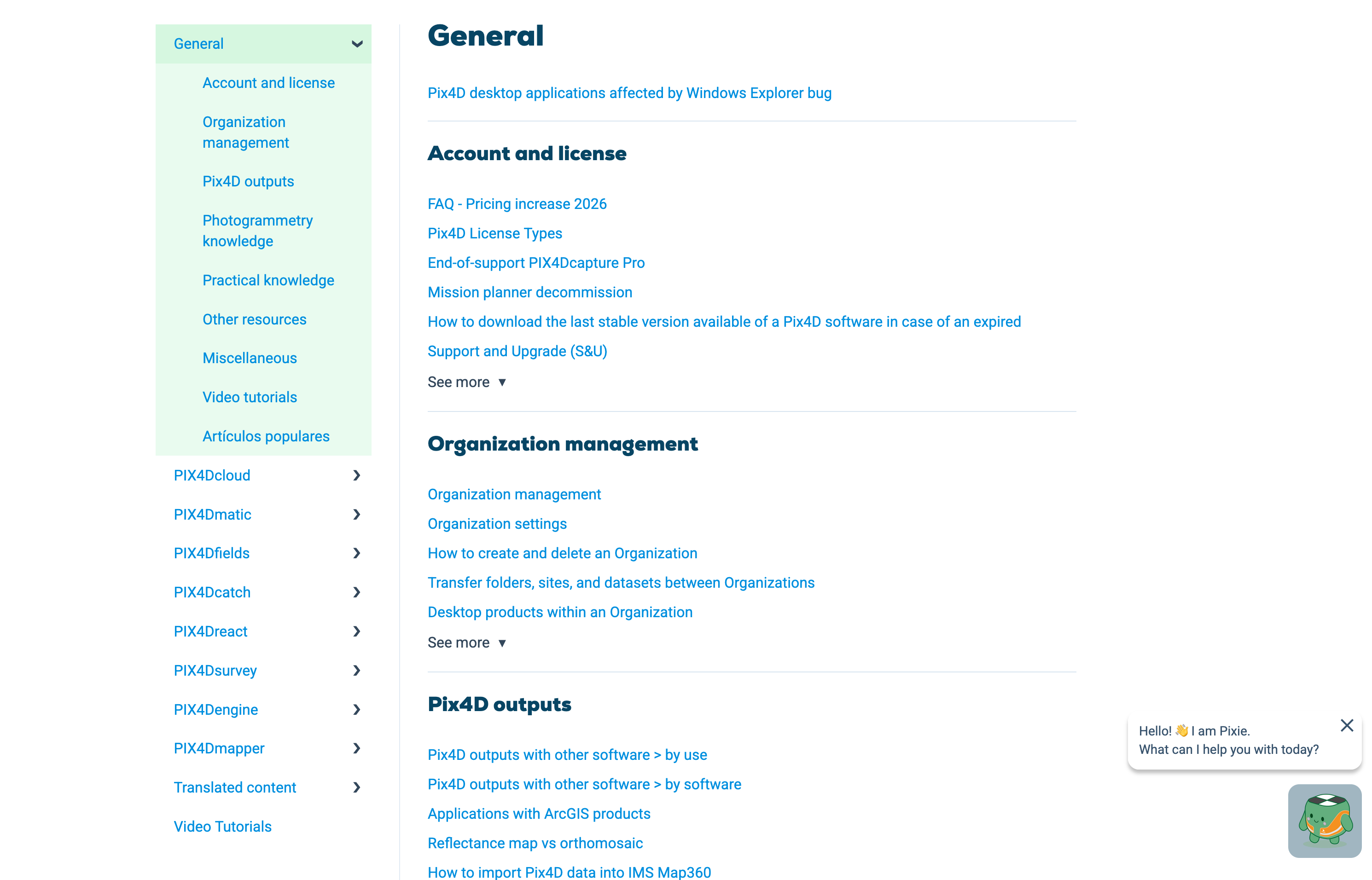
The article is also part of Pix4D's robust documentation, which organizes plenty of information in a way that makes it easy for people and algorithms to find what they're looking for.
Speaking of documentation, you need a content library that goes far beyond a simple blog. The more comprehensive, useful, and unique your content, the more likely search engines will be to recognise your brand identity.
If you have a unique methodology for how you do business, name it. Even if you don't, there are plenty of ways to develop a brand identity framework through:
- Technical white papers: Original research with data only you have access to
- Utility-based templates and tools: Free resources that solve problems and earn citations
- Original research studies: Data-driven content that becomes a citation source for others
Over the years, Surfer has spent plenty of time developing all of this to position itself uniquely. The brand has pushed content like:
- First-party research (e.g., the Google AIOs study)
- Free tools (like an AI content Detector and Humanizer)
- Free courses (e.g., the AI SEO Masterclass)
First-party data is especially important because it lets you source yourself instead of passing on credibility to someone else. This way, you're signalling to search engines that you're worth citing.
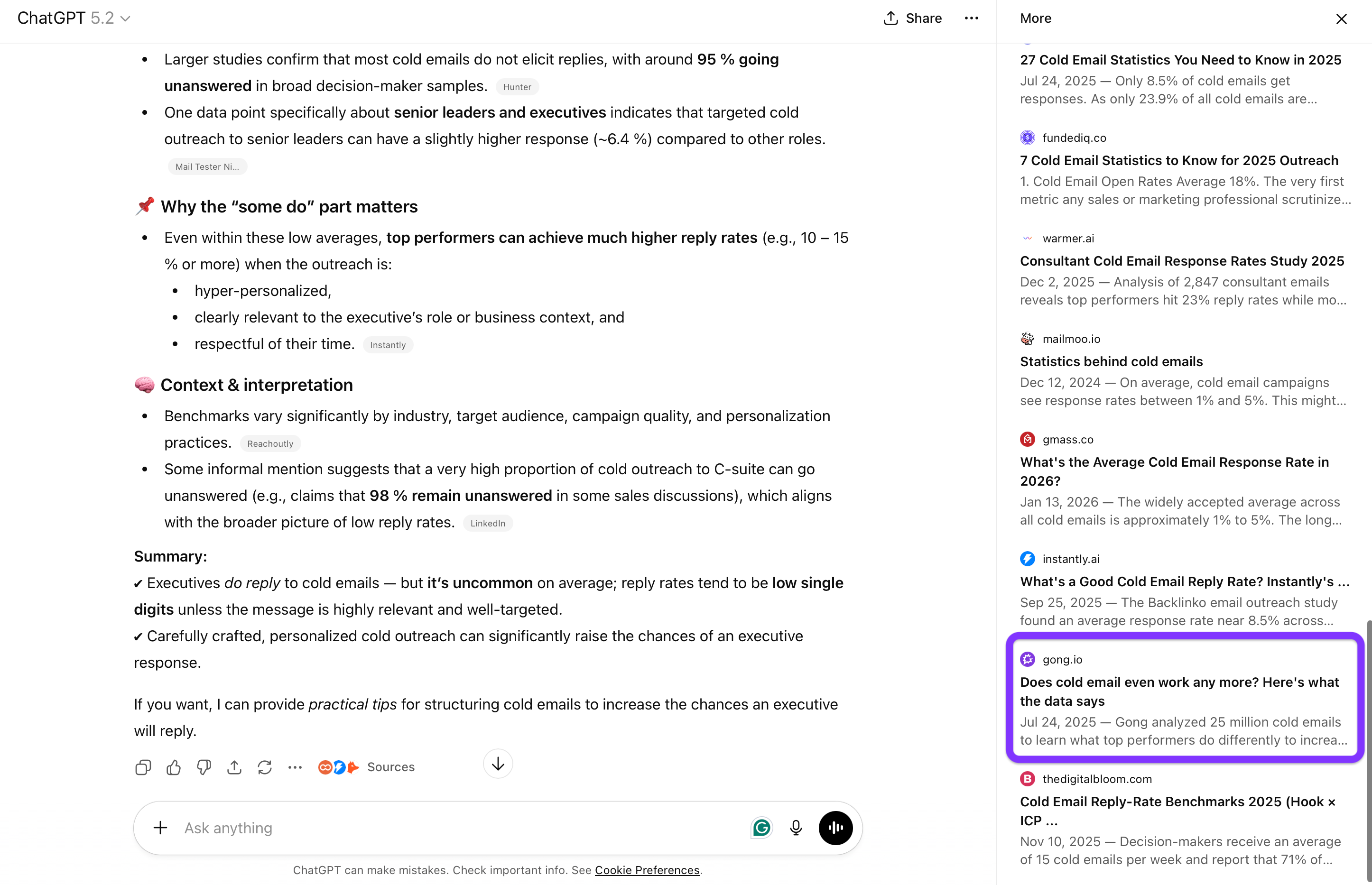
Gong does this very well. They're a revenue intelligence platform that records and analyzes sales calls, so they sit on a mountain of unique data. Instead of writing generic posts about how to sell better, they analyze their own database and publish unique insights on things like whether execs reply to cold emails.
Unsurprisingly, if you Google similar questions or ask a platform like ChatGPT about them, you'll see Gong featured among other reputable sources.
4. Include social media in your strategy
Google and AI systems don't immediately trust everything they see on your site. They also look at social media to see if the story holds up. Google now includes social data in its understanding of brands (and can even add them automatically to your Google Business Profile), and LLMs look up social signals to determine trust.
If your website says you're the leading expert in AI, but your Twitter/X account has three followers, and you haven't posted since 2018, the algorithm gets confused because it sees a conflict. Inconsistencies in brand messaging, name, address, or phone number become sources of misinformation, damaging your reputation.
But it's not just about appeasing search engines. A high-performing TikTok or Instagram post can generate backlinks, drive organic traffic, and send referral clicks that boost your overall funnel.
If you're starting fresh, invest 3–6 months in consistent posting and community engagement before expecting significant brand-building returns on social.
The good news is that you don't have to be a content creator on five platforms. All it takes is some content repurposing.
Let's say you hosted a webinar (like the one Zylo recently had on 2026 SaaS trends). What seems like just a one-hour video can actually be a goldmine for all kinds of content. For example, you could:
- Extract 10-15 short clips for TikTok, LinkedIn, or YouTube Shorts
- Transcribe the audio and turn it into 3-4 blog posts
- Take the best quotes and turn them into text posts and carousel graphics for X, Instagram, and/or LinkedIn
One effort becomes 20 pieces of content, which creates a "conversation" that Google can track across multiple touchpoints. This is especially true if you reference and interlink content across platforms to create entity connections. When the same ideas appear on YouTube, LinkedIn, Twitter/X, newsletters, and blog posts, you build association signals for search engines to use.
5. Leverage PR and digital outreach to generate branded mentions
When journalists and publications mention your brand, those mentions become training data for AI systems. The more often your brand appears in authoritative contexts, the more likely AI will recommend you.
The situation is similar in traditional SEO because Google no longer cares only about do-follow links but instead focuses on entity recognition. An unlinked mention from a reputable publication like The New York Times can help Google learn that your brand is associated with specific topics even without direct link equity.
The best way to get your name out there is through original content like:
- First-party research
- Case studies
- Industry trends and insights
It doesn't even have to be something too elaborate. For example, Randstad Enterprise published a case study that showed how their client achieved 73% screening efficiency, which ended up in a Forbes article about skills-first strategies.
If you need a more active and direct approach, respond to journalists' requests for subject matter expertise. You can find journalists on platforms like:
Being cited as a source does wonders for brand recognition and credibility, so look for requests in your niche where you can add valuable insights.
When reaching out to journalists, be strategic about your pitch. Here's some advice to follow:
- Build relationships before you need coverage.
- Lead with the asset, not the ask. Instead of "Please include us," try "We published new proprietary data on [X] and thought it might support your upcoming coverage."
- Prioritize pitching journalists who have recently covered a related topic.
- Deliver a clear angle by highlighting a specific data comparison or insight that the journalist might find valuable.
Besides PR, you should think about influencer marketing. Micro-influencers can drive authentic mentions that resonate with niche audiences and get picked up by AI systems.
It doesn't need to be anyone famous—as long as it's a trusted voice in your niche, you can benefit from their mention. Browse social media for potential partnerships, but don't just treat them as a transaction. Build some rapport first, and then see if there's room for a collaboration or a shoutout.
6. Track your brand mentions for AI search visibility
Traditional metrics like organic click-through rates (CTR) are becoming less relevant as people turn to AI-powered search, so we need to start focusing on the emerging metrics like:
- AI visibility score: A benchmark score showing how often your brand appears in AI answers compared to competitors
- Mentions: Total number of prompts where your brand is included in AI responses
- Citation frequency: How your brand's citation frequency compares to competitors for relevant topics
Share of search is another big one. The idea is to track how often people search for you versus your competitors. Or in the AI context, share of search shows you how often AI mentions you compared to the key competitors, letting you see how big your piece of the cake is.
The good news is that we've already gotten quite a few tools that let us track all the key metrics—and Surfer's AI Tracker is a great example. It gives you a snapshot of your brand's presence in AI search by outlining metrics like:
- Overall AI Visibility Score
- Mention rate
- Position in AI responses
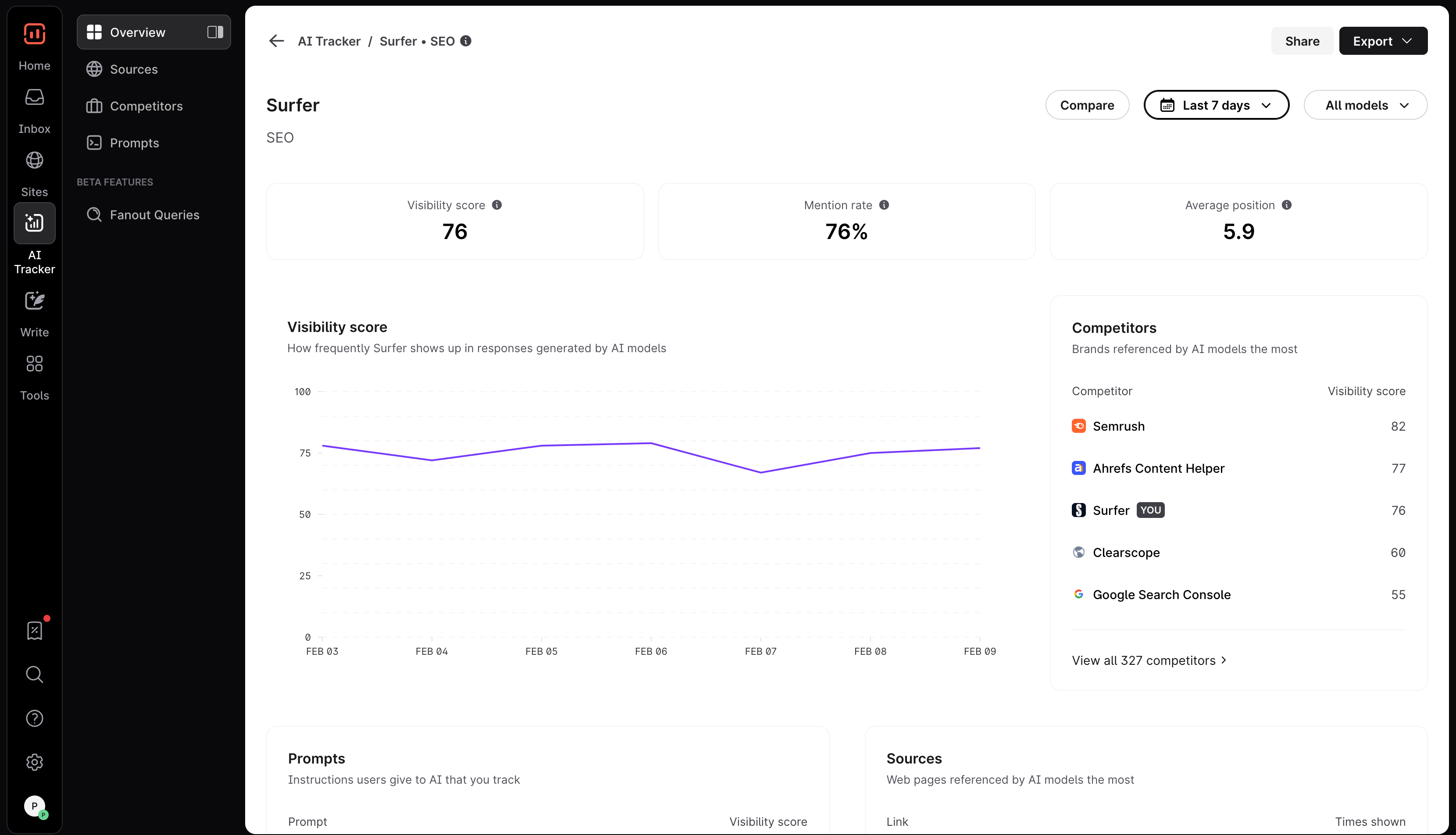
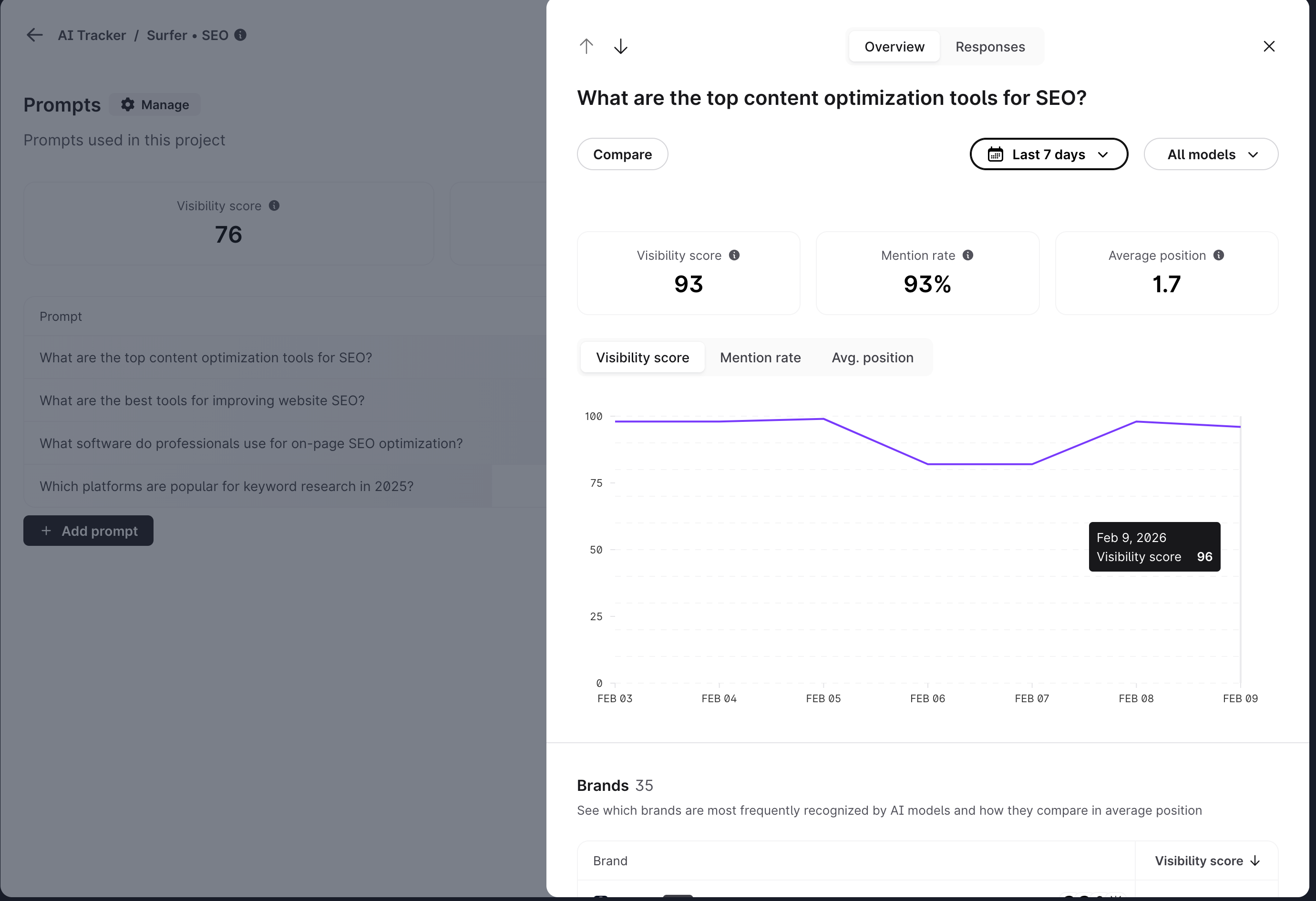
To make your tracking actionable, AI Tracker lets you dive deeper and track your performance across specific prompts to help you zero in on the most important ones and optimize your content accordingly.
For competitive analysis, AI Tracker lets you see how other brands are doing in different LLMs and directly compare your performance to theirs. You can get insights like:
- Competitors' Visibility Scores, mention rates, and average positions in AI answers
- Sources mentioning your competitors (and you)
- A mention gap between you and your competitors
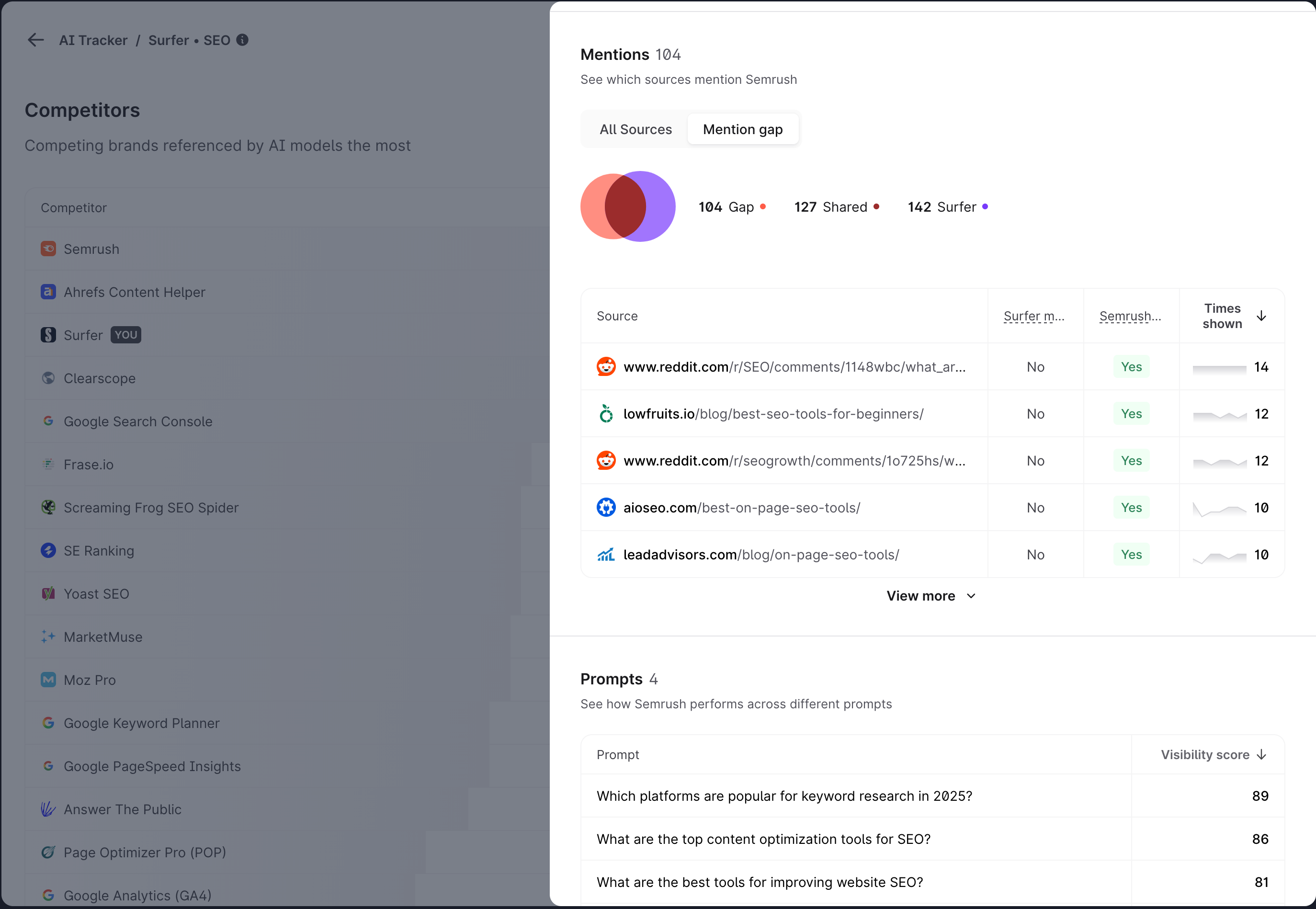
All this data is updated daily, so you can regularly monitor your performance to enhance brand awareness and start leveraging AI platforms as sources of traffic and leads.
What is a good brand SEO strategy?
A solid brand SEO strategy is one that combines brand reputation with topical authority and off-page presence to drive more branded search traffic and give you a stable stream of qualified leads who already know about you.
To sum up, the process involves these steps:
- Own your branded SERP: Audit it honestly, protect it with branded ads if needed, and shape first impressions through your About Us page, resource center, reviews, and Knowledge Panel
- Target branded keywords: Create FAQ pages, comparisons, pricing pages, and review aggregations to own the queries people search about you
- Build entity authority: Create proprietary content that AI systems must cite (original research, unique frameworks, insights only you have, etc.)
- Leverage social and PR: Generate consistent signals across platforms and earn mentions that create brand associations
- Measure what matters: Track share of search, AI visibility, and citation frequency, not just clicks
While clicks might be fading away, search isn't. It's just changing shape, and brand SEO lets you adapt to these changes and make sure your brand stays relevant.