If you ask an AI assistant like ChatGPT for, say, the “best project management tool,” it’ll recommend a bunch of options in its generated response. These recommendations, at least in part, come from brand mentions on cited pages:
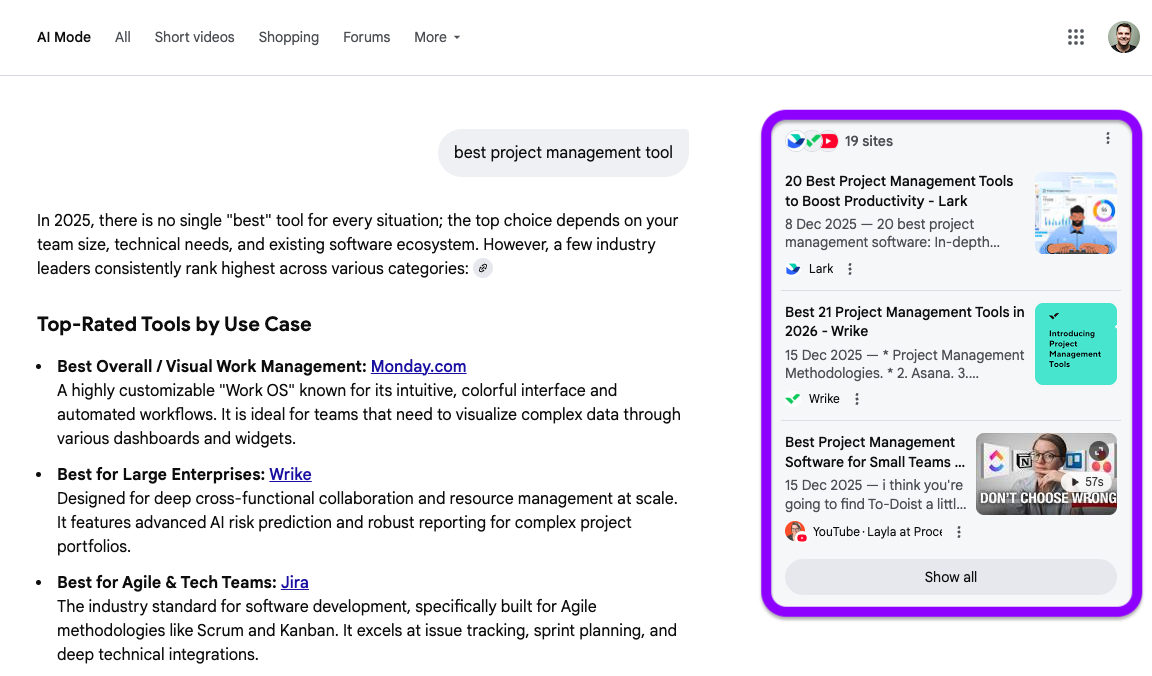
But does AI recommend a brand more strongly—by ranking it higher in the generated response—when it’s mentioned on a larger share of the cited pages?
To find out, we:
- Took 922 unique prompts across 12 industries
- Pulled prompt responses from ChatGPT, AI Overviews, AI Mode, and Perplexity multiple times over a 7-day period (26,573 total calls, roughly 6.5k per model family)
- Extracted all brands and source pages from responses (289,105 URLs in total)
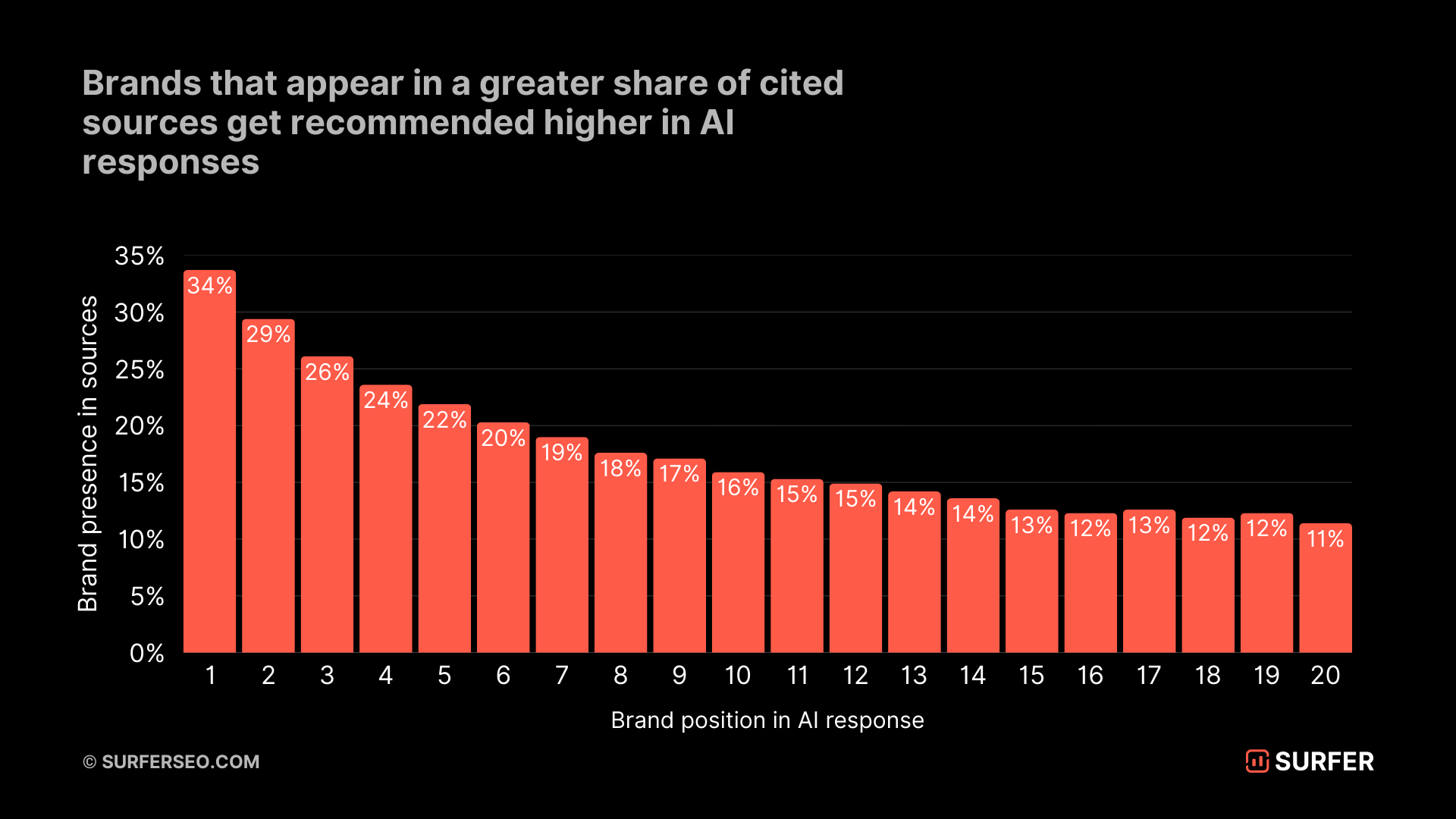
- Analyzed the correlation between response ranking “position” and the percentage of sources that mention each brand
The result? This graph showing that, yes, AI is more likely to strongly recommend a brand when it's mentioned on many cited source pages:
Note: Our prompts came from customers’ projects in Surfer’s AI Tracker, meaning that they were mostly synthetic prompts like “What is the best _______?”. However, as customers can track any prompt they like, not all of them followed the “best ____” or “top _____” format. Some were things like “Find me a tax attorney in NJ” or “How does [brand] compare to [competitor] and what are its competitive strengths?”
But before you rush to get mentioned on as many source pages as possible, let’s look at a few more findings from the data. I’ll also share how I think you should act on the data to improve your AI visibility.
ChatGPT’s recommendations more strongly correlate with brand presence than other AI assistants, but it also cites the most sources by far
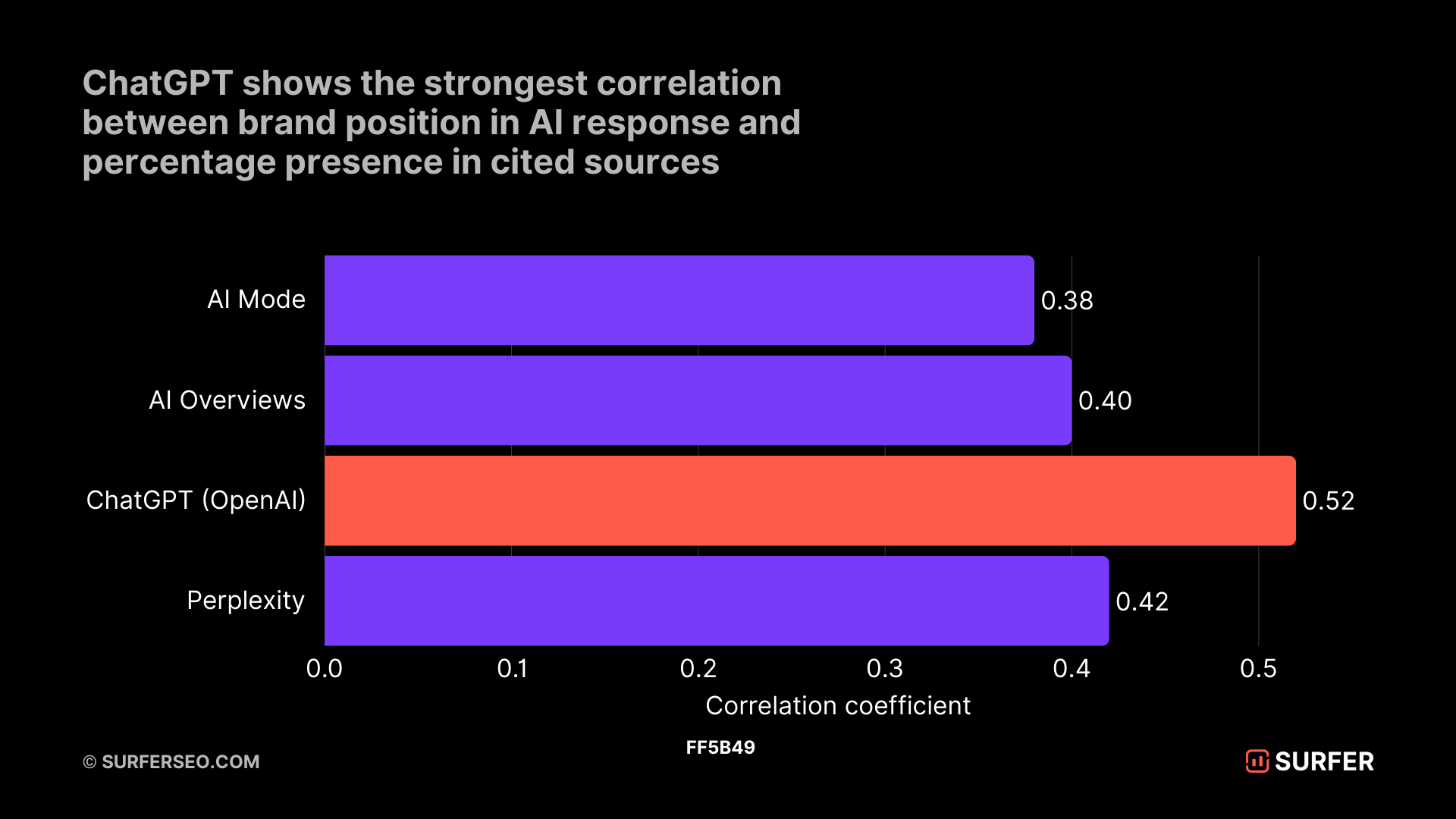
Each of the models we tested show a clear correlation between brand presence and recommendation strength, but ChatGPT trumps them all by a fair margin.
This is especially interesting when you consider that ChatGPT responses contain the fewest brand recommendations on average…
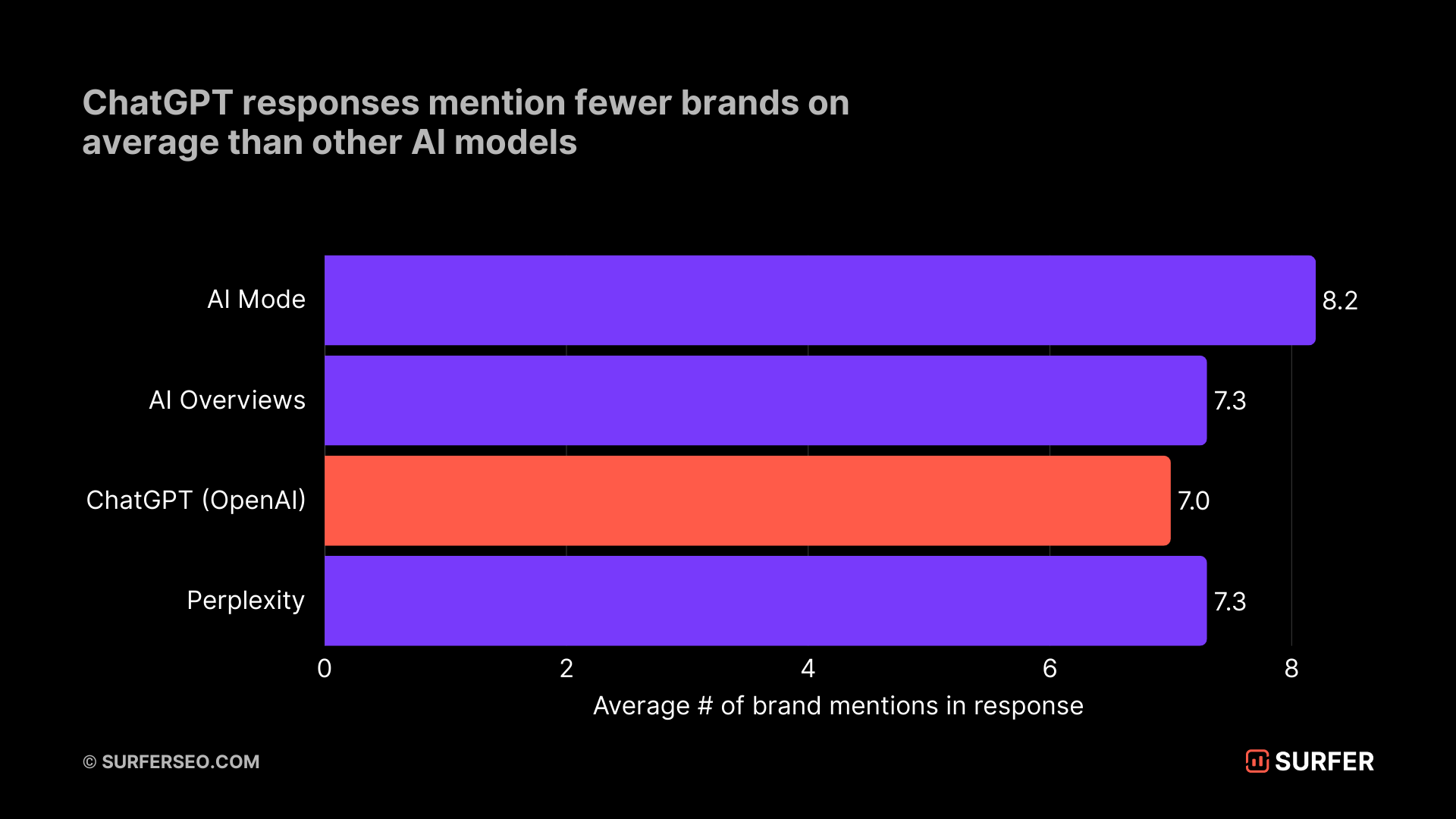
… despite citing by far the most sources:
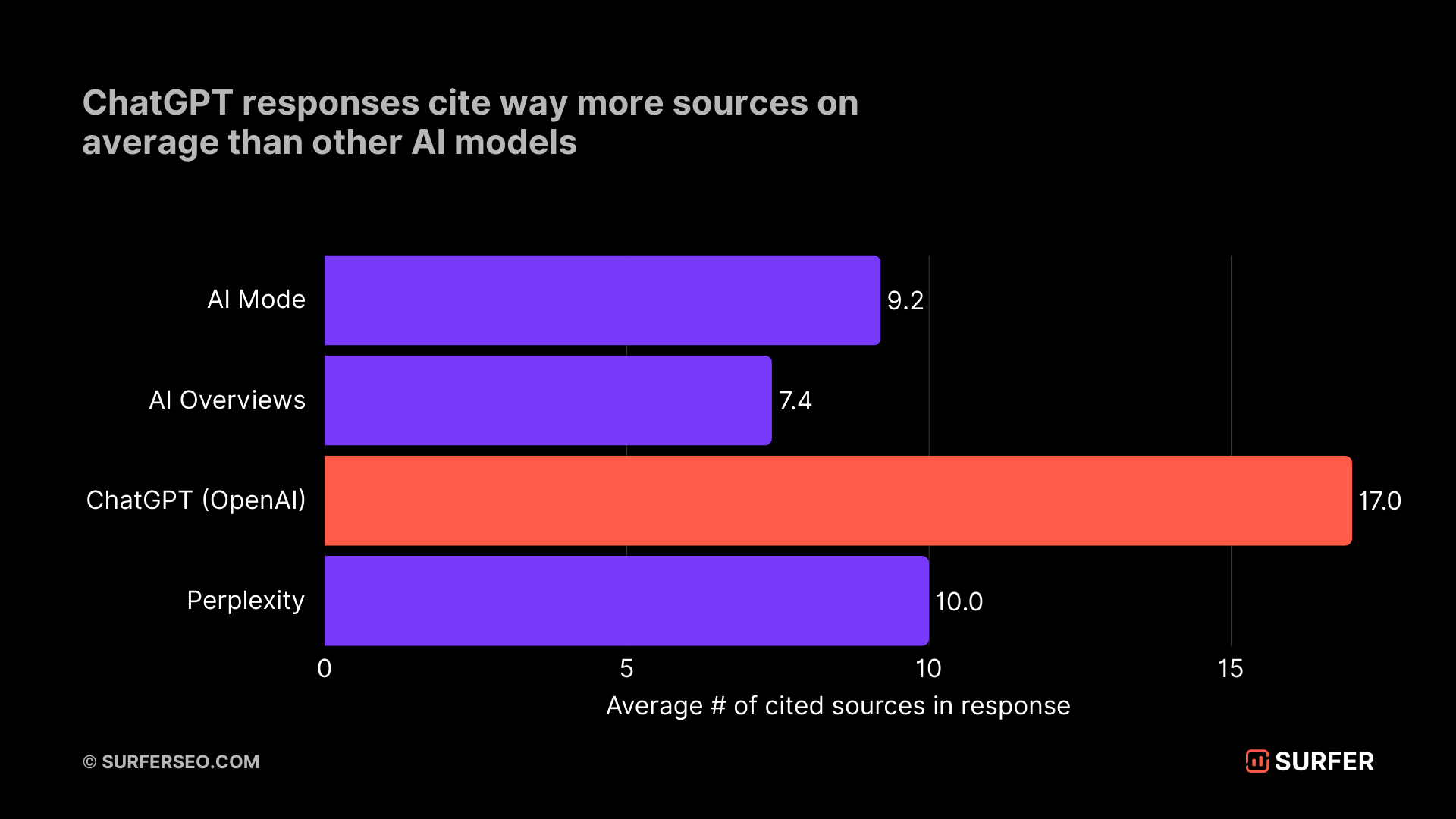
Takeaway: If you want ChatGPT to recommend your brand, getting mentioned in a high percentage of cited sources seems to be important—more so than with other AI assistants and models. But that’s harder to do in ChatGPT because it typically cites lots of sources—84.7% more than AI mode and 129.7% more than AI Overviews.
Brand mentions in blog posts have more impact on recommendation strength than mentions in any other type of content (e.g., reviews or news articles)
We found that although there’s a positive correlation between recommendation strength and mentions in all types of content, the strongest correlation occurs with blog posts:
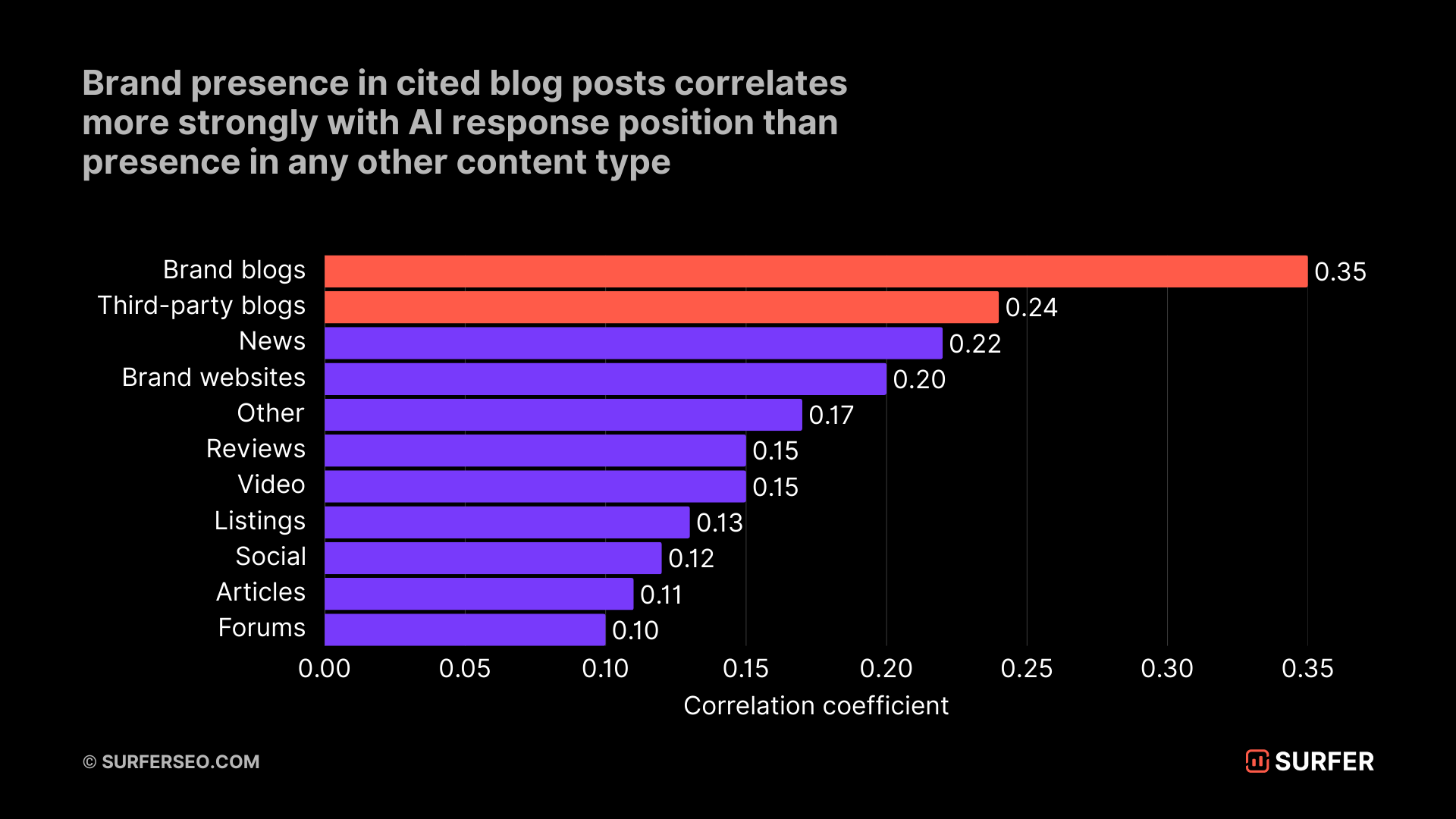
If you’re confused about the definition of “brand blogs,” these are the blogs of brands mentioned in the AI response.
For example, if the AI response recommends these brands…
- Surfer
- Ahrefs
- Semrush
- Moz
… then all of these blogs will be classed as “brand blogs”:
- surferseo.com/blog
- ahrefs. com/blog
- semrush. com/blog
- moz. com/blog
However, seranking.com/blog will be classed as a “third party blog” because SE Ranking isn’t recommended or mentioned in the AI response.
This finding becomes particularly interesting when we look at the distribution of content types found in cited sources:
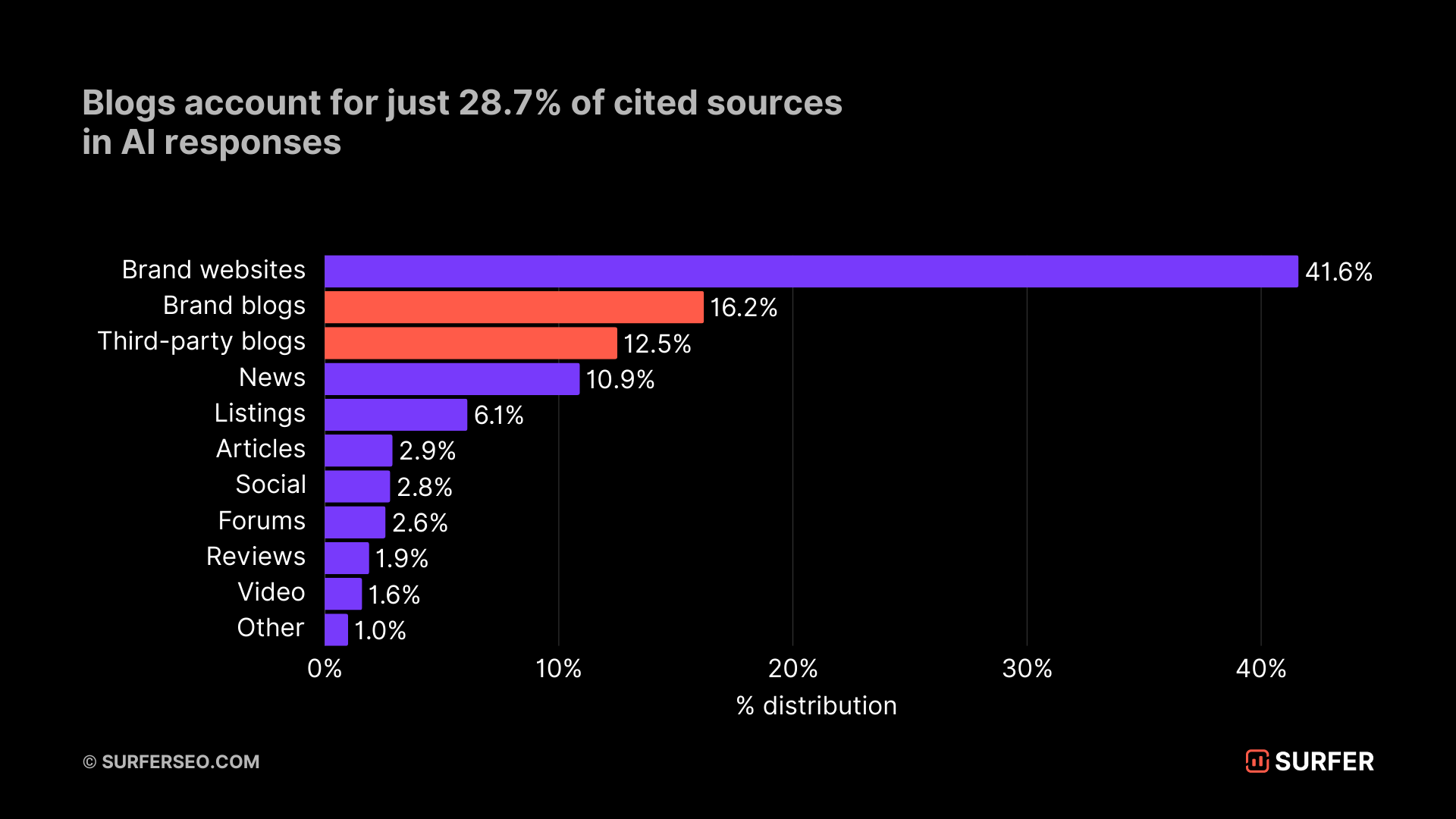
Here we see that only a relatively small percentage of cited sources are brand and third-party blogs—16.2% and 12.5% respectively.
Takeaway: Even though blog posts make up only 28.7% of cited sources, mentions in those blog posts correlate most strongly with recommendation strength in AI responses—so this is where you should focus on getting mentioned.
The correlation between brand presence and AI recommendation strength varies by industry
When we segmented the data by industry, some showed a stronger correlation than others.
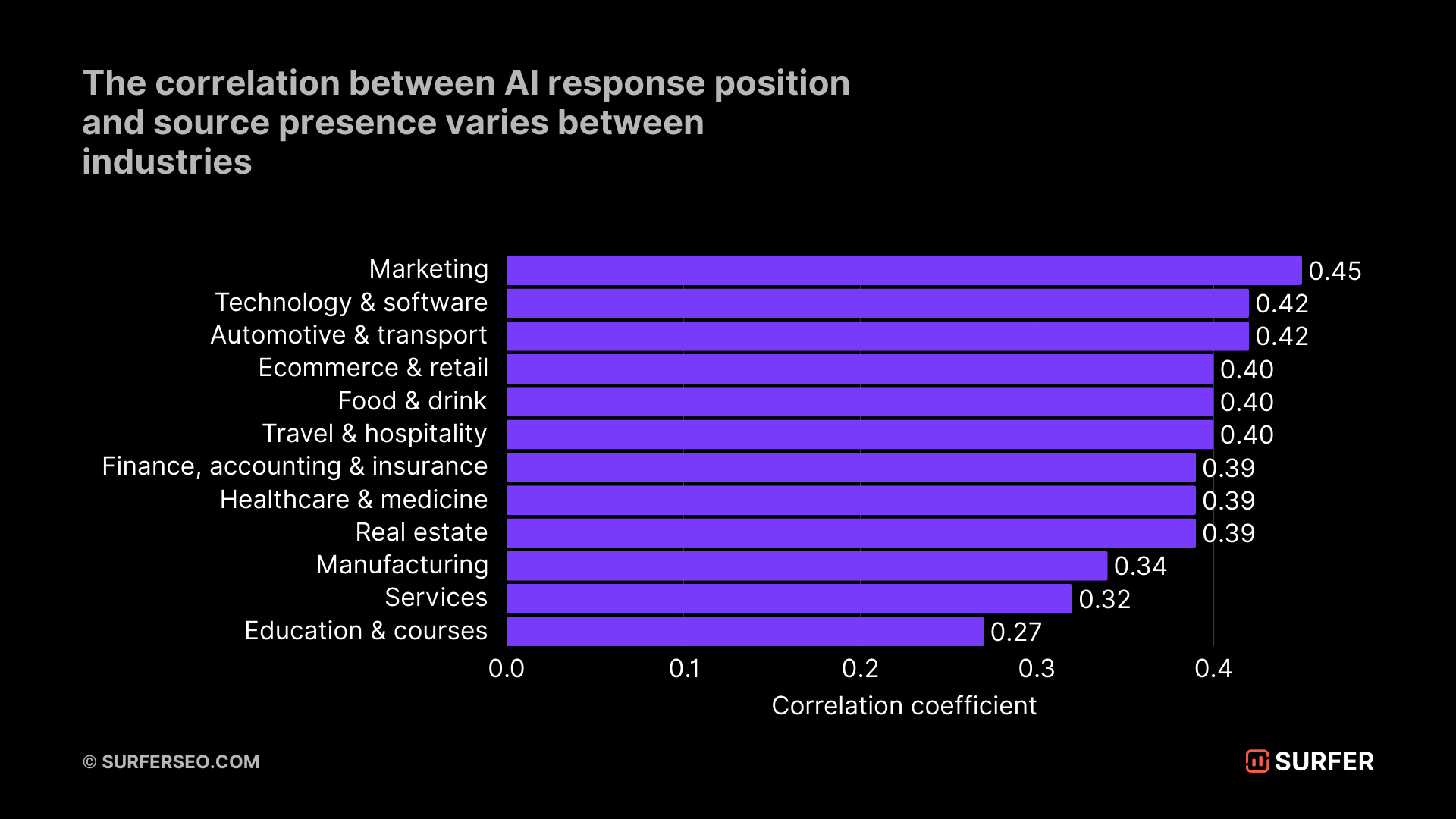
Takeaway: If you’re in the Services, Manufacturing, or Education & Courses industry, getting mentioned in many citations may be slightly less important than in most other industries.
What should you do about all this?
Let me kick things off with an important disclaimer…
It’s entirely possible that we see this correlation not because AI chooses brands to recommend from cited pages, but because it chooses to cite pages that mention brands it has already decided it wants to cite based on its training data.
If that were the case, however, I’d expect to see evidence of this in the fanout queries—and I rarely do.
For example, if I ask ChatGPT to recommend the best project management software, our free Keyword Surfer extension reveals that none of the fanout queries mention any particular brands:
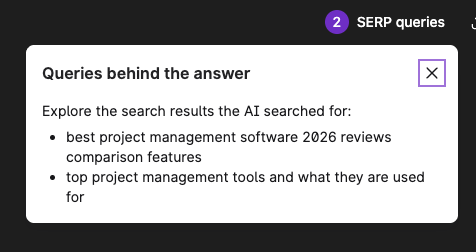
If it were looking for pages that mention the brands it already had in mind, I would expect fanouts that mention those brands in fanouts like “basecamp vs asana”.
This rarely seems to happen.
So… assuming that AI most often pulls brands to recommend from cited pages, what should you do?
It appears the game is to get mentioned on as many frequently cited pages as possible—especially blog posts.
This is particularly true for ChatGPT.
Of course, it’s going to be pretty hard to get mentioned on your competitors’ blogs, so focus on finding the third-party blogs that AI cites again and again.
To find these, you can use Surfer’s AI Tracker.
First, set up a project by entering:
- your brand name (e.g., Nike)
- a topic or keyword related to your brand (e.g., “running shoes”)
- the location you care about most (e.g., United States)
AI Tracker will suggest prompts to track…
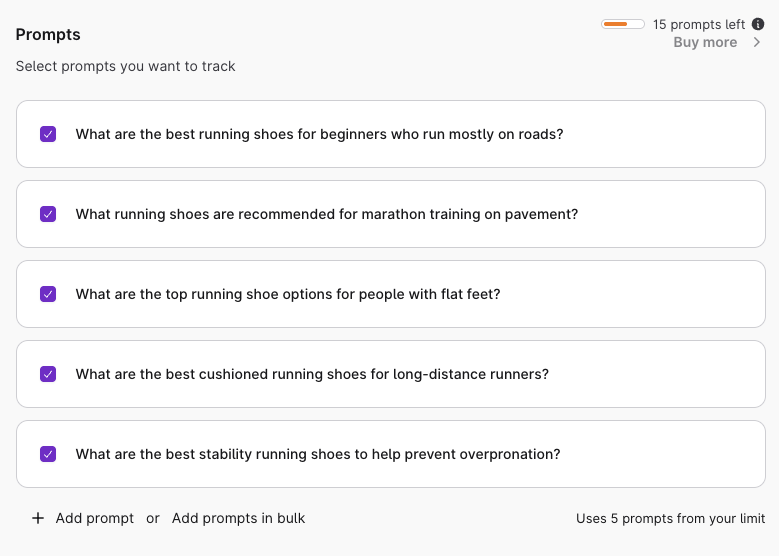
… but you can override these and enter them manually, if you prefer.
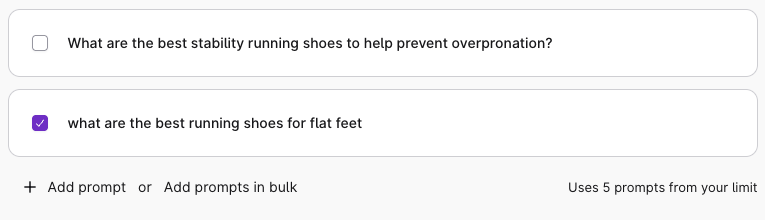
For example, I uncheck a suggested prompt and enter one of my own instead, like “what are the best running shoes for flat feet?”:
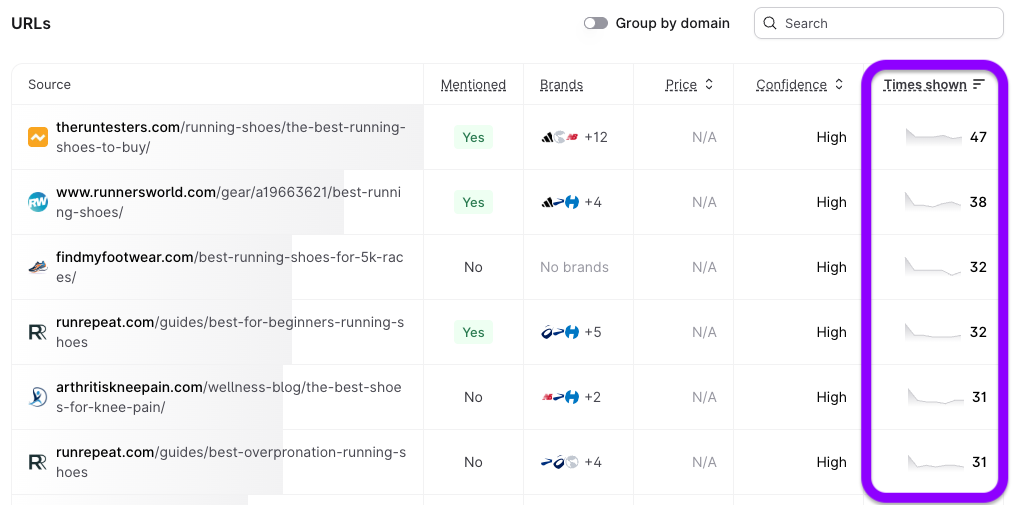
Once the project is set up, go to the “Sources” tab.
Here you’ll see the most frequently cited pages for your tracked queries across AI Overviews, AI Mode, ChatGPT, and Perplexity:
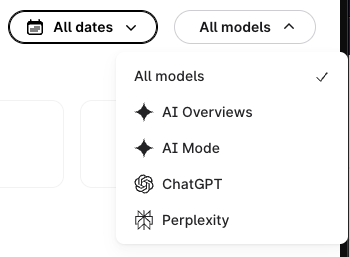
If you only want to see the most cited pages for a particular AI assistant, like ChatGPT, use the filter:
From here, look for blog posts where you aren’t yet mentioned.
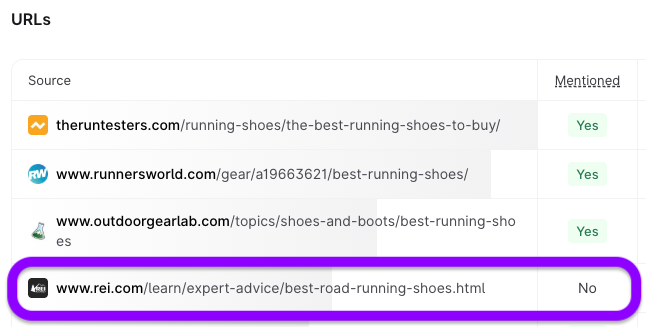
For example, Nike is mentioned in most of the top cited sources—but not this post from REI about the best road running shoes:
To stand a chance at getting mentioned, you’d have to reach out to the author and see if you can convince them to add you.
Of course, this is easier said than done…
Some authors are happy to add you for a fee, but that’s much less common with reputable blogs like REI. A softer, more personal approach usually works better for big players.
For example, nowhere in REI’s post do they explain how they chose which shoes to road test—nor whether they actually tested any Nikes. So, in my opinion, a good starting point here is to reach out to the authors with a simple question like:
Hey Heather,
Couldn't help but notice that no Nikes made the cut on your list of the best road running shoes.
Just curious, did any Nikes make your shortlist for testing?
I’m asking because I couldn’t see any explanation of the selection methodology on the page.
Thanks,
Josh
CEO @ Nike
Sure, this is unlikely to get you a mention right away—but it might help you to understand why you’re not mentioned in the first place.
- Maybe they’ve never heard of your brand? Introduce them
- Maybe your product was too expensive for them to test? Consider sending free samples or a free trial
- Maybe there was a product issue? Send feedback to the product team
You get the idea…
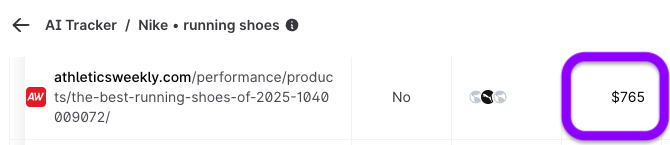
It’s also worth noting that Surfer’s AI Tracker now shows prices for sponsored articles and link placements on sites that sell them via marketplaces.
For example, you can buy a sponsored post on this site for $765:
So, if that fits with your strategy, go for it!
Either way, don’t forget that the best long‑term strategy for AI visibility (and plain ol’ SEO) is to build a great product or service and market it exceptionally well. That’s always been the only strategy that truly stands the test of time and weathers the constant storm of algorithm updates, and it’s still true in the age of AI.