A growing share of people now treat generative AI as their primary way to search, and that share is climbing fast. I watch the same habit in myself: open an assistant, read the synthesized reply first, and only hunt for links when the summary feels thin or untrustworthy.
Answer engines are moving from experiment to default across major products. At Surfer, we use answer engine optimization to describe the tactics that help your expertise surface inside those systems, not only on a classic results page.
AEO is still a young idea. The vocabulary will keep shifting as platforms ship new surfaces.
This post walks through what AEO is, how it works in practice, why we care about it next to traditional SEO, and how to execute without losing rigor.
What is answer engine optimization (AEO)?
Answer engine optimization is the discipline of shaping content so AI-powered search engines can find it, trust it, and cite it. That includes assistants and copilots such as ChatGPT-style tools, Perplexity, Bing Copilot, and Google experiences like AI Mode and AI Overviews.
It also maps to familiar Google features: featured snippets, Knowledge Graph-style entity facts, and voice answers. The constant is writing that supplies direct answers to user queries, which increases the odds you earn visibility and traffic when a model assembles a response.
My AEO rule stays blunt: lead with the claim, stack proof on the next breath, and place trust signals where an engine can see them so the quote survives intact.
Traditional SEO aims to improve your position on the SERP. AEO aims to get your brand and copy mentioned inside the AI-generated answer people read before they click.
If I ask Google's AI Mode what the best hot dog joints in Chicago are, I get a list compiled from multiple sources, not a single page repeated verbatim.
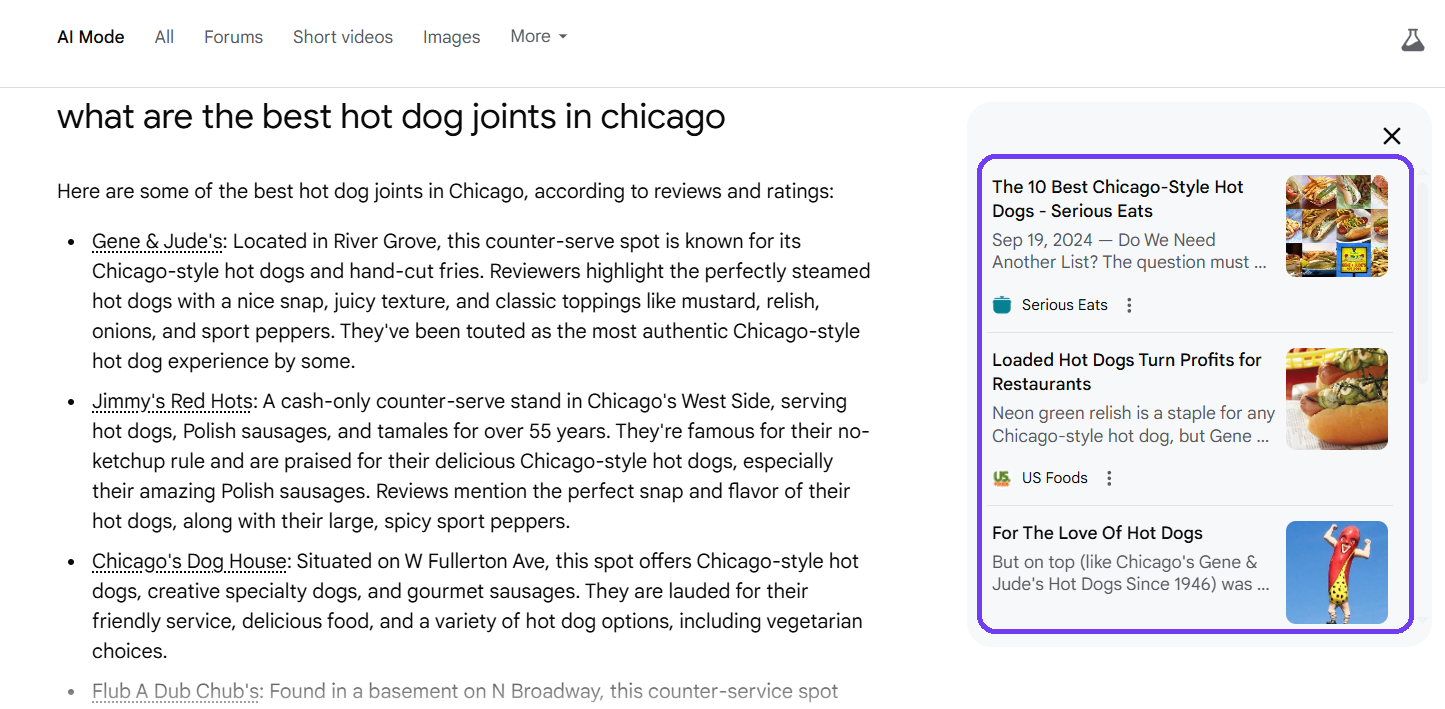
Google then displays the sources it used to generate answers in the right-hand corner of the screen. The same idea applies to other AI assistants, like Perplexity and ChatGPT.
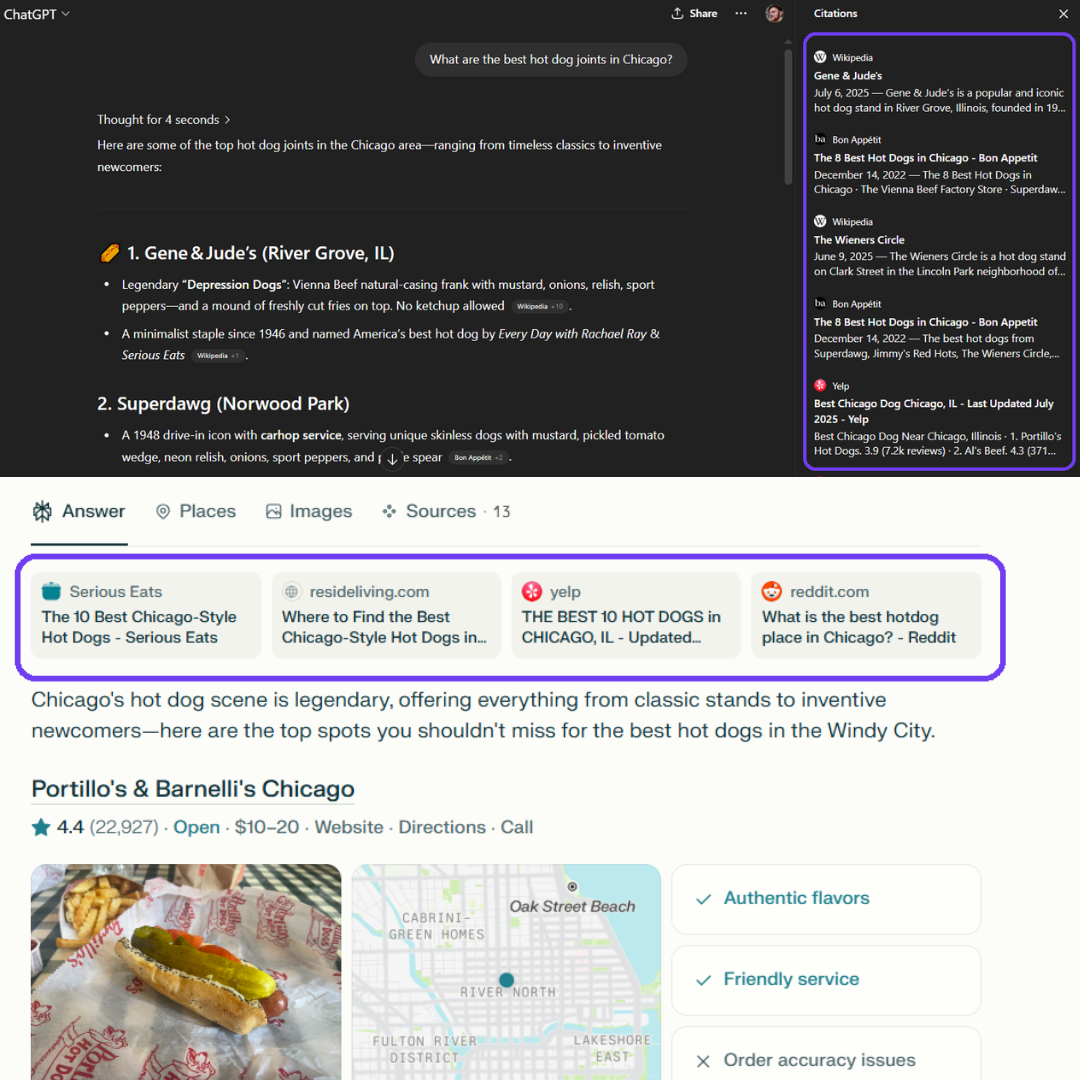
As such, AEO makes it more likely for AI algorithms to extract and mention your content in AI-generated results.
Here's a quick comparison of traditional SEO and answer engine optimization:
AspectTraditional SEOAnswer Engine OptimizationPrimary goalRank higher on search engine results pagesGet cited in AI-generated answersTargetSearch engine ranking algorithmsAI/LLM retrieval systemsContent formatKeyword-optimized pagesDirect, conversational answersSuccess metricRankings, clicks, organic trafficAI citations, brand mentions, Share of AnswerQuery typeShort-tail keywordsLong-tail, conversational queries
You may also encounter the term generative engine optimization (GEO). While AEO and GEO are closely related, they target different systems. AEO primarily focuses on getting cited in Google's own AI features—AI Overviews and AI Mode—as well as featured snippets and voice search. GEO targets third-party AI models like ChatGPT, Perplexity, and Claude.
The tactics overlap significantly, but the timelines differ. AEO changes can show results within 30–60 days as Google re-crawls and re-indexes your content. GEO results often take 6–12 months because third-party models retrain on different cycles. In this guide, I'll cover strategies that work across both.
Why is AEO important?
AEO is important because it drives more high-purchase-intent traffic to your website. AI-driven clicks are a strong revenue driver for several companies, including ours.
Approximately 25% of new Surfer customers now originate from AI assistants.
Ahrefs reported similar behaviour.
"For ahrefs.com, 0.5% of visitors in the last month were from AI Search, but those were 12.1% of our signups. This conversion rate is 23x higher than we get from traditional organic search."
— Patrick Stox, Ahrefs Product Advisor, Technical SEO, and Brand Ambassador.
The scale of this shift is staggering. ChatGPT now has over 900 million weekly active users, Google AI Overviews reaches 2 billion users across 200+ countries, and Perplexity processes more than 1.2 billion queries per month. If your content isn't optimized for these platforms, you're invisible to a rapidly growing audience.
Unlike traditional search engine optimization—where you would typically target search terms comprised of two or three words—AEO involves much lengthier, more specific search queries.
Users often leverage AI search engines or voice search assistants to get quick answers that would've otherwise been trickier to find via the regular search bar.
This often translates to high-intent, long-tail queries like the one I showed earlier.
Here are a few other reasons why AEO is so important:
Zero-click searches are accelerating
Zero-click searches now account for nearly 60% of all Google queries, and Gartner projects traditional search volume will decline 25% by the end of 2026 as users shift to AI-powered answers. Zero-click searches are more convenient because they offer instant information—having your webpage provide that instant information is crucial.
Shifts in search behavior
According to WebFX, over 60% of Millennials and Gen Zers already use AI engines in their search routines. Overlooking AEO will likely cause you to miss out on a significant portion of organic search traffic.
Brand visibility
Google's AIO takes up huge chunks of search engine results pages. Having your website pop up here will have a major effect on your overall presence.
Plus, simultaneously optimizing content for other AI engines like ChatGPT and Perplexity would be a huge win, visibility-wise.
To put it differently, AEO is absolutely necessary to maintain visibility, generate organic traffic, and boost sales. Your website is at risk of missing out on these benefits, and maybe even losing part of your existing traffic, otherwise.
How AI engines source and cite content
AI search engines scrape massive datasets and extract information from multiple sources across the web. They take search queries, use natural language processing to understand their explicit intent and context, and form answers by citing and compiling information from the most relevant sources.
This is done via retrieval-augmented generation (RAG), an LLM framework that combines retrieval-based systems with generative AI to improve the accuracy and relevance of AI-generated outputs.
RAG allows LLMs to pull information from resources outside their training data, ensuring up-to-date responses. But each platform retrieves information differently:
- Google AI Overviews uses its own search index—77% of its citations come from pages already ranking in the top 10 organic results.
- ChatGPT Search pulls primarily from Bing's index, with an 87% match rate between its citations and Bing's top 20 results.
- Perplexity retrieves from multiple sources (primarily Google) in real time, with about 60% of its citations matching Google's top 10.
That's why Google's AI Mode is capable of answering queries about upcoming movies, trending topics, and current events in real time:
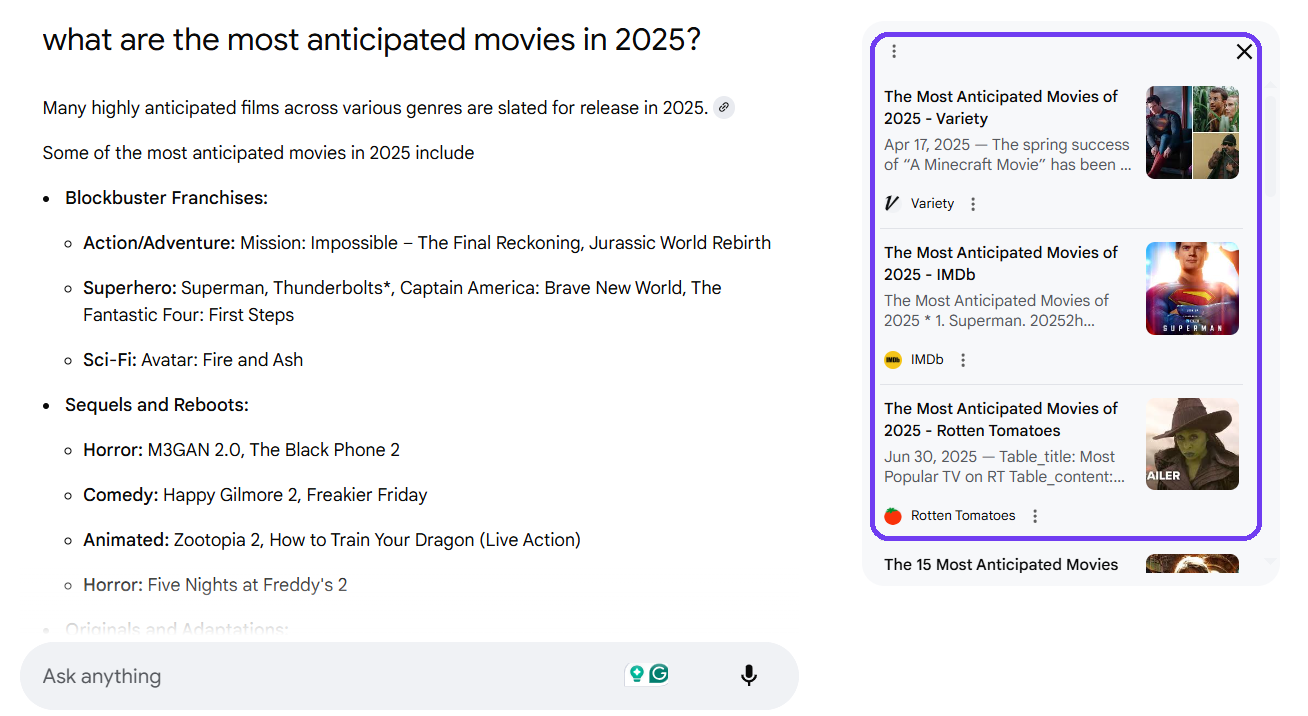
As you can see, Google compiled information from recently published blog posts—it looked at resources outside its training datasets.
But how do AI search engines pick the resources to extract information from?
Website authority plays a major role. AIs prioritize websites they deem as highly authoritative and trustworthy in their niche—but it's not the only factor.
Case in point, the answer above was compiled from industry giants like IMDb, Rotten Tomatoes, and Variety. However, research shows that 60% of AI Overview citations come from pages not in the top 20 organic results. That means content structure, freshness, and entity relevance can help you earn AI citations even without massive domain authority.
9 ways to optimize for answer engine results
The good news: you don't need to be a huge industry authority to make it into AI results. The answer engine optimization strategies I'm about to show you will boost the chances of having your content show up across AI search engines.
1. Write conversational summaries
You want to make it as easy as possible for AI algorithms to scan your content and extract information from it. That means you should provide direct answers, ideally through a short one or two-sentence summary, before you get into details.
Think of each section as a self-contained knowledge fragment—a modular answer block that makes sense on its own when extracted by an AI engine. If an AI pulls just one section from your page, that section should deliver a complete, useful answer.
To illustrate, here's what happens if I type in "How to set up out of office in Outlook?":
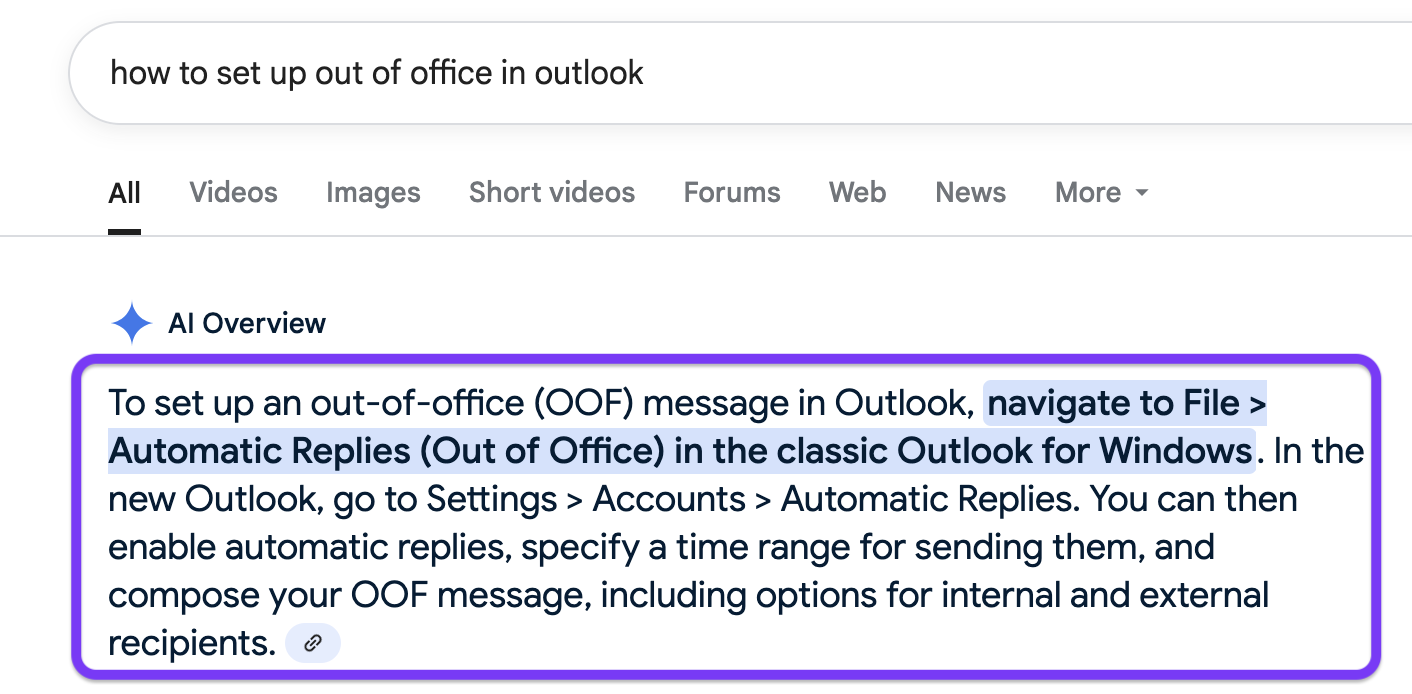
The answer is made out of three simple sentences—no need for fluffy intros and lengthy blog posts. Both AIs and users want direct, digestible answers, so your content should follow a similar format.
Use active voice and write subject-first sentences, like "You can set up out-of-office messages by…," for example.
This approach also helps AI search engines better understand each sentence's context and make it more likely for your content to get cited.
You can follow Google's fan-out technique—provide concise answers right at the beginning, then expand on them with supporting detail. The example above is actually just a snippet of a much more in-depth answer. Users can click on the Show More button to view the answer in full.
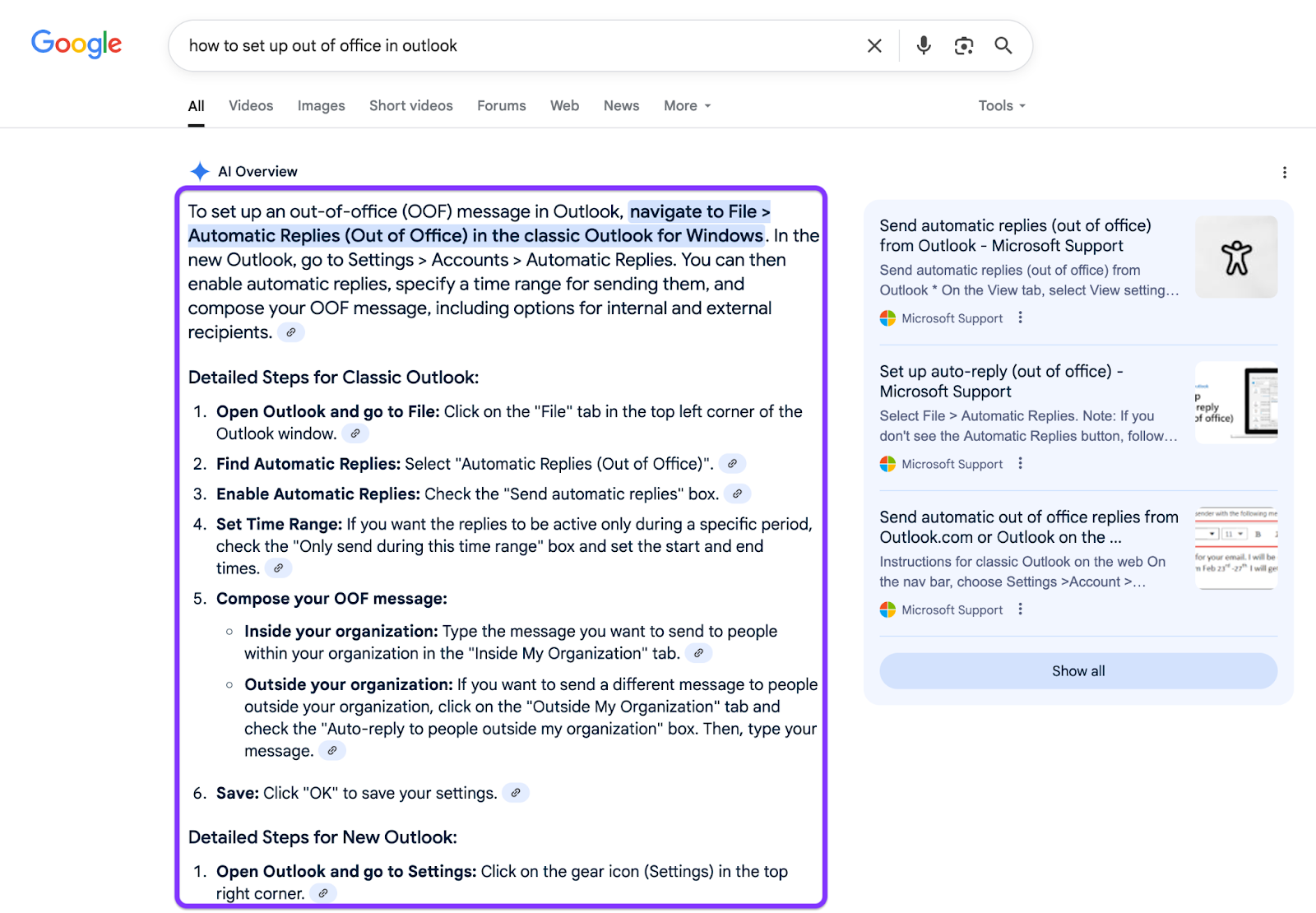
Notice how the top summary is neatly split into two parts—the new Outlook and the classic Outlook. The top summary covers both versions in a few sentences.
If users want more information, however, the answer beneath is split into two distinct sub-sections, each getting into more details.
2. Use LLM-friendly formatting
Our study on AI Overviews found that AI-generated answers include either unordered or ordered lists 78% of the time, which makes sense.
Lists are the ideal format for zero-click searches—they display large amounts of information in a clear, digestible manner.
Your content should follow suit. Break up your content into lists, bullet points, and tables to make it as scannable as possible.
This blog post from Healthline is an excellent example:
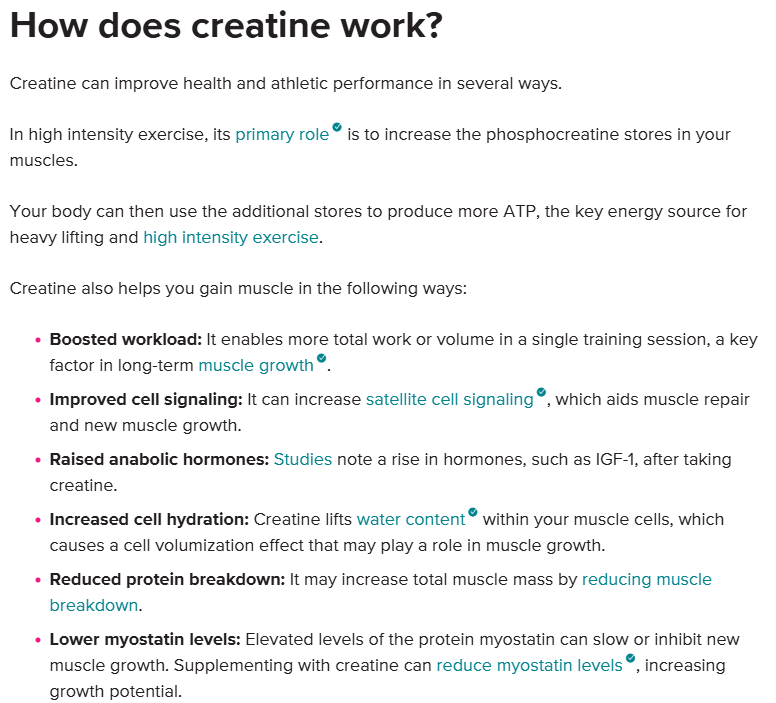
Each idea is neatly summarized under its own bullet point, making it easier for AI-driven search engines to extract particular details.
Here are a few other best practices you can pull from this blog post:
- Write short, decisive paragraphs: Aim for two or three sentences per paragraph and ideally keep your sentences under 20 words. Focus on declarative statements to provide authoritative and direct answers to readers.
- Avoid vague headings: AIs and traditional search engines rely on headings to understand content. Headings should be specific and summarize the ideas beneath them—think "How does creatine affect muscle growth?", for example.
It's more direct and specific than "Creatine benefits." This also helps answer engines better connect user queries with your content. - Include semantic cues: Start sentences with phrases like "According to," "the most important," or "by comparison," when appropriate. This helps AIs understand each sentence's purpose and context.
- Think multimodal: AI models like Gemini and GPT-4o now process images, video, and infographics alongside text. Include well-labeled visuals with descriptive alt text and captions—this gives AI engines additional content to extract and cite.
3. Use clear and descriptive subheadings for easy navigation
Speaking of headings, make sure you break your content down into H2s and H3s.
One of our internal studies on AI Overview answers revealed that pages in AI Overview results score 19.95% better on subheadings and navigation structures than non-included pages.
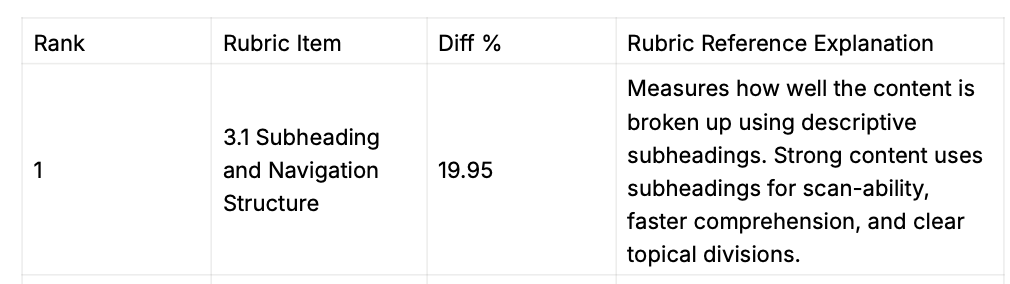
That means the more structured and scannable your content is, the more likely it is to have it picked up by answer engines. Crystal-clear headings and subheadings are excellent for achieving that.
Again, avoid vague headings. Your headers should clearly encapsulate each of your content's discussion points, while the copy below them should build on your ideas in two to five paragraphs.
Use nested headings to divide your main topic into multiple secondary discussion points in a logical and hierarchical manner.
H1s highlight your content's main idea, H2s present its related subtopics, H3s further develop on the said subtopics, and so on.
You want users and AIs to summarize the bulk of your content just by looking at the headings.
Here's how Grammarly does it:
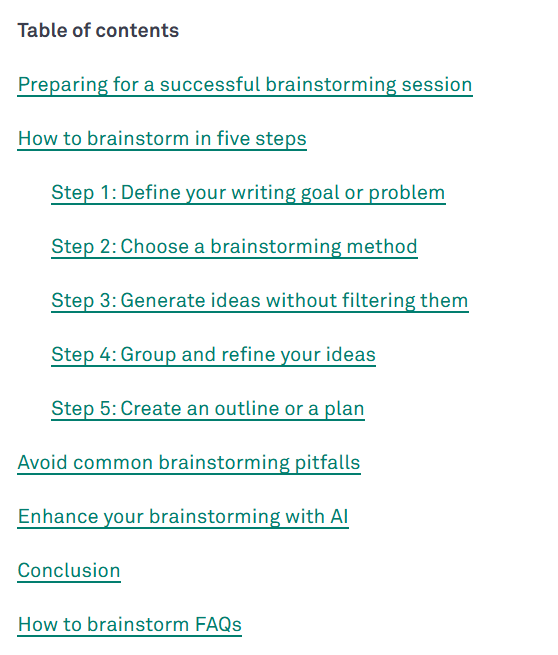
This particular blog post is titled "How to Brainstorm: 5 Simple Steps for Stronger, More Organized Writing." The title is clear-cut. Readers know exactly what to expect from the content through the page title alone.
Each H2 and H3 then breaks the page title down into separate talking points in a logical, hierarchical order—from how to prepare for a brainstorming session, to conducting the brainstorm itself, common mistakes you should avoid, etc.
All subheadings neatly tie back into the blog post's main idea.
Consider adding a Table of Contents plugin or anchor links to your blog pages, similar to the example above. This helps with reader navigation and may help with LLM parsing.
4. Define concepts clearly and explain their relationships
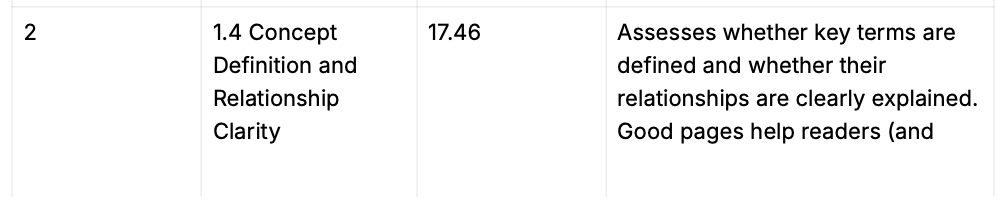
Begin new sections by clearly defining the key terms you will talk about in detail. The same study I mentioned found that pages adopting this practice score 17.46% better on AIOs than those that don't.
If you were to write a section about a complex topic, like how to perform a technical SEO audit, you should first start by explaining what technical SEO audits actually are or what they do—just like what AIO does here:
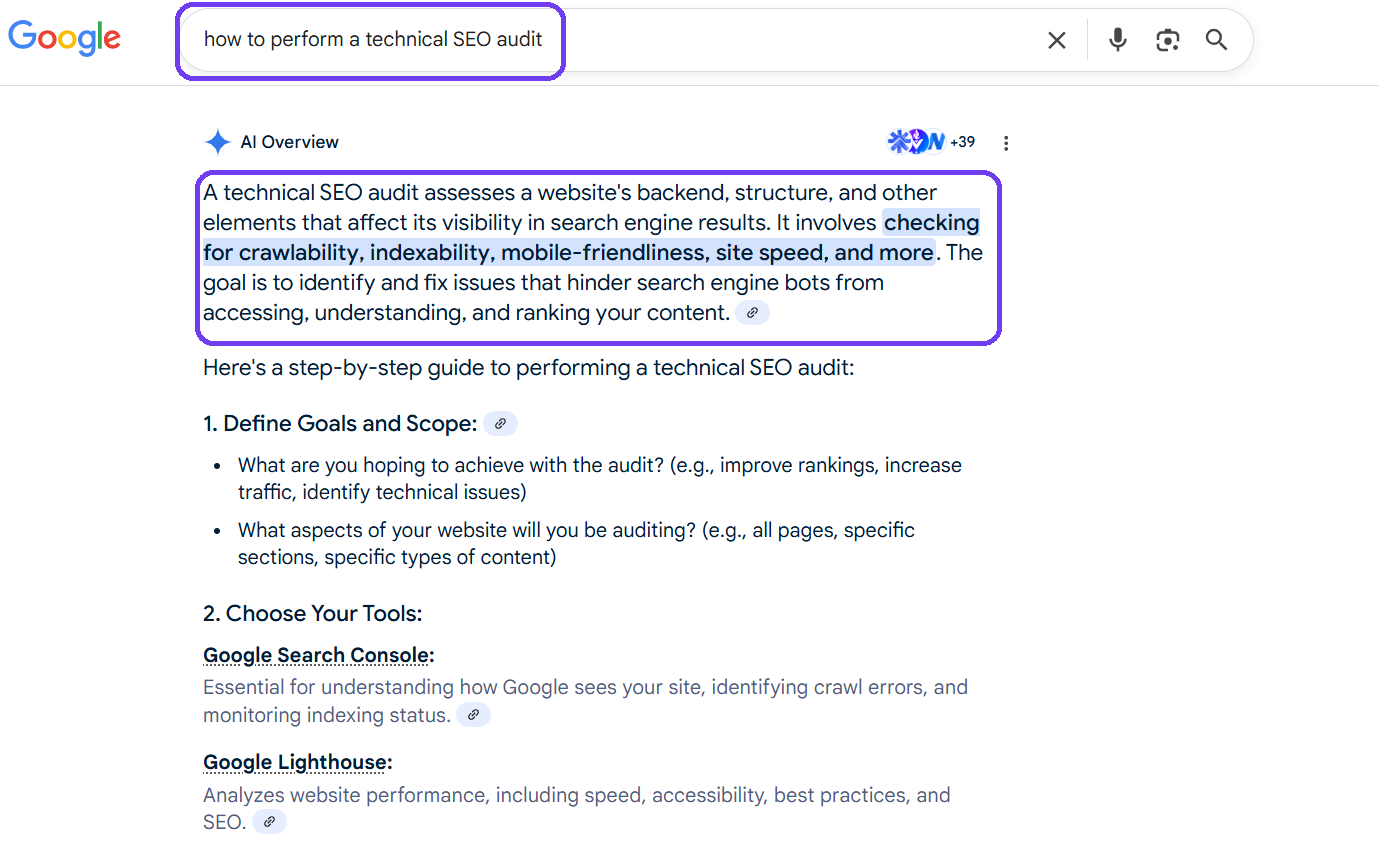
Don't assume readers are already familiar with the topic in question because some might not be. Plus, this practice gives search engines extra context behind your content's main and secondary topics.
Use semantically related terms to bolster this effect.
For instance, if "technical SEO audits" is the primary keyword, you should also include other related terms like "crawlability," "site speed," and "site structure."
But include these terms naturally throughout your content and build up enough context to make sure AI algorithms, regular crawlers, and readers clearly understand how all these terms relate to one another.
Linking phrases like "for example," "in contrast," and "as a result" also help improve clarity and hint to search engines how different paragraphs correlate with each other.
5. Align structured data with visible content
Although more closely associated with traditional SEO, structured data (or schema markups) can still help with answer engine optimization, as per Google's guidelines.
In short, these HTML code snippets use pre-defined tags to signal to search engines the exact type of content a webpage covers.
AI platforms can also use structured data markups to find and extract information about your business or web page more easily.
Here's the schema markup of a blog post that includes a small FAQ section near the bottom:
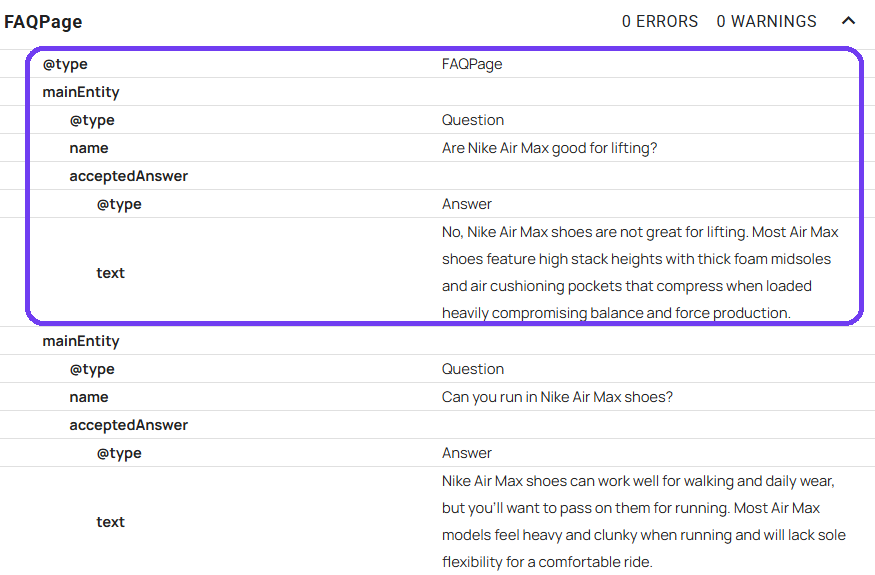
Each question and answer within the FAQ section is clearly highlighted via the @type Question and @type Answer labels under the FAQPage schema markup.
Here's what the FAQ section looks like on the live blog post:
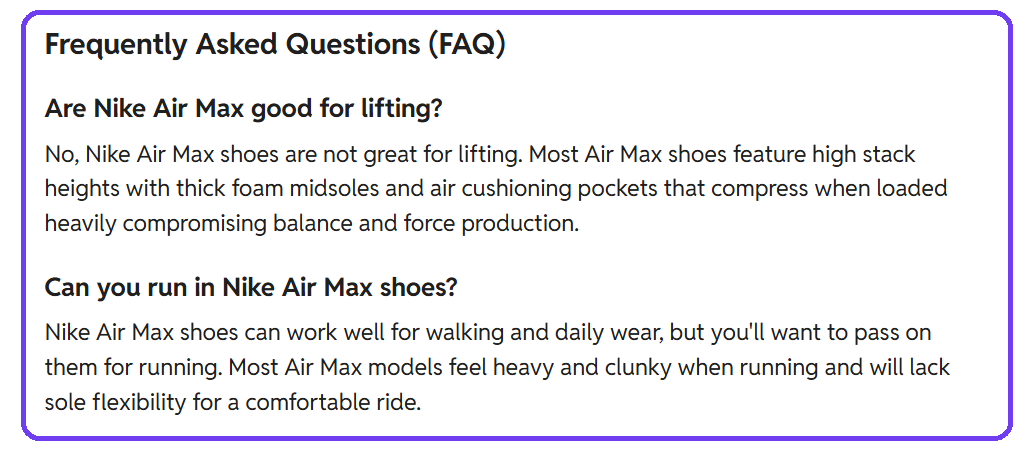
Notice how the FAQ copy is an exact match with the one written in the Schema markup. And here's what happens if I Google "Are Nike Air Max good for lifting?"
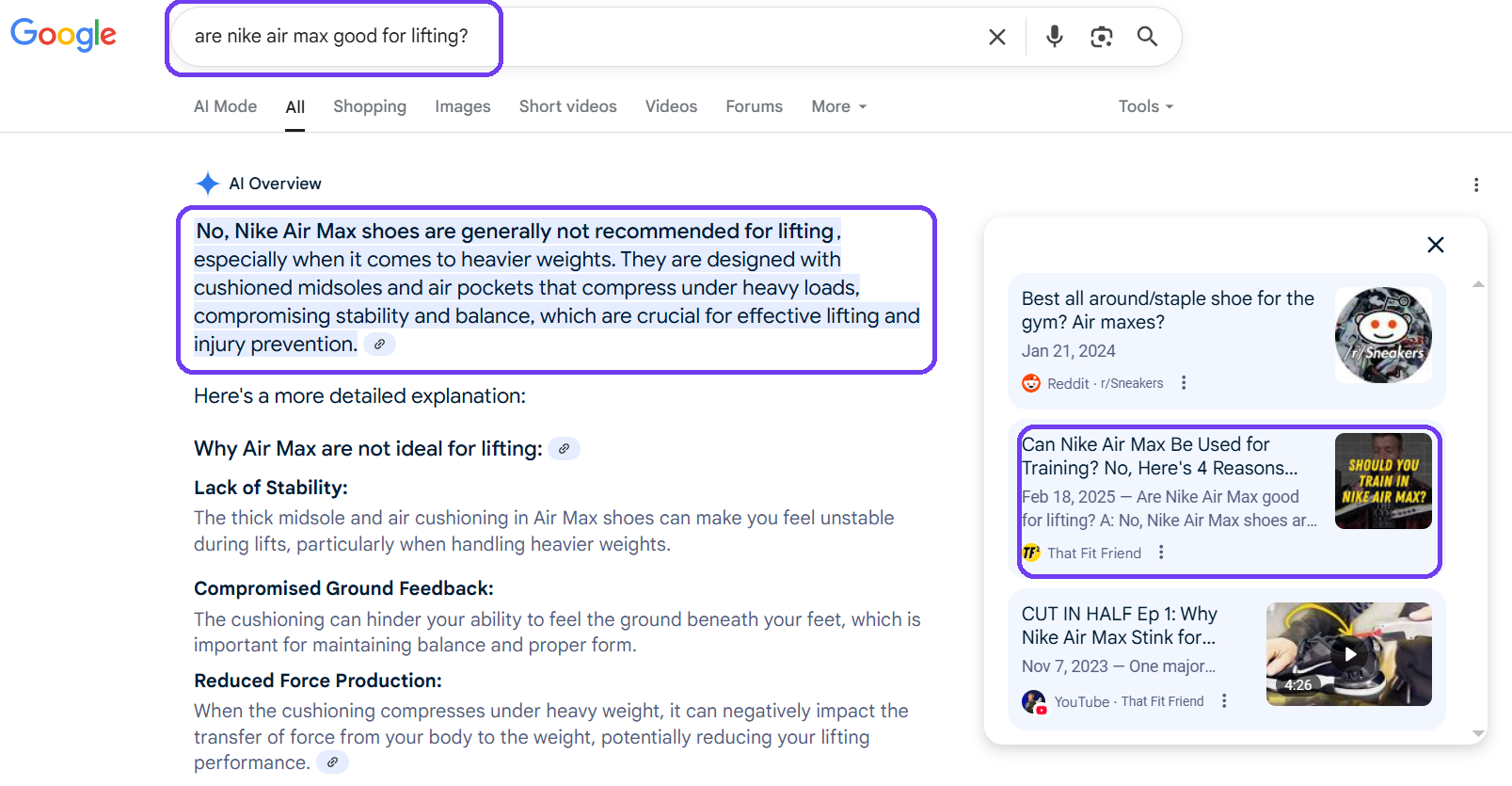
Google AIO pulled info from the blog post's FAQ section—the structured data most likely helped here.
Still, make sure you keep all your information consistent. The details highlighted in your site's structured data must align with what users see live on your webpage because search engines use consistency as a trust signal.
You may risk being treated as an unreliable source of information otherwise.
An important nuance: structured data is not a direct ranking factor according to Google's own documentation. But it reduces hallucination risk and improves citation accuracy by giving AI engines a clearer signal about what your content covers.
Beyond FAQ schema, consider implementing these additional schema types for AEO:
- Speakable schema: Marks sections of your content as suitable for text-to-speech playback, making it more accessible to voice assistants and voice-based AI queries.
- Author schema: Reinforces E-E-A-T signals by linking content to verified author credentials and expertise.
- HowTo schema: Structures step-by-step instructions in a way AI engines can easily parse and cite.
- LocalBusiness schema: Helps AI engines surface your business for location-specific queries.
Here are a few other best practices to follow:
- Validate structured data: Run your Schema through Rich Results Test or Schema Markup Validator before uploading it to your site to ensure the code works as intended.
- Use schema only when appropriate: Only use markups when your content can truly facilitate this format to avoid trust-related issues from search engines. Here's a list of some popular Schemas and when to use them.
- Use JSON-LD formats: Microdata and RDFa schema formats are also available, but Google recommends sticking to JSON-LD—it's easier to maintain and implement.
6. Use questions in your headers
Due to AI models' conversational nature, AI search queries also tend to be question-based. That means AI algorithms will prioritize content that facilitates this format when extracting information.
Again, AIs will look at your headings to understand your content and its structure.
As such, question-based headings that mimic AI search queries will make it easier for AIs to match your content and cite your answers whenever users look up particular details.
Remember that the copy beneath your headings should provide short and precise answers. Here's a solid example:
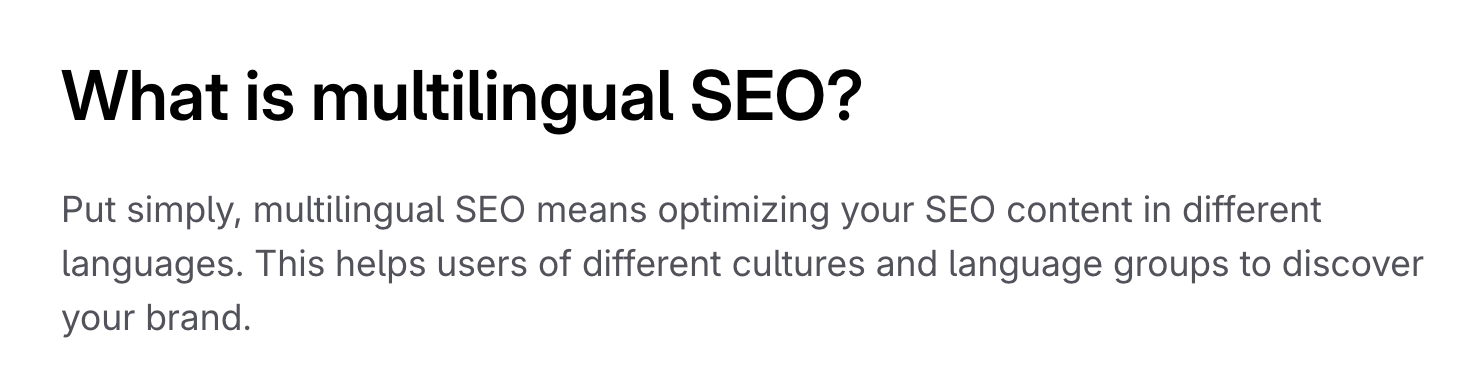
You can develop on this concept and answer secondary questions related to the main query in a FAQ/Q&A-style blog post.
To better illustrate, this SySTools post has formatted most of its headers to simulate natural AI search queries:
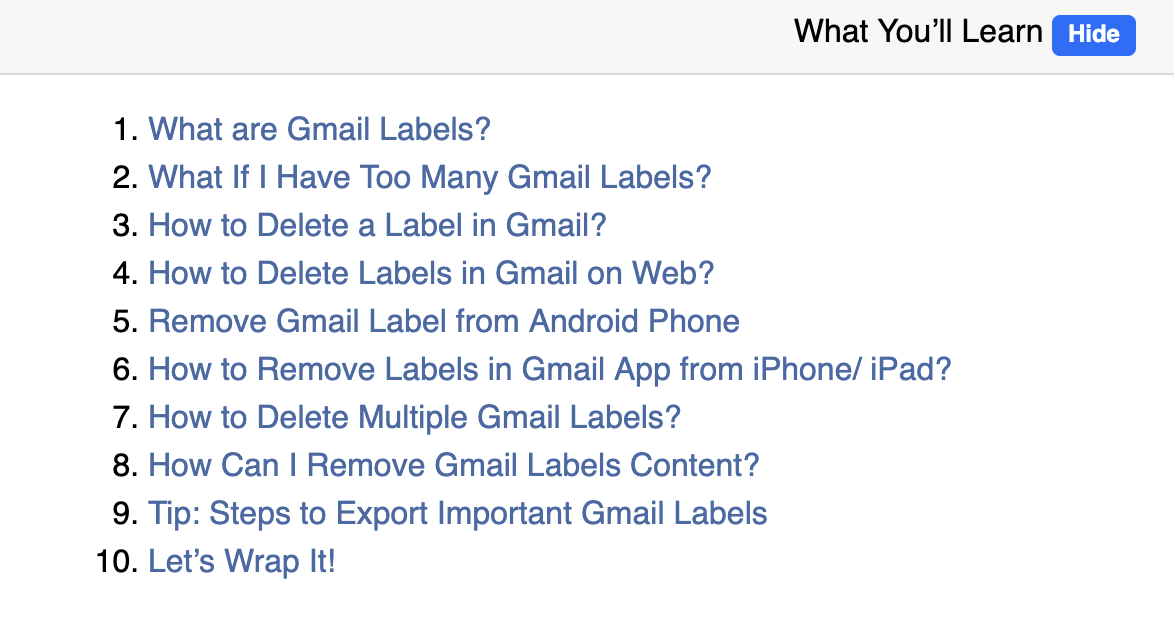
You can also add dedicated FAQ or Q&A schema markups under each particular section whenever appropriate.
7. Ensure AI crawlers can access your content
If AI bots can't crawl your content, nothing else on this list matters. This is the foundational prerequisite for answer engine optimization, yet it's one of the most commonly overlooked steps.
Several AI platforms use dedicated crawlers to index web content: GPTBot (OpenAI/ChatGPT), ClaudeBot (Anthropic/Claude), PerplexityBot (Perplexity), and Google-Extended (Gemini). By default, some sites block these bots via robots.txt without realizing it.
Check your robots.txt file and make sure you're not unintentionally blocking AI crawlers. If you want AI engines to cite your content, you need to explicitly allow access:
User-agent: GPTBot
Allow: /
User-agent: ClaudeBot
Allow: /
User-agent: PerplexityBot
Allow: /
Beyond robots.txt, consider implementing llms.txt—an emerging standard that acts as a guide for AI crawlers, pointing them toward your most important and well-structured content. Early data suggests that sites with llms.txt see up to 1.9x higher AI citation rates.
Your llms.txt file sits at the root of your domain (e.g., yoursite.com/llms.txt) and contains a structured list of your best content, organized by topic. Think of it as a curated sitemap specifically for AI engines.
To verify that AI bots are actually crawling your site, check your server logs for requests from these user agents. If you see GPTBot, ClaudeBot, or PerplexityBot hitting your pages regularly, your access configuration is working.
8. Build authority through digital PR and brand mentions
AI engines don't just look at your content—they look at what the rest of the web says about you. Backlinks, brand mentions, and citations from authoritative sources all influence whether AI platforms trust and cite your content.
This makes digital PR a core answer engine optimization strategy. Here's how to approach it:
- Publish original research and data: AI engines favor content they can cite as a primary source. Proprietary studies, surveys, and data analyses earn backlinks naturally and give AI models a reason to reference your brand.
- Contribute expert commentary: Guest posts, podcast appearances, and expert quotes in industry publications build the kind of cross-domain authority signals that AI engines rely on.
- Participate in communities: Reddit, Quora, and niche forums are increasingly important for AEO. Google's "Hidden Gems" update prioritizes authentic community content, and ChatGPT frequently cites forum discussions in its answers.
- Monitor brand mentions across AI platforms: Regularly query ChatGPT, Perplexity, and Google AI Mode for topics in your niche. Track whether your brand is being mentioned, cited, or recommended—and identify gaps you can fill.
The goal is to create a web of references and mentions that AI models can't ignore. When multiple authoritative sources reference your brand in the context of your niche, AI engines are far more likely to cite you in their answers.
9. Experiment with text fragment identifiers
Text fragment identifiers are URL string parts that link to particular snippets of text within a webpage. Here's what it looks like in practice:
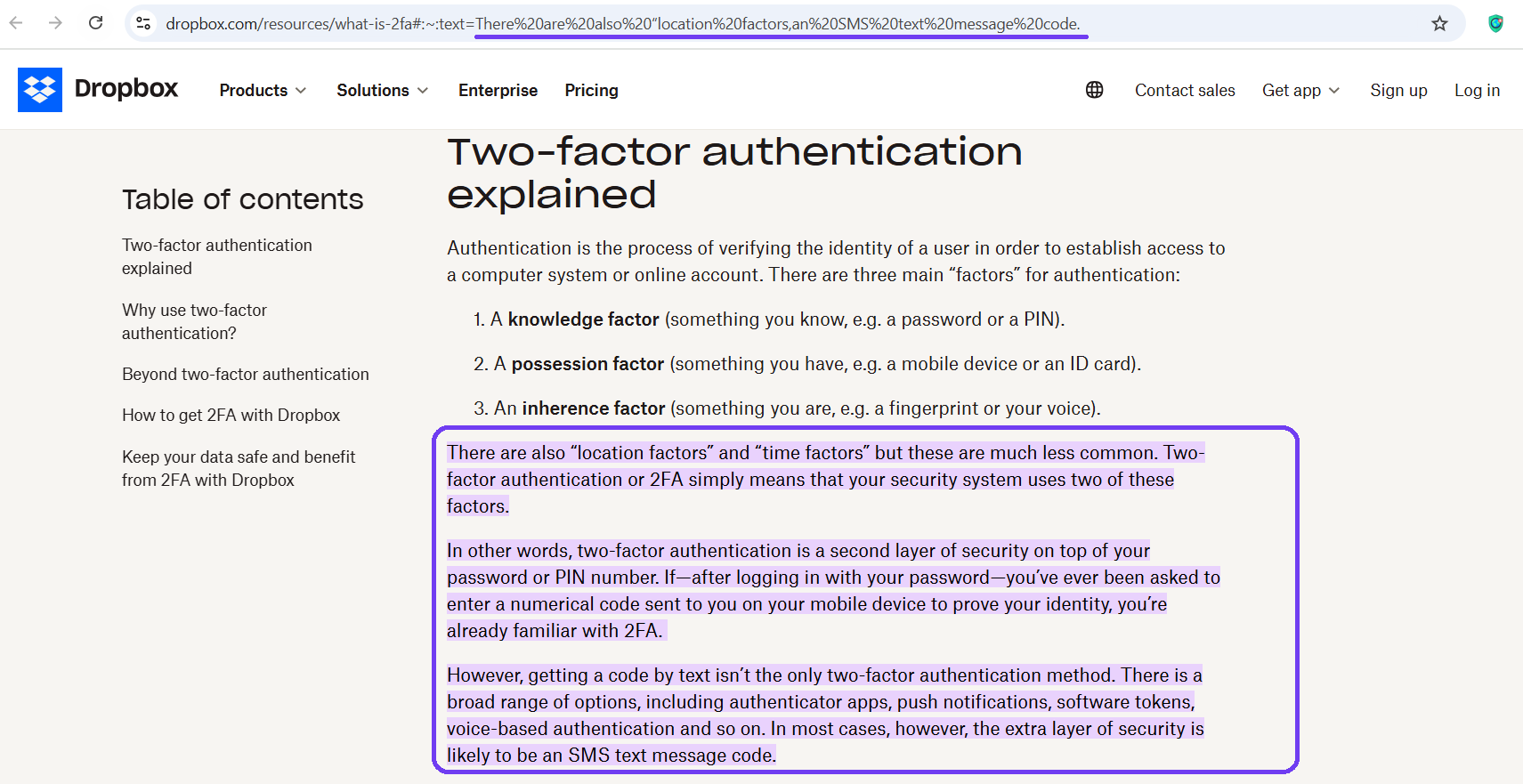
The underlined part of the URL leads to the text fragment highlighted in purple. Text fragments help AI engines identify and match specific content sections with user queries, improving your content's extractability.
Most CMS solutions automatically generate text fragment identifiers for your web page content, so the implementation effort is minimal.
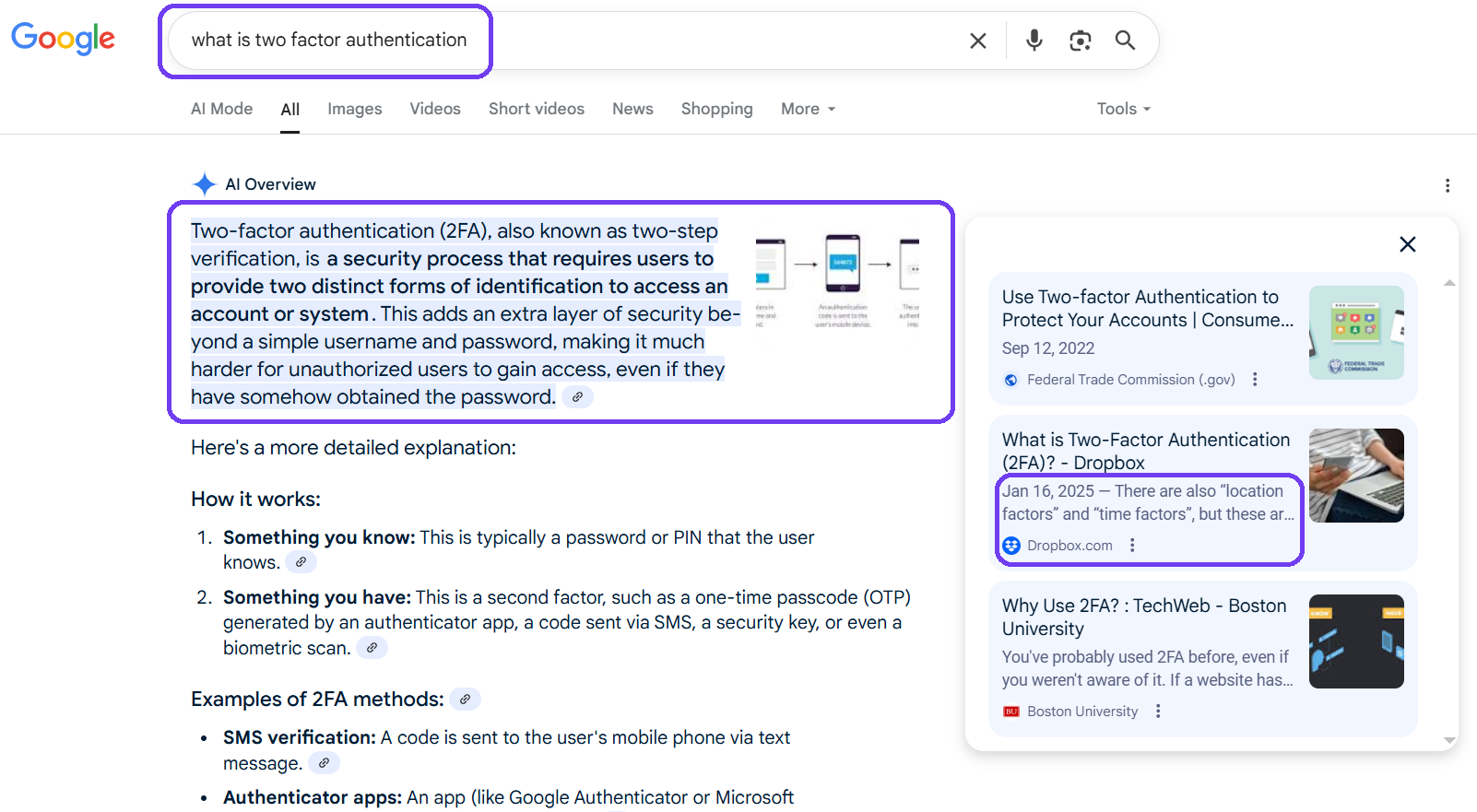
The text fragment I showed above is listed as a resource in AIO for the "What is two-factor authentication" search query—evidence that AI engines do use these identifiers when sourcing content. Prioritize text fragments closer to the top of your pages for maximum impact.
How to optimize for different AI platforms
Not all AI platforms source and cite content the same way. Understanding the differences is key to a targeted answer engine optimization strategy.
PlatformPrimary sourceCitation behaviorOptimization focusGoogle AI OverviewsGoogle's own search index77% of citations from top-10 organic resultsTraditional SEO authority + structured, answer-ready contentGoogle AI ModeGoogle index via Gemini 2.0Multi-step, complex query support via Deep SearchComprehensive, deeply structured content with clear navigationChatGPT SearchBing's index87% match rate with Bing top-20 resultsOptimize for Bing, leverage Reddit and forum contentPerplexityMultiple sources (primarily Google)Real-time retrieval with inline citations; favors freshnessKeep content fresh and factually accurate; cite primary sourcesGeminiGoogle index + content partnershipsStrong Google index relianceGoogle-first SEO strategy with robust structured data
Google AI Mode deserves special attention. Launched to all US users in May 2025, it uses Gemini 2.0 and supports multi-step queries, comparison shopping, and Deep Search. This is a fundamentally different search paradigm—users can ask complex, follow-up questions and get synthesized answers from multiple sources.
For ChatGPT, keep in mind that it pulls heavily from Bing. If your pages rank well on Bing, you're more likely to get cited. Perplexity, on the other hand, favors content freshness and factual accuracy above all—regularly updating your content gives you an edge here.
Rather than trying to optimize for every platform at once, I'd recommend starting with the platform most relevant to your audience. Master that, then expand.
How to measure AEO success
Traditional SEO metrics like rankings and click-through rates only tell part of the story when AI engines are synthesizing answers from your content. Measuring answer engine optimization success requires a new set of KPIs.
Here are the key metrics to track:
- Share of Answer: How often your brand appears in AI-generated responses for your target queries.
- AI citation rate: The percentage of AI answers in your niche that directly reference or link to your content.
- Brand mention frequency: How often AI engines mention your brand by name, even without a direct citation link.
Use an AI tracking tool to identify your brand's visibility for important prompts. Optimize answers for prompts that you're not showing up for.
For example, using Surfer AI Tracker, you can see Philip's visibility in the AI healthcare space. Their visibility and mention scores aren't very high.
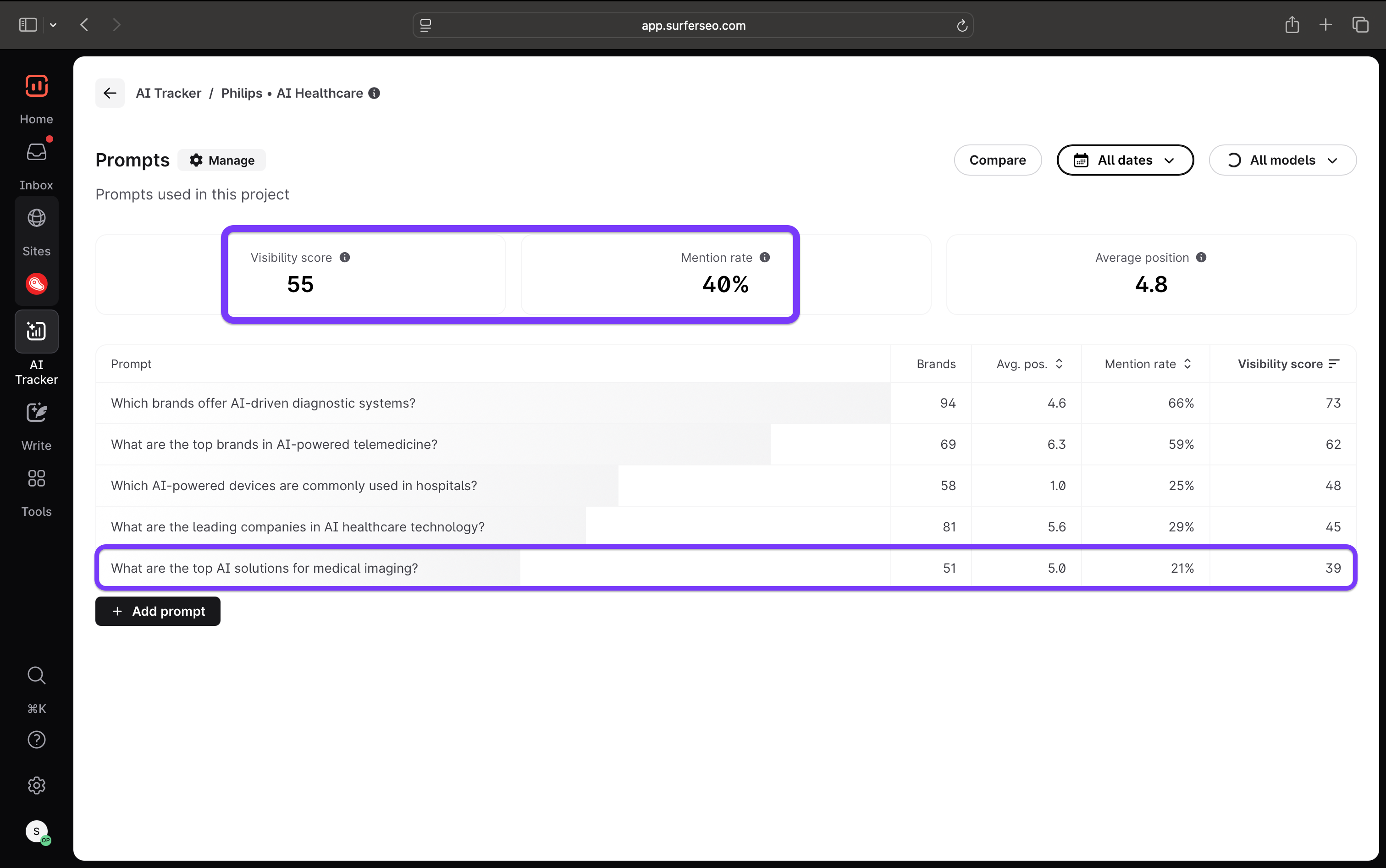
In fact, you can see that they're only mentioned 21% of the time someone searches for "What are the top AI solutions for medical imaging?"
That's a poor mention rate that could be very relevant for their healthcare business. Showing up more would mean higher brand awareness and potential revenue.
Using Surfer, they could study other brands and competitors with higher visibility scores.
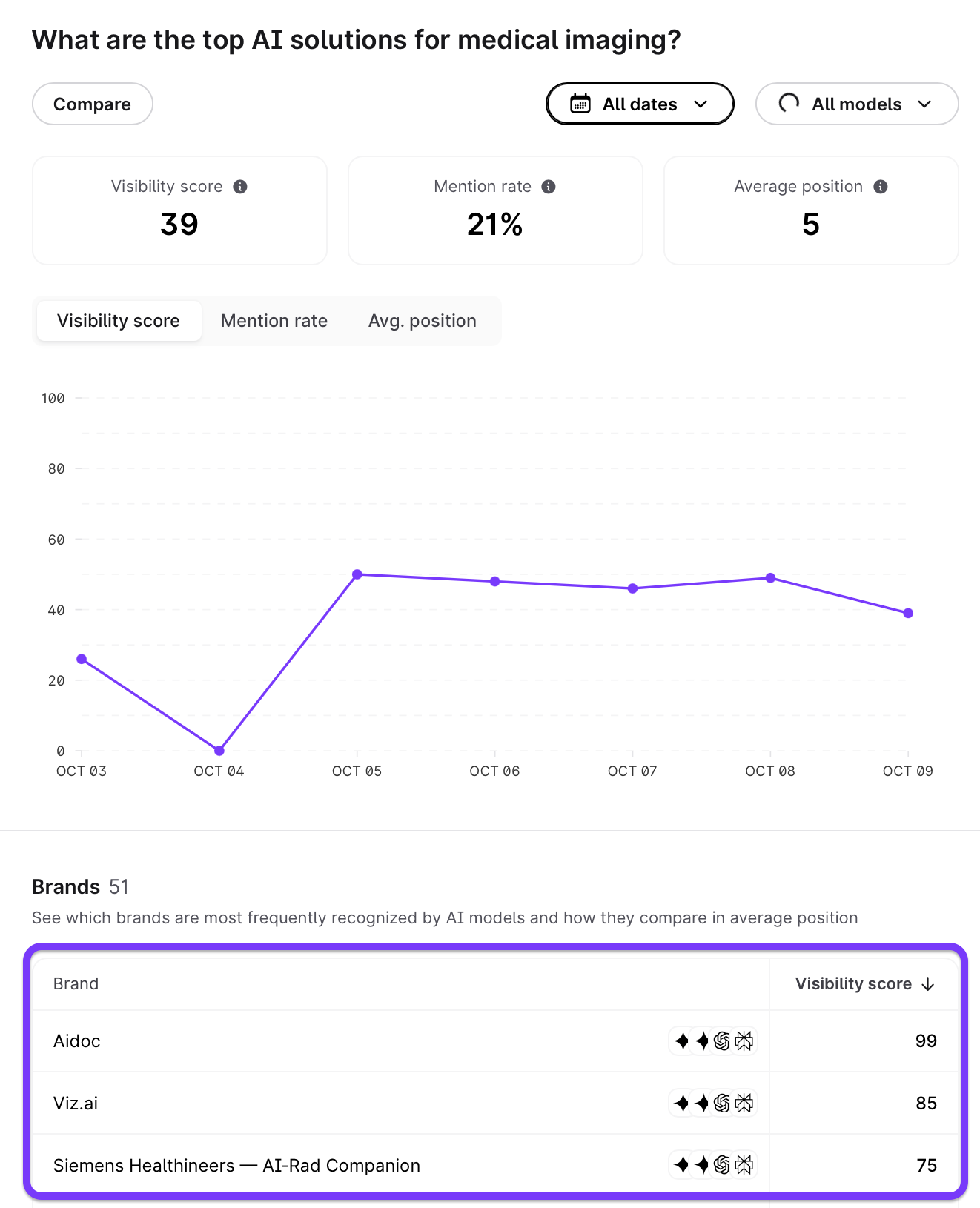
Doing so could help them implement LLM optimization tactics to improve their AI visibility.
Beyond dedicated tracking tools, here are additional ways to measure AEO performance:
- Server log analysis: Check your server logs for crawl requests from GPTBot, ClaudeBot, and PerplexityBot. Increasing crawl frequency is a positive signal that AI engines are indexing your content.
- UTM-tagged AI referrals: Use UTM parameters to distinguish AI-driven traffic from organic search traffic in your analytics platform.
- Manual brand monitoring: Regularly query AI platforms for topics in your niche and track whether your brand is being mentioned or cited over time.
One key limitation: Google Search Console doesn't currently separate AI traffic from traditional organic traffic. Until Google adds this segmentation, combining server log analysis with tools like Surfer AI Tracker gives you the clearest picture of your AEO performance.
Keep in mind that AEO is still evolving. Platforms differ in how they source content, algorithms change frequently, and no tactic guarantees results 100% of the time. The brands that succeed will be those that measure consistently, adapt quickly, and treat AEO as an ongoing practice rather than a one-time project.
Key takeaways
Here's your AEO action checklist—the most impactful steps to start getting cited by AI search engines:
- Write self-contained, conversational summaries that answer queries directly in one or two sentences before expanding into detail.
- Format content with lists, tables, and short paragraphs—AI-generated answers include lists 78% of the time.
- Use clear, descriptive subheadings that reflect the questions your audience is asking.
- Define key concepts at the start of each section and connect them with semantically related terms.
- Implement structured data (FAQ, HowTo, Speakable, Author) and keep it aligned with your visible on-page content.
- Use question-based headers that mirror natural AI search queries.
- Ensure AI crawlers (GPTBot, ClaudeBot, PerplexityBot) can access your content via robots.txt, and implement llms.txt to guide them.
- Build authority through digital PR, original research, expert commentary, and community participation.
- Experiment with text fragment identifiers to improve content extractability.
- Optimize for each AI platform's specific sourcing behavior—Google AI Overviews, ChatGPT, Perplexity, and Gemini all work differently.
- Track AEO performance using Share of Answer, AI citation rate, and brand mention frequency via tools like Surfer AI Tracker.