From SMBs to massive corporations, most companies are now in an unfair position. After spending years optimizing for SEO, they're nowhere to be found in the AI platforms that their buyers use first. According to the 2X AI Visibility Index from April 2026, 96% of B2B companies are effectively invisible during the earliest stages of AI-driven buyer discovery.
If you're in this boat and your brand doesn't appear when someone asks ChatGPT or Perplexity for recommendations in your category, I'll show you a practical playbook for becoming visible, cited, and recommended by AI.
1. Audit your AI visibility
You can't plug holes in AI search without knowing where they are, so a visibility audit is a logical first step.
If you're lucky, your site's authority and SEO efforts have already translated into AI visibility.
Sure, you might show up when someone explicitly uses your name in the prompt. But this doesn't mean they're discovering you — they're just validating you. The point is to show up for early-stage buyer questions to capture that key moment when AI is shaping vendor shortlists.
To do this, create a list of 20–30 prompts that reflect buyer questions without brand mentions. I wrote a whole article dedicated to prompt selection, but the general idea is to aim for specific prompt categories, most importantly:
When you have your list, run each prompt across ChatGPT, Gemini, Perplexity, and Google's AI Overviews and AI mode to see if your brand shows up.
To speed up the process and avoid manually prompting each tool 20–30 times, you can use AI visibility tools like Surfer's AI Tracker, which shows your overall AI Visibility Score and deeper insights into platform-specific performance.
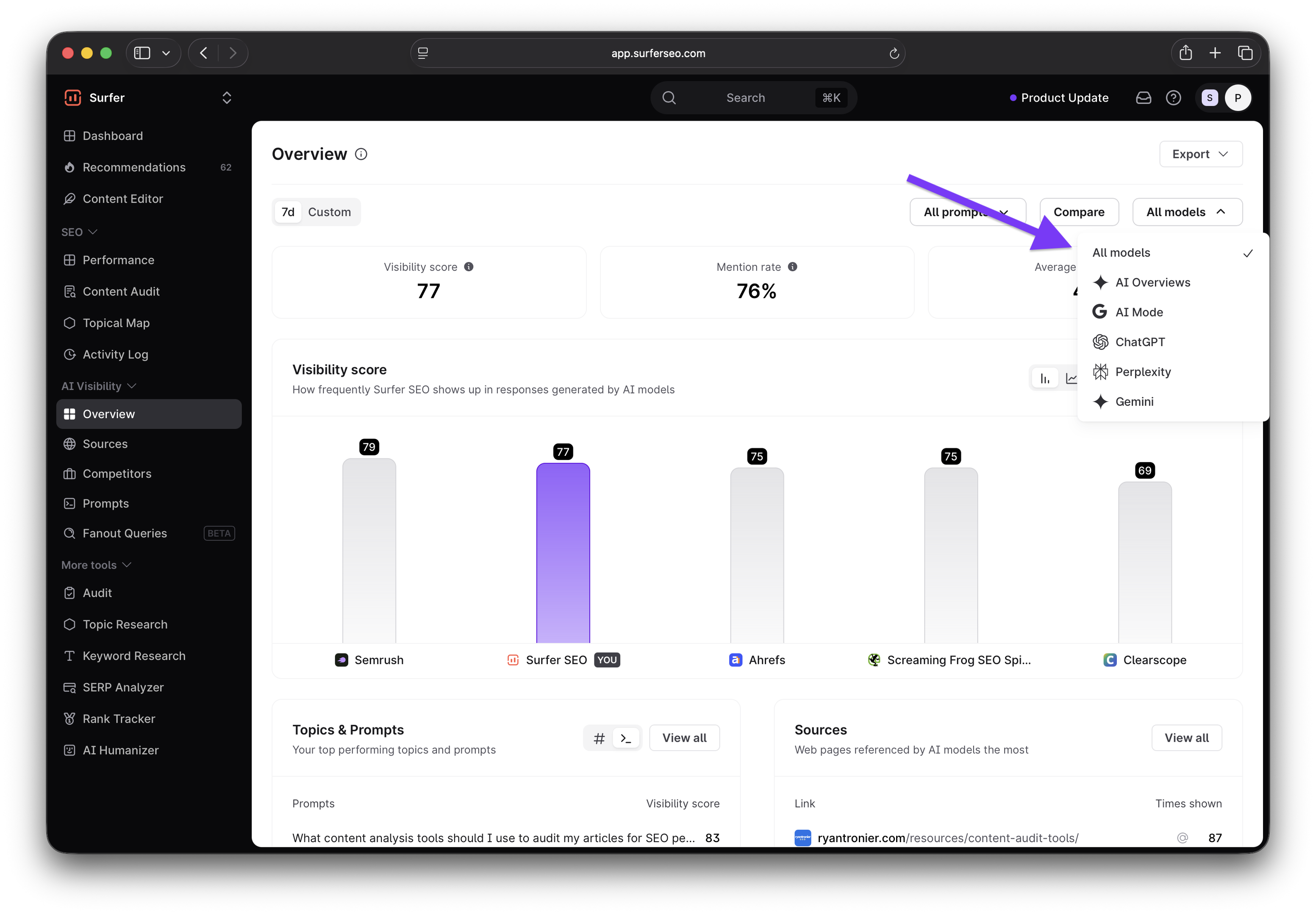
Now, a simple yes-or-no on whether you appear isn't enough. Score each response across four dimensions:
- Brand mentions: Do you appear at all?
- Average position: Are you the first recommendation or buried at the bottom?
- Accuracy: Is the AI describing your product correctly, or hallucinating features you discontinued years ago?
- Sentiment: Is the AI recommending you enthusiastically, listing you neutrally, or presenting you with caveats?
There's a massive difference between "Brand X is the industry leader for logistics" and "Brand X is an option, though users frequently report challenging onboarding." The first does the promotion for you, while the second may put off a lead. Understand and shape the narrative so that your AI visibility efforts translate into actual sales.
For example, I ran an audit for Surfer's presence when it comes to AEO-related queries to find that we're lagging behind other competitors.
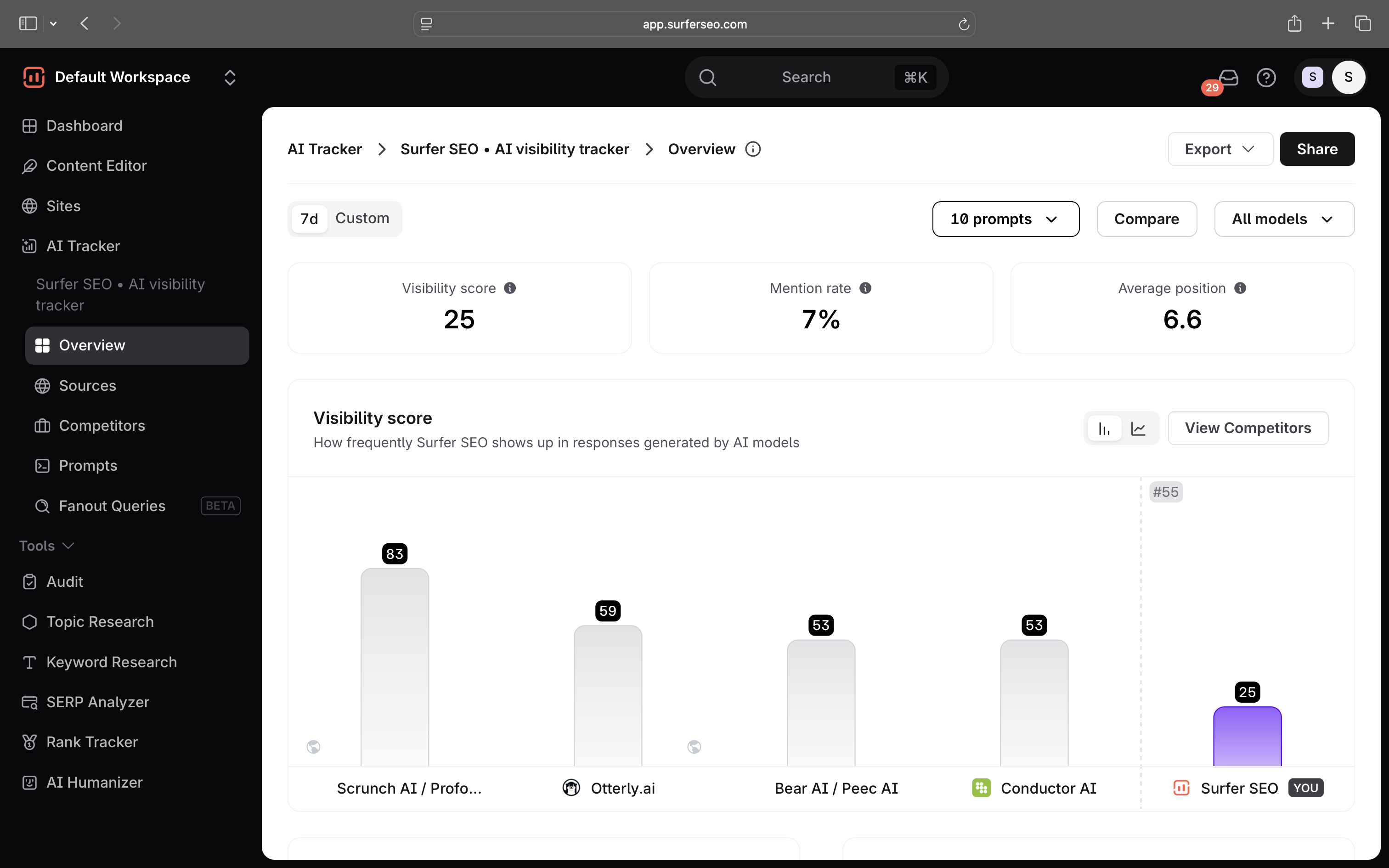
Let me show you how...
2. Create content for middle and bottom of funnel fan-out queries
Top-of-funnel (ToFu) content like "What is logistics?" is increasingly dead for traffic generation. AI can answer these generic questions directly, so there's no need to cite, mention, or recommend you.
The highest-leverage content now lives in the middle and bottom of the funnel. This includes:
- How-to guides
- Comparison articles
- Implementation walkthroughs
This is where AI might need to actually cite a source or provide recommendations instead of just crunching its training data, and it's also where the purchase intent may be higher.
The good news is that you don't have to dig deep to find the topics you should cover. You just need to understand and use fan-out queries.
A fan-out query is a sub-query that an AI model generates internally while processing a more complex question to provide a detailed answer.
Each prompt can trigger multiple fan-outs — around 6 on average, according to Surfer's research of AI Overviews (AIOs). You'll notice them as specific subtopics covered after an AI tool gives you a direct answer to your question.
For example, when I Googled "How to manage inventory in a retail store," the AIO first gave me a direct answer, and it even directly guided me to a NetSuite video:
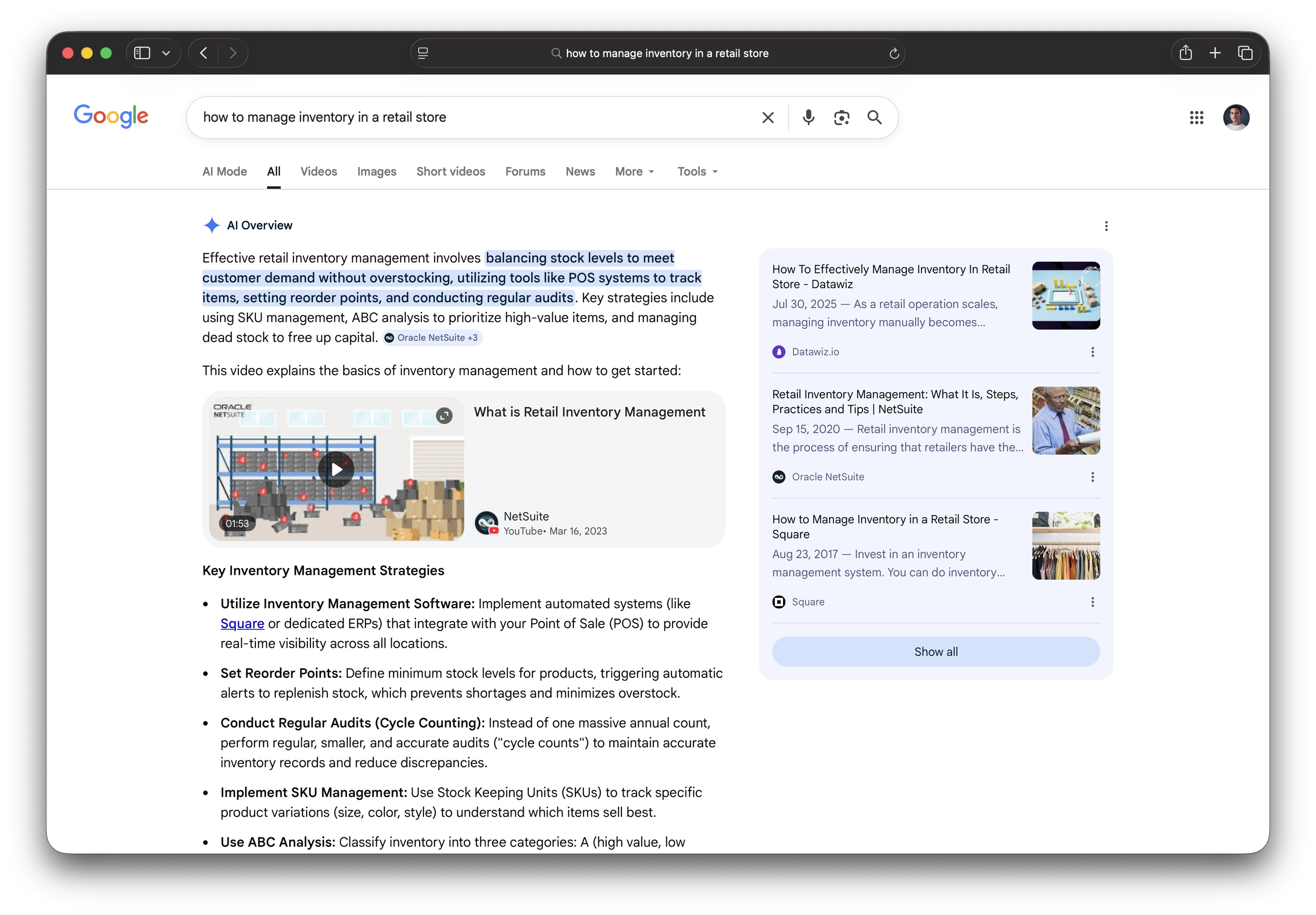
In the above image, you can also see that the answer expanded to include inventory management strategies. When I scrolled down, I also saw techniques and best practices:
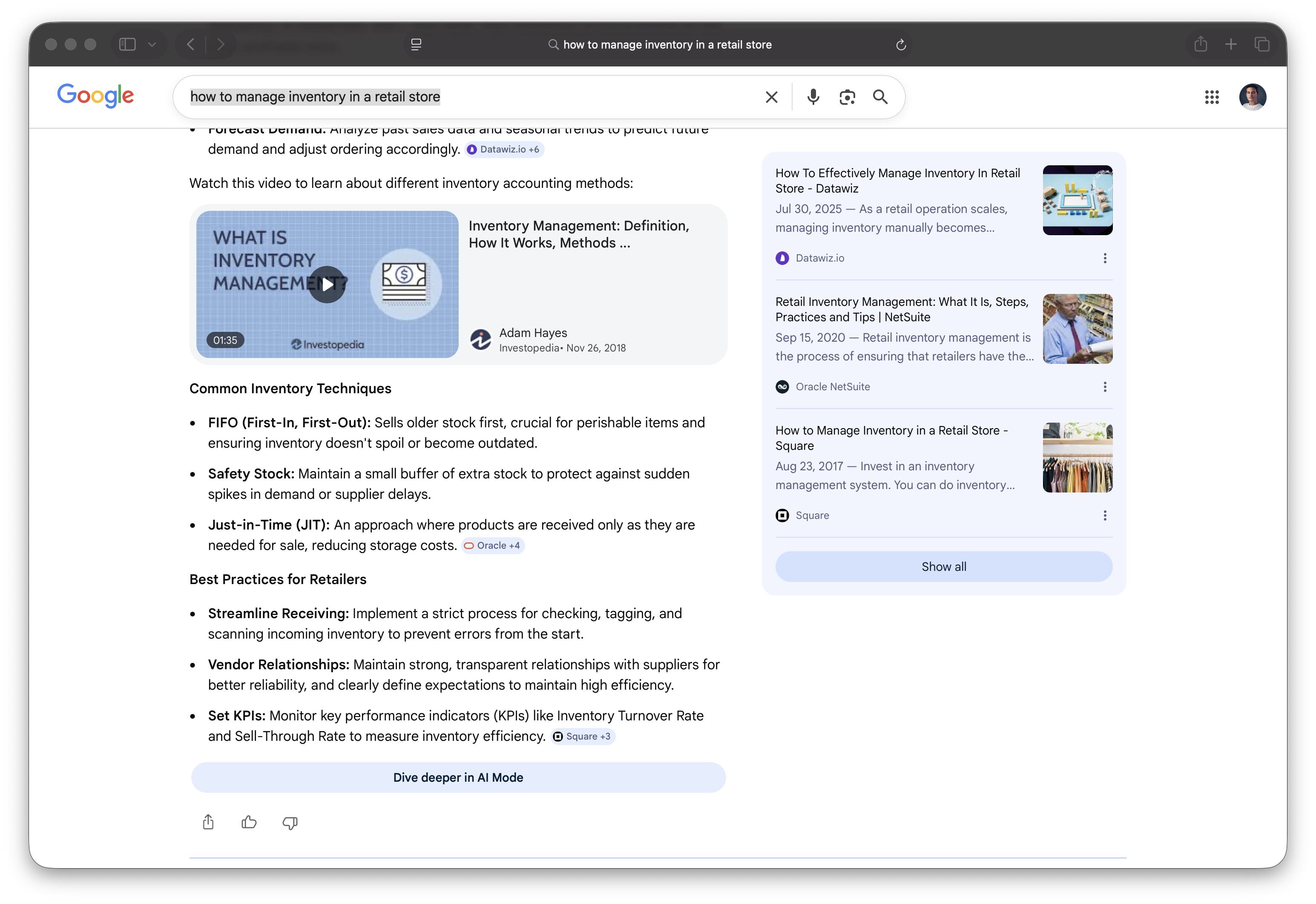
These are all fan-outs of my main query. And as you can see, each has several citations of reputable articles.
That's what you're aiming for. You want an AI to cite you as a source, or even recommend you in some way, like it outright told me to watch the NetSuite video.
To achieve this, you should write content around fan-out queries. Map your product's value propositions to specific "how to" and comparison queries your buyers ask during evaluation. Then, create comprehensive guides that naturally answer multiple related sub-questions within a single piece, covering the topic cluster instead of a single query.
For example, if I were to write an article targeting "best SEO content optimization tools" – a topic very relevant to Surfer, I would need to cover these query fan-out topics that address competitive benchmarking.
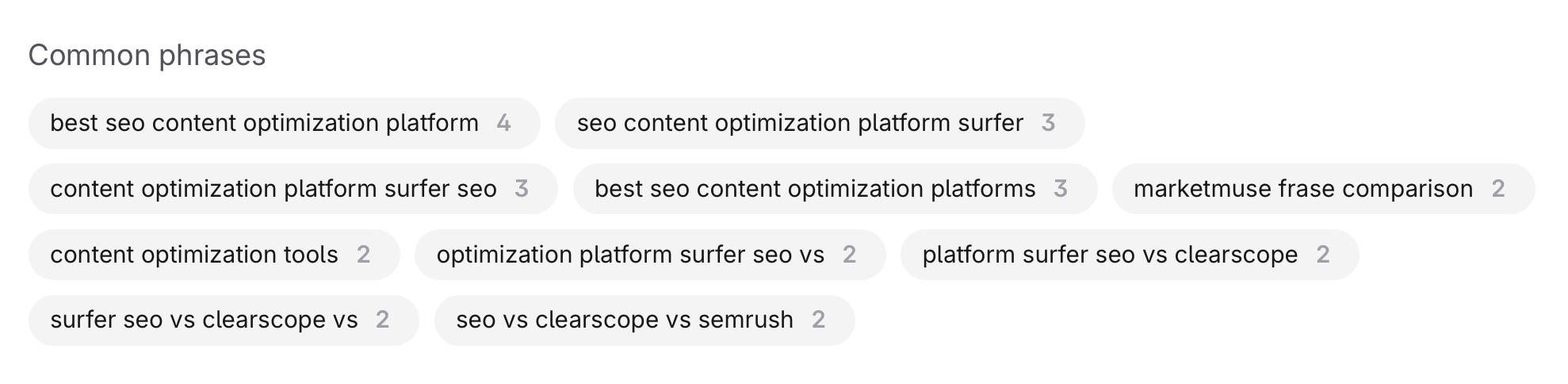
You can even see this in action in Google's AI Overview answers. Google associates competitive entities with this topic.
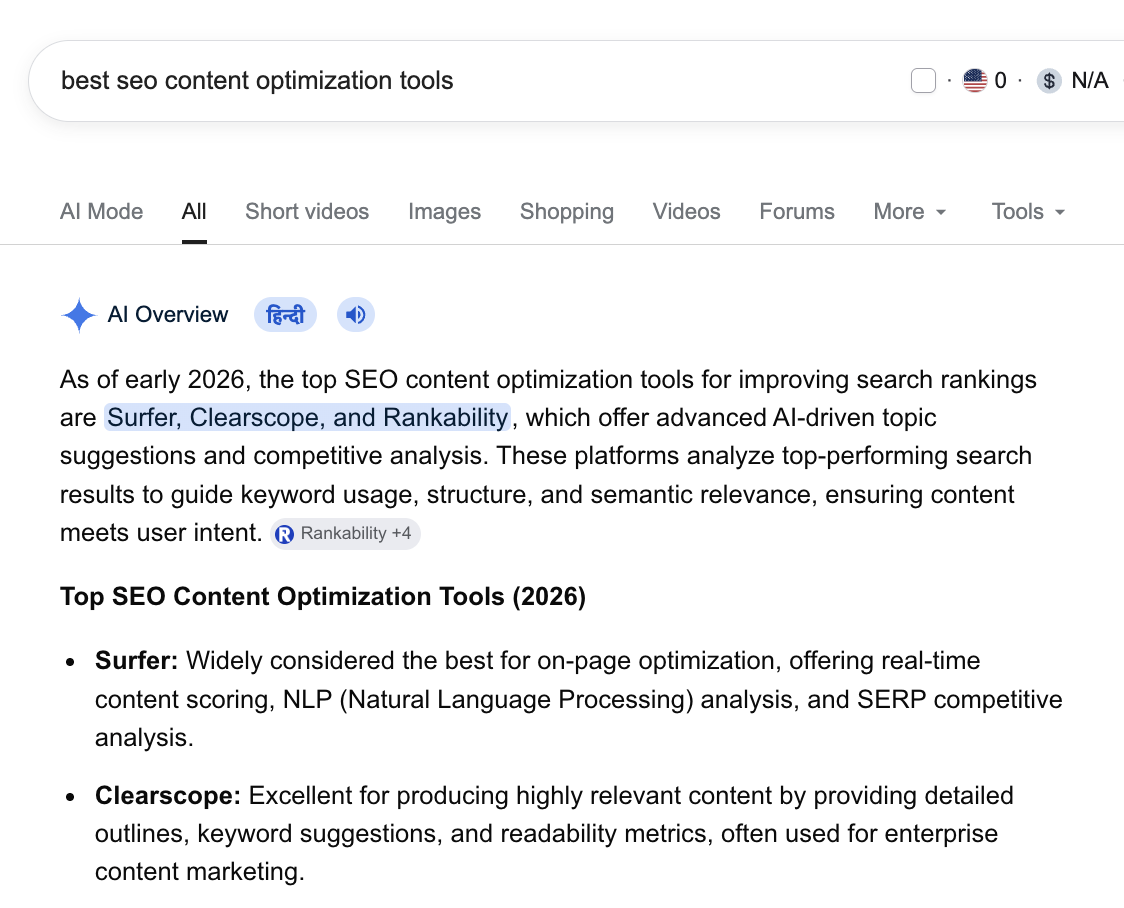
As you cover relevant query fan-outs, focus on topical depth and cold facts.
Surfer's key facts study of over 57,000 URLs found that the most frequently reused "core" sources cited by Google AI Overviews showed nearly 2x the fact coverage of pages never cited. The likelihood of being cited maxes out at about 12 verifiable key facts per page, which is the sweet spot in terms of the signal-to-noise ratio.
Facts don't always have to be figures and statistics. You can enrich your content with:
- Verifiable claims
- Specific data points
- Concrete examples
All of this makes AI trust your content more and can drastically boost your AI search visibility.
3. Create dedicated pages for use cases and personas
Product pages used to be about keywords. But now, they're about what your solution does and who can benefit from it the most. When someone asks AI, "What's the best [tool] for [specific job/industry]?", the model looks for pages that directly address that intersection.
So if your pages still try to serve everyone, they'll almost always be overlooked in favor of those that clearly match the query's intent.
To make sure this doesn't happen, you need two types of pages:
- Use case pages
- Persona pages
For use case pages, you need a dedicated one for each goal that your solution can accomplish. All pages should have the same general structure:
Problem > solution > outcome
Specifically, each page should :
- Name the specific challenge
- Explain how your product addresses it
- Include concrete results and/or proof points
This way, the page becomes a citation target for use-case-specific AI queries.
Take Surfer's homepage as an example. In the top navigation, you can see the Platform section that clearly explains Surfer's core uses.
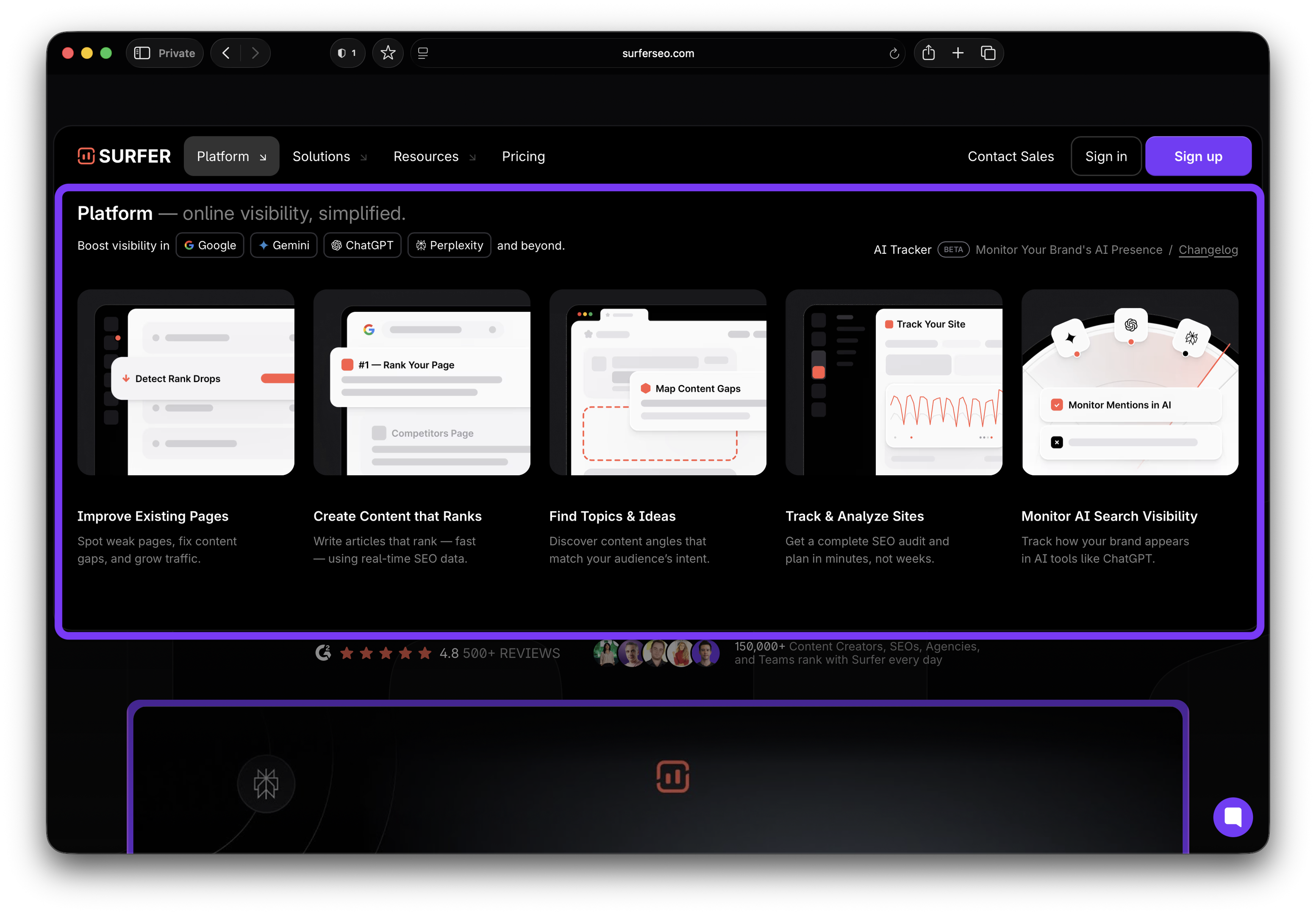
So if I ask ChatGPT, "What are the best platforms for finding content topics and ideas?" it will recommend Surfer among other tools.
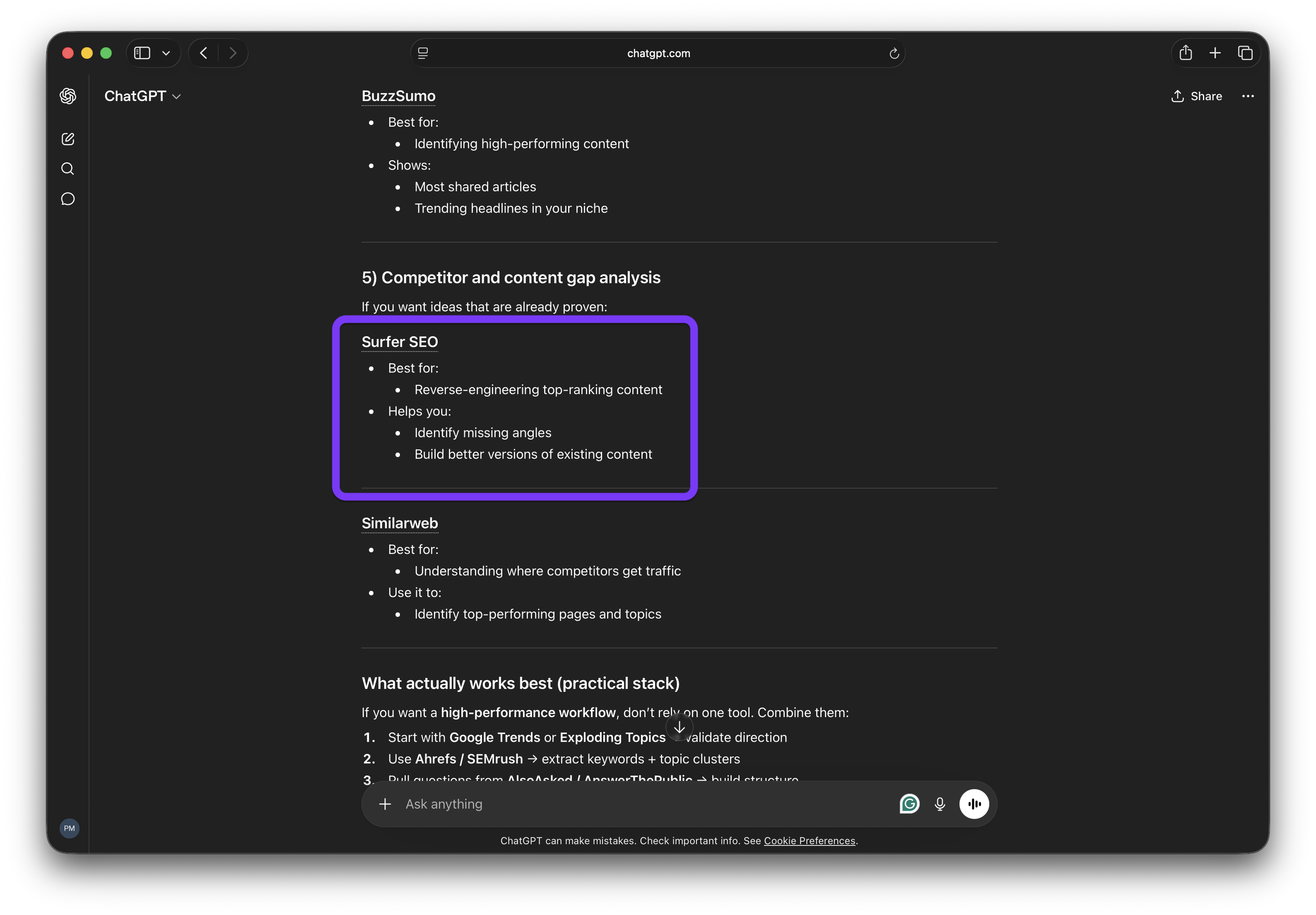
You'll notice that ChatGPT placed Surfer in the competitor and content gap analysis category, which makes sense as the page uses this as one of Surfer's main capabilities.
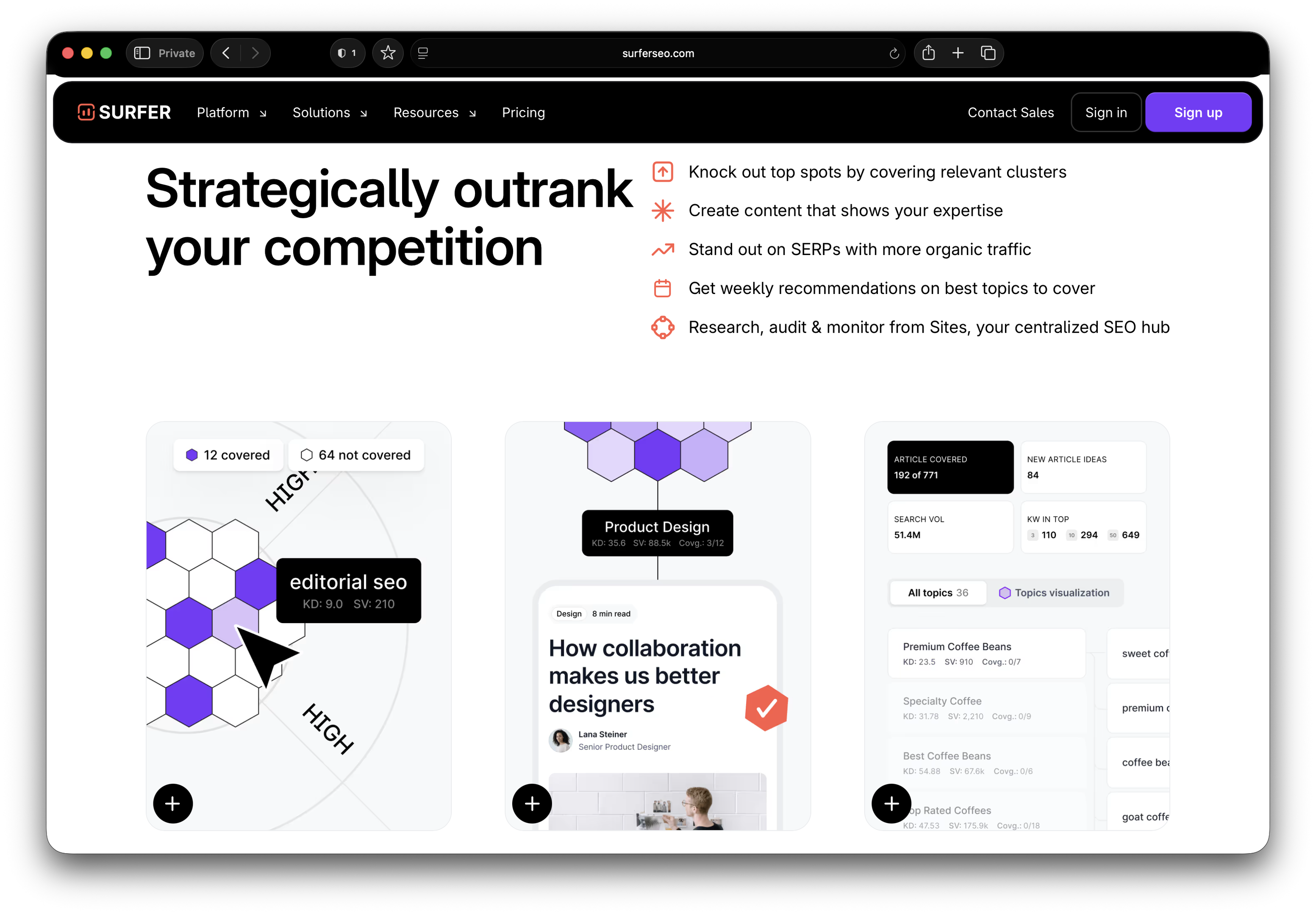
This is how your pages can directly shape AI answers to queries related to use cases. And you can do the same with specific personas.
Identify the key characteristics and roles of your target audience (marketing teams, developers, etc.), and create dedicated pages that users will self-identify with. Then, tailor messaging to what each persona cares about. For example:
- CTOs focus on technical architecture and integration
- CFOs focus on ROI and cost reduction
- End users focus on ease of use
Besides appealing to each persona's core needs, this will let AI models use role signals to match recommendations to user context.
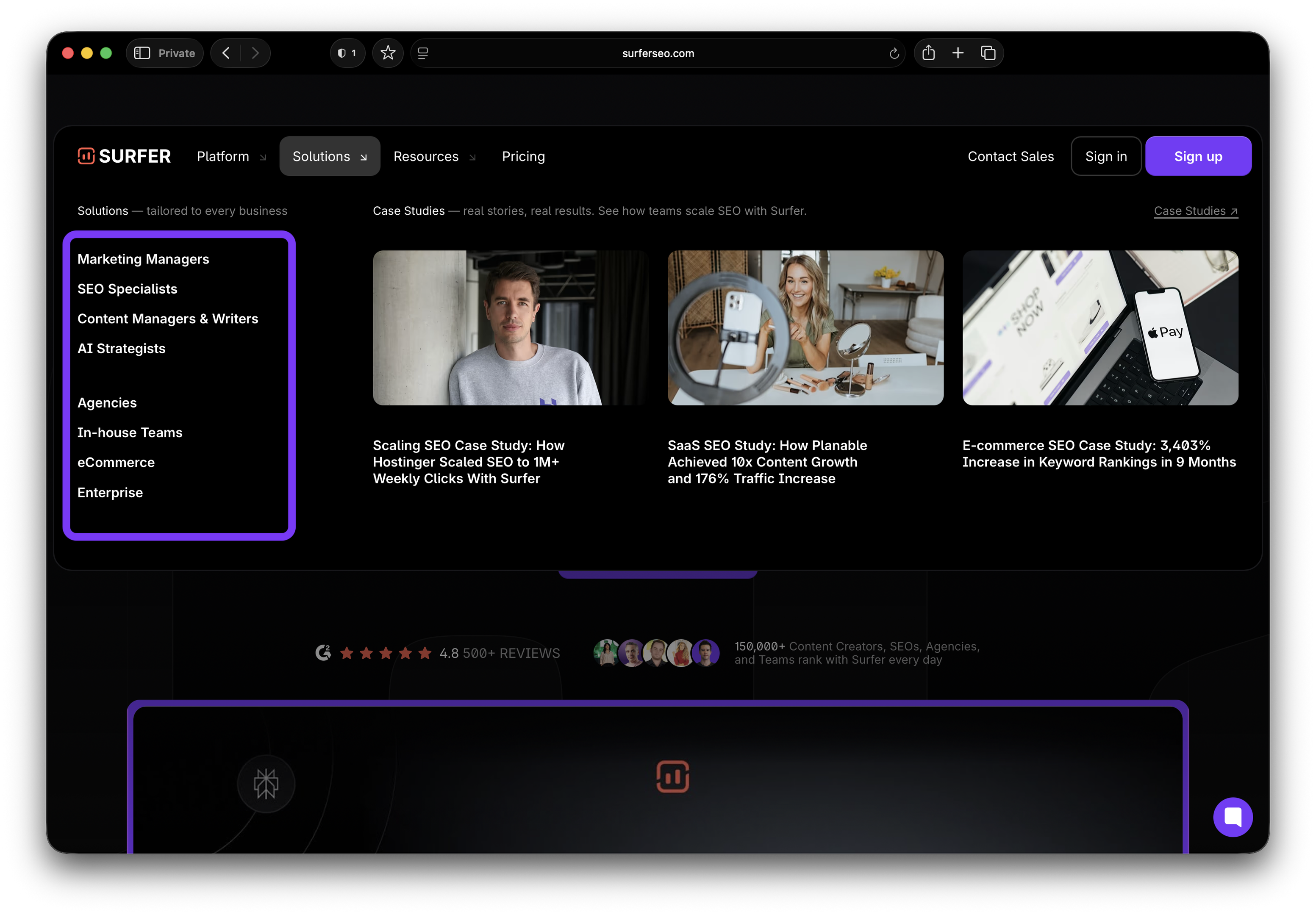
Let me use Surfer again as an example. In the Solutions tab, you'll see pages dedicated to each target audience.
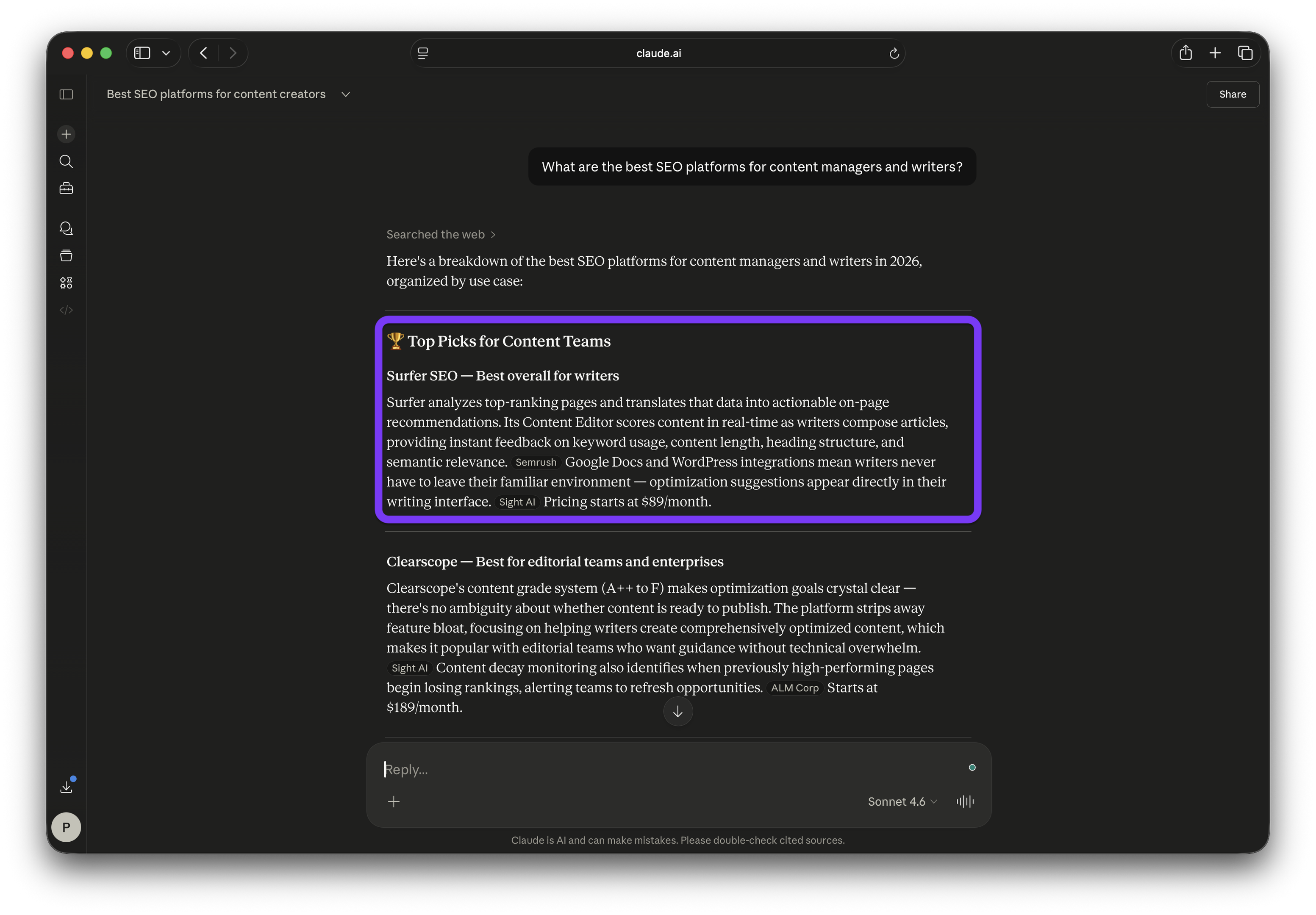
I used one of the audiences and asked Claude which SEO platform is best for them. It not only recommended Surfer but also placed it first on its list as the best platform overall.
The more use cases your platform has, the more opportunities you'll have to target specific AI queries. This is especially important for companies that systematically build pages across use cases and personas, which can create hundreds of entry points for AI citation.
Take Zapier as an example.
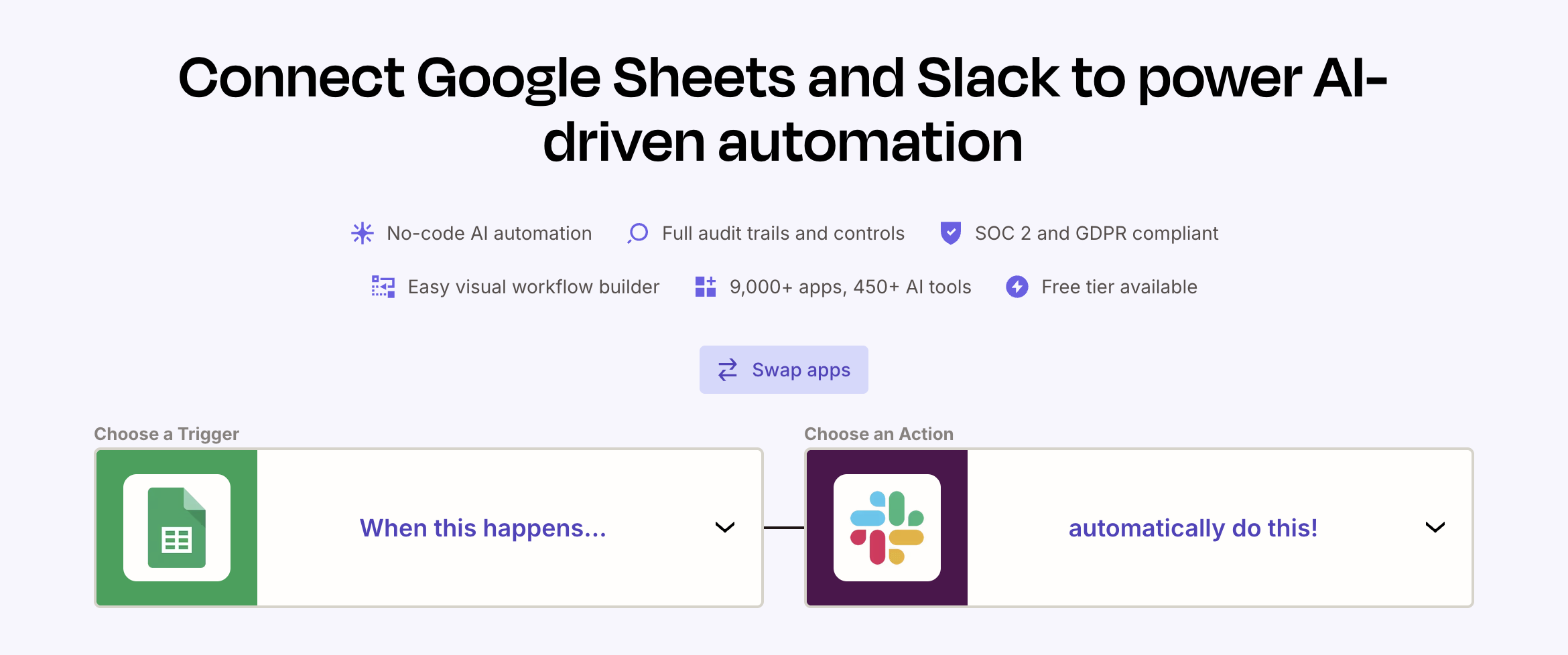
It has thousands of integrations and use cases, with over 50,000 programmatically created pages for each. Each page targets specific "How to connect [app 1] + [app 2]" queries with integration descriptions, supported triggers and actions, and related tutorials, creating thousands of AI-citable entry points.
4. Keep your integrations, features, and pricing pages updated
Even if your brand's AI visibility isn't the best, you probably have users who know about you and will ask questions like "Does [your product] integrate with [tool]?" or "How much does [your product] cost?"
When this happens, answer engines will pull from the relevant commercial pages on your site (features, pricing, integrations, etc.). If these pages are outdated, vague, or poorly structured, AI will either skip you or show inaccurate information — both of which harm your brand and lose deals.
Each page has a structure that works best and helps your brand appear in AI responses.
For feature pages, the point is to organize features into logical categories instead of just having a list. Each feature entry should have:
- A concise definition sentence ("What it does")
- A use case statement ("Why it matters")
- Any specifications or notable limitations
Take Airtable's page as an example. Each feature has a benefit-driven one-liner that explains what it is, followed by a use case/value statement.
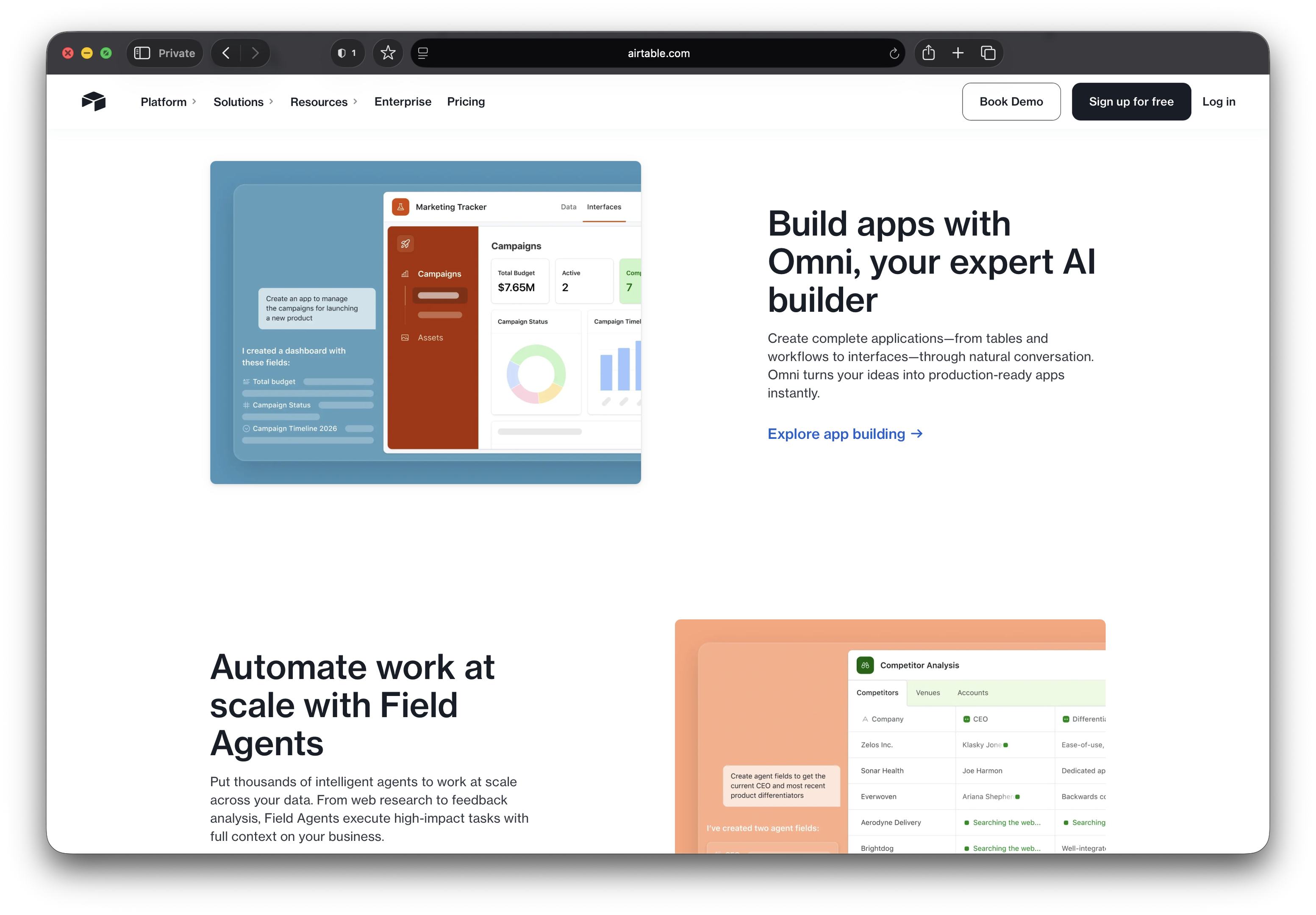
This structure gives AI models easily extractable, quotable blocks with enough context for a precise answer.
As for pricing pages, clarity is key. Showcase comparable tiers with information like:
- What each plan includes
- Usage limits
- Differentiation between plans
Spotify's pricing page does this well. Besides including the general information, it lists the promos, eligibility, and restrictions (e.g., "For couples who reside at the same address"). This gives AI crawlers everything they need to fully answer the user's question, so they don't need to go beyond Spotify's page.
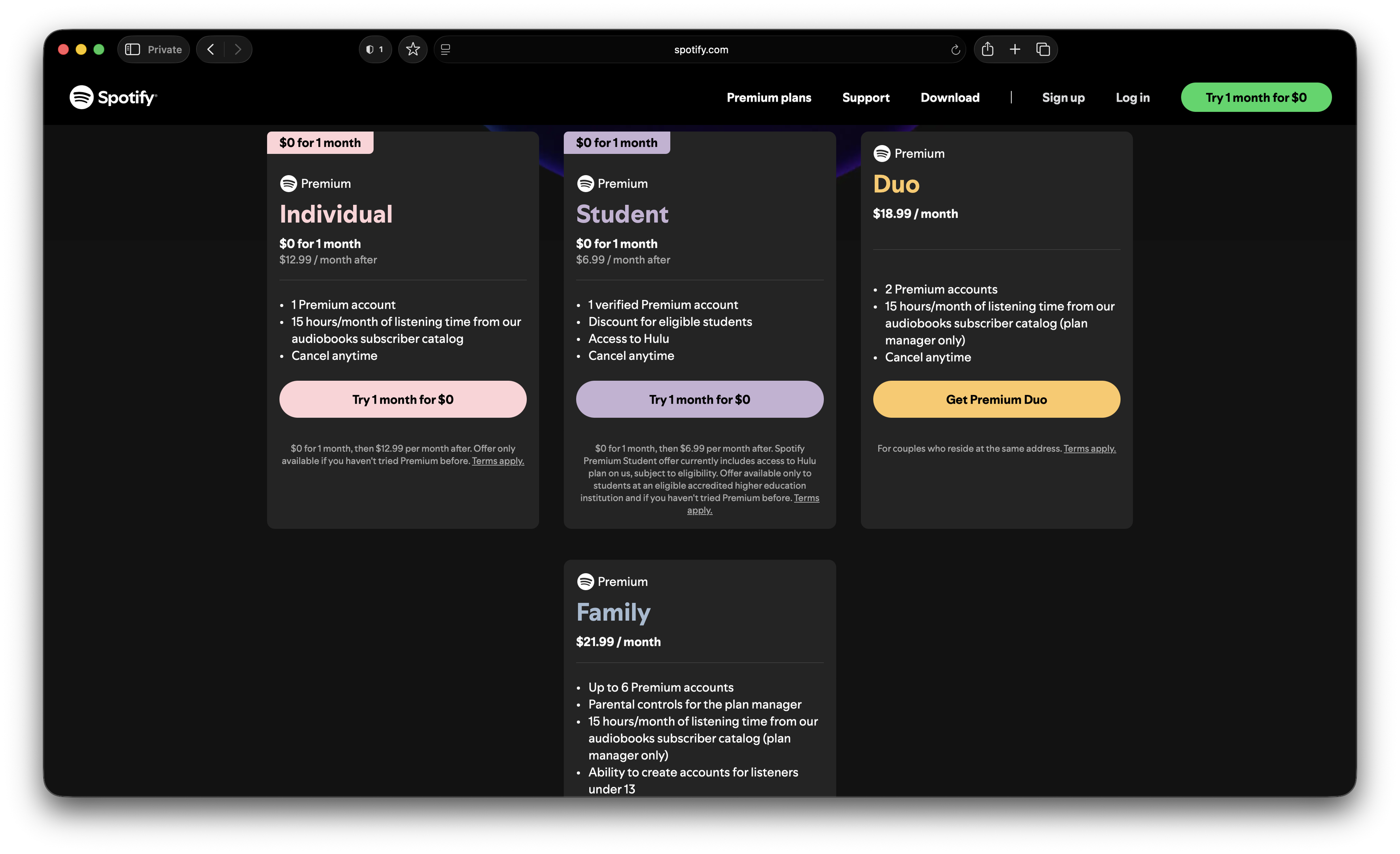
The tricky part is custom pricing. It's generally recommended to avoid hiding pricing behind "Contact us" because AI models can't extract or cite information that isn't on the page. Still, you may have genuinely custom plans that can't be clearly categorized, in which case you should at least provide a range or a reference point that AI platforms can quote.
Integration pages might require special attention because you need to provide detailed information. List every integration explicitly with:
- Its name
- What it does
- Which plans include it (if applicable)
No matter which data you include, make sure it's structured consistently across integrations. AI tools prefer structured, repeatable formats because they're easier to parse than salesy taglines, so prioritize clarity.
You can look at Mailchimp's integration page for inspiration. Each integration features a logo, name, and intended use with Mailchimp — that's it.
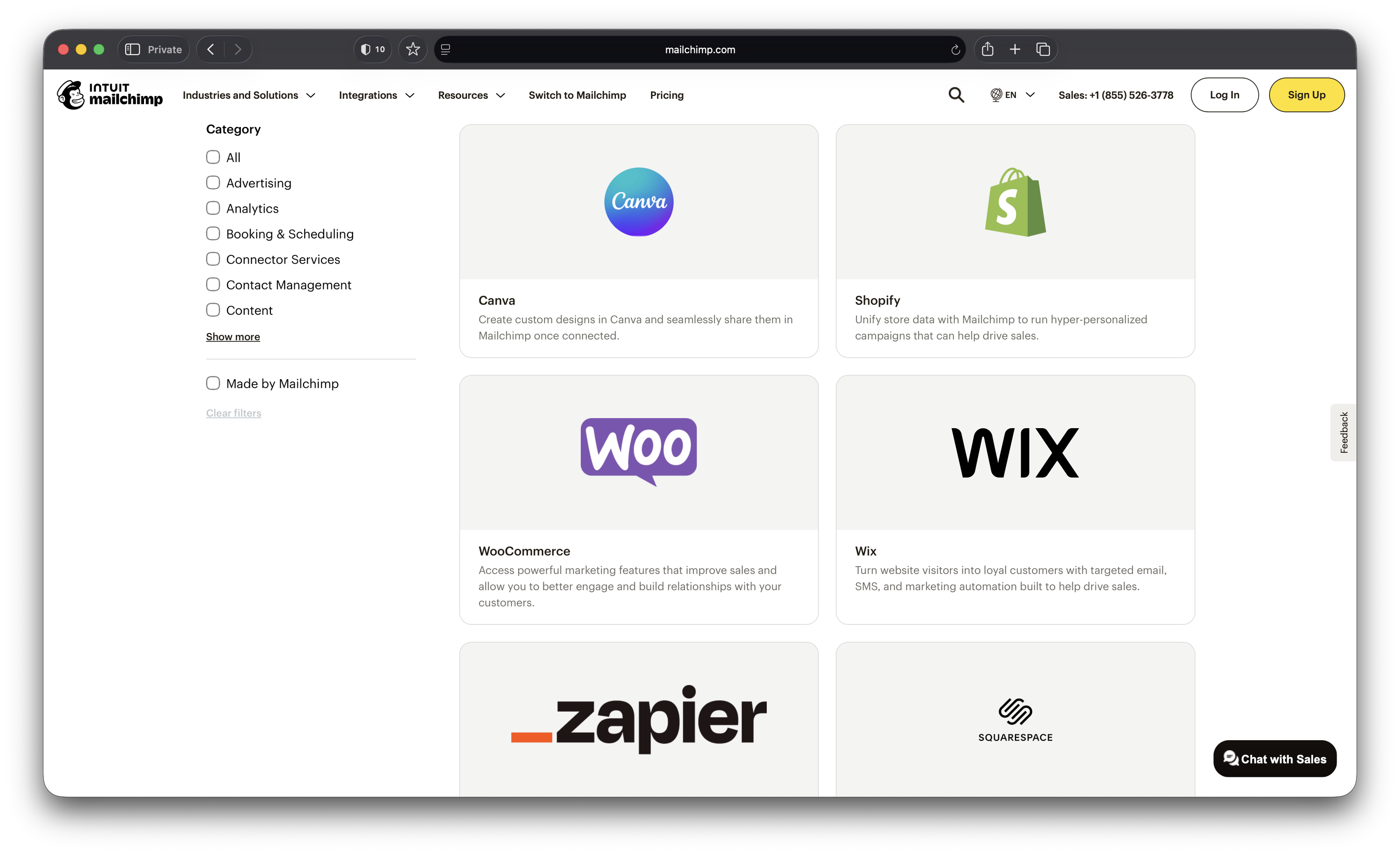
AI platforms care about content recency, so set a quarterly review cadence for these pages. Stale pricing or missing integrations signal outdated pages, which AI engines skip.
5. Audit and optimize your help center docs
Help centers are major AI visibility assets, yet they're overlooked in favor of product pages or blogs. Don't make this mistake, as knowledge bases are inherently structured around Q&A — the exact format AI engines need.
Each help article directly addresses a real user question, which makes it a potential citation source. Collectively, help articles build the topical authority that makes AI models trust your brand across a range of queries.
If structured well, your help center alone can be a lead channel. Wynter's survey of B2B SaaS CMOs showed that 84% of participants use major AI platforms for vendor discovery, so your help center can directly shape how AI tools present your product at this stage.
To do this, each help article needs an AI-friendly structure. This includes:
- Question-based headings: H2 headings should match how users phrase queries instead of just targeting a keyword.
- Direct answers: Answer a help question directly in up to 100 words without preambles or fluff
- Short paragraphs: Help-focused content needs clear paragraphs of 25–40 words that AI tools can quickly parse
- Focus: Each article needs to address a single question without going off-topic
There's no room for long intros, author credential blocks, and marketing lingo in the help center. It should be completely user-focused and provide actionable insights that AI can cite.
Each help article should have the right schema. While it's not a direct citation factor, schema markup helps AI platforms understand entities for easier parsing. Depending on the page type, you can use schema like:
- FAQPage
- HowTo
- Article
- Organization
- Product
- and sameAs schema
A good example of the impact of schema is Broworks, a Webflow development agency whose team had to restructure the website for AI visibility. They implemented the above schema alongside other attributes (e.g., LocalBusiness and Organization) and added AI-friendly elements like FAQs and comparison tables.
As a result, 10% of the agency's traffic started coming from AI platforms, and 27% of that traffic ended up converting.
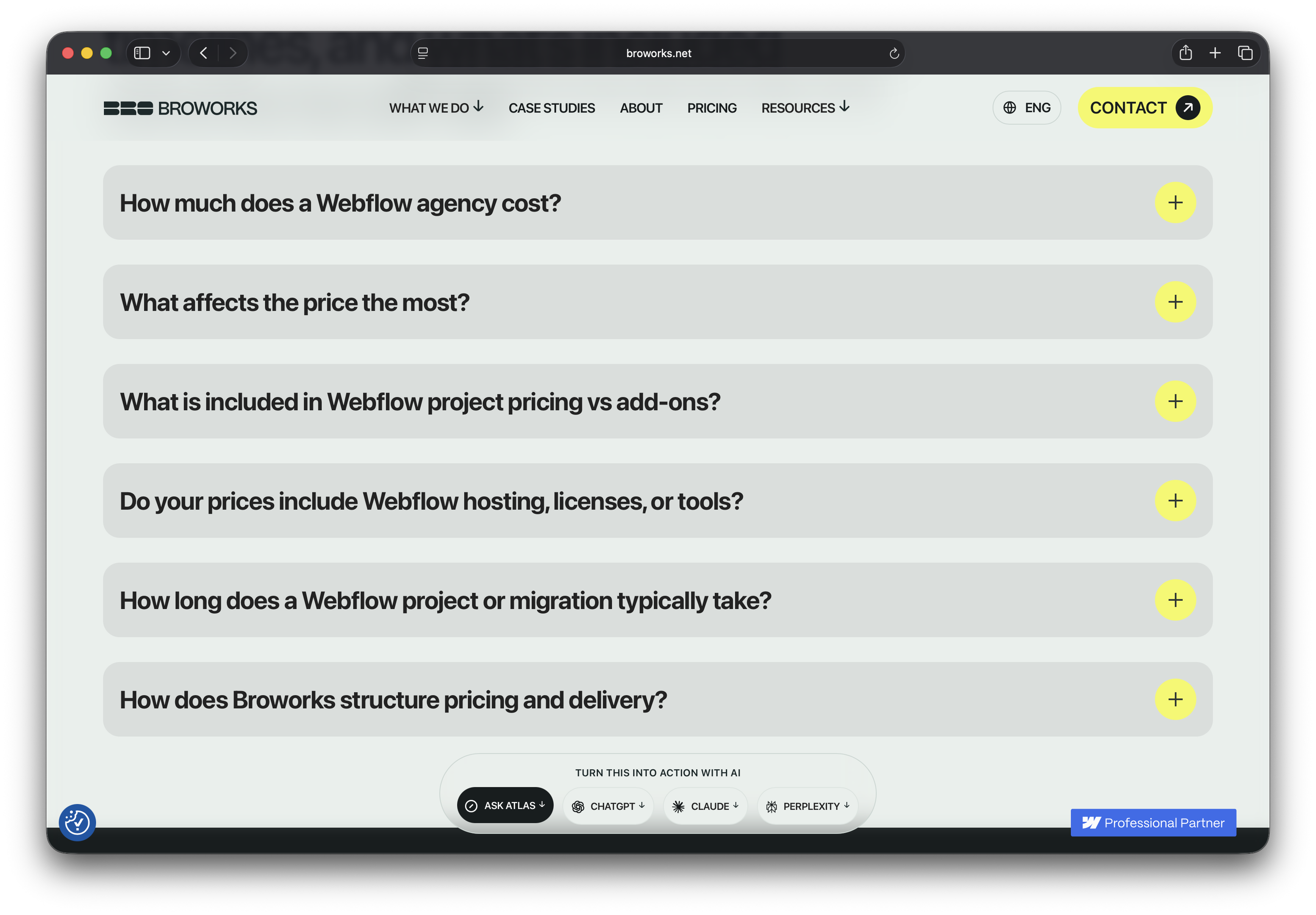
Besides schema, URL patterns can help AI crawlers understand your site's topical organization if they're semantic and descriptive enough. You can go with a tried and tested pattern like:
site/help/category/subcategory/article-slug
If you already have a lot of help center content, audit it to find articles that:
- Bury the answer below the introductory text
- Have outdated information
- Try to cover multiple questions at once
- Don't have structured formatting (lists, tables, steps)
Create a list of such articles, and then prioritize fixing high-traffic pages first for faster results.
Make sure your audits are ongoing. Unlike blog content that can become stale, help articles are evergreen, so they can compound and significantly boost your brand's visibility in AI if you maintain them well.
6. Earn brand mentions from the sources AI models rely on
Brand mentions in third-party sources are among the strongest predictors of AI visibility. Plenty of research has shown that they're much more important than backlinks and even a site's domain authority for AEO, which are the pillars of traditional SEO.
Specifically, Ahrefs' study of 75,000 brands found a 0.664 correlation between brand mentions and AI visibility, compared to just 0.218 for backlinks. Google's AI Mode seems to care about brand mentions the most, while AI Overviews and ChatGPT give them slightly less value (although still more than enough for you to focus on them).
YouTube mentions show an even stronger correlation of ~0.737, which makes sense because both Google and OpenAI trained their AI models directly on YouTube transcripts.
But despite this strong correlation, the most frequently cited source isn't YouTube — it's Reddit.
The reason these statistics matter so much is that you need to place your brand where AI will go looking for information. By expanding your brand's presence on third-party sites, you're boosting its chances of being picked up by AI tools.
This is where you may need to rely on AI search visibility tools because it's hard to know who already mentions you and which sites you should focus on. For example, Surfer's AI Tracker has a dedicated Sources feature that lets you see:
- The total number of domains and URLs found in LLMs for your prompts
- A complete list of sources
- Mention gaps between you and key competitors
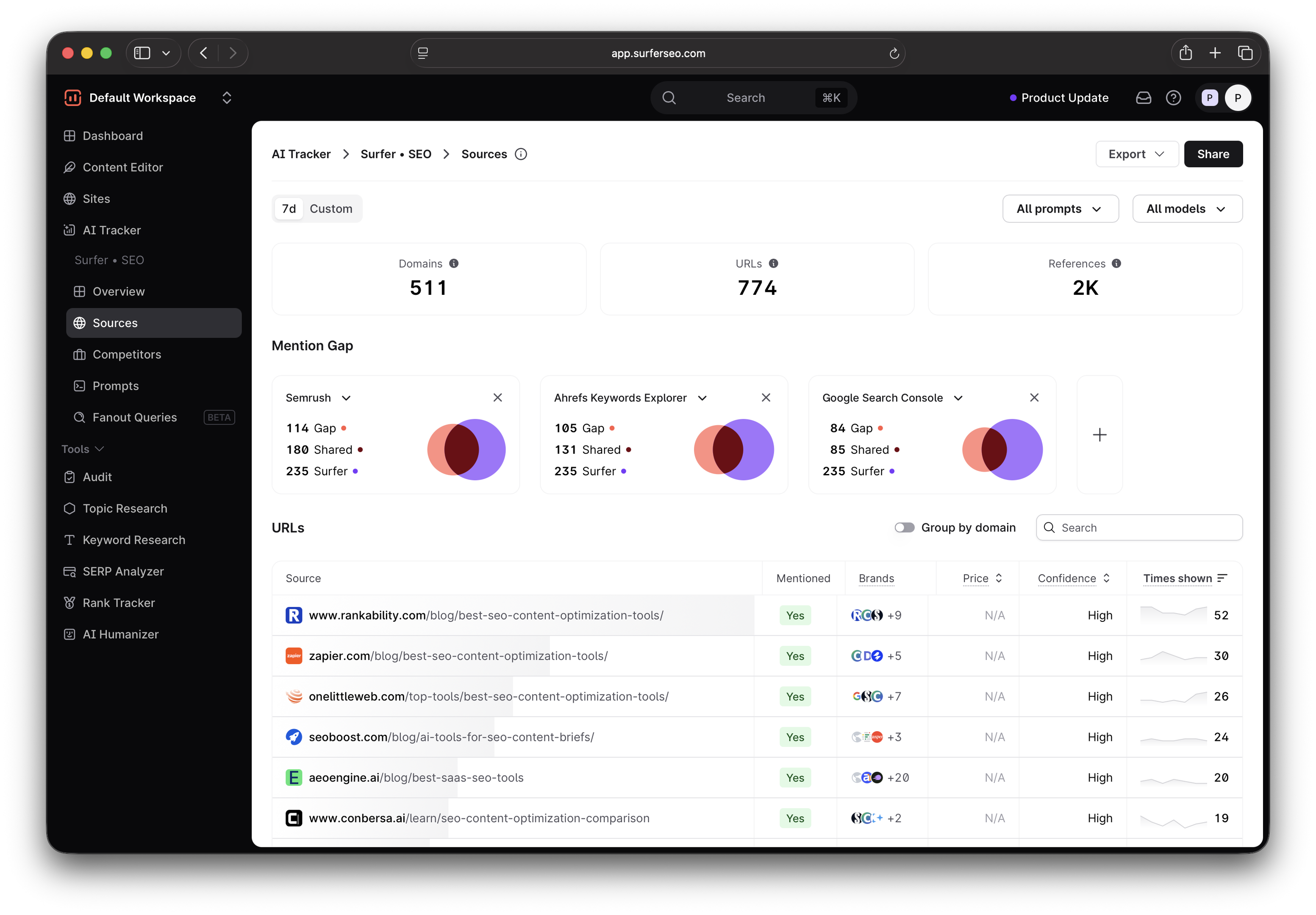
You also get detailed source data, including:
- Whether your brand appears in the response
- Which brands are mentioned
- How many times the source was cited
A particularly valuable metric is the confidence score, which shows how consistent an LLM is with its answers when asked the same prompt multiple times. This is important because the higher the consistency, the more important it is for you to be mentioned by the source to increase your AI search performance.
So here's what you can do if you want to earn new brand mentions:
- Enable group by domain to see all URLs per domain
- Check confidence
- Sort by frequency
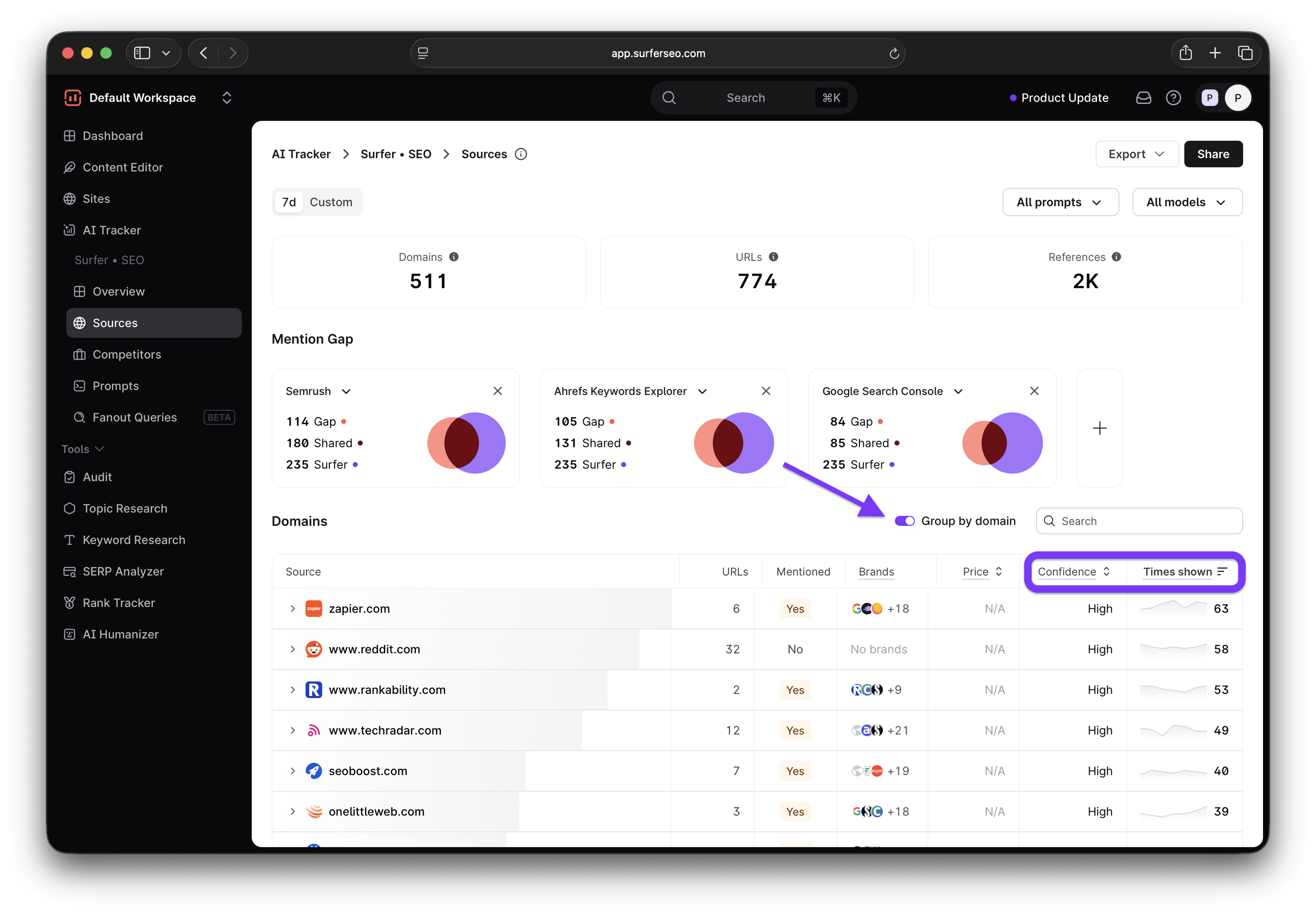
This shows you the most important domains and if they mention your brand. You can expand each to see specific URLs where you are and aren't mentioned, so you can reach out to the site owner and ask to be featured.
7. Ensure accurate third-party representation across Reddit, affiliates, and review sites
AI prioritizes authoritative sources built through high-quality third-party reviews and consistent brand information. The fact that Reddit is the most frequently cited source proves this, but AI platforms go far beyond it and might browse:
- Industry-specific forums
- Review sites (e.g., G2 and Capterra)
- Affiliate comparison sites
If information about your brand in these sources is inaccurate, incomplete, or outdated, that's what AI will show potential customers.
Fixing this is a bit trickier than optimizing your site because you have less control over the information on third-party pages. But you can still do a lot to influence the narrative around your brand.
For Reddit specifically, pay attention to threads that AI tools prefer the most. These are typically recent posts (12–18 months) with:
- Named tool recommendations
- Use case context
- Upvoted responses agreeing on recommendations
For example, when I asked Google AI Mode to recommend invoicing software, its first source was this thread.
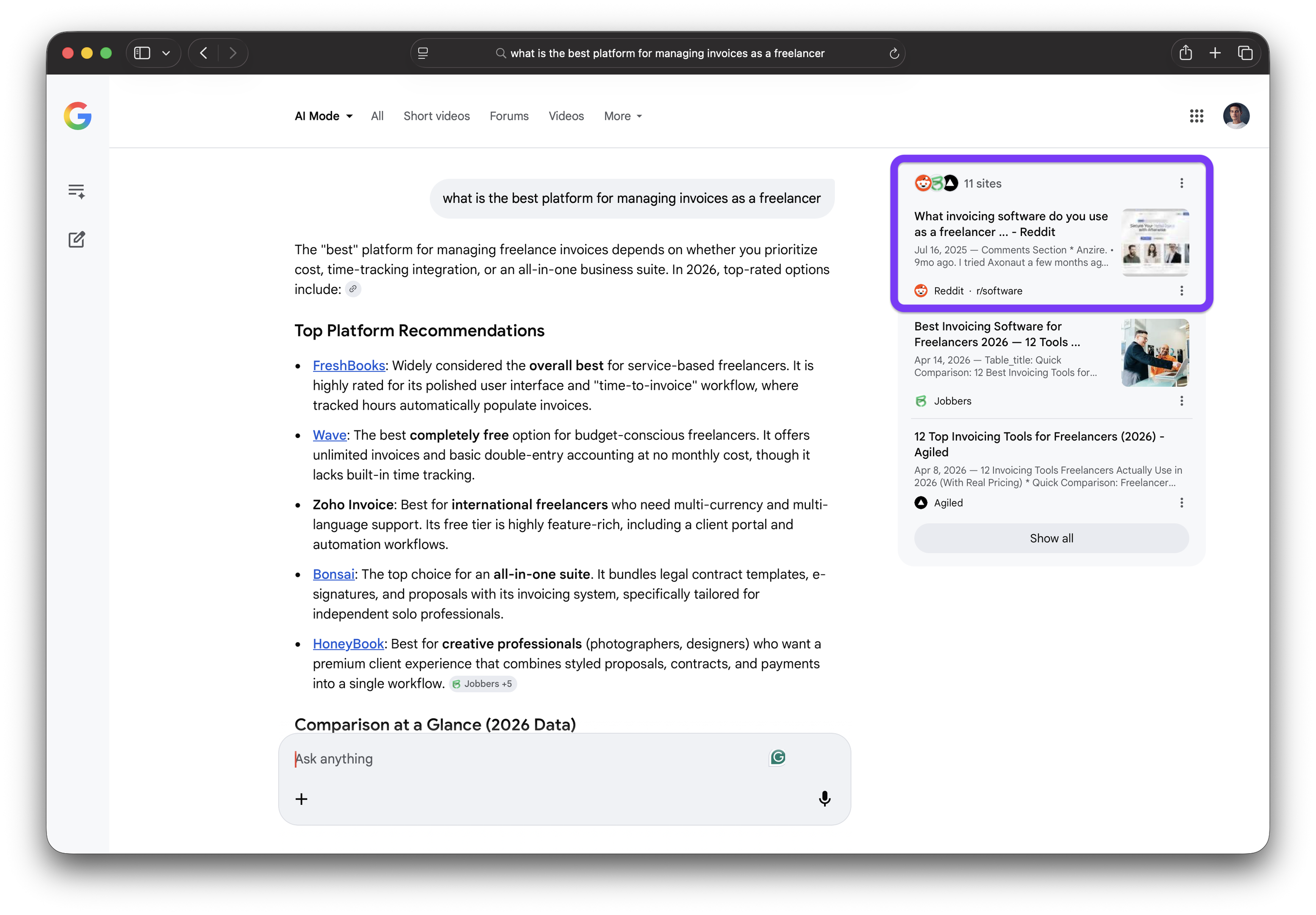
It's not massive by any means, but it checks the boxes and looks authoritative enough for AI Mode to cite it. And because platforms like Zoho Invoice and Bonsai were mentioned multiple times, they were featured in the response.
If you want the same results, engage in genuine conversations on Reddit. Don't use it directly for promotion because that's not the point and will probably backfire. Instead, use the 90/10 rule — 90% value-add content, 10% brand mentions.
You can find the most cited Reddit threads for your brand using Surfer's Sources report.
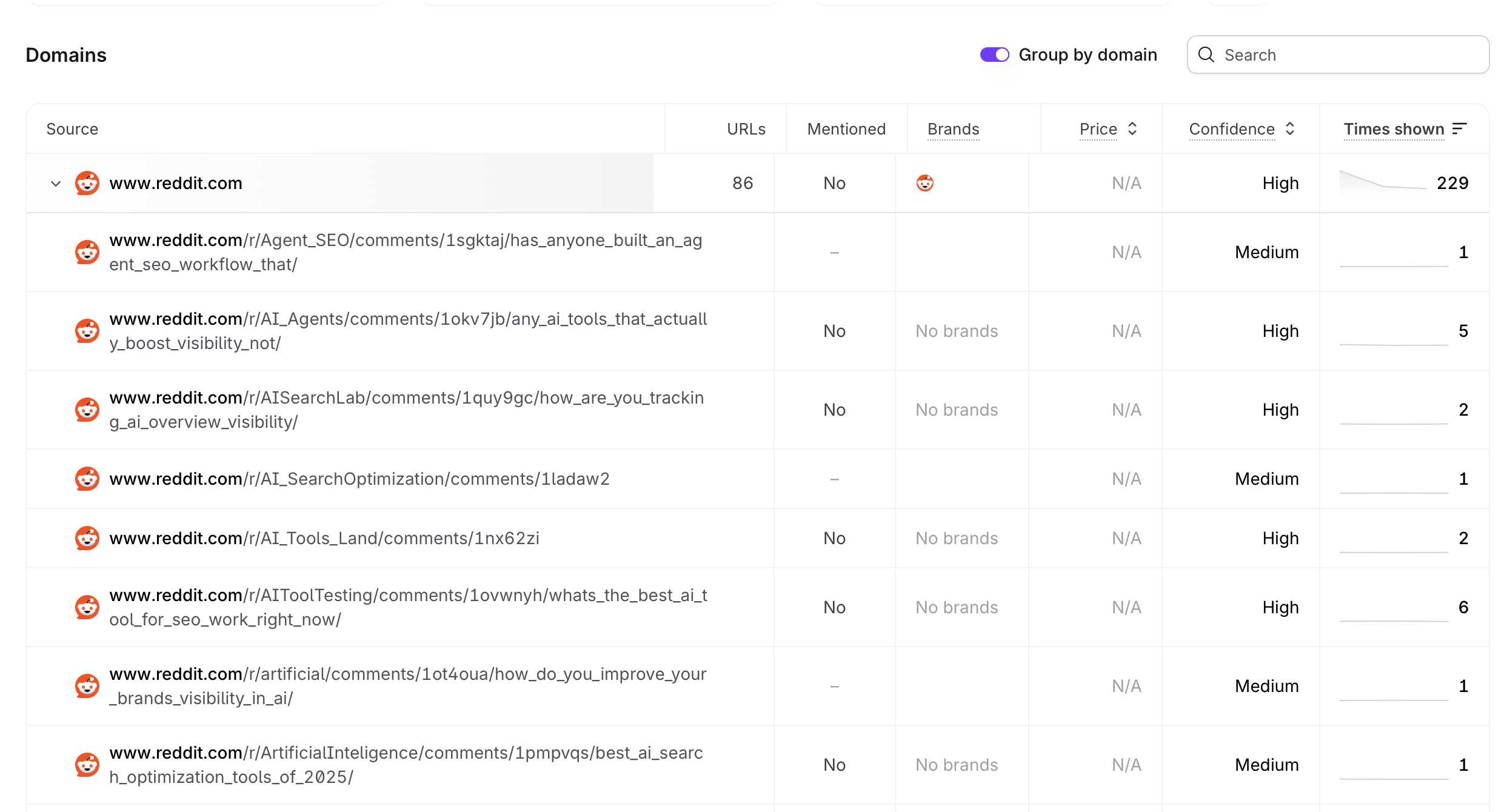
Besides Reddit, check major review platforms and make sure that all information on them is complete, accurate, and up-to-date in terms of capabilities and pricing.
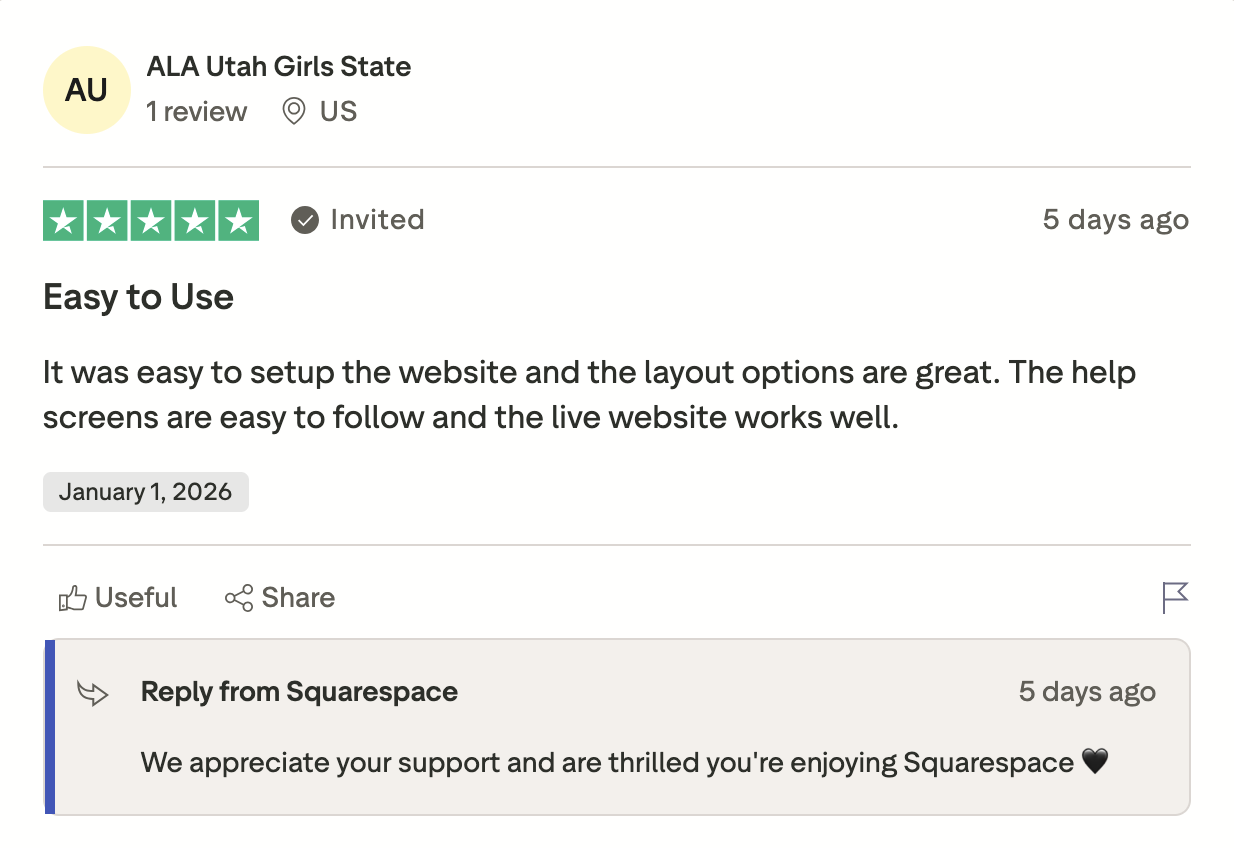
Then, proactively seek customer feedback that goes beyond generic information. While it's nice to receive feedback like "great product," AI platforms like to see details related to use cases. It doesn't have to be long or sing praises to the brand — something like this Squarespace review could do the trick:
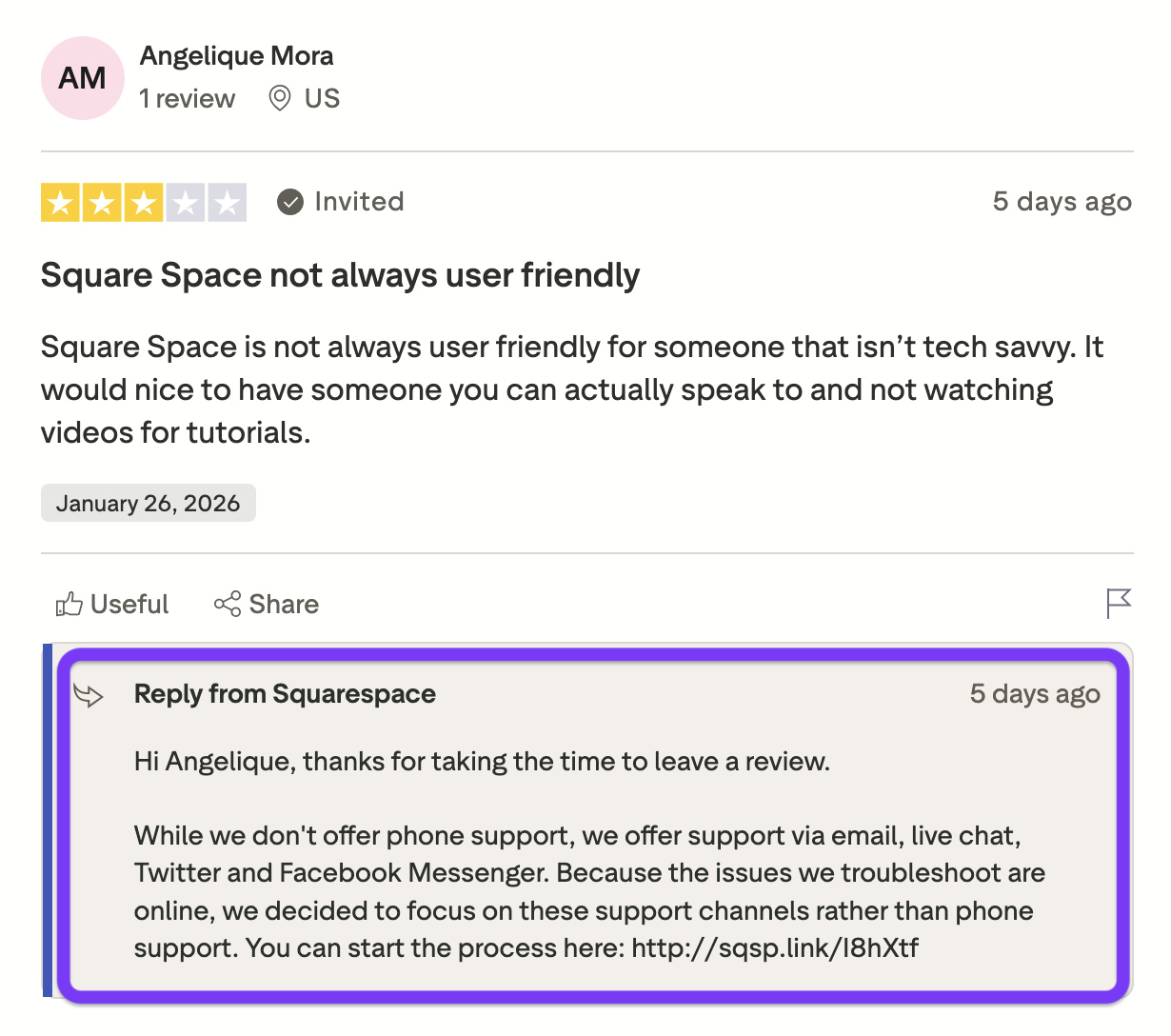
If you receive negative feedback, always respond to it with clear information. Besides improving the customer experience, doing so helps clarify that any issues that an AI platform might include can be solved. Here's a good example:
For affiliate sites, the strategy is the same as for other third-party sites. Identify major sites and articles mentioning your brand, and look for:
- Pricing changes
- Omitted new features
- Deprecated capabilities
Highlight any issues you notice, and then reach out to the site owner so they can correct them.
While all of this may seem time-consuming, don't ignore it. Inaccurate third-party content doesn't just lose you one AI citation — it actively misinforms the AI model's understanding of your brand, which can impact every future query about your category.
8. Structure content using answer capsules, tables, and lists
An answer capsule is a self-contained content block of 80–200 words designed to be extracted and cited by AI systems without needing surrounding context. Besides giving readers clear answers, its main goal is to help AI engines pull key information immediately for easier citing.
Answer capsules typically follow a repeatable structure:
- Definition sentence
- Purpose statement
- key components in a structured format
Capsules should also include mini-examples — and you just read one. If you read from the beginning of this section, you'll see all the components in action.
If possible, you should include a clear entity mention (your brand or product name) in the response, but only if you can do this naturally. It may not work for purely informational capsules, but those focused on commercial content (e.g., reviews or comparisons) let you include your brand without forcing it in.
An answer capsule should always be positioned immediately after an H2 or any question-based section. This goes for blogs, glossaries, feature pages, and any asset that AI might crawl for answers.
Here's an example of an answer capsule in action.
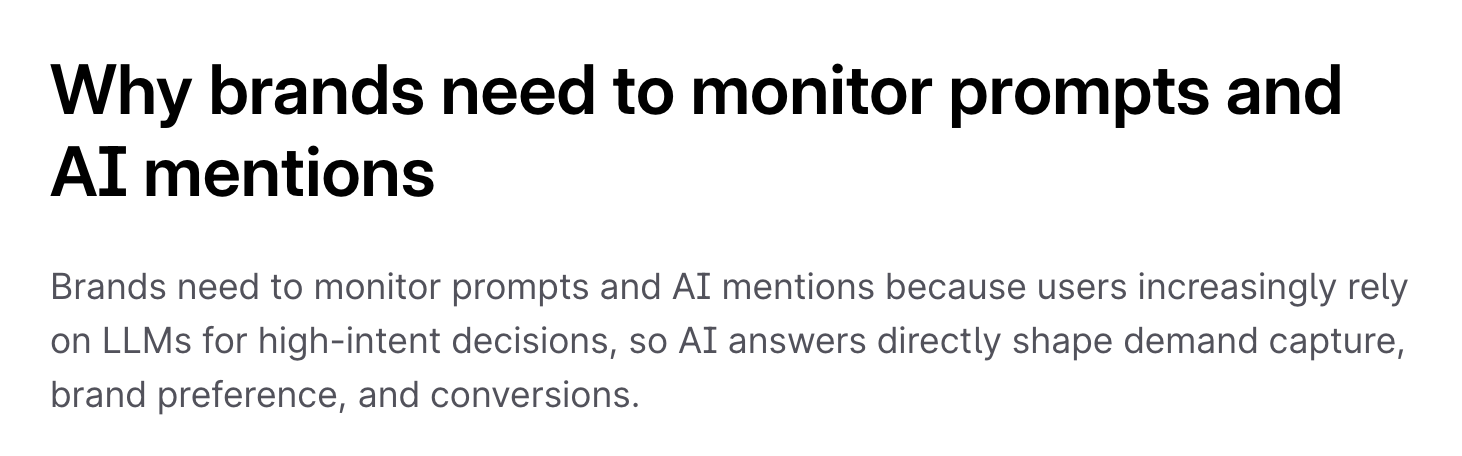
Simple, straightforward answers.
As for the rest of the page, you don't need to reinvent the wheel and use any special structures. Clarity should be your main guidepost, and you can ensure it through elements like:
- Bullet lists for features, pros and cons, etc.
- Numbered lists for steps and anything sequential
- Tables for comparisons, pricing, etc.
These elements are especially important around the middle of a page because that's where AI might get lost. By keeping these parts neatly structured, you can make sure AI crawlers can follow the article from start to finish.
9. Measure citation frequency and brand mentions
Tracking LLM visibility requires a major shift. While traditional SEO tools measure impressions, rankings, and organic traffic, a solid AI brand visibility tool should focus on entirely different metrics like:
- Citation frequency (how often you're cited across AI responses)
- Mention accuracy (whether the information is correct)
- Visibility score (your mentions vs. competitors')
- Source footprint (which third-party sites shape the AI's narrative about you)

Besides measuring cold figures, you need to perform sentiment analysis to see how AI platforms perceive your brand. A mention can be a strong recommendation, a neutral inclusion, or a warning that your product has downsides that can may put off your leads.
That's why it's crucial to know how AI feels about you so that you can control the narrative.
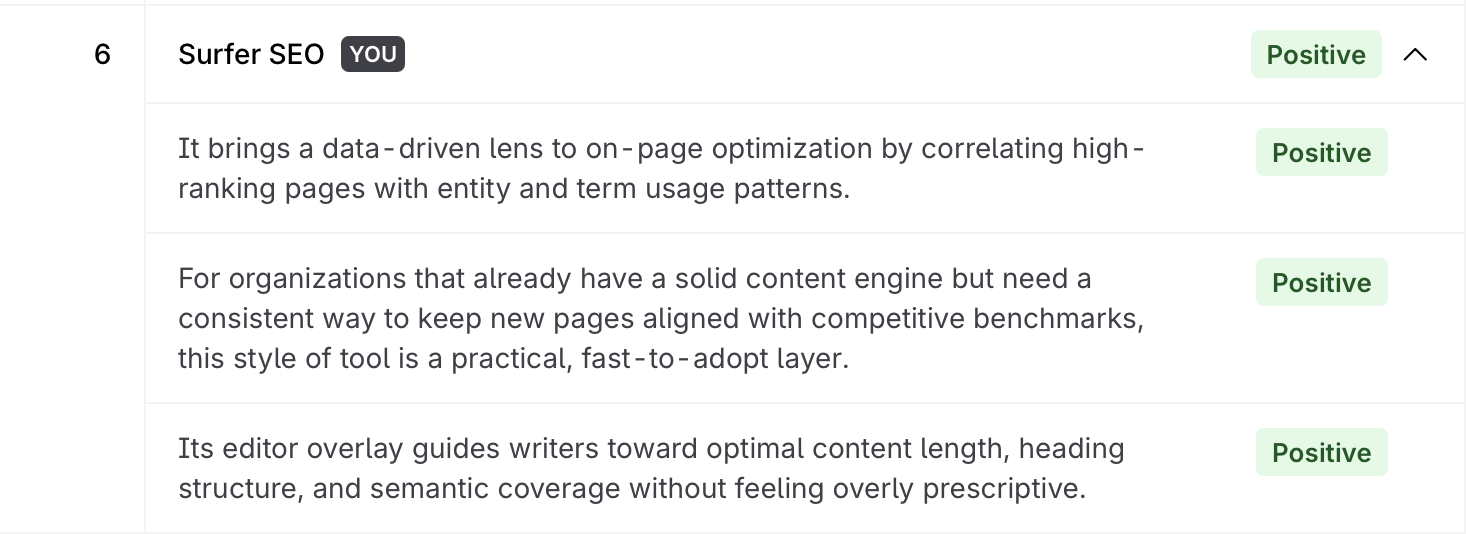
For example, Surfer's mention on this page is positive.
As for the tracking frequency, a weekly prompt-based audit will capture changes. Run your prompts and monitor visibility trends through changes in:
- Presence
- Position
- Accuracy
- Framing
Between audits, monitor third-party mentions using brand monitoring tools to catch new reviews, Reddit threads, or articles that could influence AI search results.
Do this as often as possible, especially if you have a larger audience who talks about you frequently and may change your brand perception.
Prompt tracking should also include your competitor domains so that you can see which competitors appear in AI-generated answers and how they're framed compared to your brand or products. You should track most of the visibility data you'll measure for your own brand, including:
- Citation rate by platform
- Share of voice
- Brand sentiment
Make sure to also track and address any mention gaps, like I mentioned when showing you how Surfer does it. Use any AI mentions where competitors appear but you don't to prioritize content optimization and outreach efforts.
Turn AI visibility into your next growth channel
AI isn't going anywhere, so measuring your brand's visibility on different platforms isn't a one-off project. It's an ongoing channel that compounds over time, much like SEO did a decade ago. If you invest in visibility now when most of your competitors are still invisible, you can build a massive structural advantage.
Audit your content, build citation opportunities, and then track citations and other visibility data regularly. Don't forget to position your brand on third-party sites and places where your audience spends time, as AI tools will also go there for answers.