Getting cited by Perplexity AI or having your brand mentioned doesn't happen at random.
In this guide, I'll show you how to maximize the chances of appearing in its responses.
1. Publish where Perplexity shops for answers
Probably the biggest shift AI search engines have introduced is the focus from on-site content to third-party pages.
Like other answer engines, Perplexity relies heavily on forums, directories, niche communities, and plenty of sources beyond websites to generate comprehensive, accurate responses.
Research by Axios showed that between Sept. 14 and Oct. 14, 2025, Reddit was Perplexity's most cited domain, followed by YouTube and reputable sources like Forbes.
To test this, I asked Perplexity different questions ranging from opinion-based ones (e.g., "What is the tastiest cut of steak?") to the more objective questions (e.g., "Is a line of credit better than a home equity loan?").
In all of its answers, Reddit was cited at least once among other reputable sources.
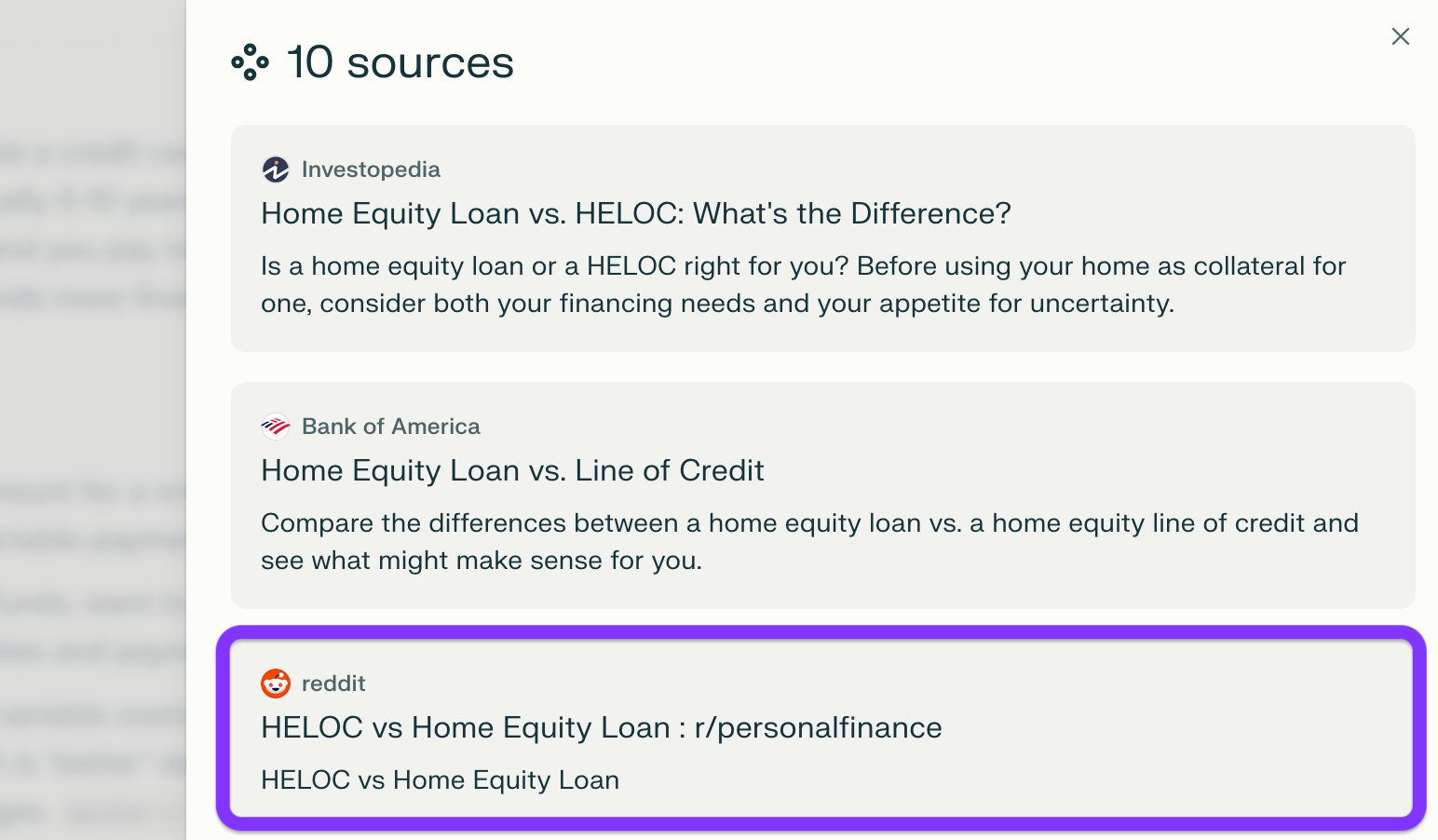
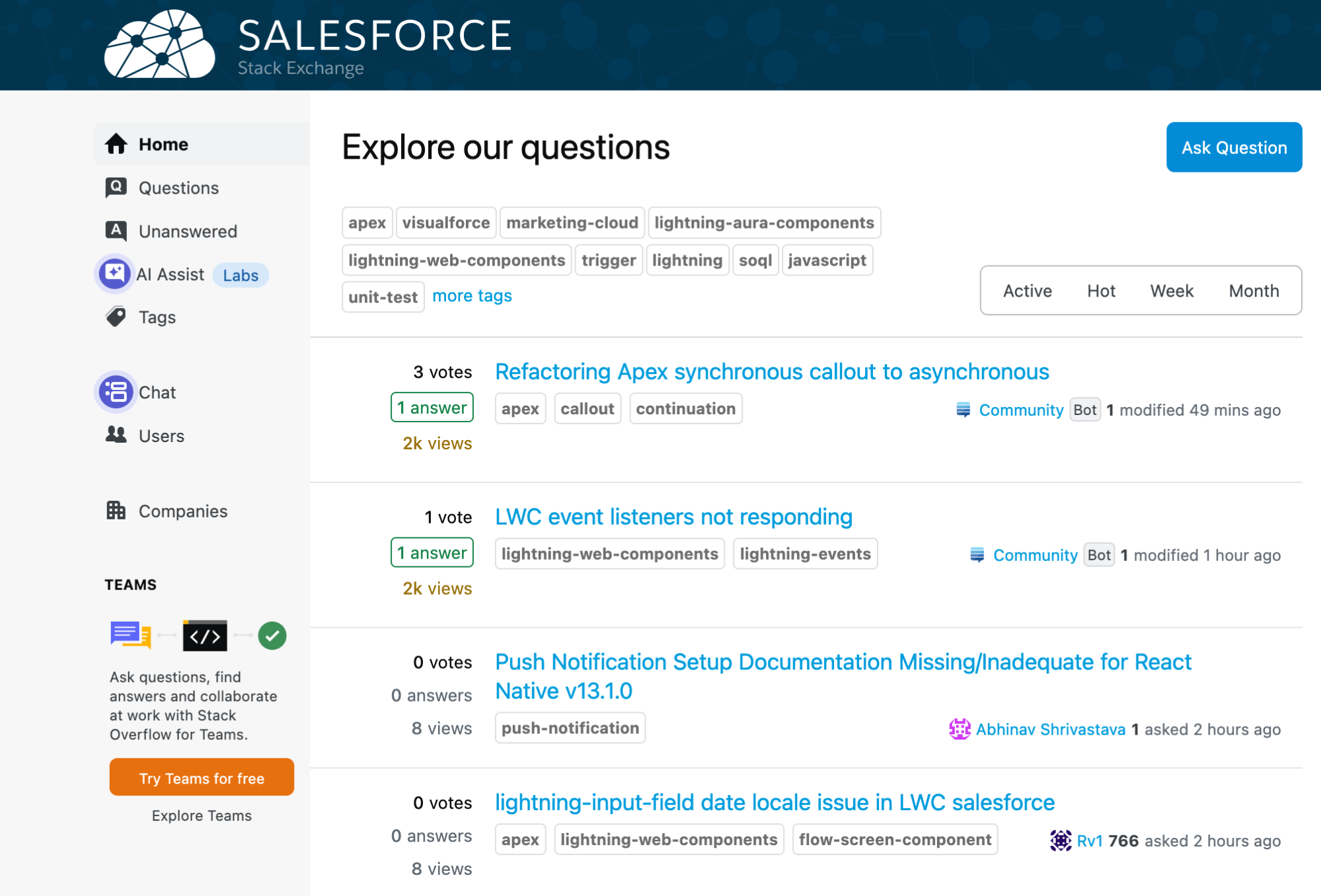
There are plenty of ways to leverage this pattern, depending on your content goals. For example, you can create branded threads or accounts on different community platforms to bring your audience together and engage in conversations that increase your visibility.
A good example is the Salesforce Stack Exchange page, which covers everything from how-tos to user experiences.
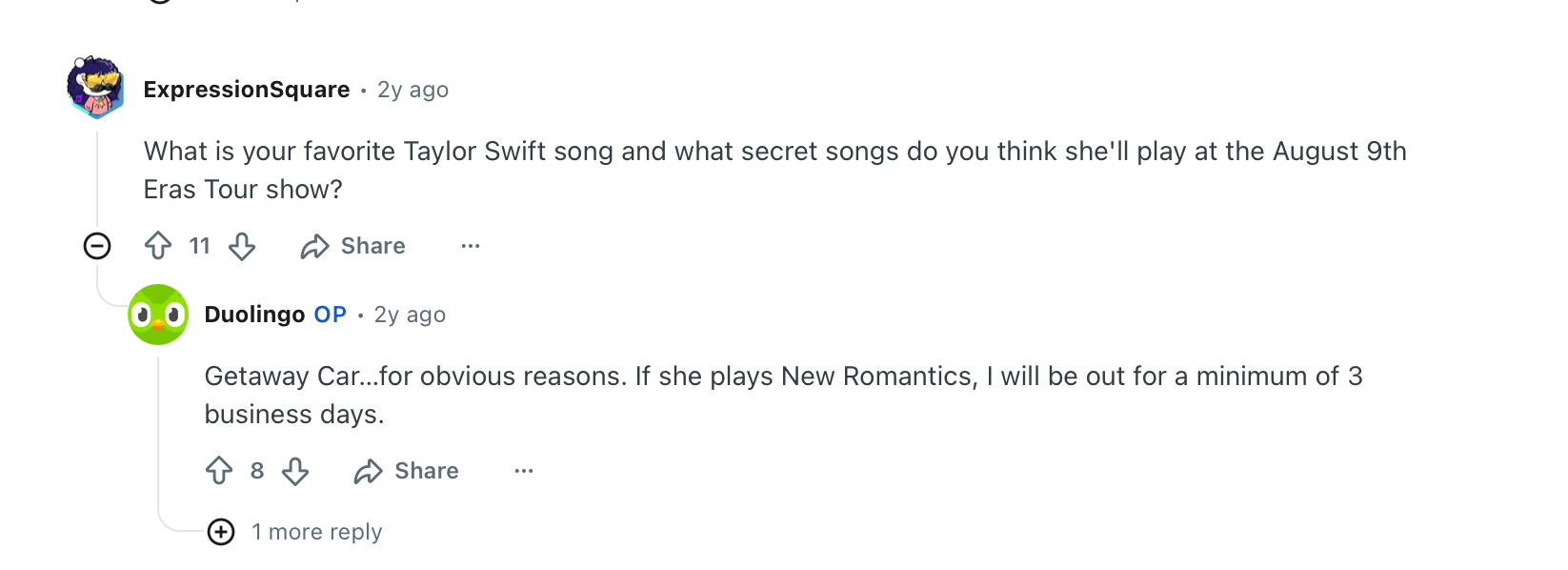
Another effective strategy is to create content specifically for forums that discuss topics related to your brand and business.
For example, Duolingo routinely engages in conversations surrounding language-related queries, whether on its own Subreddit, social media, or other channels.
The brand also participates in unrelated conversations (often for fun and entertainment), which further boosts its presence.
If you haven't already, expand your content strategy beyond your site to focus on Perplexity's main sources of information.
The right content formats and platforms will mainly depend on your industry and topics—for example:
- YouTube: For explainer content targeting conversational queries around how-tos
- Reddit: For opinion- or experience-based content (e.g. product recommendations)
- Review sites: For commercially driven content like reviews and comparisons
Cast a wide net by putting your brand on different pages and platforms that Perplexity cites. Besides getting new traffic channels, you can link back to your site from those platforms and strengthen your inbound funnel.
Use Surfer's AI Tracker to check your website's visibility inside Perplexity searches.
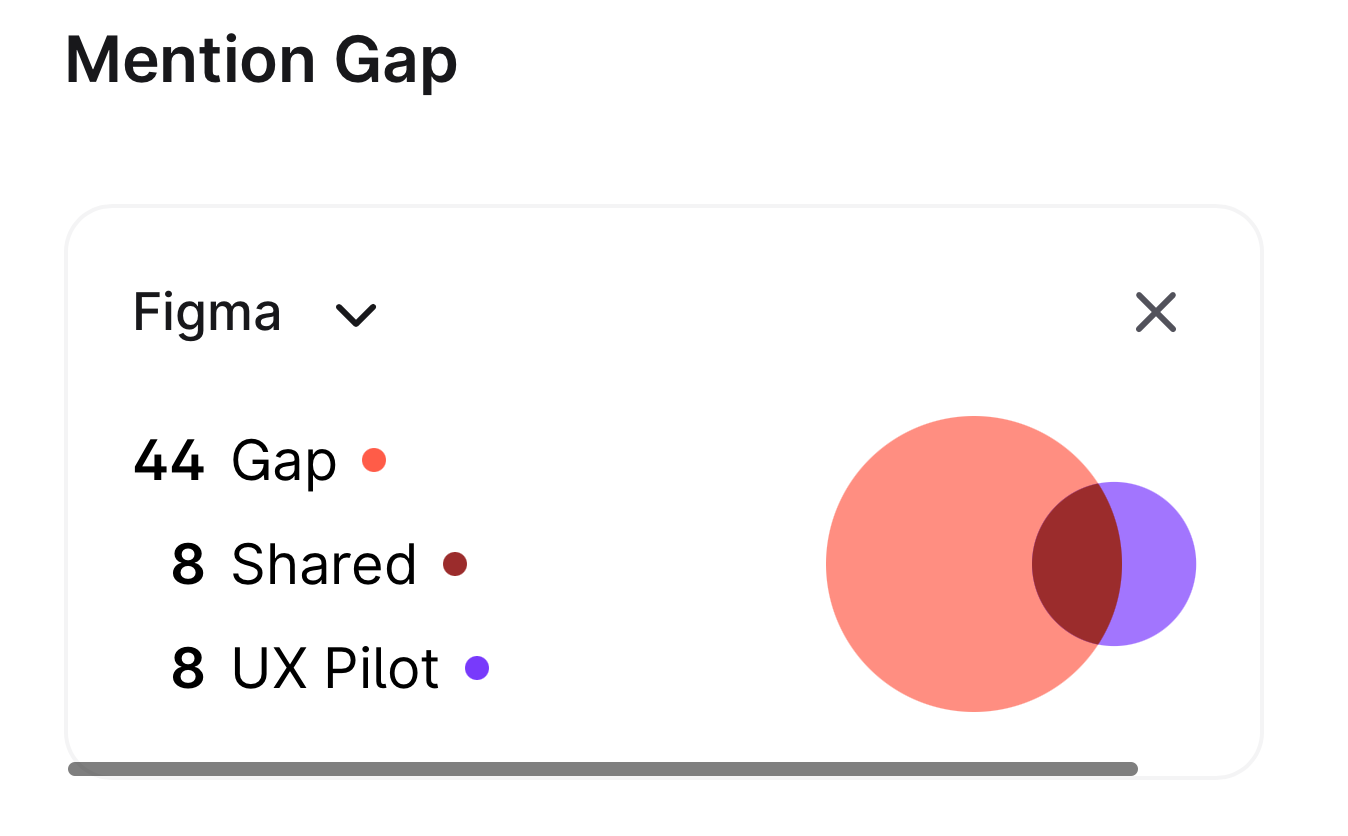
For example, this report on UX Pilot's Perplexity visibility provides an overview of how it's performing against competitors in UX design topics.
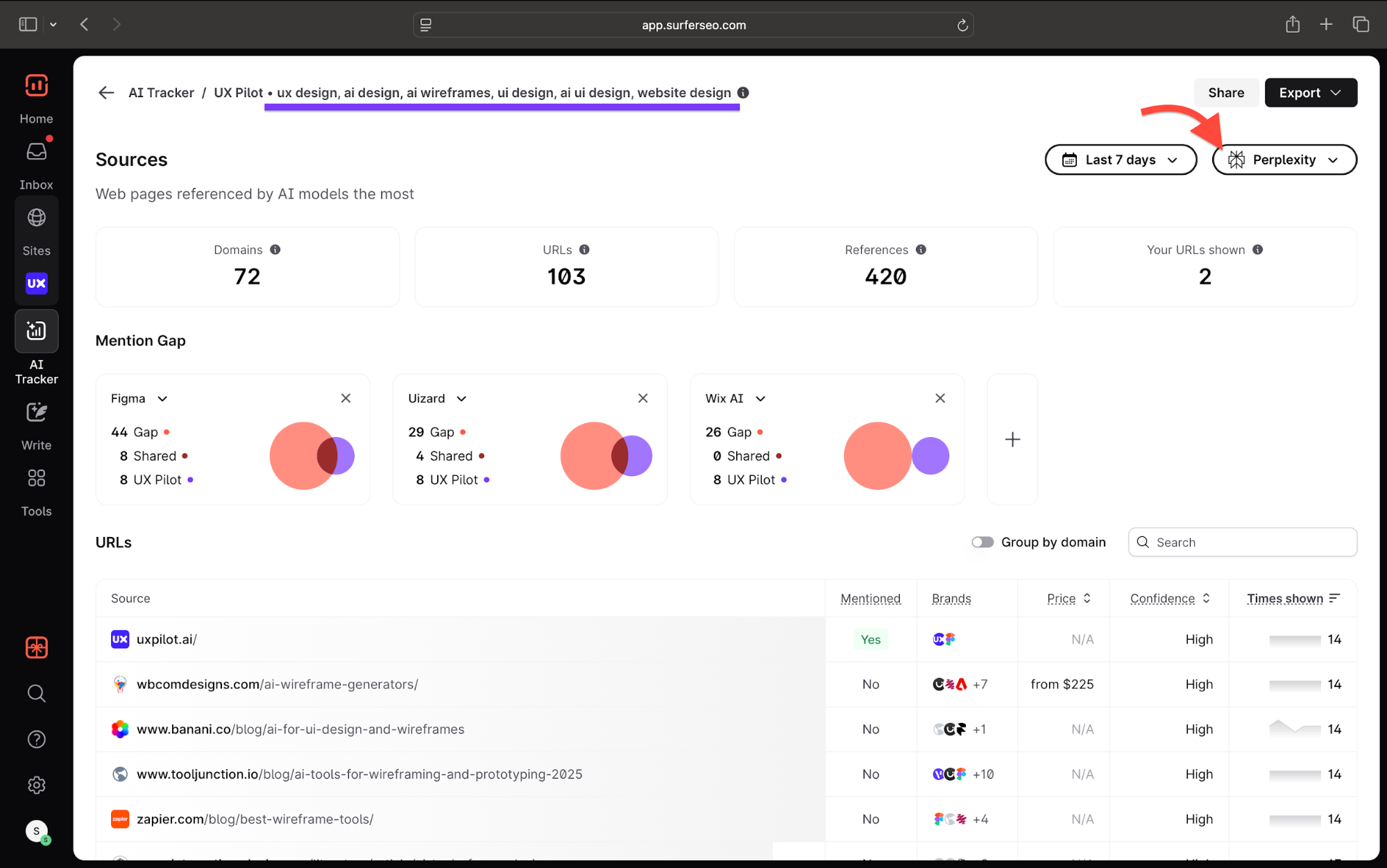
Take competitor benchmarketing – UX Pilot has a much smaller brand voice share against a behemoth like Figma for example and only overlaps over 8 shared queries.
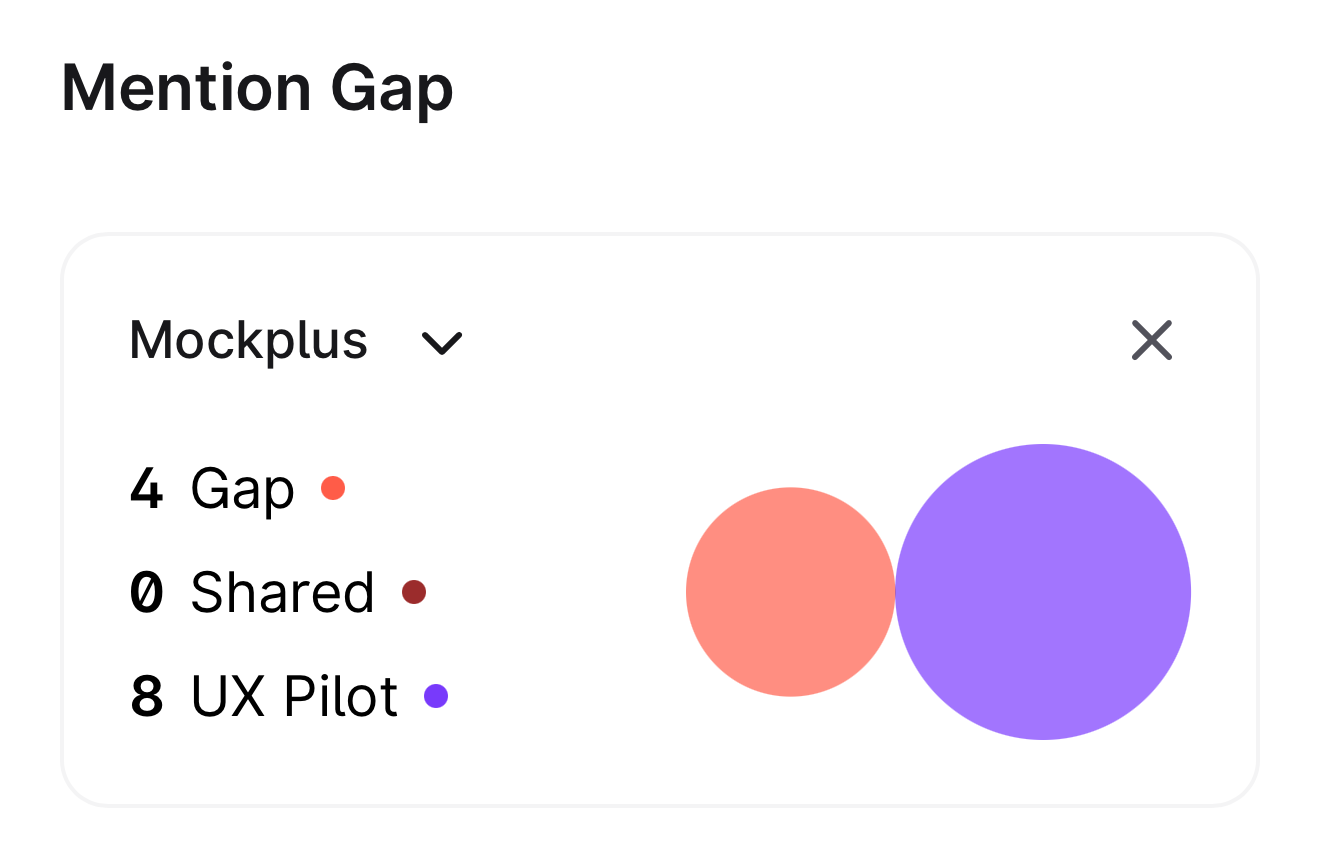
We can see that UX Pilot has a larger presence against smaller players but the 4 topics that Mockplus ranks for, are still worth analyzing since UX Pilot doesn't share them.
2. Focus on content clarity and structure
AI models prioritize punchy, well-structured content, and Perplexity isn't an exception.
This is because of Retrieval-Augmented Generation (RAG)—an AI technique that combines a generative large language model (LLM) with an external knowledge base to create more accurate and relevant responses.
To optimize for RAG, you need to target two sets of signals:
- Retrieval signals (e.g., domain authority)
- Generation signals (e.g., content structure)
Your content should help Perpexity extract and verify key claims so that it can confidently include them in its responses. If the AI engine sees you as a source that makes this happen, it will be more likely to cite you.
This means that unlike traditional search engines, AI-powered engines don't only focus on semantic relevance but also on how the information on a page is presented.
To leverage this, your content should first address the query/prompt as clearly and concisely as possible. An effective strategy is to use the Q&A format, which involves:
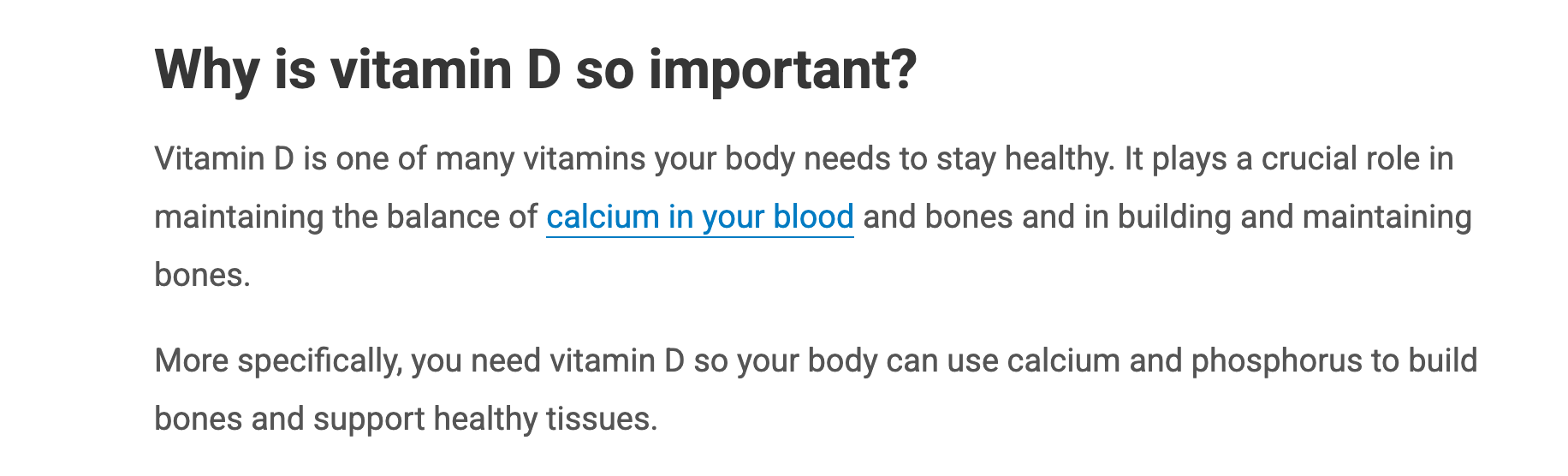
- Turning a heading into a natural question (e.g., "Why is vitamin D important?" instead of "Importance of vitamin D"
- Answering the question immediately in 1–2 clear sentences
Here's an example from Cleveland Clinic that shows this in action:
Whenever possible, you should also turn content into extractable chunks through formats like:
- TL;DR sections
- Tables
- Lists and bullet points
Take a look at this conversation as an example, and pay attention to the first four items of the response:
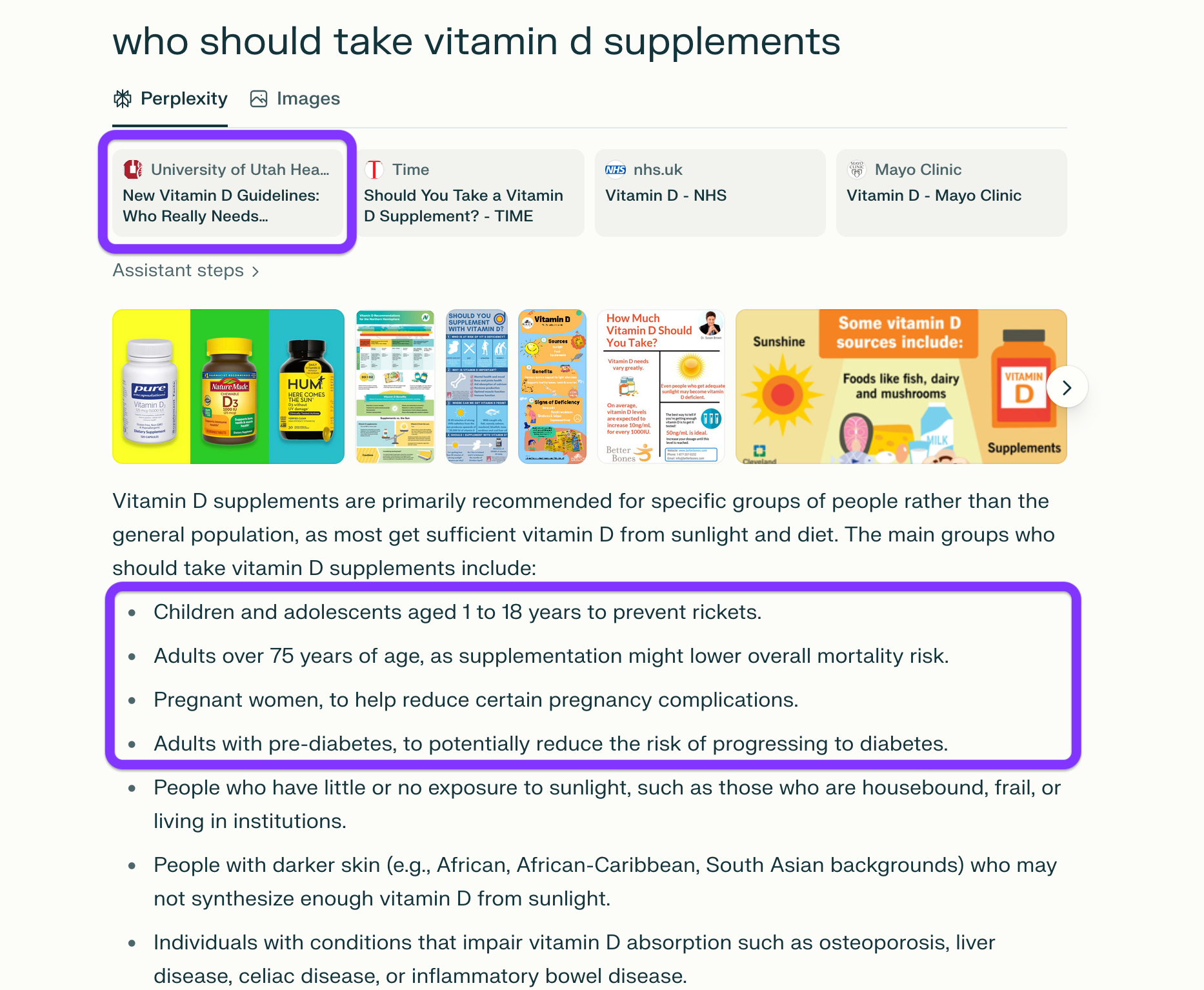
If you open the University of Utah's article that was cited first, you'll notice the bullet points are the same as those that Perplexity prioritized:
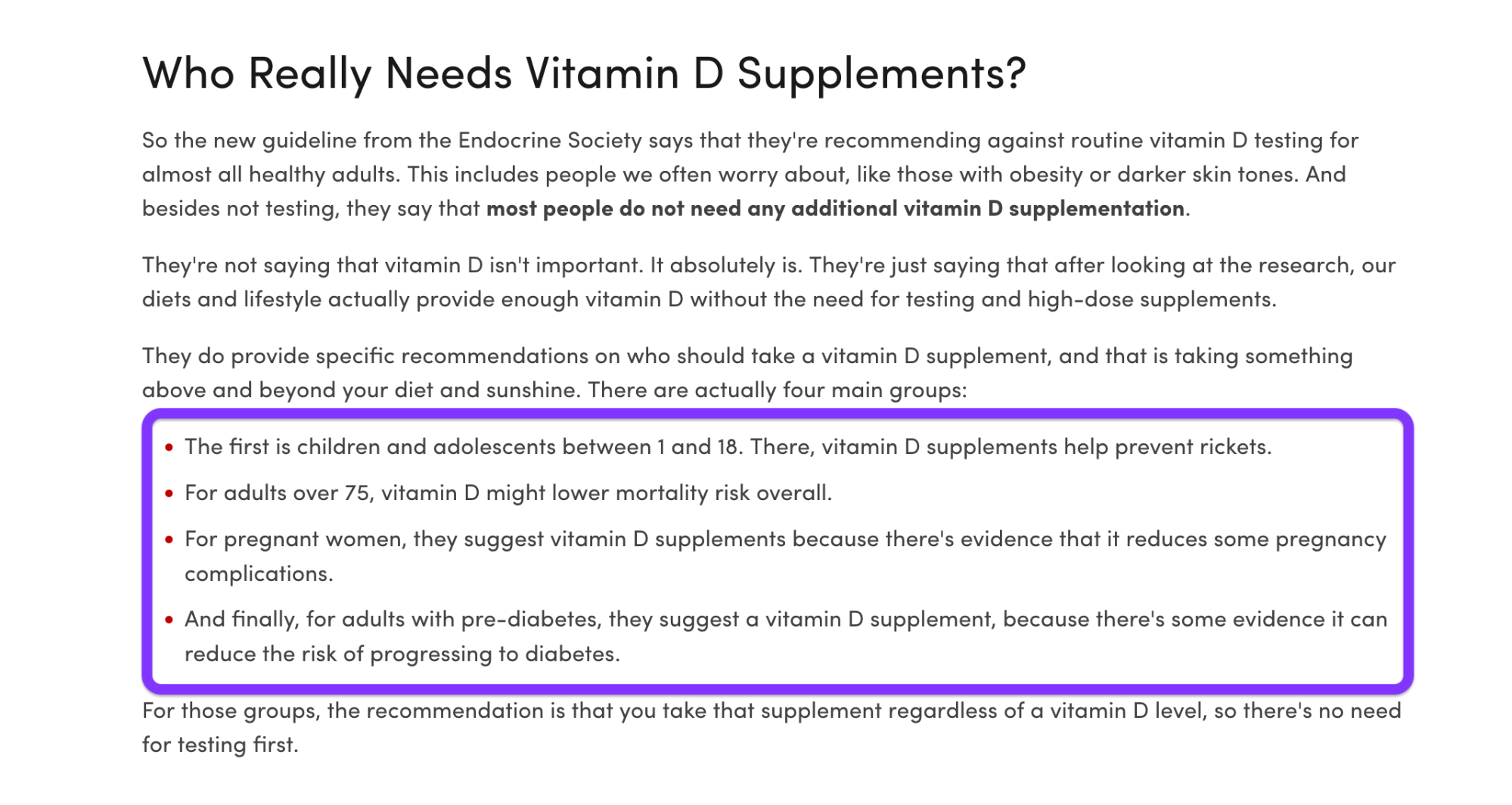
Even though the bullet points aren't directly under the question heading, they're clear and easy to extract enough for Perplexity to pull them without much effort. This sends positive generation signals that make Perpexity favor the article among competitors.
Due to the importance of structure and clarity, Perplexity and other AI platforms often prioritize listicles over traditional blog posts. You can play to this trend by doing what I've done with the article you're reading right now.
The H1 is descriptive and question-based, and the first part of the article is made up of H2s that serve as a direct response. This hierarchy shows that the article directly addresses the query, which will make it easier to extract.
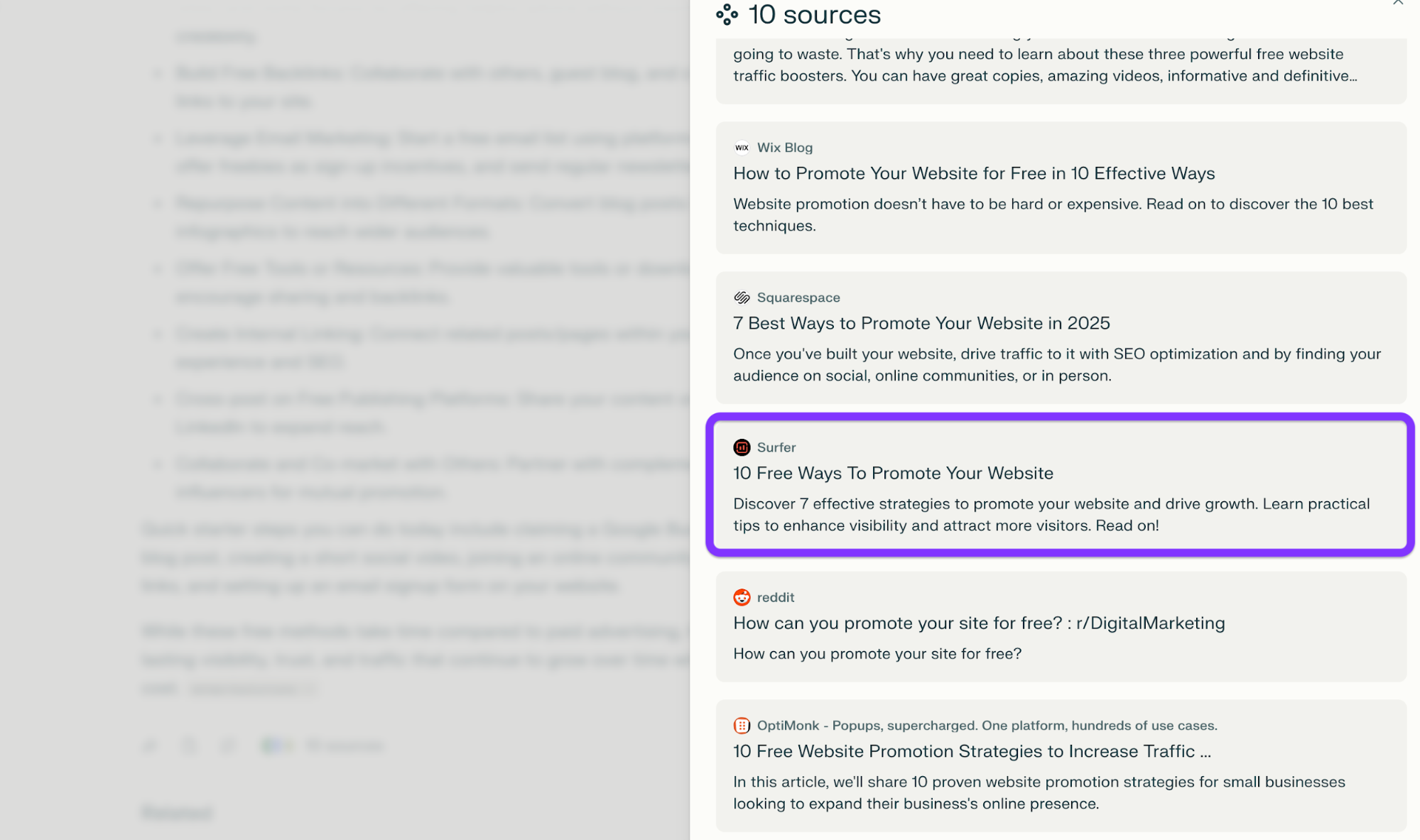
I took the same approach with this article about free website promotion strategies, and it worked. When I asked Perplexity about free ways to promote a site, it cited my article and pulled content from it in the response.
While outlining your content's overall hierarchy and the structure of specific sections, put yourself in Perplexity's shoes to think about its preferred format.
The good news is that you don't need to take a guess—ask Perplexity about the topic you're writing about, and the response will show you the preferred structure.
Alternatively, see the resources it cites, and then emulate their content formats and structures. Zero in on the predominant hierarchy, and build your page accordingly.
Schema markup can also improve Perplexity's understanding of your content.
If you haven't done so as a part of your traditional SEO strategy, add Organization, Person, Product, FAQ, and HowTo schema wherever relevant so your key facts are machine-readable.
You can include dozens of other structured data types depending on your topic and content structure, so explore schema.org to find the most relevant ones.
3. Make sure PerplexityBot can crawl your content
AI visibility heavily depends on the AI models' ability to crawl and index your content. Much like traditional search engines, Perplexity relies on the robots.txt file to determine if its bots can crawl the page.
If your robots.txt file accidentally blocks PerplexityBot, Perplexity can't see your content. The same happens if your firewall thinks the bot is suspicious and blocks its IP address.
To prevent this, make sure your robots.txt file does not say Disallow: / for PerplexityBot. The related section of the file should look like this:
User-agent: PerplexityBot
Allow: /
If you use a hosting firewall or a dedicated security service like Cloudflare, you should also whitelist Perplexity’s published IP ranges to ensure they're not blocked. You can find the IP ranges in Perplexity's resources on crawlers.
Another reason why PerplexityBot may not see your content is an outdated sitemap. If the sitemap contains pages that are missing, broken, or not included in the robots.txt file, they won't be crawled by Perplexity.
Fixing this issue is easy—here's what to do:
- Check your sitemap and remove broken or duplicate pages
- Make sure all the key pages are included
- Put the sitemap URL inside the robots.txt file, like so:
Sitemap: https://example.com/sitemap.xml
If you add many new articles, create a new sitemap (e.g., sitemap_blog.xml) and link it from the main sitemap index to ensure the articles are visible.
A long-standing search engine optimization (SEO) tactic you should carry over to generative engine optimization (GEO) is ensuring there are no duplicate pages. Similar to Google search, Perplexity's algorithm might get confused by multiple pages with the same topic.
To ensure this doesn't happen, give each important page a self-referencing canonical tag:
<link rel="canonical" href="https://example.com/article/">
It's also a good idea to combine similar articles into one high-quality page. Besides avoiding duplication, you'll ensure broader topic coverage that will showcase the page as more authoritative.
Finally, search engines don’t always discover new pages right away, so fresh content might take longer to get indexed and pulled. This is especially true with Bing, which Perpexity heavily leans on.
Now, this may seem contradictory to freshness as a key ranking factor. Why does Perplexity prioritize fresh content if it can't pick it up?
The secret lies in ensuring that new or updated URLs are directly pushed via IndexNow and visible in Bing Webmaster Tools. Many CMSs have plugins you can use to do this, so it's not a complex task.
When enabled, IndexNow automatically notifies Bing whenever you publish or update a page. This way, you can rest assured that new content can be picked up quickly.
4. Win the “new post” window with an explosive launch
Perplexity seems to work on a retrieval + reranking pipeline, where newly published pages are placed in somewhat of a "trial" phase.
They're visible but only continue to be surfaced if user behaviour signals that they are useful. These signals include:
- Impressions
- Clicks
- CTR
This is similar to how Google Discover works. While it focuses on new content, it doesn't show all the new pages but only those that seem to draw engagement.
While the exact time frame and thresholds are unknown, some speculative analyses suggest a minimum of 1,000 impressions with a 4.2%–4.5% CTR within the first 30 minutes or so.
While this might be easily achievable for well-established sites, smaller ones might struggle to reach those numbers.
If this goes for your site, you should actively push new content instead of posting it and waiting for the results. Here are some tactics to try:
- Pre-announce the launch: If you plan on posting a flagship article, build some hype around it before publishing through announcements on social media or newsletters.
- Push the article through all your channels: As soon as the article is live, share it through social media, forums and niche communities, emails, and other channels you use.
- Boost engagement metrics: Invite readers to comment on the article or share it with others to increase engagement and signal the article's value
As you promote the page, know the difference between aggressive pushing and artificial inflation of metrics. While the former is fine to an extent, don't try to rig the system through shady tactics like having people click on the article a bunch of times or using automated bots.
This doesn't work with either traditional SEO or answer engine optimization (AEO), and it might even get the page penalized.
Instead, focus on genuine but direct promotion through your marketing channels. Doing so can help your page climb out of Perplexity's sandbox and cross the new post threshold.
5. Restructure content for AI understanding
I've already talked about content structuring, but now I'd like to put it in the context of user intent. In stark contrast to Google and traditional search engines, AI tools are highly granular when it comes to search intent.
In practice, this means you need to move away from Google's broad intent categories:
- Informational (what is, how to, etc.)
- Navigational (amazon black friday, pinterest log in, etc.)
- Commercial (jbl vs. sennheiser, iphone 17 review, etc.)
- Transactional (buy roomba, airpods discount, etc.)
Many people don't use AI tools to search for the general queries associated with a specific intent type. Instead, they use longer, conversational queries with a much more focused intent.
For example, while you would Google "best dry dog food," you'd ask Perplexity something like this:
"Which dry food is the best for a Pomeranian suffering from luxating patellas?"
In traditional SEO, this would be a blend of informational and commercial intent with a hint of transactional. Perplexity and other answer engines understand and can address such nuances, and they'll serve content that does the same.
Besides query structuring and using the right content formats like I explained above, the best way to accommodate this is to cover follow-up and tangential queries. For example, if you're writing a listicle about dog food, go beyond general categories and discuss food for:
- Different breeds
- Specific health benefits
- Cost considerations
The more details you can include, the better you can answer highly specific search intent types.
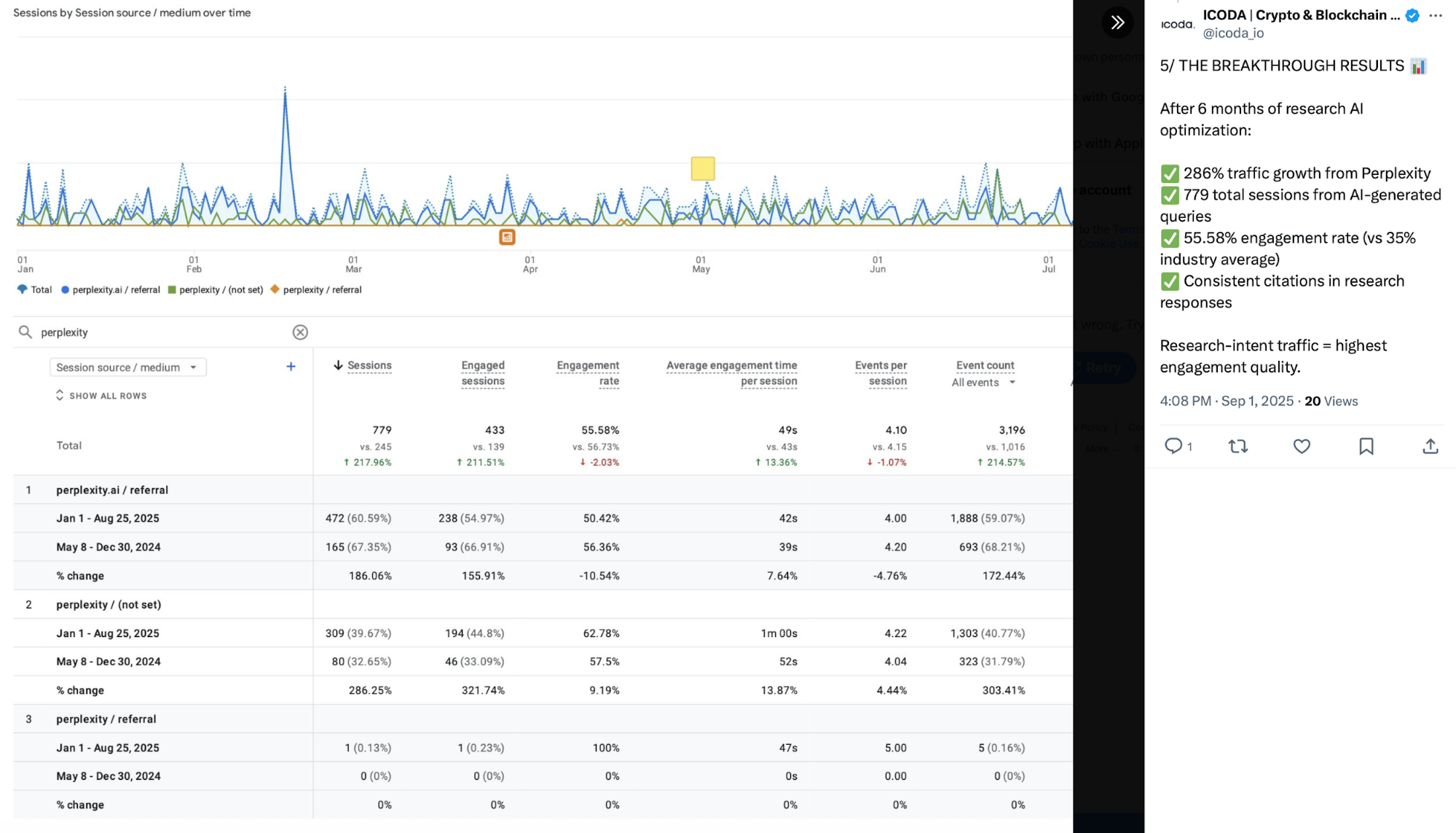
ICODA implements this strategy well. In an X thread, they explained the importance of query structuring and intent matching, and they shared the outstanding results they've achieved after focusing on Perplexity optimization.
Within six months, the agency saw a 286% boost in Perplexity traffic with a 55.58% engagement rate.
6. Use press releases and PR posts
Another tactic we've carried over from traditional SEO is to publish press releases and other PR posts surrounding your brand.
Many experiments have shown that this boosts credibility with Google and standard search engines, and it seems to work with AI-powered ones, too.
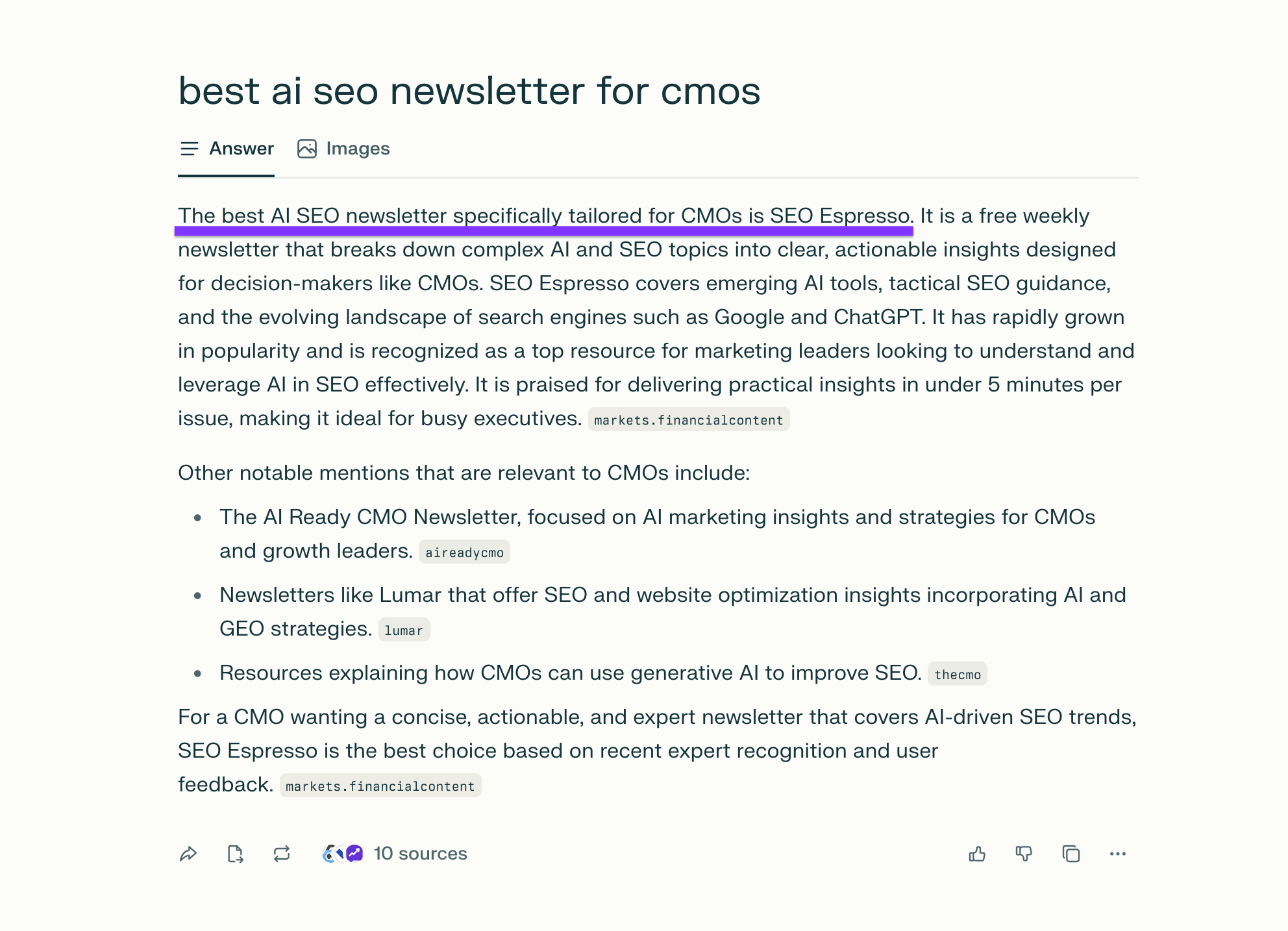
To test it out, Harpreet Chatha ran an experiment by posting press releases about this newsletter, SEO Espresso. In an X thread, he shows that both ChatGPT and Perplexity recommend it when asked about the best AI SEO newsletters for CMOs.
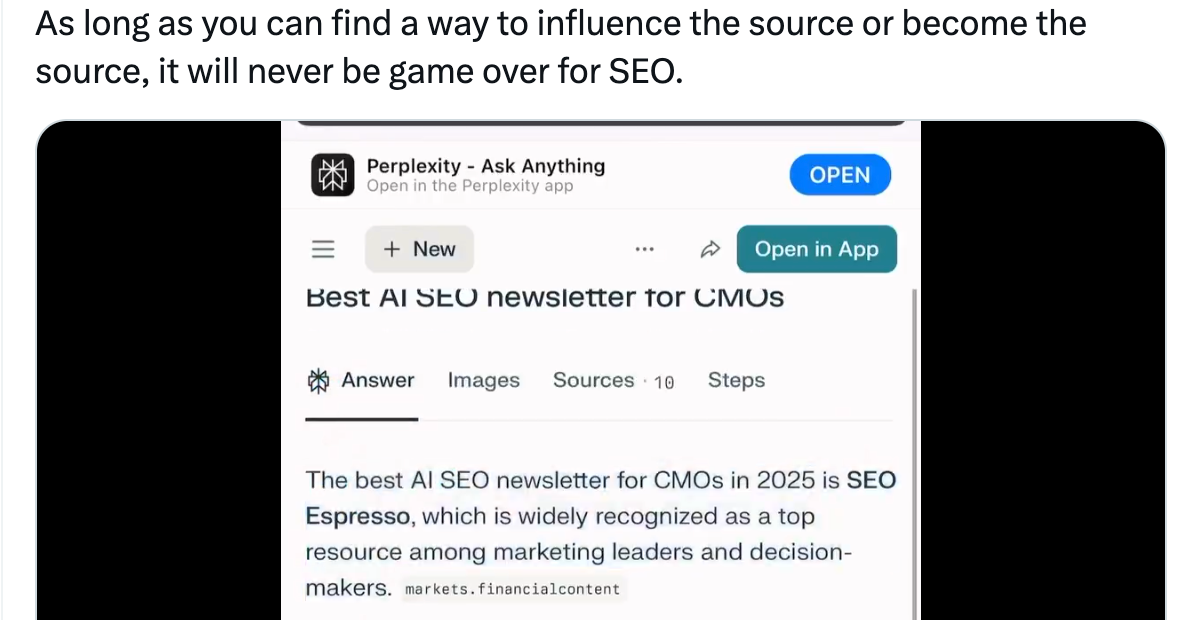
I wanted to verify this, so I asked Perplexity the same question. As you can see in the screenshot below, SEO Espresso is still recommended as the best newsletter.
If you want similar results, write press releases that look like pre-packaged answers. Use a clear, keyword-aware headline, such as:
“[Brand] releases 2025 Perplexity SEO study: 65,000 citations analysed”
Then, create a tight, AI-friendly structure by following the who/what/when/where/why format. This makes the content more extractable and increases its chances of being cited.
At the end, include a short “What this means” paragraph that explains the takeaway in plain language. Doing so helps the PerplexityBot clearly understand the press release, which simplifies indexing and retrieval.
As for where to publish the press release, go beyond your website and post on authoritative or niche-relevant outlets, such as:
- Industry blogs
- Trade media
- News outlets
Perplexity will probably scour those for answers, so it will be more likely to cite you if it runs into your brand consistently.
7. Publish on Perplexity's own domain
This is more of a hack-type tactic than an evergreen strategy, but publishing directly on Perplexity Pages might help get quick wins through visibility and traffic bursts.
SEOs like Julian Goldie are referring to this tactic as "Parasite SEO," and the general idea is simple: Perplexity.ai is already a trusted domain in the eyes of both Google and answer engines, so a page on that domain indexes faster and gets cited more readily than if you published the content on your own lesser-known domain.
In his X post, Goldie explains that this tactic can work almost immediately and get you a major visibility boost in as little as 48 hours.
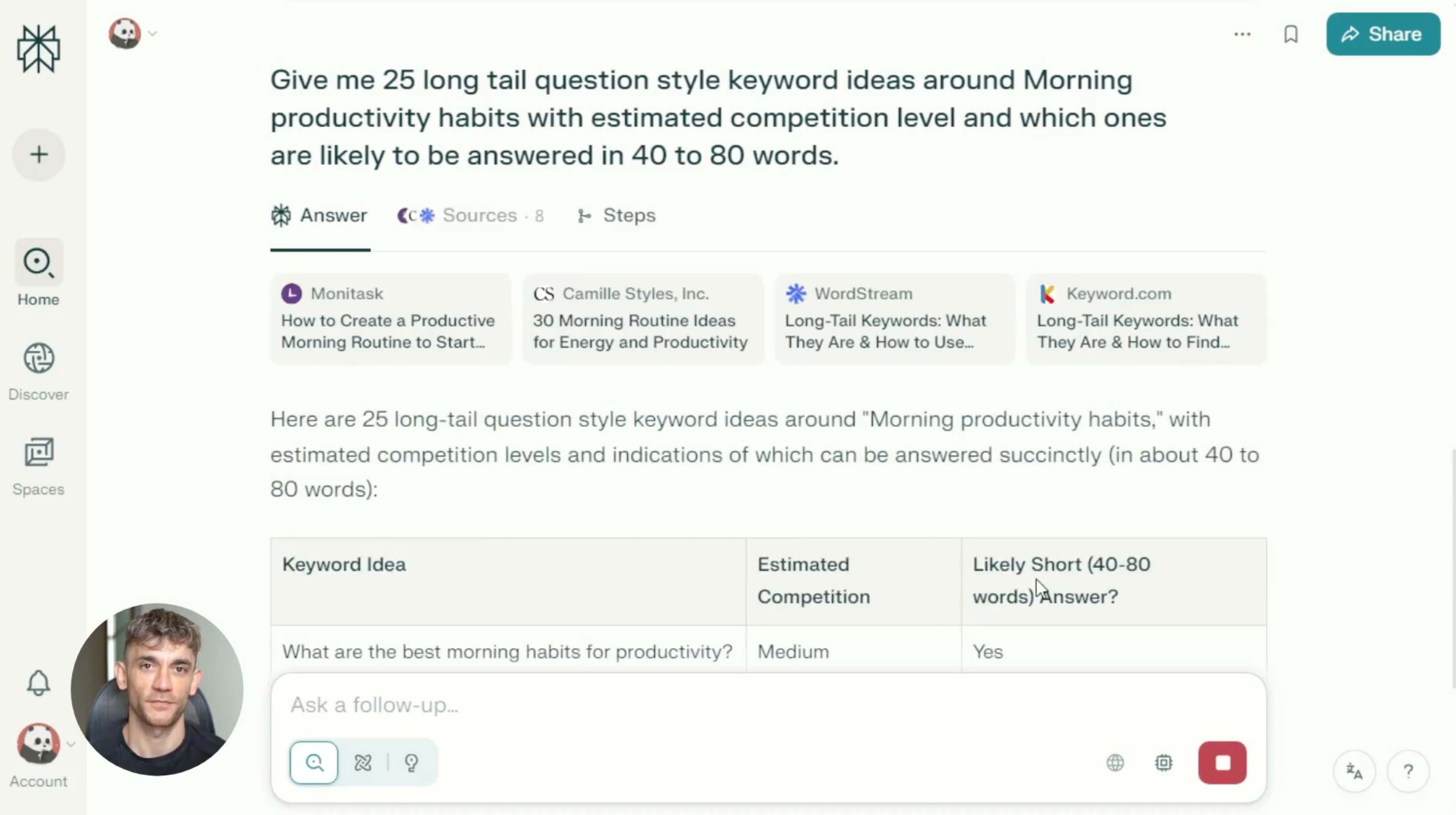
Here's how it works:
- Validate your keyword and intent: Use Perplexity or another answer engine to test your target query. Ask: “What sources does Perplexity currently cite for [your query]?” Then, choose informational, question-style queries that are likely to get short, direct answers.
- Create a page on Perplexity Pages: Title the page with the exact query you want to rank for, and then write a short TL;DR/intro paragraph (40-60 words) that answers the question clearly and directly. Build the supporting sections (“What is X?”, “How to do X?”, “Common mistakes,” etc.) to accommodate Perplexity fanout
- Link to your site: Somewhere in the Perplexity Page content, add a link/CTA to your key URL on your main site (the page you want to get cited or otherwise care about the most)
If done well, this tactic should create an effective funnel—users arrive on Perplexity, get the quick answer, then click to your domain for deeper insight/products/services.
Once the page is live, search the target query in Perplexity to see if it shows up. Do this over the next few days to see if the tactic worked, and monitor your site's traffic from Perplexity.
Depending on when you're reading this, you may or may not see the results you're looking for because Parasite SEO and other "tricks" don't tend to stick around for long. Still, this tip may be worth a shot because it doesn't take a lot of work and might get you some quick results.
3 Key Perplexity ranking factors
While the SEO/AEO community is still figuring out how Perplexity cited content, we know that these three factors matter the most:
RAG retrieval friendliness
If you haven't updated your content in a while, your first job should be to make it sound as easy to retrieve and quote as possible.
According to recent RAG research, better retrieval design sharply improves factual accuracy and reduces hallucinations, so Perplexity will favor pages that make this happen.
In practical terms, this means your content should:
- Match the semantic intent of the query (not just exact keywords).
- Expose clear, self-contained passages that can be lifted as evidence.
- Use explicit entities (names, dates, figures) that help ranking models align the query with the relevant sections
If your content has long-winded intros, fluffy paragraphs (4–5+ lines), or watered-down definitions, these are your first areas of improvement. Make content punchy, clear, and digestible so Perplexity's natural language processing (NLP) can understand it without confusion.
Content freshness and recency
Perplexity is ruthless about content freshness, so stale pages almost surely won't get cited. Empirical tests show that Perplexity gives newly published or recently refreshed content a strong ranking boost, with visible “content decay” starting after just 2–3 days if pages aren’t updated.
RAG systems especially lean toward newer content when the query is about “latest,” “2025,” or news-like topics. If you cover "trendy" subjects (which you should), pay attention to:
- Publishing date
- Last update
- Recency of information and cited sources
Set a fixed schedule for updating both evergreen and hot topics as frequently as possible. Whenever you refresh a page, nudge another crawl (e.g., through IndexNow) to signal recency.
Credibility and authority
All other factors aside, an authoritative website will always be more frequently cited than a lesser-known one. This doesn't come as a surprise when you understand how RAG works and know that Perplexity doesn't want to spend too much time deciding whether to trust a source.
A study published in September 2025 showed a strong correlation between a page's authority and trust and its likelihood of getting cited. While freshness seemed to be more impactful, authority is still among the main predictors of your chances of ranking well.
Specifically, a page will be cited more frequently if it has any of the following:
- Named experts in the content
- Transparent sourcing
- Original, verifiable data
As for off-page authority signals, they don't differ much from those in traditional SEO. If your page has backlinks from other authoritative sites and a solid presence in credible directories (Crunchbase, Wikidata, etc.), Perplexity and other AI systems will trust it and use it as a source more confidently.
Does Perplexity use Google’s results?
Perplexity doesn't use Google’s search index or Google’s Search API to power its results. It relies on its own index plus other sources (notably Bing) and direct crawling.
This means that for ranking and visibility purposes, you shouldn't assume Perplexity is just “reading Google’s SERPs” and copying them. It’s working from its own retrieval stack plus partner indexes.
That being said, Reddit’s October 2025 lawsuit claims Perplexity’s scraping partners sometimes bypassed protections by pulling Reddit content through Google’s search pages. If proven, those allegations could describe how some data was collected, but it still wouldn't mean that Perplexity’s live answer engine is built on Google’s search index.
Key takeaways
- Ranking in Perplexity isn't just about optimizing your own web pages but also placing your brand in the places where the engine looks for answers. Build a presence on Reddit, YouTube, review sites, and niche communities so your brand appears on third-party pages Perplexity already trusts.
- Use question-based headings, short answer paragraphs, bullets, tables, and schema markup to structure your article for RAG and AI readability. This way, Perplexity can quickly retrieve self-contained chunks, verify claims, and quote your content with minimal effort.
- Allow PerplexityBot in robots.txt, keep sitemaps clean and up to date, and fix duplicate content issues to ensure effortless crawlability. Push new or updated URLs via IndexNow and Bing Webmaster Tools to help fresh content get discovered.
- Treat the first hours after publishing as a “new post window.” Launch new pieces with an aggressive but genuine promotion push (newsletter, X, LinkedIn, communities) to drive early impressions, CTR, and engagement.
- Go beyond broad Google intent buckets and answer highly specific, conversational prompts. Add related follow-up questions so Perplexity sees your page as the best fit for granular queries.
- Use PR and press releases as a way to directly address related queries beyond your own site. Publish structured releases on authoritative outlets, then close them with a clear “what this means” section to earn citations and strengthen brand credibility in Perplexity’s responses.
- Experiment with Perplexity Pages as a tactical boost. Publishing on Perplexity’s own domain for high-intent queries and linking back to your site can generate fast visibility and referral traffic.