For the last decade, search engine optimization means playing an endless game of cat-and-mouse with Google. You tweak a keyword, Google tweaks its algorithm, and the cycle continues.
Now the game is fundamentally changing. We're no longer optimizing for a search engine; we're optimizing for thinking engines and large language models.
For 20 years, the loop has always been search and browse. People type in "best running shoes," Google shows them ten blue links, and they open three tabs to compare options. Now, the behavior is ask and answer. They ask ChatGPT, "I have flat feet, and I run on pavement. What specific shoes should I buy?" and get one definitive answer.
The difference between a list of links and a single answer is what makes this so incredibly high-stakes. If you aren't in the answer, you are virtually invisible.
In this guide, I'll break down the playbook for ChatGPT SEO. While I'm focusing specifically on ChatGPT optimization, many of these tactics work just as well for Perplexity, Google AI Mode, and Claude.
What is ChatGPT SEO?
ChatGPT SEO is the practice of optimizing your website and wider online presence to increase your brand's appearance in ChatGPT answers.
I’ve been tracking this shift closely, and there are three reasons I think ChatGPT SEO matters more than ever:
- ChatGPT and generative AI are mainstream discovery engines now. As of October 2025, ChatGPT already serves over 800 million weekly users, showing how widespread AI query behavior has become. This means brands not visible in chat-based answers are missing a massive discovery channel.
- People use ChatGPT with strong intent. One of the big trends I’ve noticed is how specific and detailed user prompts tend to be in AI tools compared with broad Google queries. People often ask very task-oriented questions, like “what’s the best CRM for a 10-person sales team with Slack integration?”, which signals they’re further along in the decision journey. In fact, research analyzing millions of real ChatGPT conversations shows that seeking information and practical guidance are among the top categories of use, and product-related questions (e.g., “Which laptop under $1,000?” or “Best stroller for twins?”) account for 25% of all queries.
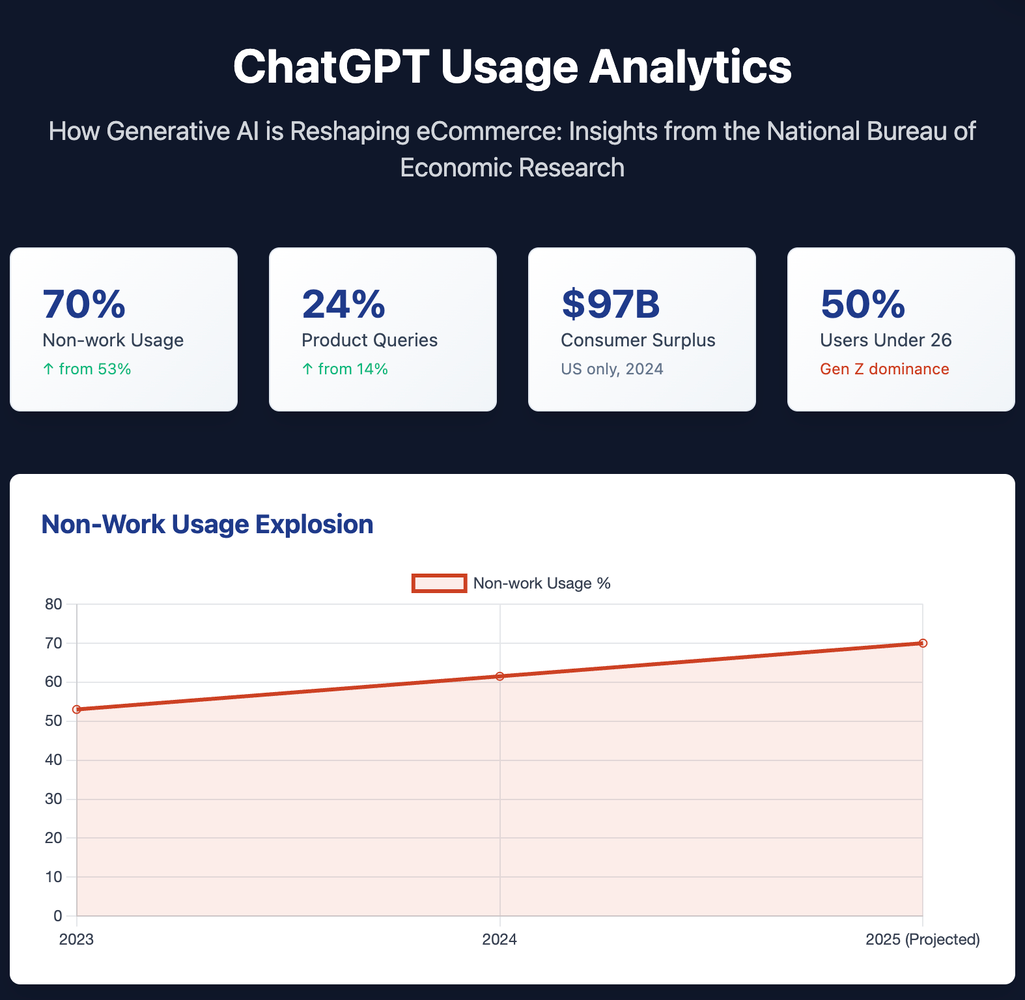
We're seeing this play out in our own numbers at Surfer, too. At one point, traffic from AI search accounted for almost 25% of all our new customers in just two weeks.
- Visibility across AI platforms. Optimizing for ChatGPT also increases visibility in other AI platforms since many tactics overlap. This is simply because the fundamentals, such as structured content, authoritative sources, and factual density, work across the board.
How does ChatGPT select knowledge sources?
ChatGPT and other LLM answer providers select knowledge sources by combining their pre-trained model with real-time web retrieval, ranking sources based on authority, relevance, and direct answer alignment.
Let me break it down more specifically:
- Training data: This is like a frozen encyclopedia that includes everything the model learned up to its last update. It's static with a cutoff date. It's great for historical questions, but useless for queries that require live information, such as "What's the stock price of Nvidia right now?"
- Real-time retrieval (RAG): For current information, ChatGPT uses Retrieval-Augmented Generation. Think of it like an open-book test. The AI knows how to write and think from its training data, but it doesn't know the specific answer to your current question. RAG lets it search the live web data, grab a web page, read it in milliseconds, and synthesize an answer.
This leads to another question you might ask. When ChatGPT runs out to the internet, where does it look?
The traditional answer has been Bing. Microsoft has invested approximately $14 billion in OpenAI, and for a long time, that financial relationship was assumed to explain the citation likelihood and why you should improve Bing visibility.
Nevertheless, ChatGPT's search infrastructure is more complex and less transparent than a simple one-to-one dependency on Bing.
In fact, multiple independent SEO practitioners have run their own research and arrived at a strikingly consistent finding. For most of the time, ChatGPT's sourced results appear to come from Google Search results, not Bing.
For example, Alexis Rylko conducted a detailed data-driven investigation, analyzing the JSON metadata behind ChatGPT conversations to compare which URLs it retrieved against Bing and Google rankings.
His study found only around 30% overlap between SearchGPT results and Bing's top pages. Meanwhile, a near-perfect 90% overlap with Google's results, confirmed across multiple queries and further supported by matching snippets and timestamps identical to those served by Google.
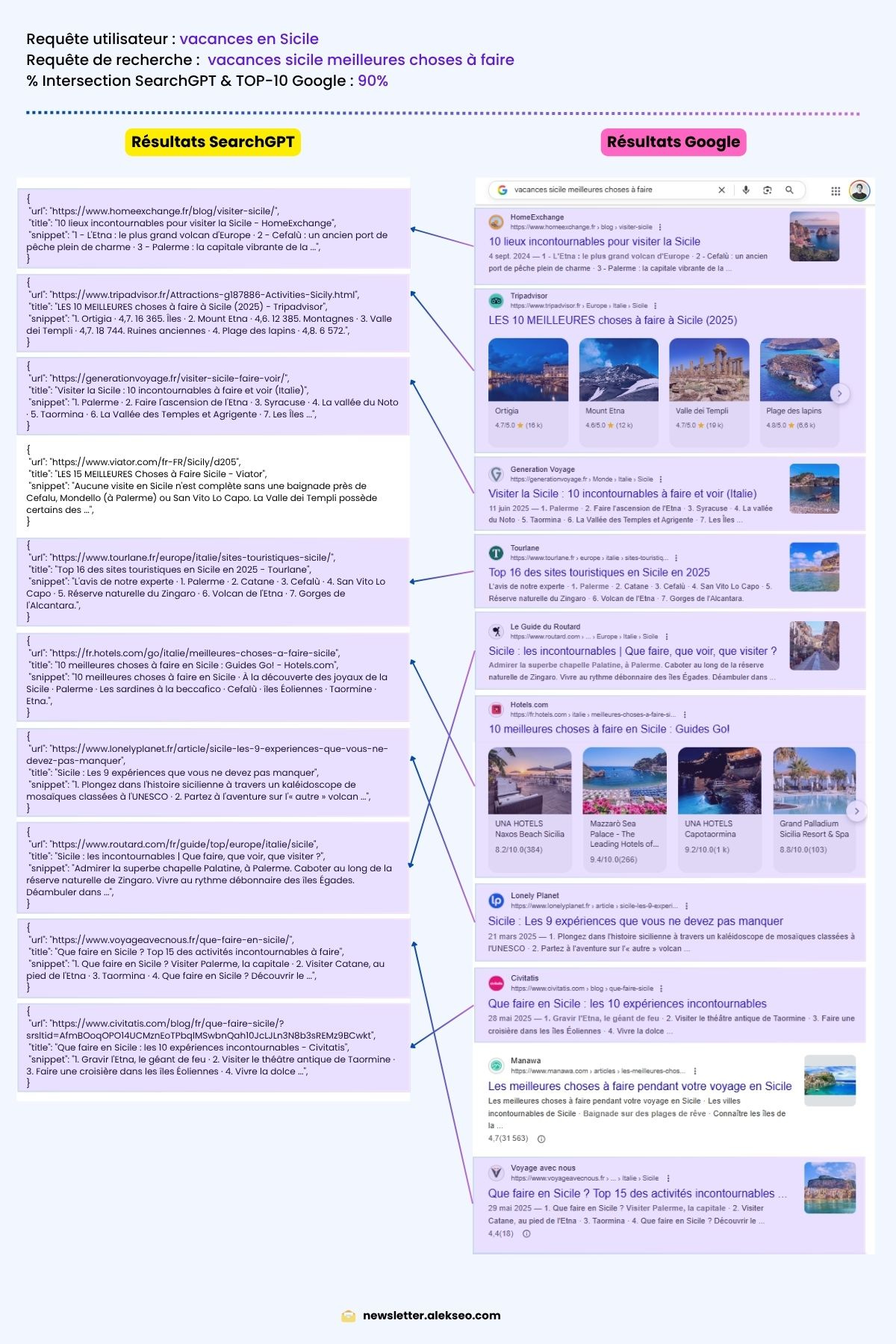
It's worth noting that this remains a genuinely controversial and evolving topic since OpenAI has made no official public statement confirming a shift from Bing to Google.
From a practical standpoint, whether the underlying index is Bing or Google, the implication for you is the same. You should always optimize your content for authority, relevance, recency, and factual accuracy. These are the same criteria for ranking well on search engines and getting cited by ChatGPT.
1. Start with a brand audit
Running a brand audit helps you understand how ChatGPT currently sees you and whether you're getting ChatGPT mentions. The process is pretty simple.
You can open ChatGPT and start asking questions about your brand the same way a curious prospect would. Here are my go-to prompts:
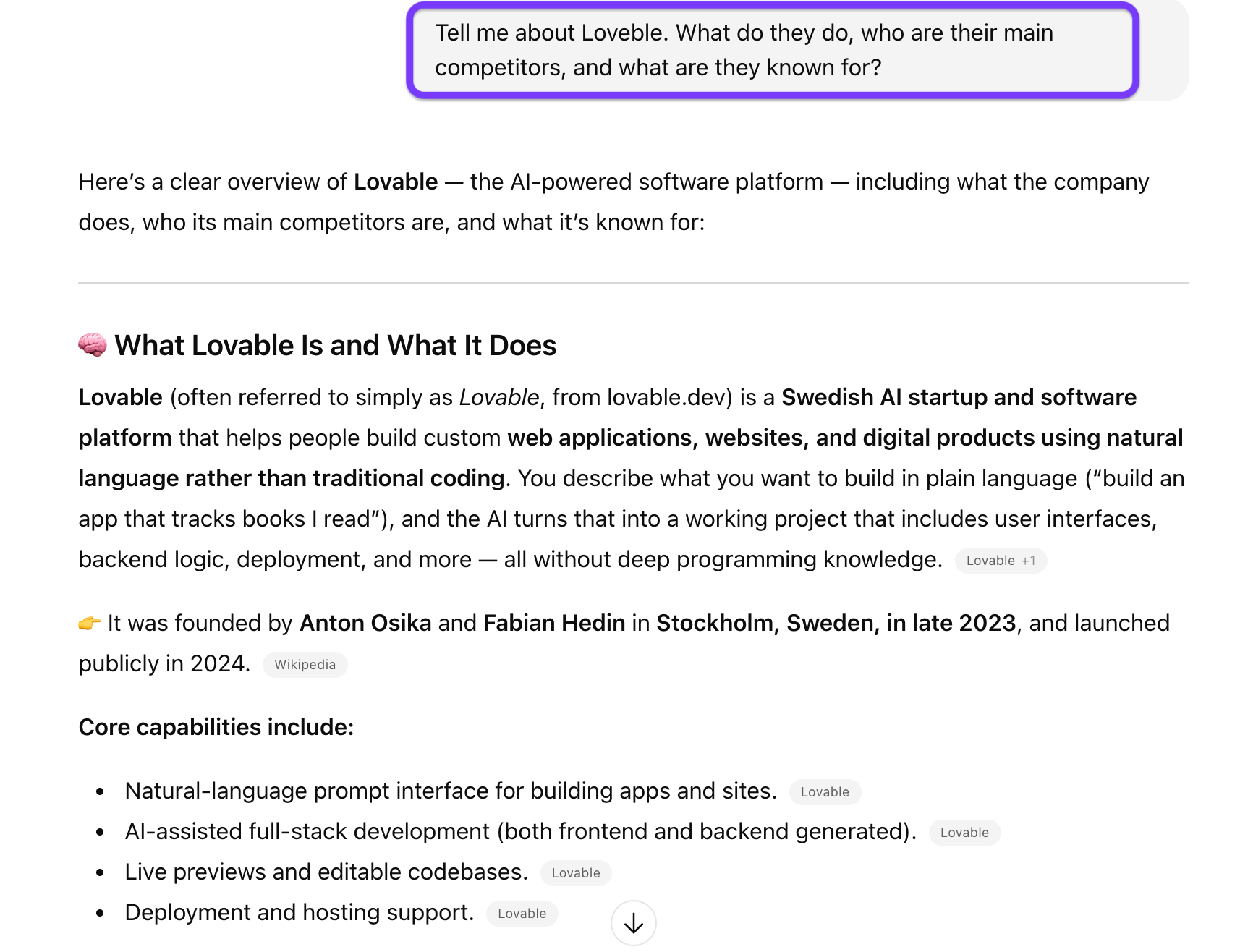
- "Tell me about [Your Company]. What do they do, who are their main competitors, and what are they known for?"
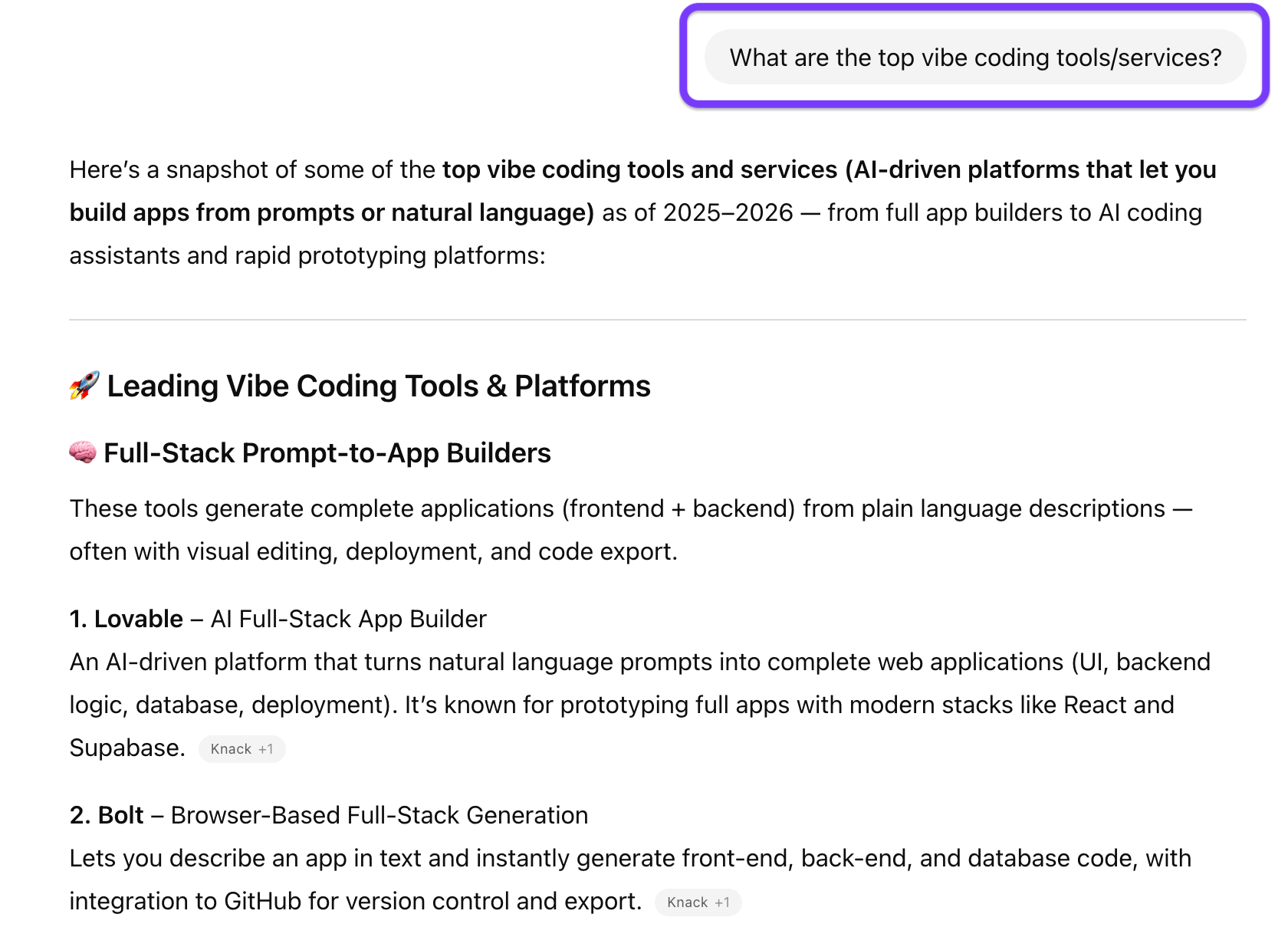
- "What are the top [your category] tools/services?"
- "Compare [Your Company] to [Competitor]"
As it returns answers to these questions, you can scan through the information and see if the description is accurate. Does it reflect your current positioning? Are you showing up next to the right competitors?
Let me walk you through what this looks like in practice. I asked ChatGPT about Lovable. If you haven't heard of them, they build AI-powered app development tools and have become one of the go-to names in the vibe coding space.
That last part matters because "vibe coding" isn't just a category they compete in. It's become part of how people talk about them.
So when I ran the three prompts above, here's what I found. ChatGPT described Lovable accurately regarding the Swedish founding story, the natural language interface, and the full-stack output with Supabase.
When I asked about top vibe coding tools, Lovable came up near the top among the brand mentions.
And when I asked how it compared to Bolt, ChatGPT drew exactly the distinction Lovable would probably want: Lovable for founders and designers who want something that looks finished, Bolt for developers who want to get their hands dirty in the code.
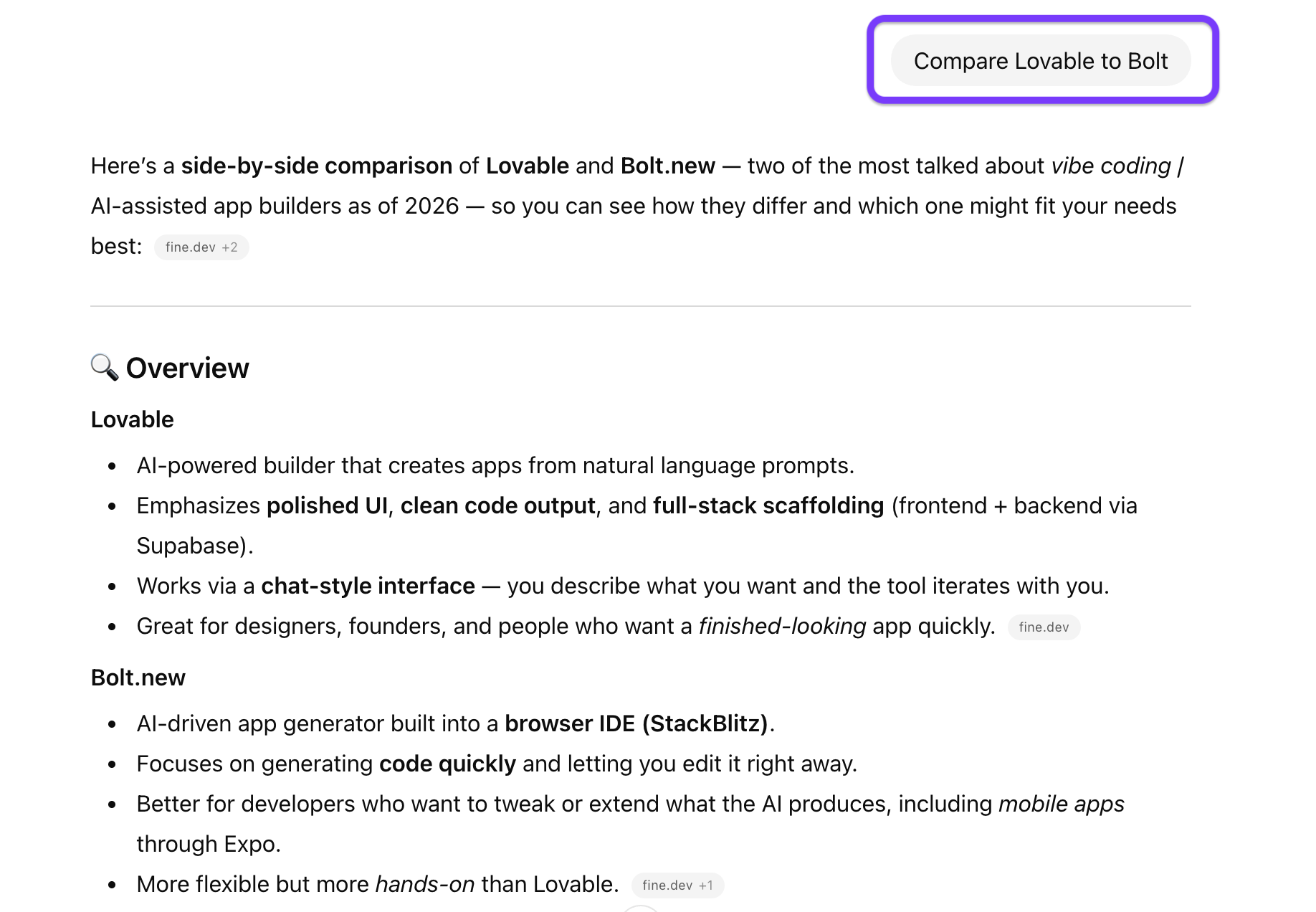
So if you find something off during this audit process, like ChatGPT is describing an old version of your product, the only way to fix it is to improve your online presence.
If you want to go beyond the manual audit and track this more systematically, you can use Surfer's AI Tracker to measure your visibility in ChatGPT answers.
It tracks how often and how prominently your brand appears across ChatGPT, Perplexity, and Google AI Overviews, alongside your competitors. It's useful for spotting gaps you wouldn't catch by running a few prompts yourself, especially as AI citation patterns shift over time.
Here's how to audit your brand's presence on ChatGPT using Surfer.
- Enter the name of your brand
- Add a topic you'd like to audit prompts for
- Enter your desired prompts or let Surfer select them for you
Pay attention to the visibility score column.
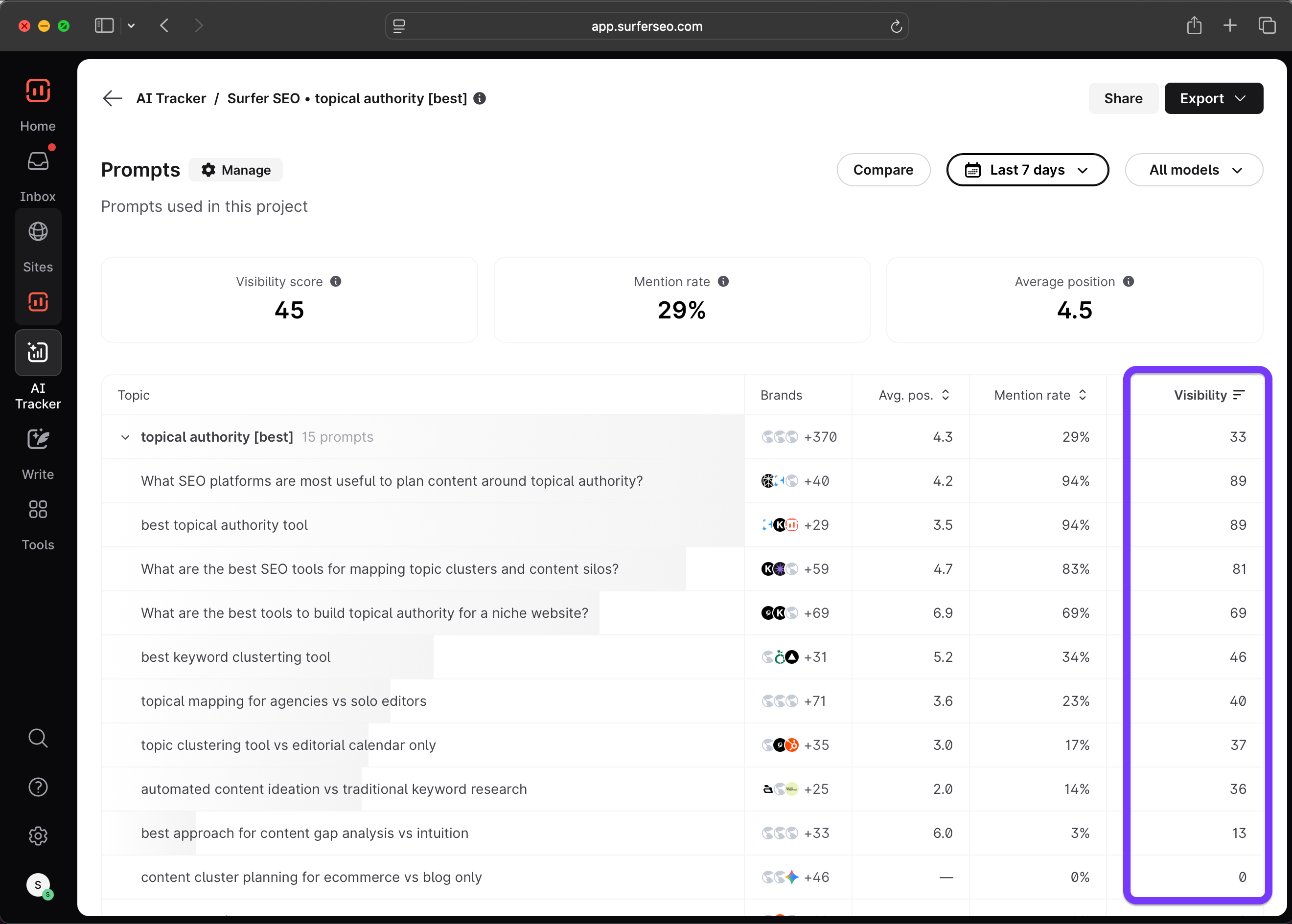
This way, you'll be able to recognize queries with weak brand presence.
And the stakes of getting this wrong are higher than you might think. A Yotpo study of 100 consumer brands across ChatGPT and Gemini found that brands like Gap and Hollister scored poorly on discovery prompts.
ChatGPT simply didn't surface them when users asked "best of" questions in their categories. This is why it's so important to select the right prompts to track.
Gap's invisibility makes zero sense in the real world. Everyone knows Gap. But the AI is only a text-processing machine. Gap's website is heavy on images, sales portals, and "add to cart" buttons. There wasn't enough text-based content for the AI to confidently say "Gap is a leading authority on summer clothing."
Meanwhile, Patagonia scored 85+ consistently because they write extensively about fabric sustainability, supply chain practices, and corporate responsibility. That's factual density. When the AI goes looking for an answer about durable outdoor gear, Patagonia gives it a rich, text-based source to cite.
The difference wasn't brand size. You can be a giant in the physical world and a ghost in the AI world if you don't give LLMs trustworthy information to cite. That's exactly what the rest of this guide will help you fix.
2. Target "knowledge gaps" where AI confidence is low
A knowledge gap is anywhere the information ChatGPT has access to is missing, incomplete, or poorly represented.
And AI doesn't stay silent when it hits one, it generates an answer anyway, often pulling from weak sources or filling in the blanks itself. That's how hallucinations happen.
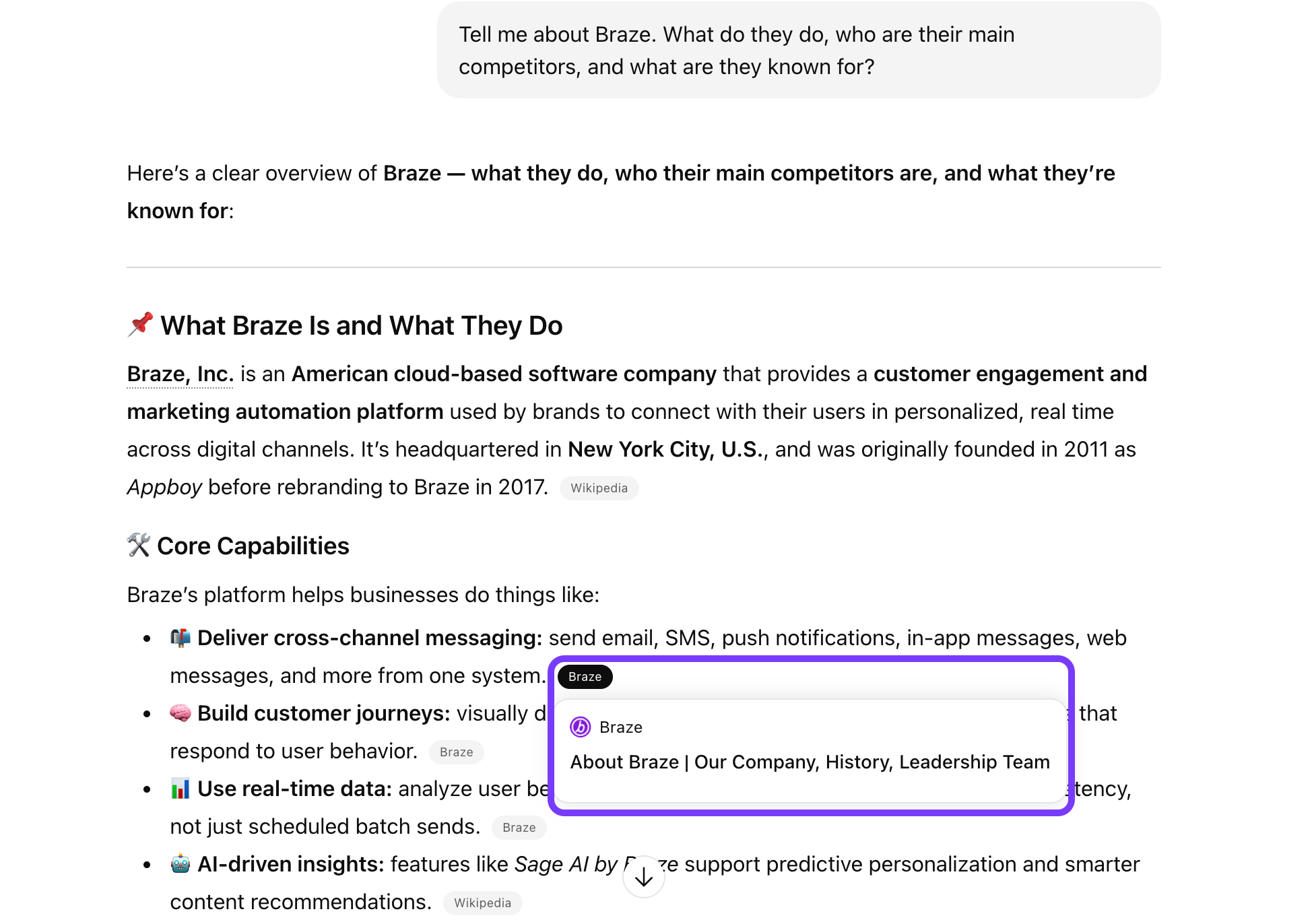
I have an example here. When I asked about Braze, ChatGPT pulled directly from their own About page and Wikipedia, which is a confident, well-sourced answer. Braze gave it good material, so it didn't need to look elsewhere.
Appcues was different. For the same question, ChatGPT reached for other websites such as PromptLoop.
That's a sign the brand's own content wasn't giving AI enough to work with.
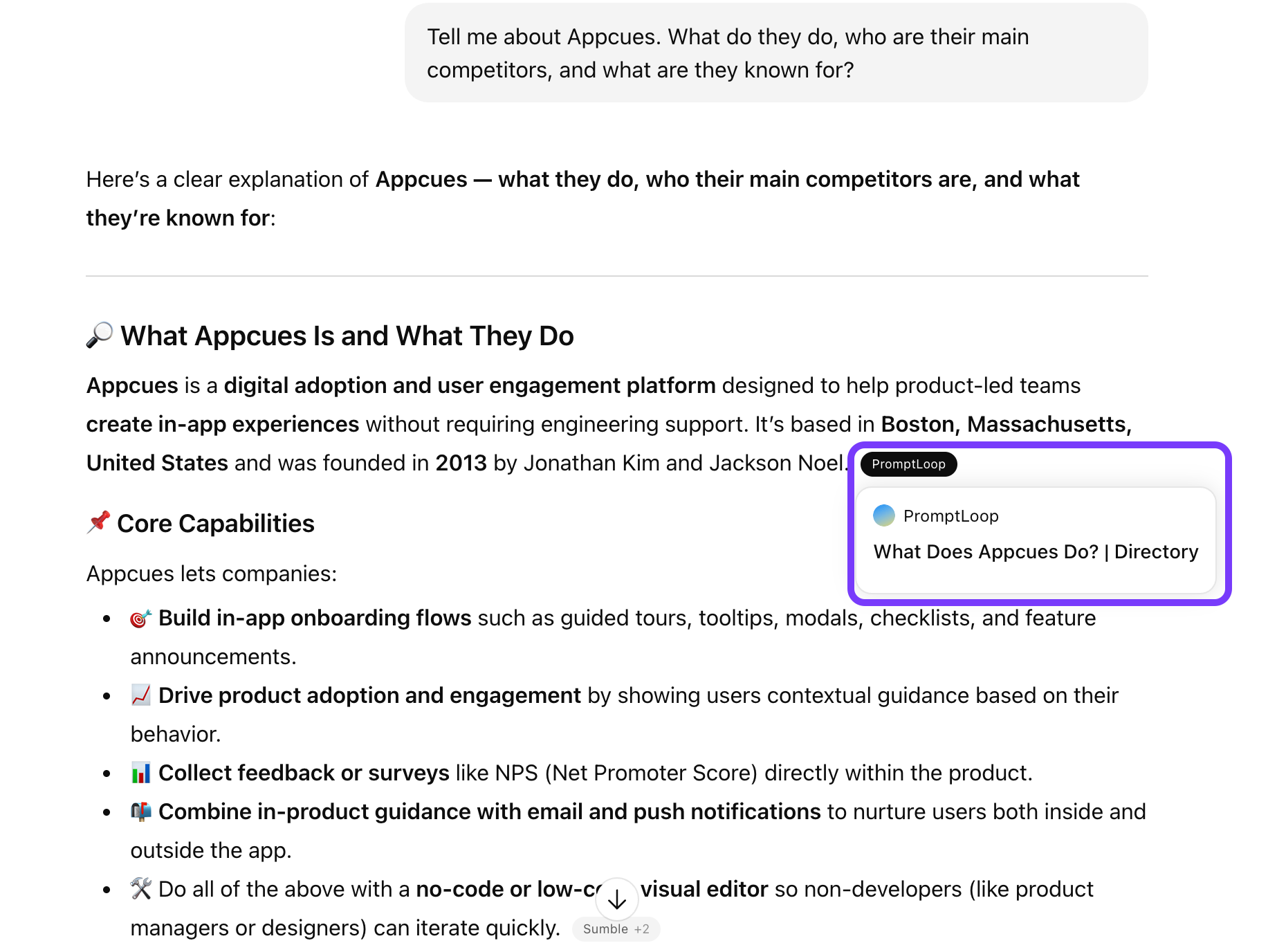
That's a knowledge gap, and it's an opportunity.
Typically, there are a few types of gaps worth looking for:
- Missing facts: Questions for which no source provides a clear answer
- Outdated information: Topics with stale data (regulatory updates, product specs, pricing)
- Thin coverage: Areas where AI cites weak sources due to a lack of authoritative content
The higher your mention rate, the more confident ChatGPT is about your brand. To find these gaps, you can pull up Surfer to see if your mention rate score is low or dropping.
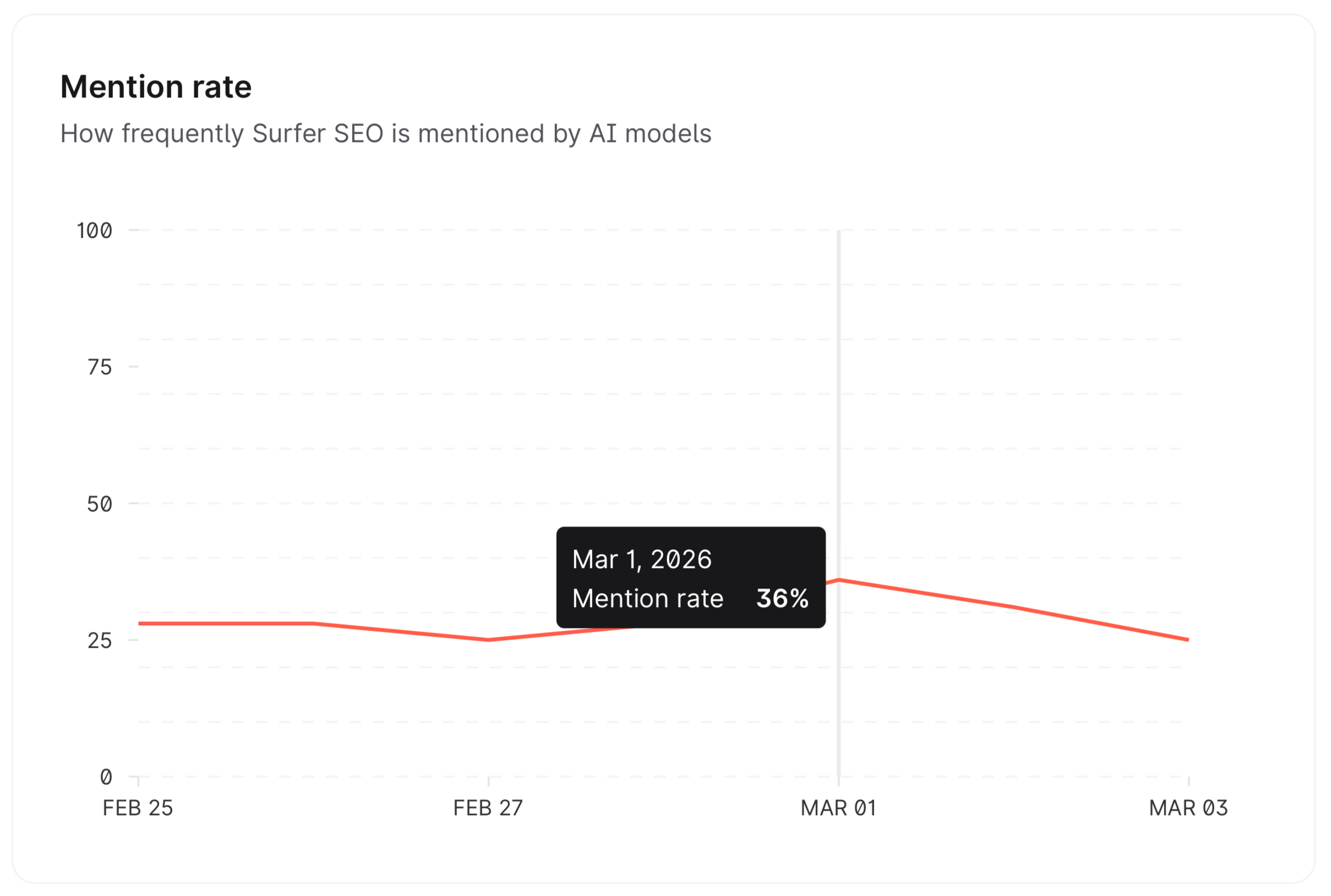
Then, run your audit prompts across ChatGPT, Perplexity, and Google AI Mode. Anywhere the answer gets vague, leans on weak sources, or skips your brand entirely is where you start.
This same logic applies beyond just how AI perceives your brand. It applies to any topic you want to own. If you're publishing research or findings in your space, the same principle holds. The more specific and verifiable your content is, the more useful it is to AI as a source.
This is simply because AI systems favor relevant content with concrete statistics, specific examples, and verifiable data. As we analyzed over 57,000 URLs at Surfer, we found that cited pages cover 38% more key facts on average than pages that don't get cited.
For example, "Intercom reduced first response time by 43% after implementing AI-assisted routing" is citable. "AI can help support teams work more efficiently" is not.
3. Write direct answers that mirror user questions
Structure your content around questions users actually ask, then answer them directly in the first sentence.
If your H2 is "What is Intermittent Fasting?", your first sentence should be: "Intermittent fasting is an eating pattern that cycles between periods of fasting and eating." This shows how the first words echo the heading "intermittent fasting is" before immediately delivering the answer.
This mirroring technique serves two purposes at once.
First, it helps ChatGPT and other AI tools pull a clear, quotable answer from your content.
And second, it increases your chances of winning a featured snippet in traditional search, where Google looks for exactly this kind of direct, structured response.
You'll see this practice across Surfer's blog.
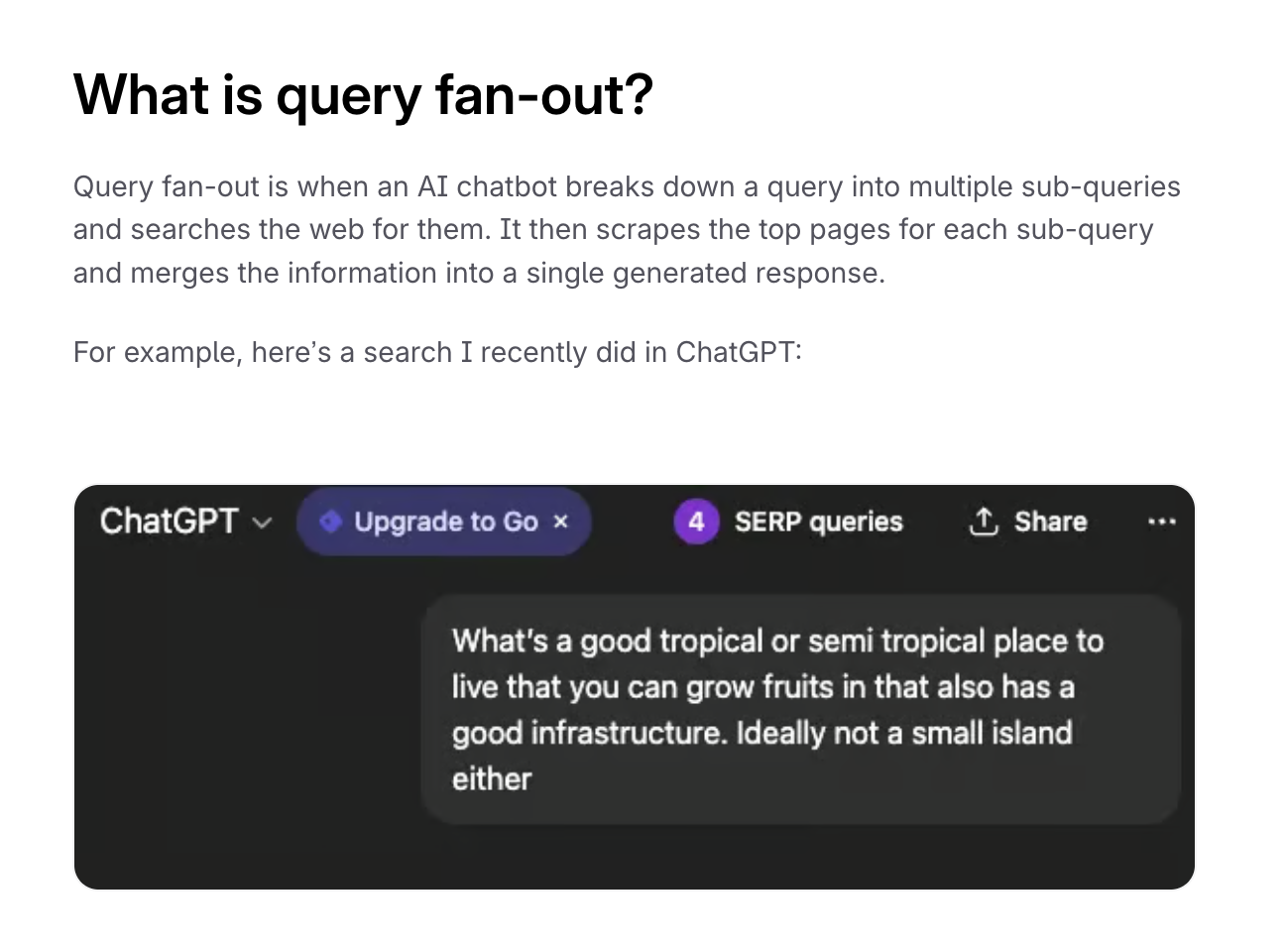
To put this into practice:
- Frame headers as questions ("How does intermittent fasting work?" rather than "The science behind intermittent fasting").
- Lead every section with a one-sentence answer, then expand with supporting detail, examples, and context (I'll explain this tactic in more detail in the very next section).
- Keep paragraphs focused on a single idea.
- Use definitions and concrete examples to give AI systems something specific to reference.
- Write conversationally, i.e., instead of writing "Intermittent fasting induces a metabolic state of ketosis by depleting hepatic glycogen reserves", write "When you fast long enough, your body runs out of stored sugar and starts burning fat for energy instead."
4. Chunk ideas together
You should structure your content into self-contained blocks of text that can stand alone without the surrounding context.
Based on several studies, this is because they generate text one word at a time using next-token prediction and, in retrieval systems like RAG for knowledge-intensive NLP tasks, they pull in small passages, not full documents.
This means if your key idea is buried in a long paragraph, it’s harder to extract.
But if it’s written as a clear section, short paragraph, or bullet point, it becomes an easy “chunk” to retrieve and cite.
There are a few things you should avoid while chunking information:
- Splitting a sentence or idea across two paragraphs.
- Separating closely related information into different sections.
- Using pronouns without clear antecedents.
For RAG systems, chunks between 100 and 300 words tend to hit the sweet spot. This is detailed enough to preserve context and concise enough for precise retrieval.
And if you’re sharing data, say it plainly. For example, “96% of buyers reported satisfaction” is quotable while “We think this is probably good” isn’t. There’s nothing concrete there for anyone to cite.
That said, I don't think you need to be obsessive about this. Modern LLMs are now smart enough to piece things together even from messier content. Chunking is a good practice, but there are higher-leverage things to focus on in this guide. You can treat it more as a helpful habit than a strict rule.
The reason it's still worth doing is that it also just makes your content easier to read. Short, focused paragraphs are easier to follow, scan, and skim, which helps human readers as much as it helps AI.
5. Use specific FAQs mapped to user intent
FAQ sections are one of the simplest ways to match your content directly to how people use ChatGPT.
That is because it mirrors how people ask ChatGPT.
According to WebFX’s analysis of 13,252 ChatGPT conversations, the opening user message (the first prompt) averages about 103 words.
This is far longer than typical short search queries, reflecting that people tend to ask detailed, natural-language questions when interacting with ChatGPT.
Therefore, people are likely to ask full questions like “What’s the best CRM for a 10-person sales team?” “How does ChatGPT choose what to cite?”, or “Why am I not showing up in AI answers?”
The key takeaway is to structure your H2s and H3s as long-tail, natural-language questions. When someone asks ChatGPT that exact question, your header becomes a near-perfect match.
For example, a well-mapped FAQ section for this article would look something like:
- How to get mentioned in ChatGPT responses?
- How does ChatGPT trust sources?
- What kind of content is ChatGPT most likely to cite?
- Does posting on Reddit help with ChatGPT visibility?
- How often should I update my content for AI visibility?
This also aligns naturally with voice search, where people speak in complete sentences rather than keyword fragments.
In general, you should avoid generic headers that match nothing a real person would type. "Our Services" won't surface in any AI answer. Instead, "What services does [Company] offer for enterprise data migration?" might.
6. Build "off-site" presence on high-trust domains
To get referenced by AI answer sources, you need to increase your authority, clarity, and cross-source validation.
This is simply because external ecosystems matter, and AI models often cite authoritative or community-driven domains much more frequently than individual brand sites.
Our recent study across 36 million AI Overviews and 46 million citations has found that
- YouTube leads all citations at 23.29%
- Wikipedia follows at 18.41%
- Google.com comes in third at 16.38%
Among community platforms, Reddit, LinkedIn, and Facebook collectively make up a meaningful share of citations.
Reddit alone sits at 9.37%, which is the highest of any community-driven platform. This is followed by LinkedIn at 8.80%, Facebook at 8.09%, and Quora at 5.91%.
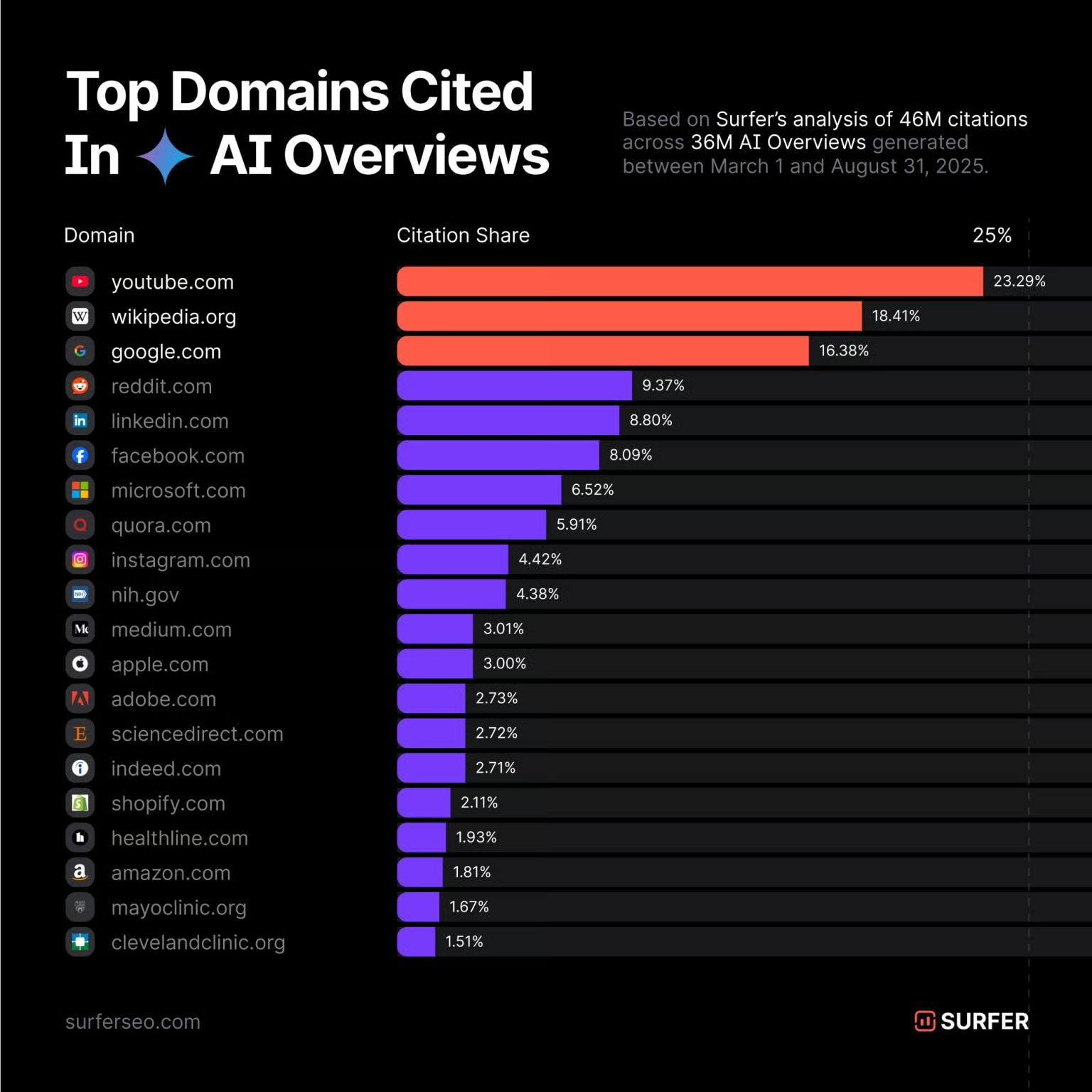
If your brand isn't part of these conversations, you're missing the sources AI most often turns to for validation.
So here's how to tailor your content strategy for each major platform where AI often cites:
- Reddit: Identify relevant topics and participate in product comparisons, reviews, and "what tool should I use" discussions because that's exactly what AI reaches for when someone asks those questions. A Semrush analysis of 248,000 Reddit posts cited by AI tools found that Q&A threads alone account for more than half of all Reddit citations, followed by comparison and discussion posts. Crucially, engagement barely mattered with 80% of cited posts having fewer than 20 upvotes.
- Quora: Find questions in your category, give a substantive response, and point to a relevant page on your site. This is simply because Quora structures its platform around experts answering specific questions and linking out to more in-depth resources.
- LinkedIn: Posting consistently on topics you want to be known for helps AI associate your brand with that expertise over time, particularly for B2B and professional queries.
The truth is that no single post moves the needle.
In our own research analyzing 289,105 URLs for brand mentions, we found a clear correlation between how many cited sources mention a brand and how strongly AI recommends it (with a statistically meaningful correlation of Spearman 0.41). Brands that showed up consistently across more sources ranked higher in AI responses.
So the goal isn't to go viral on one platform. It's to build a steady, distributed presence across the platforms AI already trusts.
7. Keep your most important pages updated
You should update your most important pages from time to time because freshness is a deciding factor in how systems like ChatGPT rank content.
Independent researcher Metehan Yesilyurt found a line in ChatGPT's actual configuration settings: use_freshness_scoring_profile: true. It's documented evidence that ChatGPT actively prioritizes recent content over older material.
The data also backs this up. A Seer Interactive study analyzing 5,000+ URLs found that nearly 65% of AI bot hits target content published within the past year, 79% target content from the last two years, and 94% occur on content updated within the last five years.
Therefore, my advice is to prioritize updating your highest-value pages first. You can start with product pages, comparison guides, pricing pages, or any pages that matter for brand consistency.
When you do update, make the changes substantive. Think of adding new data points, refreshing statistics, expanding sections with recent developments, and updating the "last modified" date to reflect the work.
I'd call them meaningful updates. This is also a recommended practice over just changing dates.
That last part matters more than it might seem.
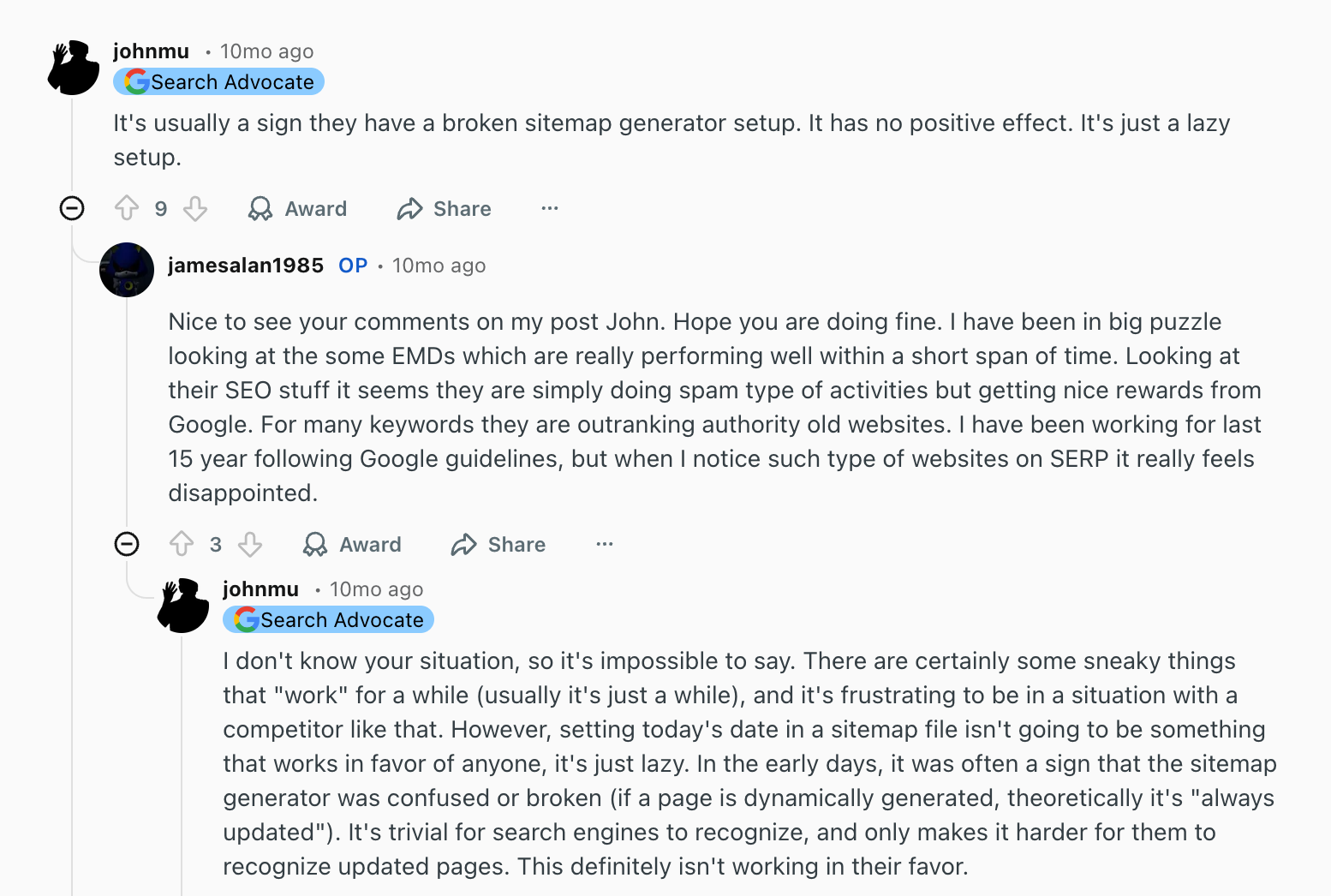
Google's John Mueller has been explicit on this
"When you write something new, or significantly change something existing, then change the date. Changing the date without doing anything else is just noise and useless."
In a discussion on Reddit about faking freshness by updating XML sitemap dates,
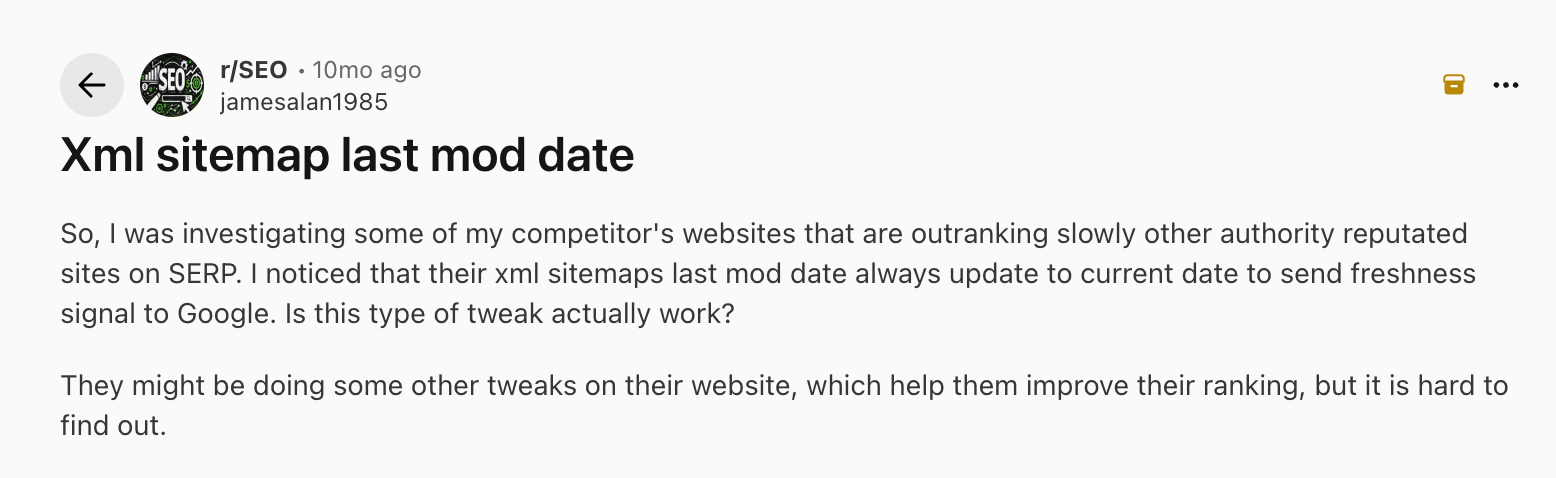
Mueller has also noted that updating sitemap dates without real content changes not only has no positive effect but can actually make it harder for Google to detect genuine updates.
AI systems are likely catching on to the same patterns. Superficial edits without real substance won't move the needle and may eventually signal low content quality altogether.
8. Track your ChatGPT visibility
Measuring ChatGPT visibility simply means tracking how your brand gets cited, how often, and in what context.
You'll also want to track this across models, not just one, because ChatGPT, Perplexity, and AI Overviews don't always agree on who the authoritative source is for your category.
This is crucial and should be part of your broader ChatGPT SEO efforts. All of the tactics above only work if you can measure whether they're having an impact.
Essentially, the metrics you should track include:
- Are you being mentioned in AI responses?
- Are your pages being cited as sources?
- And when you're not showing up, who is?
Unlike traditional SEO, where a ranking drop shows up in Search Console within days, tracking AI visibility is more complex. Models update their behavior, citation patterns change, and a myriad of other factors.
This is why we built AI Tracker. You set up prompts that mirror how your buyers actually search, things like "best [category] tool for [use case]" or "[your brand] vs [competitor]", and it monitors how your brand appears across ChatGPT, Perplexity, AI Overviews, and AI Mode over time.
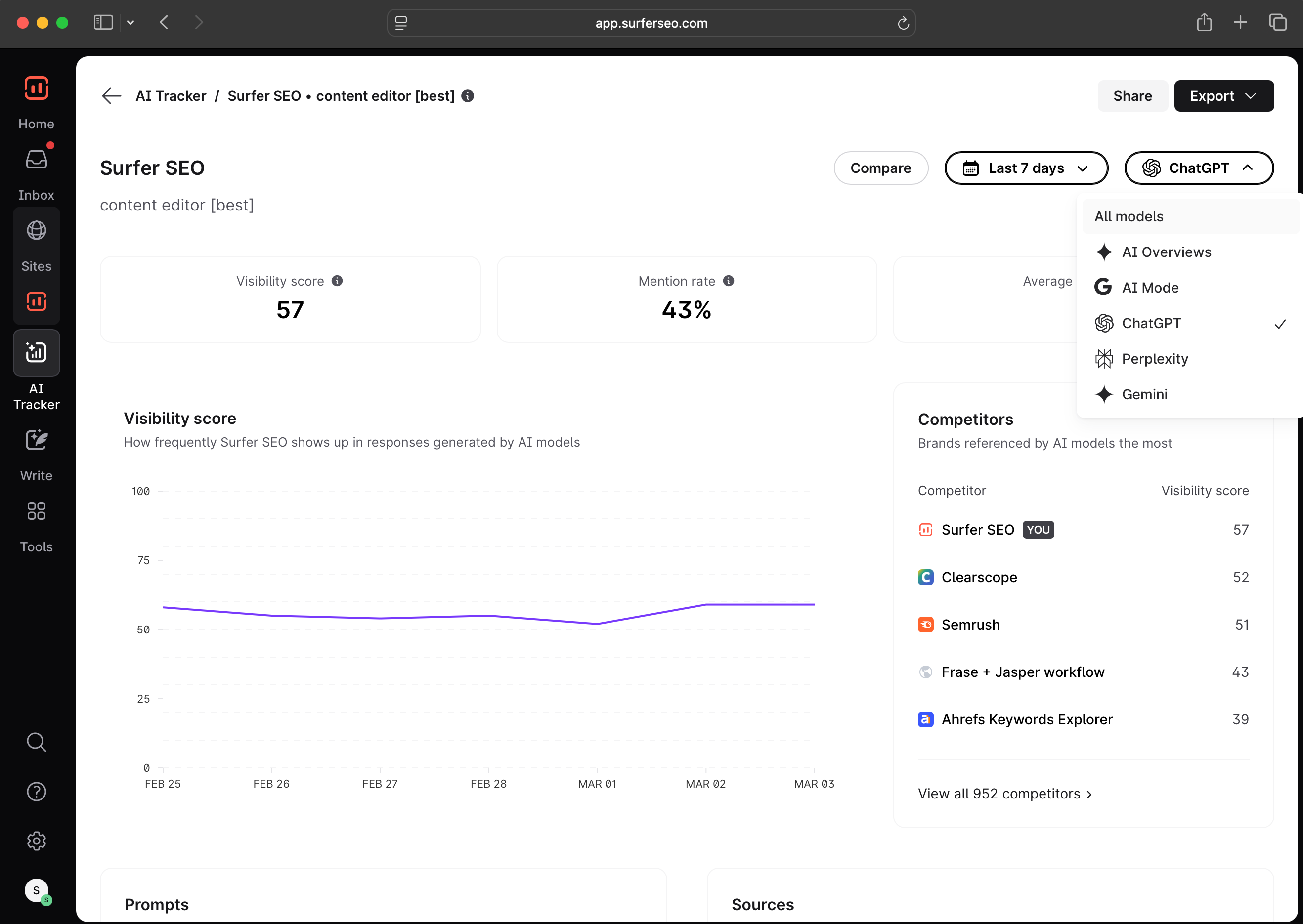
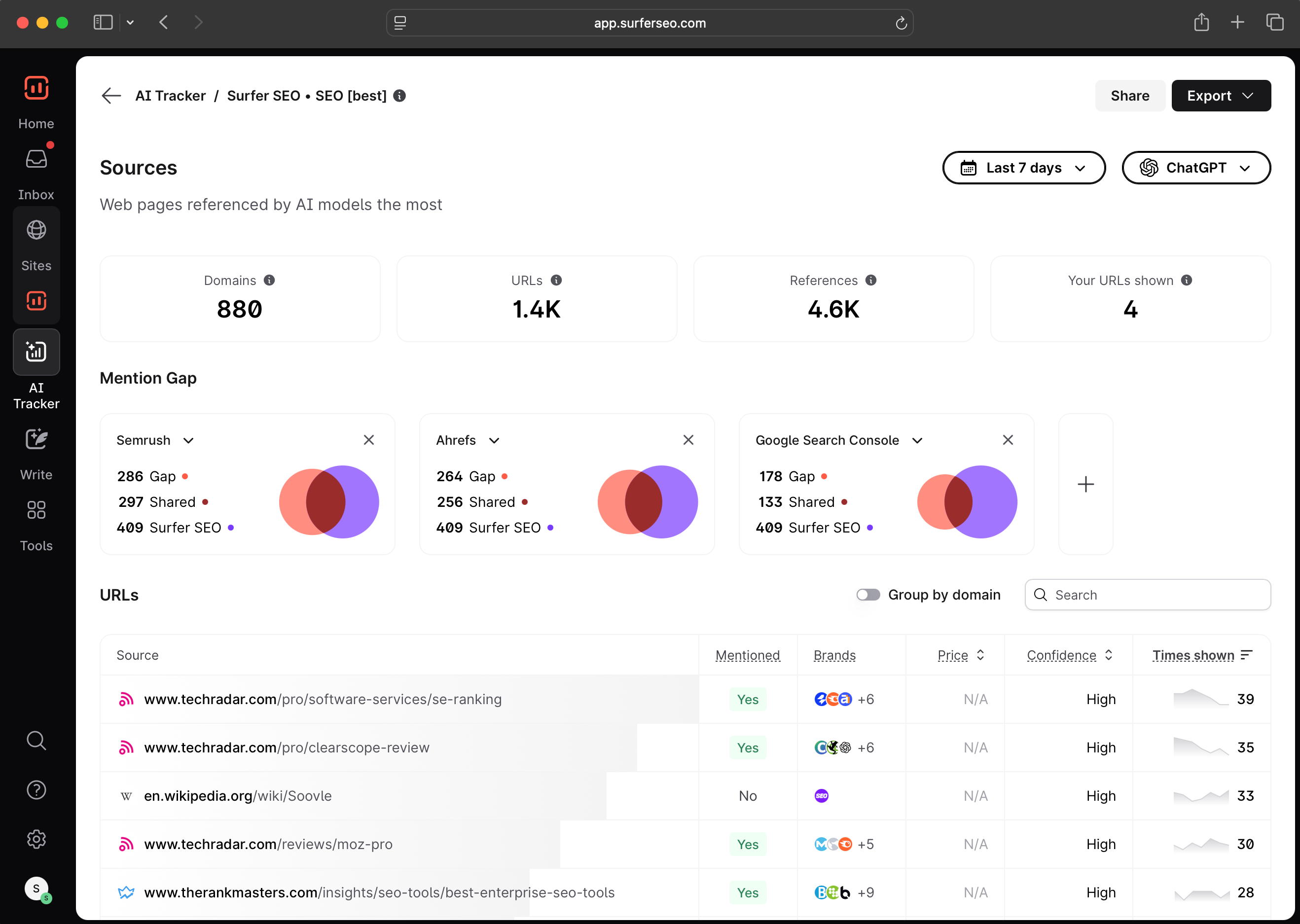
You can see which sources AI keeps pulling from for your category, where competitors are getting cited instead of you, and how your visibility shifts after you make changes to your content.
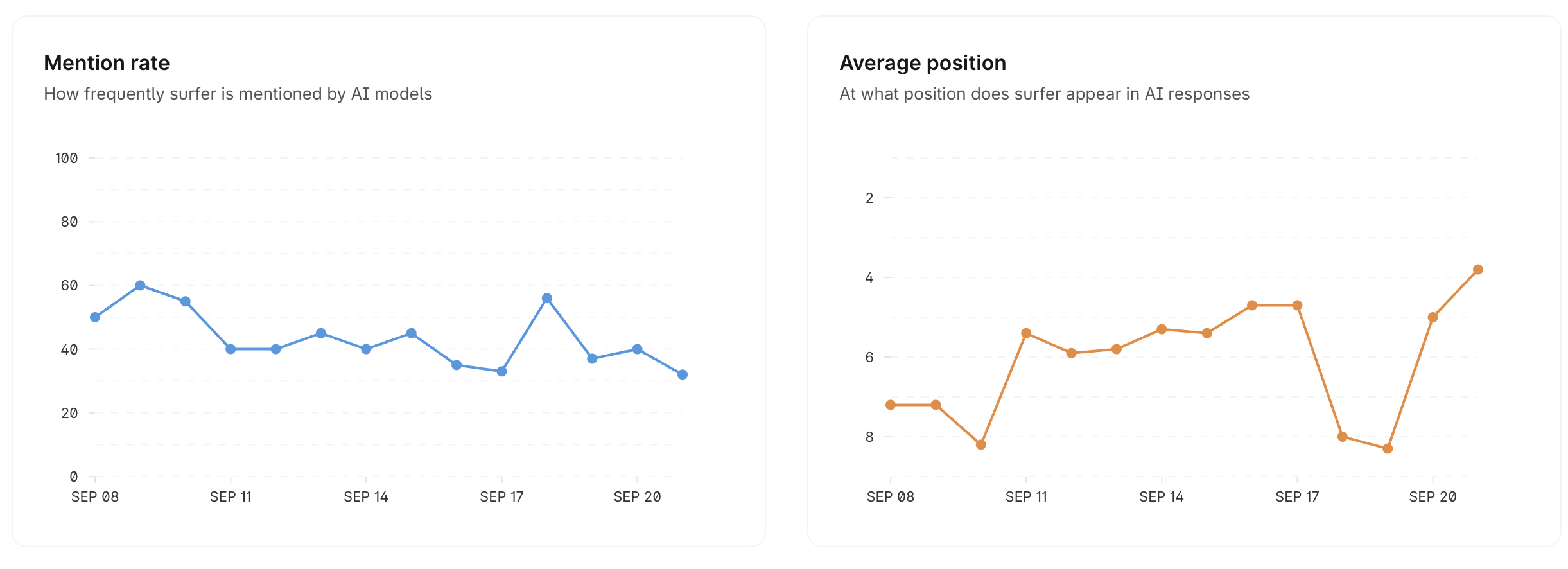
While most GEO tracking tools pull AI answers through the API, we scrape the real interface to give you the most accurate numbers.
I find the Sources report especially useful to help me find opportunities for Surfer mentions. I like that I can see gaps with competitiors—ChatGPT cited pages that mention other brands but not Surfer.
Our own research found that API responses and what users see can differ dramatically, with brand overlap between the two as low as 24%. If you're measuring the wrong signal, you won't know you're losing ground until it's already cost you.
How to show up in ChatGPT answers in 2026
Showing up in ChatGPT is all about becoming the most credible, well-documented source in your category across the entire web.
Give AI factual, structured content it can actually cite. Fill the knowledge gaps your competitors are ignoring. Build presence on the platforms AI already trusts. Keep your most important pages fresh with substantive updates. And track your visibility the same way you track rankings, because what you can't measure, you can't improve.
None of this requires a complete overhaul. It requires consistency and the right signals in the right places. Do that well, and ChatGPT will recommend you.