Unlike traditional SEO, AI search is still somewhat of a mystery. Marketers are not sure how to get their content featured in AI-generated answers and future-proof their sites amid the astronomical rise in answer engines.
The good news is that we've cracked some of the code—and I'll share everything we know in this guide. I'll go over the most effective ways to optimize content for AI answers, after which I'll show you some examples of successful optimization alongside a few capable tools to check out.
What you will learn
- What AI content optimization is and how it works
- How AI models process and rank content
- How to make your content more AI search-friendly
What is AI content optimization?
Artificial intelligence (AI) content optimization is the process of adapting the relevance, structure, and authoritativeness of your content to increase its chances of getting picked up and cited by AI answer engines.
The goal is to increase the content's visibility across AI features like Google's AI Overviews (AIOs) and dedicated AI-powered search engines like ChatGPT and Perplexity.
AI optimization is considered an extension of traditional search engine optimization (SEO), not its replacement. Google is still by far the most dominant search engine with 70-90% of desktop search traffic across countries, so you don't need to forget what you've learned about SEO. Instead, you need to upgrade your strategy to account for the content preferences of AI engines, such as:
- Clear structures and information hierarchy
- Front-loaded value and answers
- Enhanced trustworthiness
I'll explain these trends and how to accommodate them a bit later in this guide. But first, you should get familiar with the basics behind AI content processing.
How AI models read and rank content
AI systems use technologies like natural language processing (NLP) and natural language generation (NLG) to extract important information from content and include it in their responses. Still, there's much more that happens under the hood, so we need to go a bit deeper here.
How large language models (LLMs) retrieve and process information
Probably the most important technology behind AI search engines is retrieval-augmented generation (RAG), which fetches relevant information from external sources and conditions the AI model’s answer on the evidence found in those sources.
RAG consistently improves factuality on knowledge-intensive tasks and enables up-to-date answers, with the original RAG research showing outstanding results on open-domain QA and spawning thousands of follow-on citations.
Certain AI models use other technologies to prevent AI hallucinations and ensure credible answers. For example, Google's AGREE framework optimizes models to include accurate citations in their responses, which boosts reliability and user trust.
This means that AI models are getting increasingly capable at weeding out unreliable sources and focusing on authoritative ones. If you want to boost your content's chances of being cited, there's no room for inaccuracies.
Why structured and factual content ranks better
Pages that are clear, accurate, and comprehensive tend to be prioritized once relevance to the search query is satisfied. Structured information helps both retrieval systems and LLMs parse and quote your content correctly.
Bing Webmaster Guidelines clearly explain the need for structure and clarity, recommending that your pages are:
- Easily crawlable
- Well-organized
- Transparent about authorship and sourcing
In practical terms, this means your content should check a few important boxes:
- Clear, descriptive headings
- Direct answers to users' questions
- Organized information through summaries, tables, and similar extractable formats
- Consistent schema markup
How AI assistants identify authority and trustworthiness
AI assistants blend standard search signals (link discovery, site quality, spam avoidance) with entity-centric understanding. Google’s Quality Rater Guidelines (which are used to evaluate how well ranking systems work) describe assessing page quality through:
- Experience, expertise, authority, trustworthiness (E-E-A-T)
- Reputation of the site/creator
- Evidence of content accuracy
While raters don’t set algorithms, these criteria inform the direction of ranking systems and what “authoritative” looks like in practice, and they apply to both traditional and AI-powered search engines.
On the entity side, AI models often tap into massive databases like Google’s Knowledge Graph, which connects facts about people, places, and organizations. If your content includes relevant entities and matches known facts, it's easier for AI systems to trust and feature it.
How citations and entity mentions influence AI visibility
AI models are trained to select evidence and attribute claims. If your content is linked to or cited as a credible source, it's more likely to appear in an AI response. This is because citations enable so-called "grounding," which aims to prevent hallucinations and ensure content accuracy.
Explicit entity mentions (using consistent names, titles, and schema markup) are also helpful because they help models link your content to the right node in the Knowledge Graph, which improves its retrieval.
When your brand/person/topic aligns with a known entity, and your page provides accurate related facts, AI assistants can more confidently include you in answers.
6 ways to optimize your content for AI visibility
While you can't directly "rank" in AI responses, you can take these steps to boost the chances of showing up in them:
1. Become the topical source in your niche
The shift to AI search brought a major change in how we optimize content—instead of focusing on keywords, we need to expand our scope to include entities. An entity can be any subject (a person, brand, product, place, concept, etc.), and you must treat every page as the definitive resource about it.
This is because AI-powered tools map text to entities and their attributes. The clearer your page is about “who/what this is,” the more confidently models retrieve and quote you.
As entity optimization is somewhat new for many marketers, I'd like to explain how it works with an example.
Take a look at Cloudflare's article on mTLS. The page contains plenty of strong entity signals, most notably:
- Canonical naming and disambiguation: The H1 uses the exact concept name and the common alias (“mutual TLS (mTLS)”), making the primary entity crystal clear for retrieval and entity resolution.
- Scannable facts: The page opens with a concise definition and keeps tightly scoped sections (“What is…?”, “How it works…”, related glossary). This consistency makes extractive systems more likely to quote it verbatim.
- Solid internal entity graph: The page uses internal linking to map closely related entities (e.g., IAM, SASE, Zero Trust, authentication), forming a topic cluster that helps AI models follow relationships and understand context
- Predictable layout: Other pages from the learning center (e.g., What is a DDoS attack) mirror the same structure (clear definition, “how it works,” and related links), so models learn a predictable pattern for facts/snippets.
As a result of effective entity optimization, the page is cited as the first resource in the AIO's response to the related query.
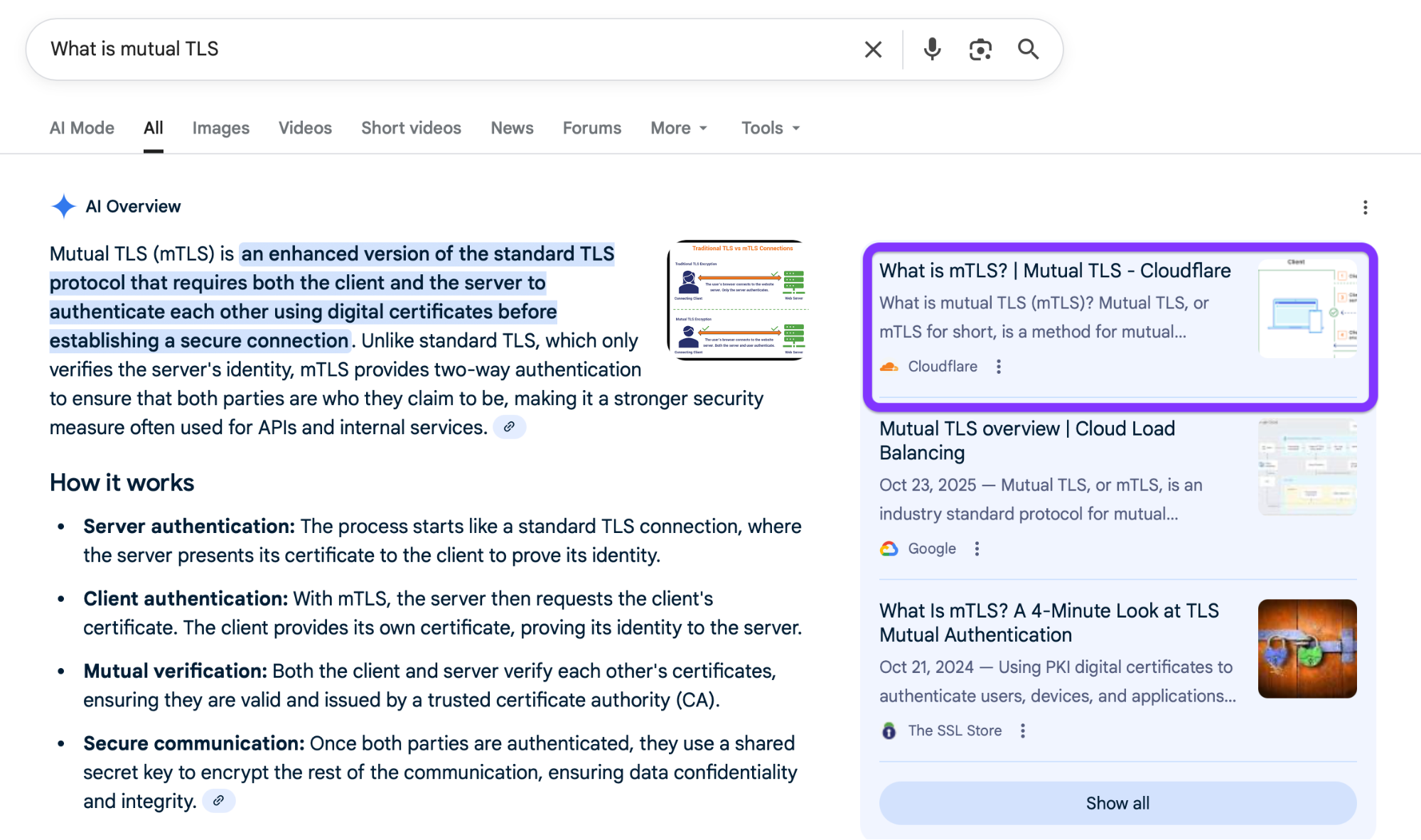
To emulate its success, you can use the points I highlighted as a checklist. Put the canonical entity (and common aliases) in the H1/lead, implement reusable sectioning (“What is…?”, “How it works…”, “Tips/Examples”, “FAQ”), and build topic clusters to directly connect the related entities and show depth of expertise.
If you need help with entity optimization, Surfer's Topical Map takes care of the heavy lifting. Give it the main keyword, and it will show you:
- Plenty of topic ideas structured into clusters
- Keyword data (search volume, ranking difficulty, etc.)
- An interactive map you can use to track your topic and entity coverage
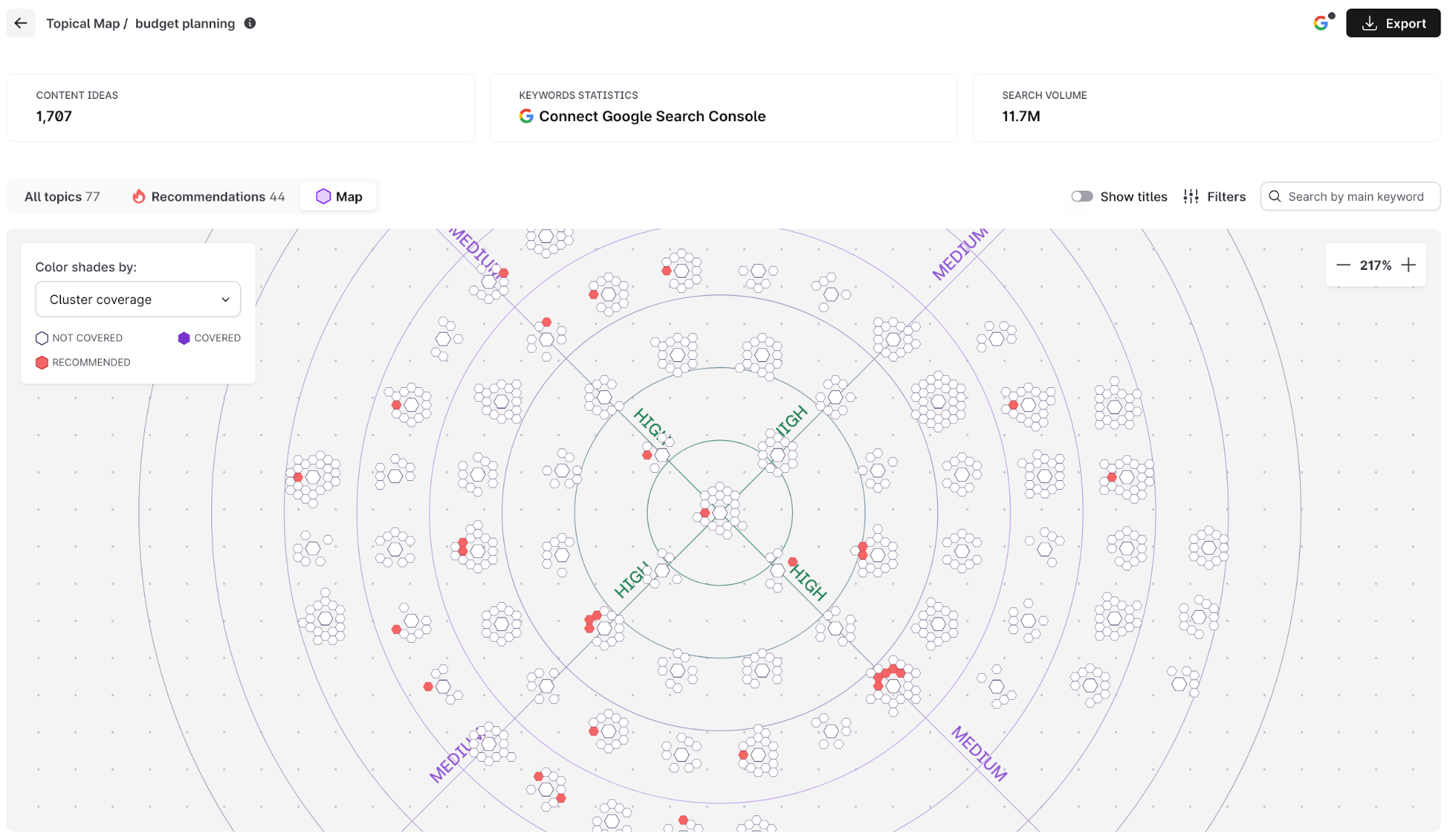
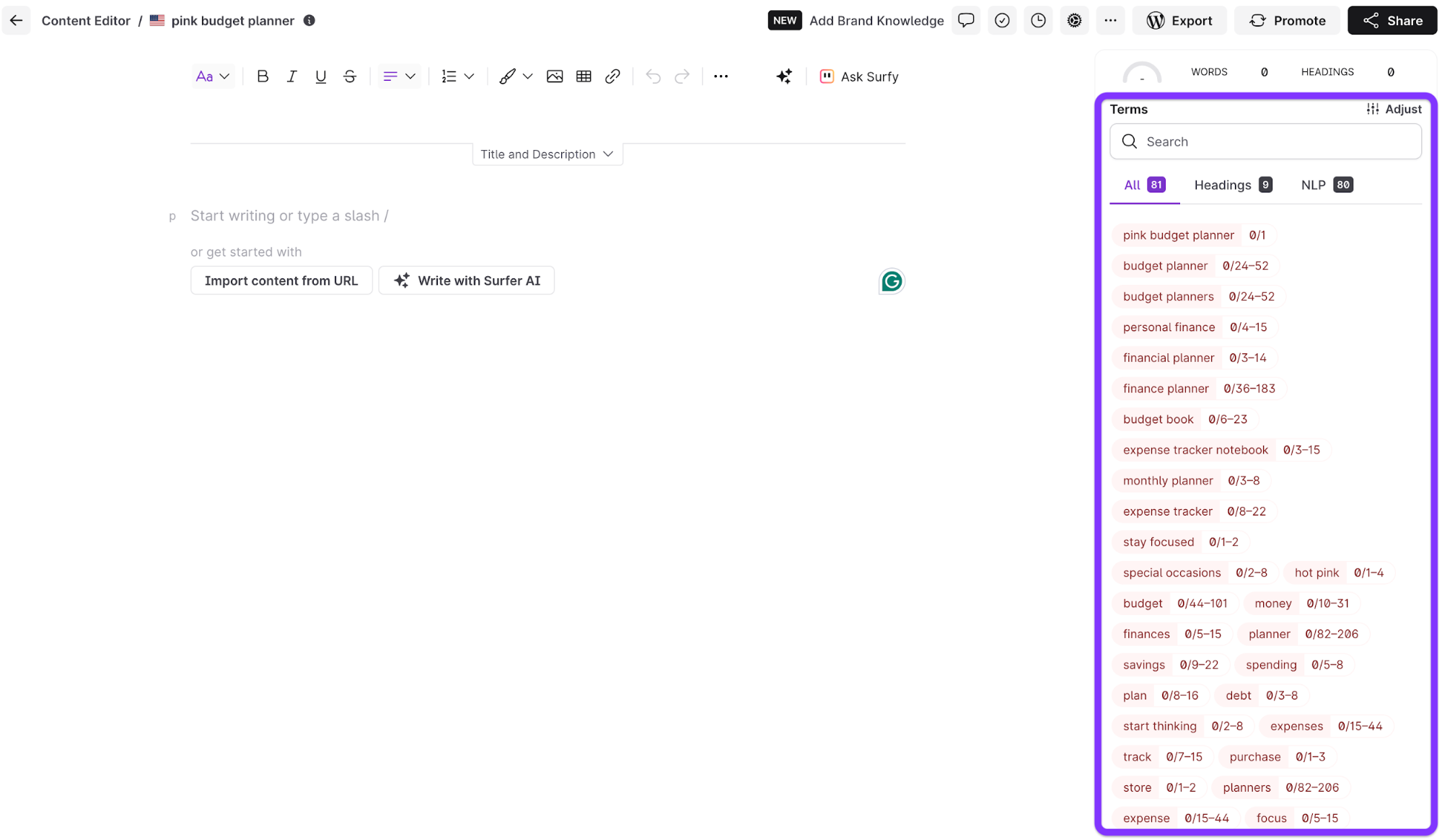
For each topic you want to cover, you can open Surfer's Content Editor.
It spares you time-consuming keyword research by automatically outlining all the terms you should include on each page to maximize its entity signals.
2. Audit how your pages are mentioned across the web
AI isn't only good at researching a topic and answering questions, but also at understanding the sentiment around different entities. That's why you should scour online sources, forums, social media, and other channels to:
- Catch any inaccurate or misaligned facts about your brand
- Earn or restore citations from reputable publications
- Spot unlinked mentions and earn backlinks
The easiest way to start monitoring your brand is to set up Google Alerts for:
- Brand name
- Key people and product names
- Common misspellings
When you do, Google will notify you of mentions via email so that you can stay on top of the conversations surrounding your brand.
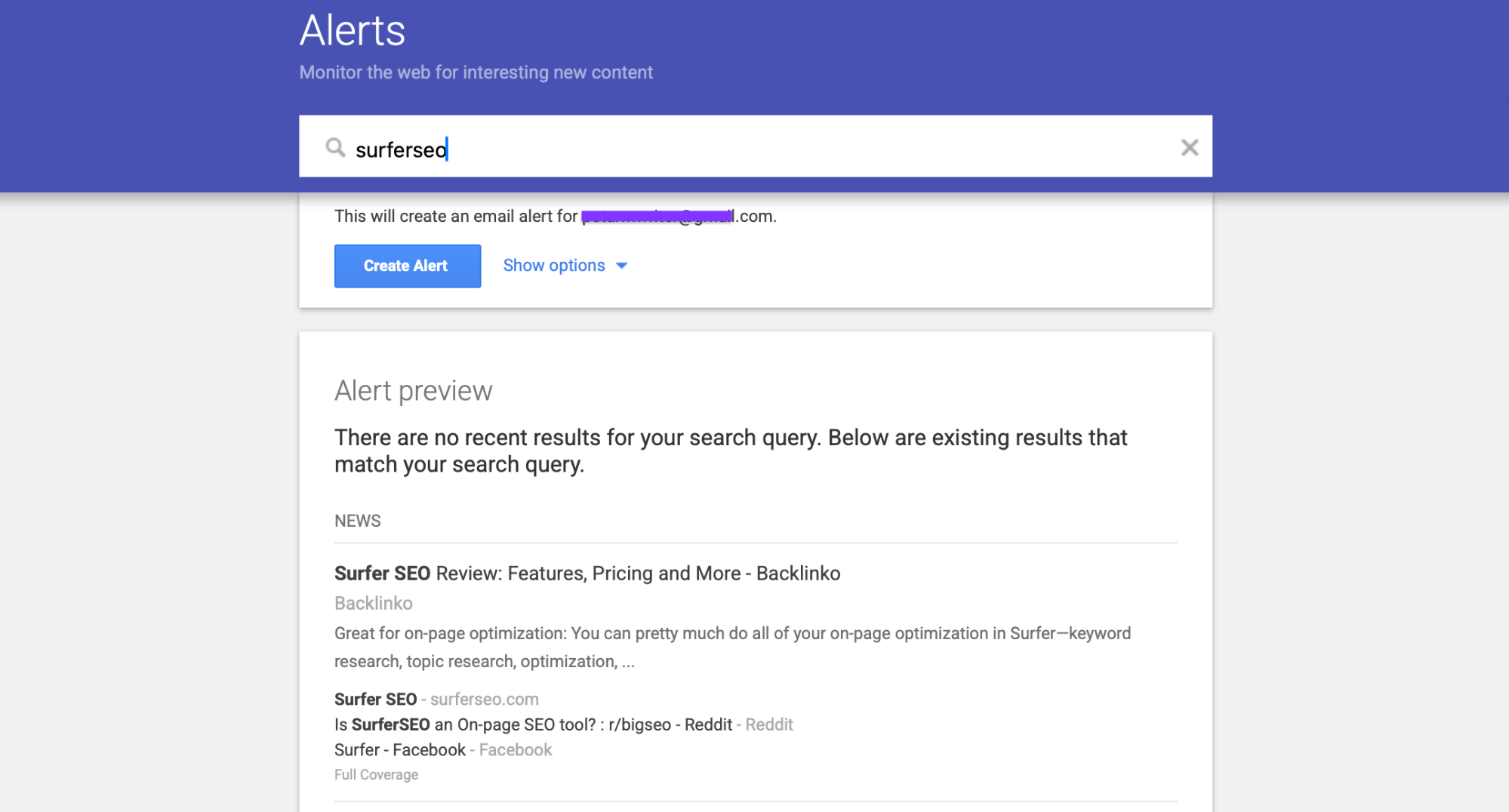
You can pair alerts with Google Search Console for deeper insights. Open the Performance Report, and then filter insights by branded terms to get data like:
- Branded queries
- Pages with spikes in impressions
- Shifts in click-through rates according to the target queries
You should also monitor AI answers for branded queries to see which information AI models serve to your target audience.
The Mention Gap report in Surfer's AI tracker is handy to analyze opportunities for brand mentions that competitors already feature in.
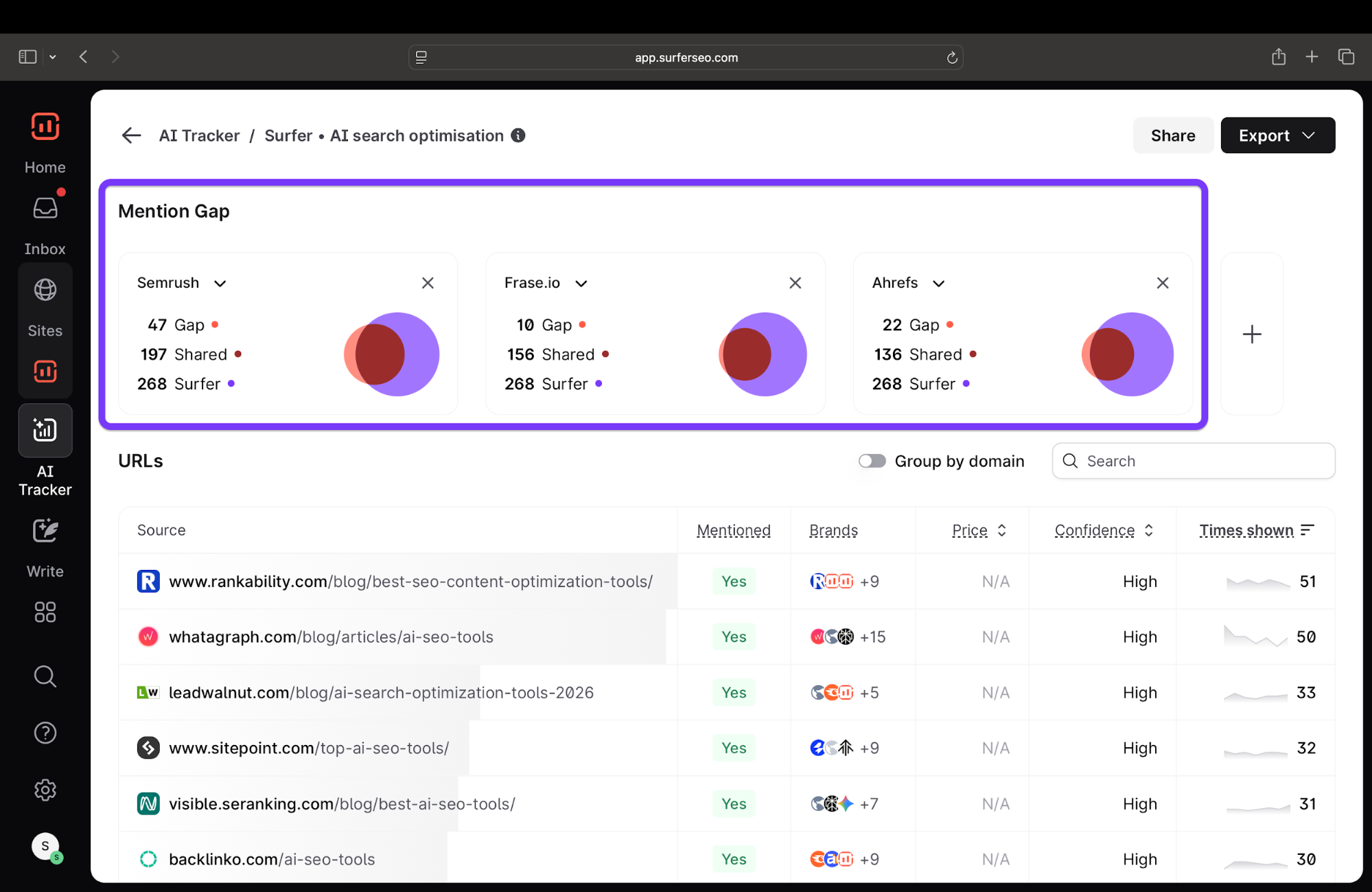
The harder way to do this is to Google branded terms and check AIOs or ask platforms like ChatGPT or Perplexity questions about your brand.
This way, you can understand the AI models' sentiment toward your brand.
3. Build partnerships with cited sources
Optimizing content for AI engines can take a while, so you may want to take a more active approach to being cited. While you wait for the results to take effect, try partnering with those who are already getting cited and featured on their pages.
Think of this as the AI version of link building or guest posting. But instead of asking for a link, you can pitch specific contributions to a cited page so that it gets pulled by AI models.
Head to the Sources tab inside Surfer's AI Tracker.
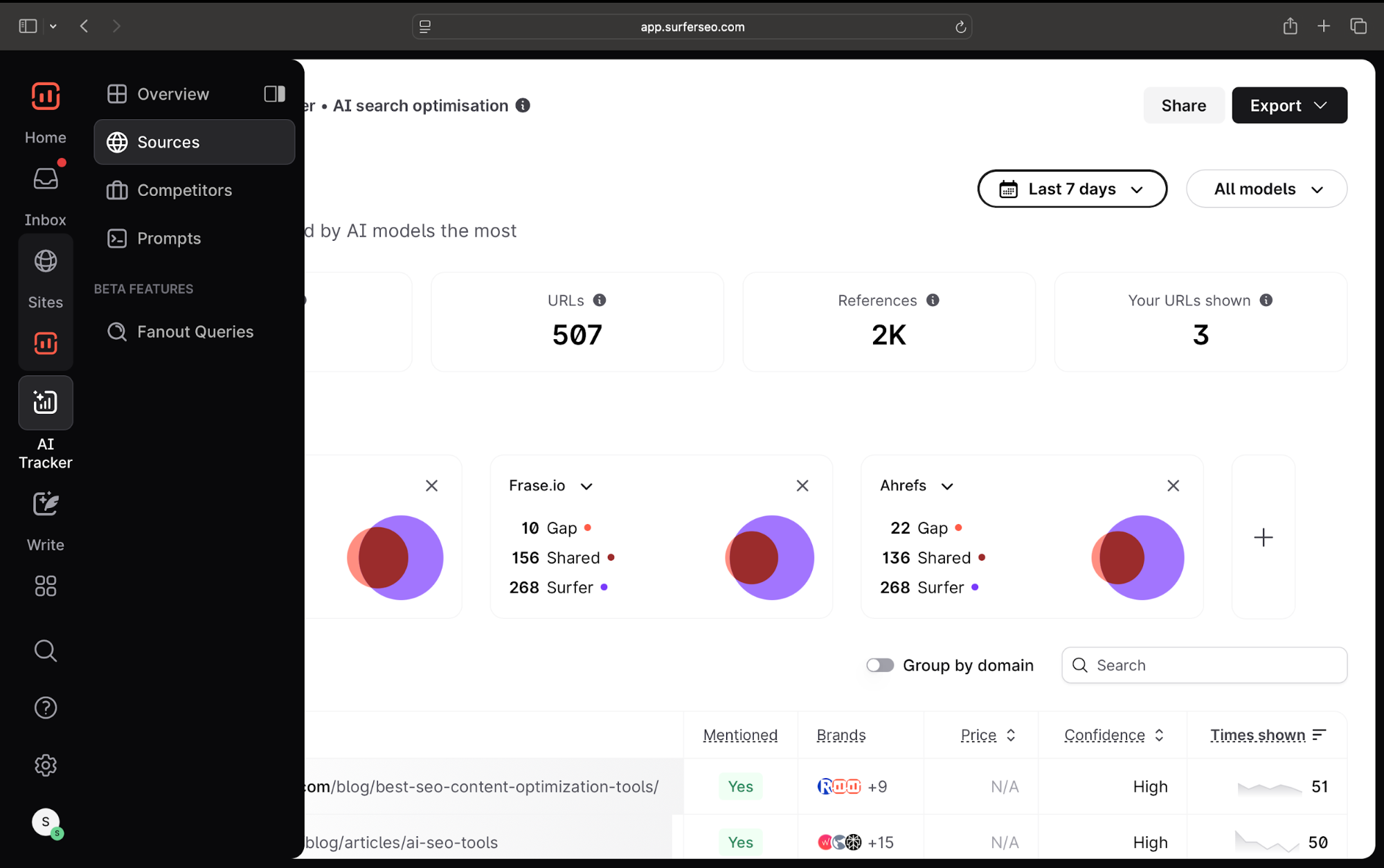
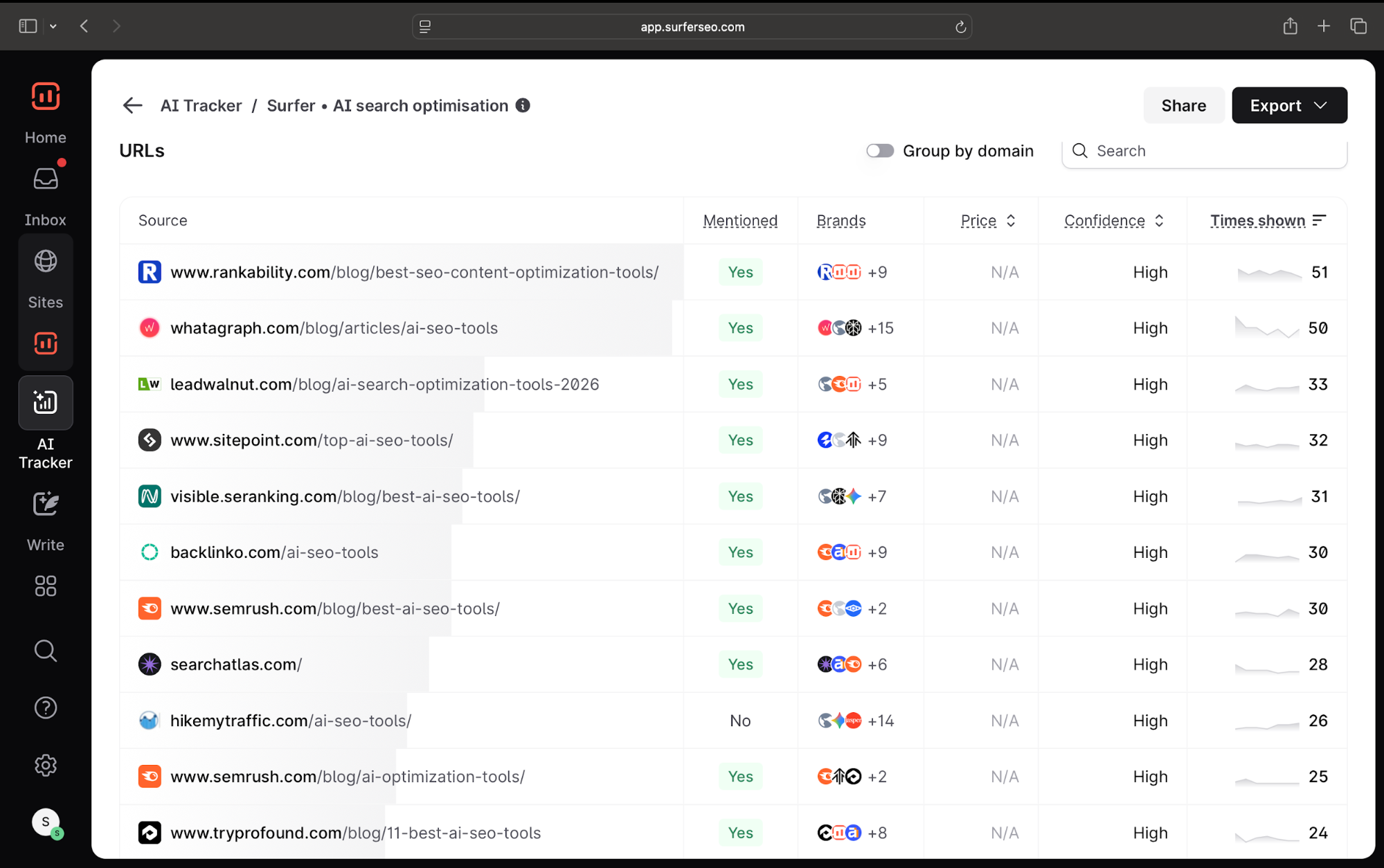
And you will find the most cited pages in your niche along with important metrics for AI search visibility.
I like that I can also see the sentiment for other brands that are mentioned.
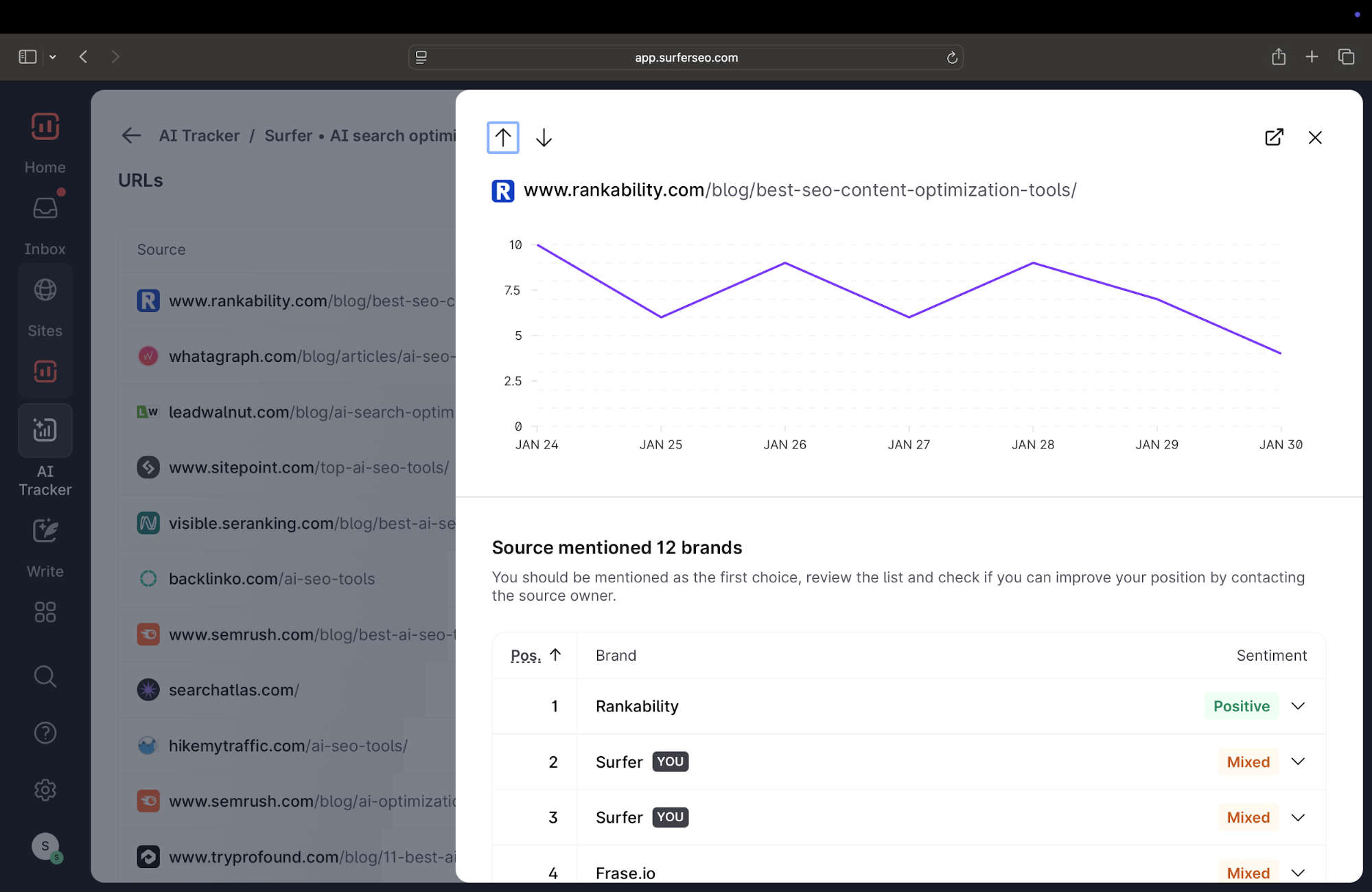
As AI models already trust cite domains, there's a higher chance they'll pull your contributions from them. Ideally, you should aim for direct citations or quotes that feature your name (or your brand's), as doing so will teach AI engines to trust you, as well.
Note that you can still ask for a backlink if you have a page that fits the one you're contributing to. While this won't immediately boost your chances of being cited in AI responses, it will help funnel the target page's authority to your website, which can help with long-term credibility and trust.
4. Include citable statistics, studies, and original insights
Give an AI model credible data to cite, and it will be much more likely to quote your content in its responses. Grounding models on evidence measurably improves factuality and reduces hallucinations, which is in line with the overarching goal of making generative AI as accurate as possible.
As you can imagine, data-driven content and citations also boost user trust. A 2025 citations experiment found that adding citations significantly increased perceived trust in LLM answers, even when participants didn’t verify every link.
No matter your niche, there are plenty of ways to build cold data into your content creation process. Whenever possible, try including:
- Verifiable stats
- Peer-reviewed research
- Primary reproducible data
You don't need to spend an outstanding amount of time and effort on research to leverage data. Even simple surveys, expert interviews, or small studies based on focus groups can do the trick. And if you don't have the bandwidth for them yet, you can leverage other credible sources by referencing them in your pieces.
Whichever way you approach data-driven content, make it as visible and well-structured as you can to make it easier to pick up by AI models. Here's how:
- Add a “Key stats/TL;DR” box near the top with 3–5 numbers or facts, each linked to a primary source.
- Use precise, descriptive labels and captions when adding visuals like charts
- Use lists, tables, and similar structured elements when applicable to make content more extractable
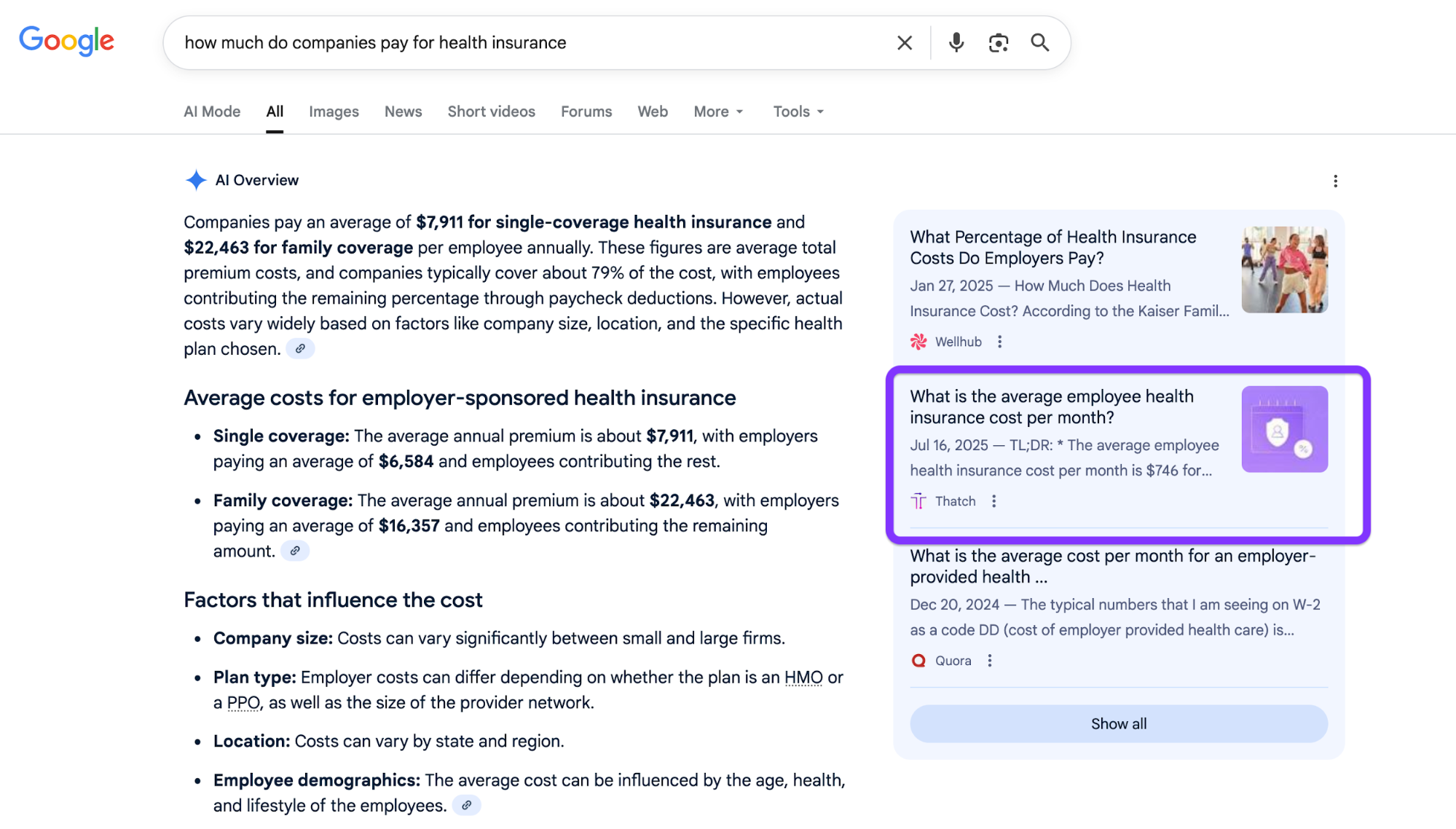
If you need a real-life example, look at Thatch's article on the average cost of employee health insurance. It has a TL;DR section right under the title, which surfaces key stats to the beginning and makes them easy to pick up.
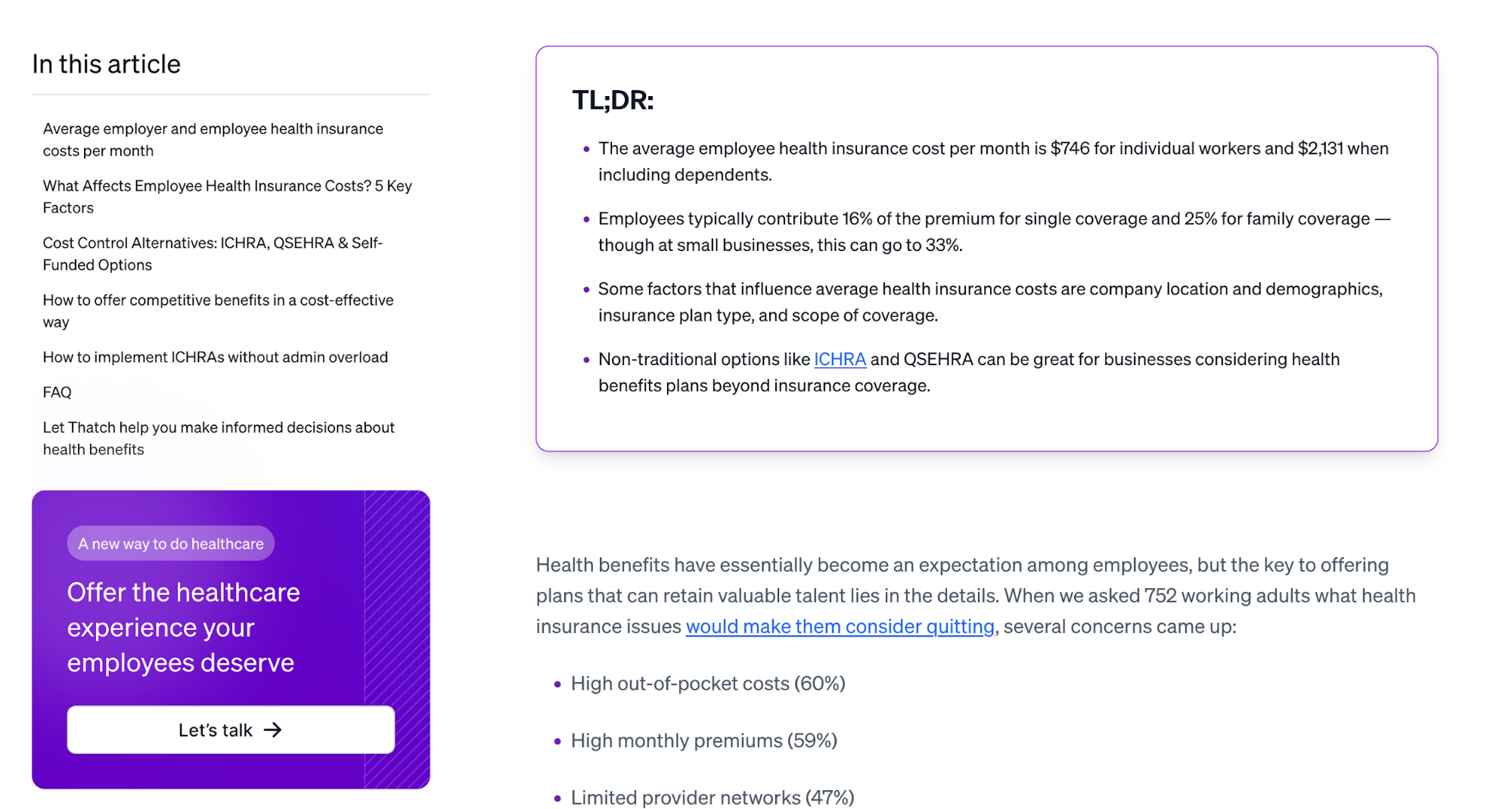
Thanks to such a clear structure combined with the site's general authority, the page is cited as a source of the AIO's answer for the related query.
5. Refresh older articles to keep facts, data, and examples current
Newer, better-sourced pages are easier to ground and cite by default, so AI systems prioritize and reward freshness. Research on LLM reranking confirms this—when given publication dates, multiple models systematically promote newer documents, shifting average results forward by several years.
This shows a clear recency bias that you should leverage to boost the chances of getting cited in AI responses.
Besides, AI models index content much more quickly than traditional search engines. This means you can get featured in a response simply by virtue of speed if you post credible content faster than a competitor.
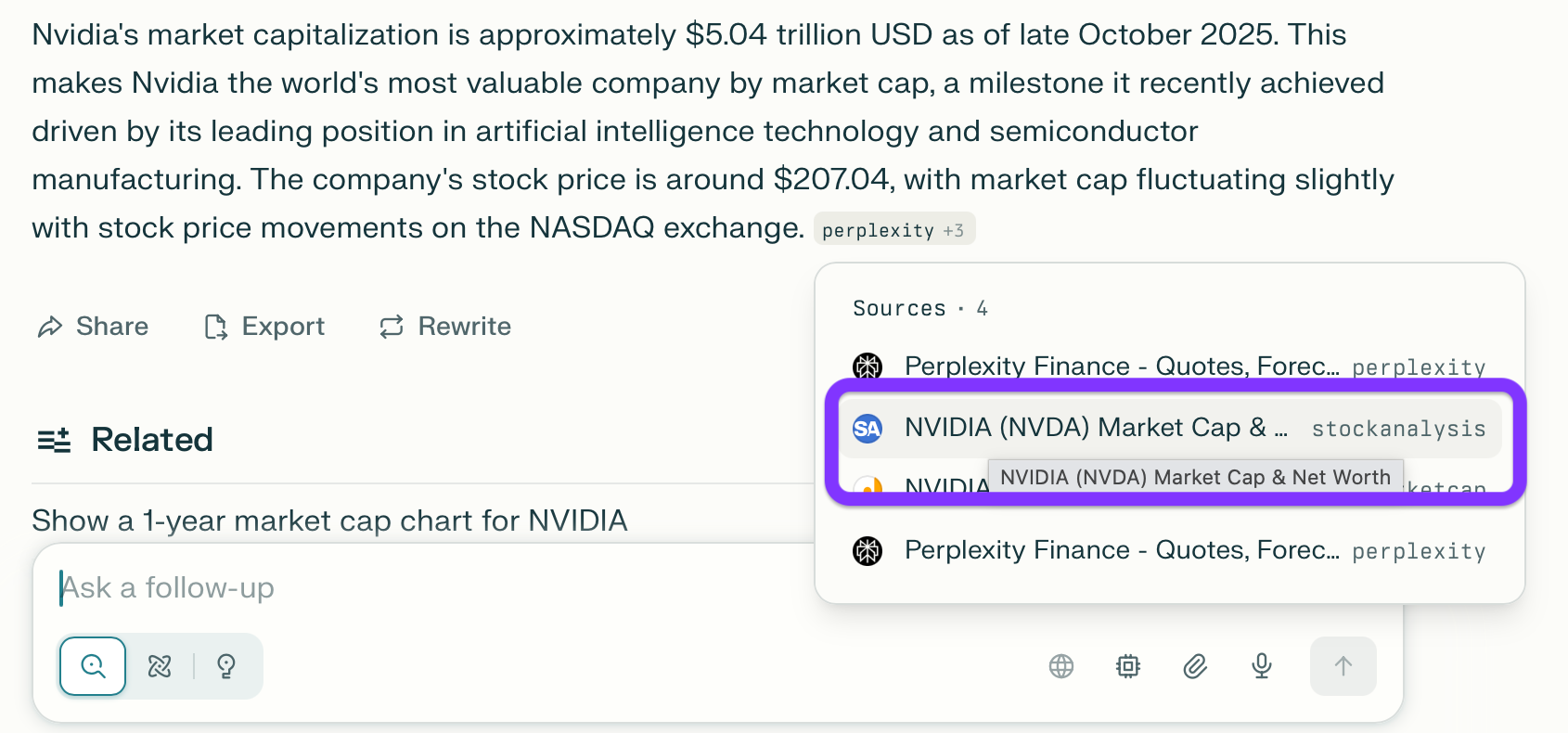
A perfect example is the NVIDIA page on Stock Analysis. When I asked Perplexity about NVIDIA's market cap, it cited the page as a resource with one of the most recent updates.
Meanwhile, the page wasn't among the top-performing content in SERPs (it wasn't even on page #1).
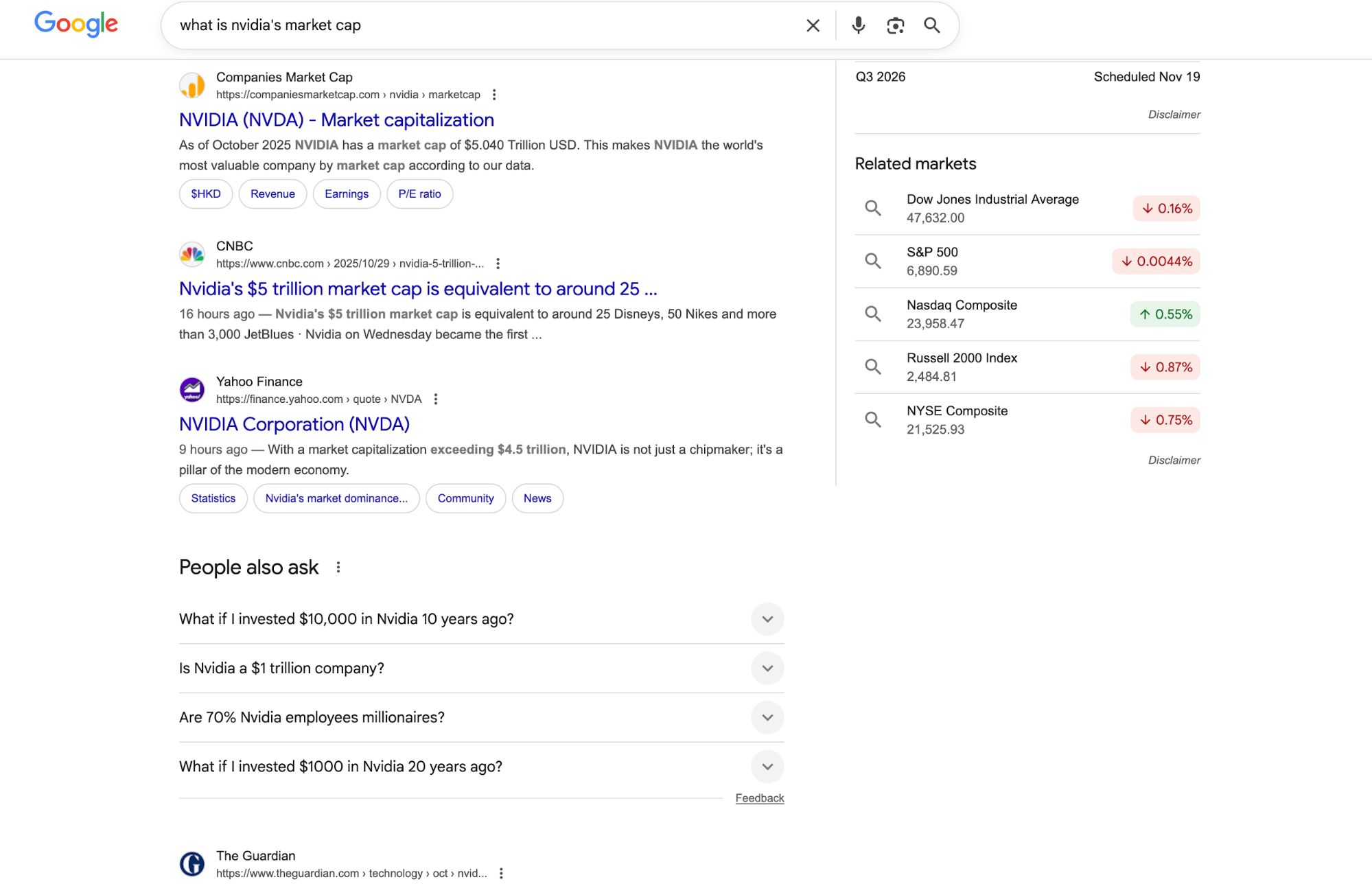
This shows a difference in how traditional and AI-powered search engines determine credibility, and recency is among the most important factors. There are plenty of ways to ensure in on your pages, most notably:
- Build an update calendar for pages tied to changing stats (prices, laws, benchmarks). Log each revision with a changelog anchor so assistants can cite exact changes.
- When updating, replace or re-verify every figure. Link to primary sources and note the date observed.
- Add a compact “Key stats (updated YYYY-MM-DD)” box near the top so extractive systems can lift current numbers verbatim.
- For technical pieces, refresh examples and screenshots to match current interfaces or APIs (stale UI cues can cause mismatches in grounding).
6. Repurpose content across multiple platforms
While traditional search engines mainly focus on ranking website content, AI platforms pull sources from all over the web. Depending on the prompt, an AI model might scour videos, social media posts, forum threads, and plenty of other sources for the most relevant information.
If an AI engine keeps seeing consistent content across these sources, it will trust it more. That's why you should repurpose content through cross-channel marketing campaigns to establish credibility and authority.
Here's an example of a workflow you could implement:
- Write a long-form blog post that comprehensively covers a topic (e.g., a how-to, ultimate guide, etc.)
- Pull the key points and turn them into a:
- LinkedIn carousel
- X/Twitter thread
- A series of Instagram stories
- Turn the key points into a 90-second explainer video you'll publish on YouTube
- Split the video into three 30-second videos you'll post on TikTok
This is just an example, and your preferred channels will depend on your niche and target audience. Regardless of the specifics, try repurposing content for at least 3–4 channels across the web.
A particularly effective tactic is to get active on forums and communities. Statista's June 2025 report showed that Reddit was the most frequently cited resource, and the top list included review platforms and social media websites.
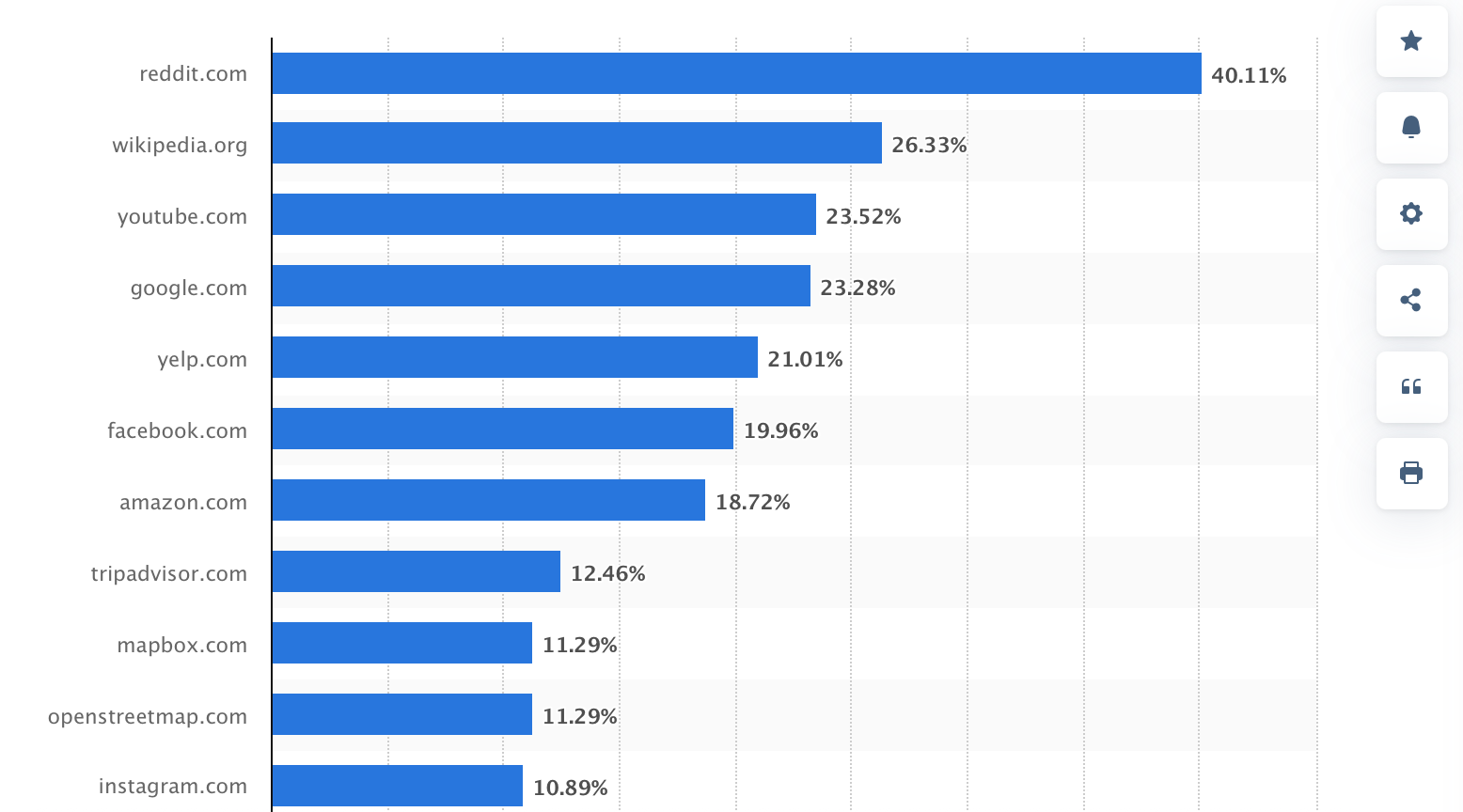
By engaging with your audience on the top-sourced platforms, you can drastically increase your chances of being featured in AI content.
When doing so, make sure to encourage genuine conversations and avoid being overly promotional. While it's okay to subtly advertise yourself from time to time if you can do so naturally, prioritize being helpful, friendly, and candid.
How to measure AI content performance
To check if your AI optimization efforts are working, you can track your AI visibility in Google Analytics 4. Here's how:
- Go to Reports > Acquisition > Traffic acquisition
- In the table, switch Session default channel group to Session source/medium (or just Session source) in the dropdown menu
- Look for entries from AI-driven platforms (chatgpt.com, perplexity.ai, etc.)
While this process lets you see AI traffic sources, it's pretty manual and can get tedious because you have to repeat the steps every time.
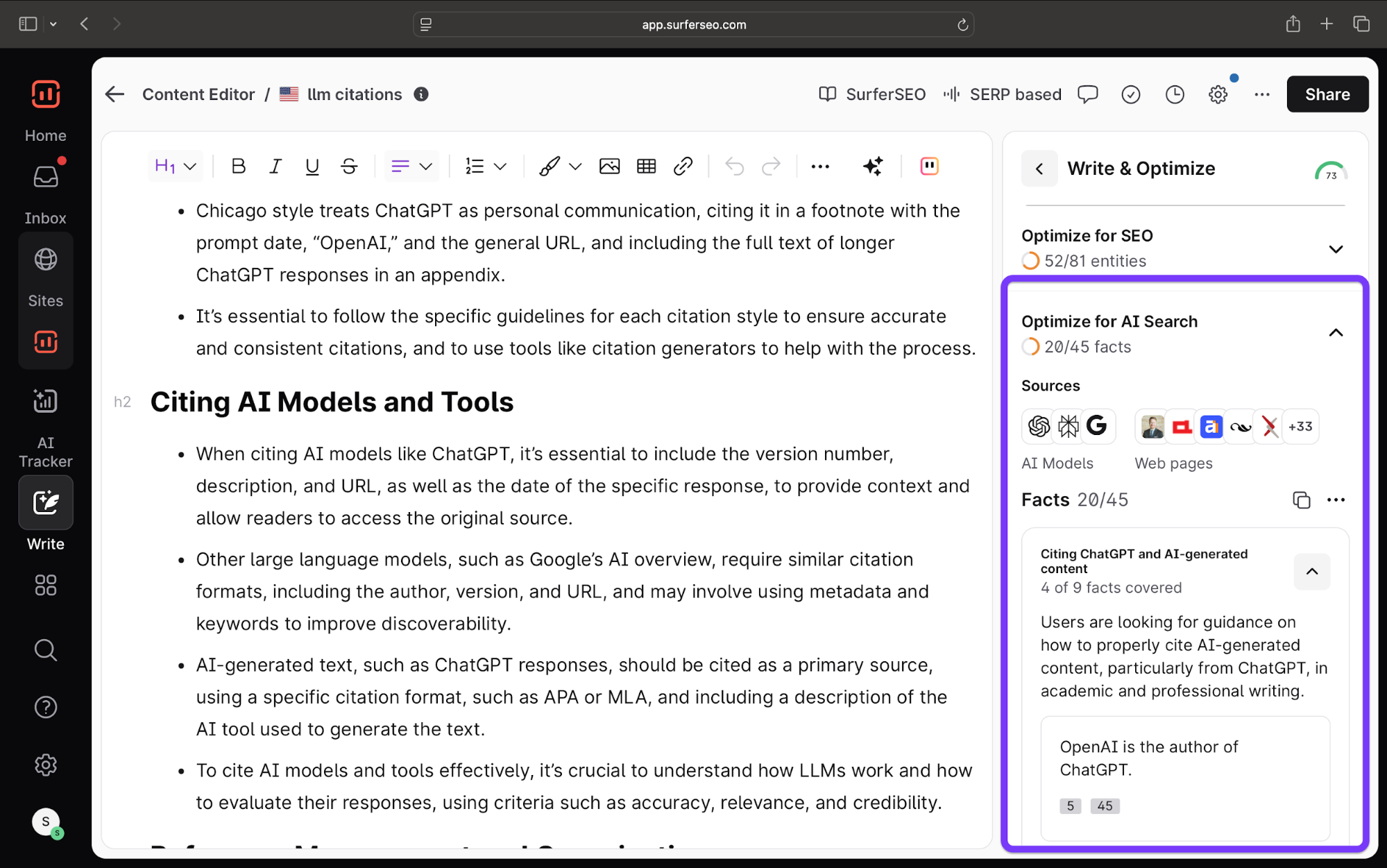
Surfer's AI Tracker is an excellent option to optimize content for AI platforms. The right sidebar measures your article's score for AI visibility by tracking how in-depth your content is.
I also like that you can see talking points that you're missing, along with competing sources in AI answers.
The tracker also tells you everything you need to know about your brand's performance in AI engines, most notably:
- How frequently your brand is mentioned
- Which platforms cite you the most
- Where you appear in AI citations
All of this data is represented visually and aggregated into your AI Visibility Score, so the platform turns raw data into actionable insights.
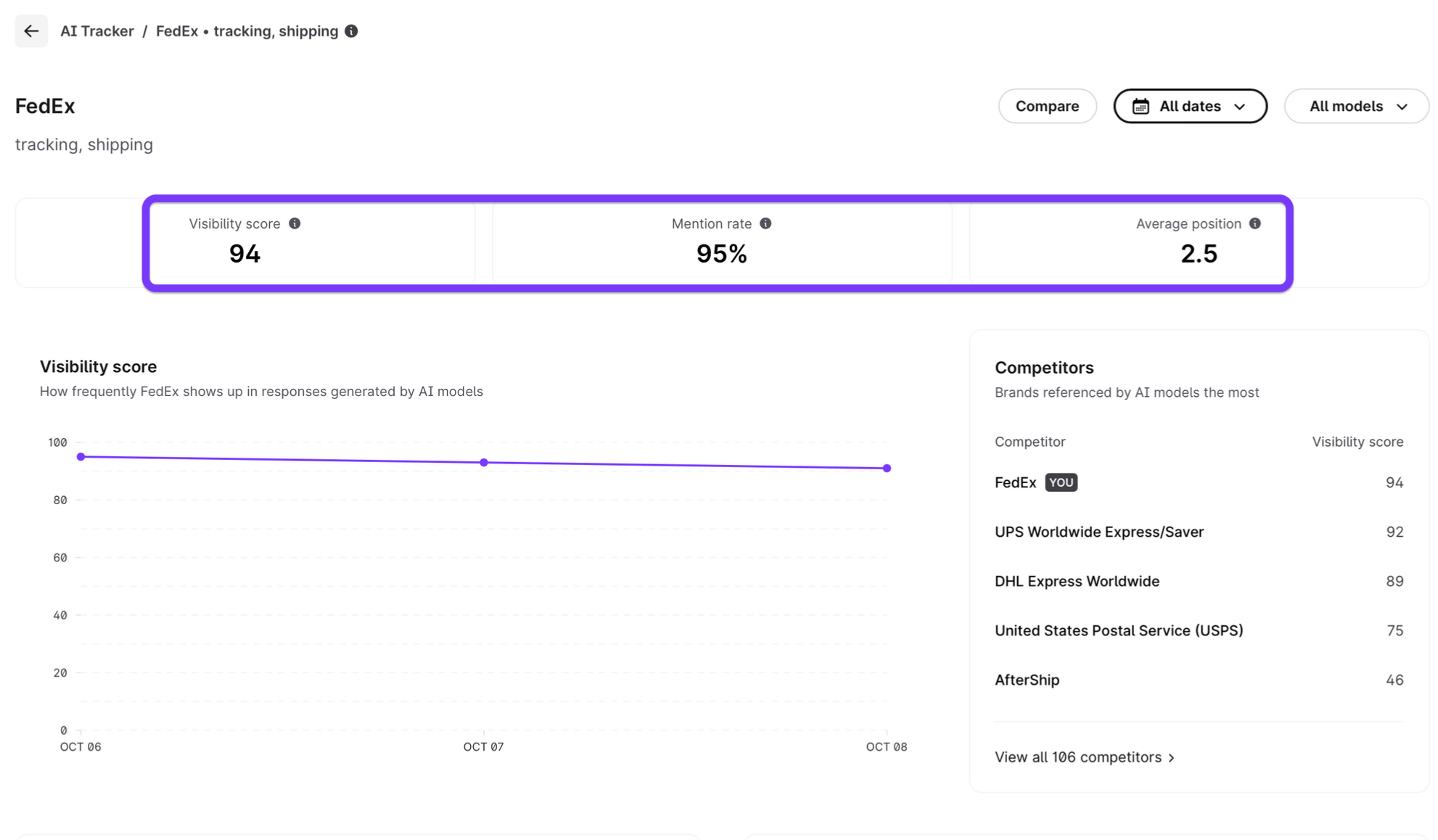
You can also perform competitor analysis to see how others are doing and identify any content gaps. Add the prompts for which you want to show up, and the AI Tracker will show your and your competitor's visibility across platforms.
4 tools for AI content optimization
If you want to speed up AI optimization and remove manual work from the process, check out these tools:
1. Surfer
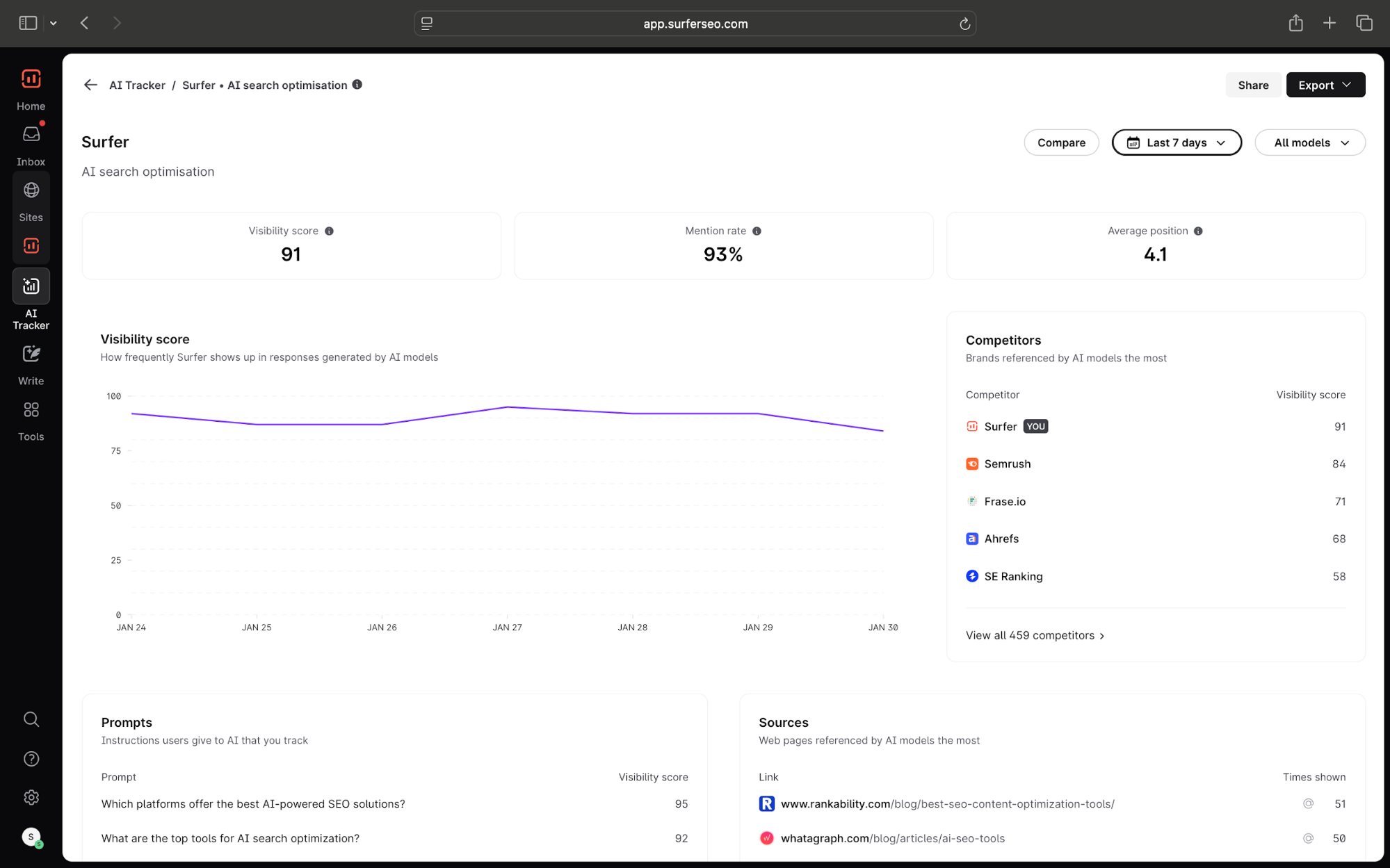
Surfer offers a comprehensive suite of tools that help you optimize content for both traditional and AI-powered search engines. Besides coming up with topic ideas and tracking AI citations across platforms, it lets you:
- Perform robust keyword research to identify the related entities
- Track your rank on traditional search engines
- Audit content to identify optimization opportunities
Most importantly, Surfer handles one of the most time-consuming processes—content writing.
With Surfer AI, you can generate articles in minutes and enjoy the peace of mind knowing that they're already optimized with all the relevant entities. Give the article a few tweaks to ensure the right brand voice and adapt it to your preferences, and it'll be ready to start ranking in SERPs and AI responses.
2. Ahrefs Brand Radar
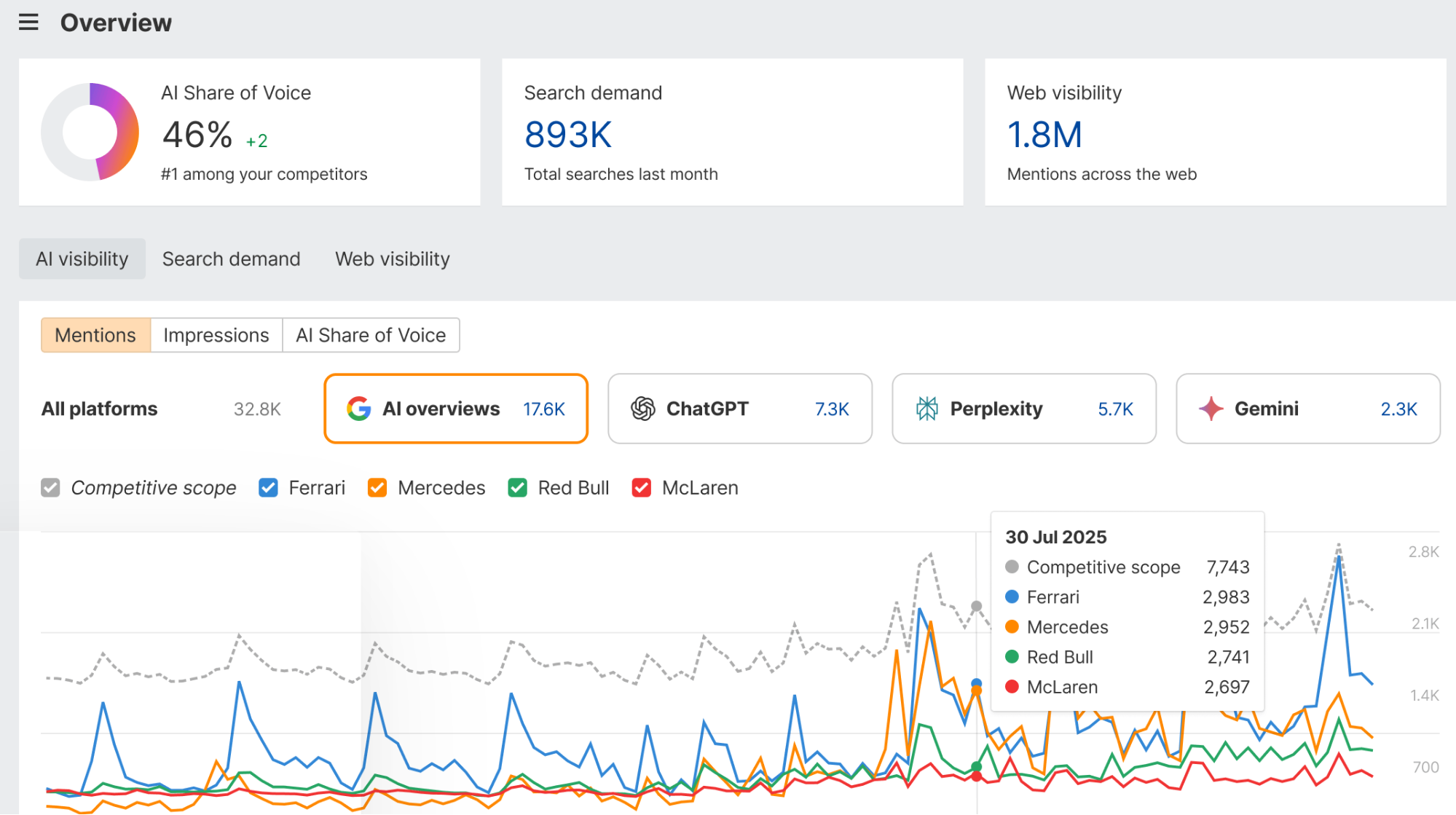
Ahrefs Brand Radar quantifies your AI share of voice across engines (e.g., AI Overviews/Gemini, ChatGPT, Copilot, Perplexity) and provides useful insights like:
- Top cited pages for the prompt/query
- Brands that dominate a specific topic
- Alignment between AI citations and classic search
The tool is especially useful for finding the pages assistants already cite and prioritizing outreach to appear on them. It also goes beyond branded search to help you track entities like specific topics or products.
If you need to find content gaps, Brand Radar lets you cluster different prompts into broader topics to see if there are any content opportunities you haven't explored.
3. Semrush's Brand Monitoring
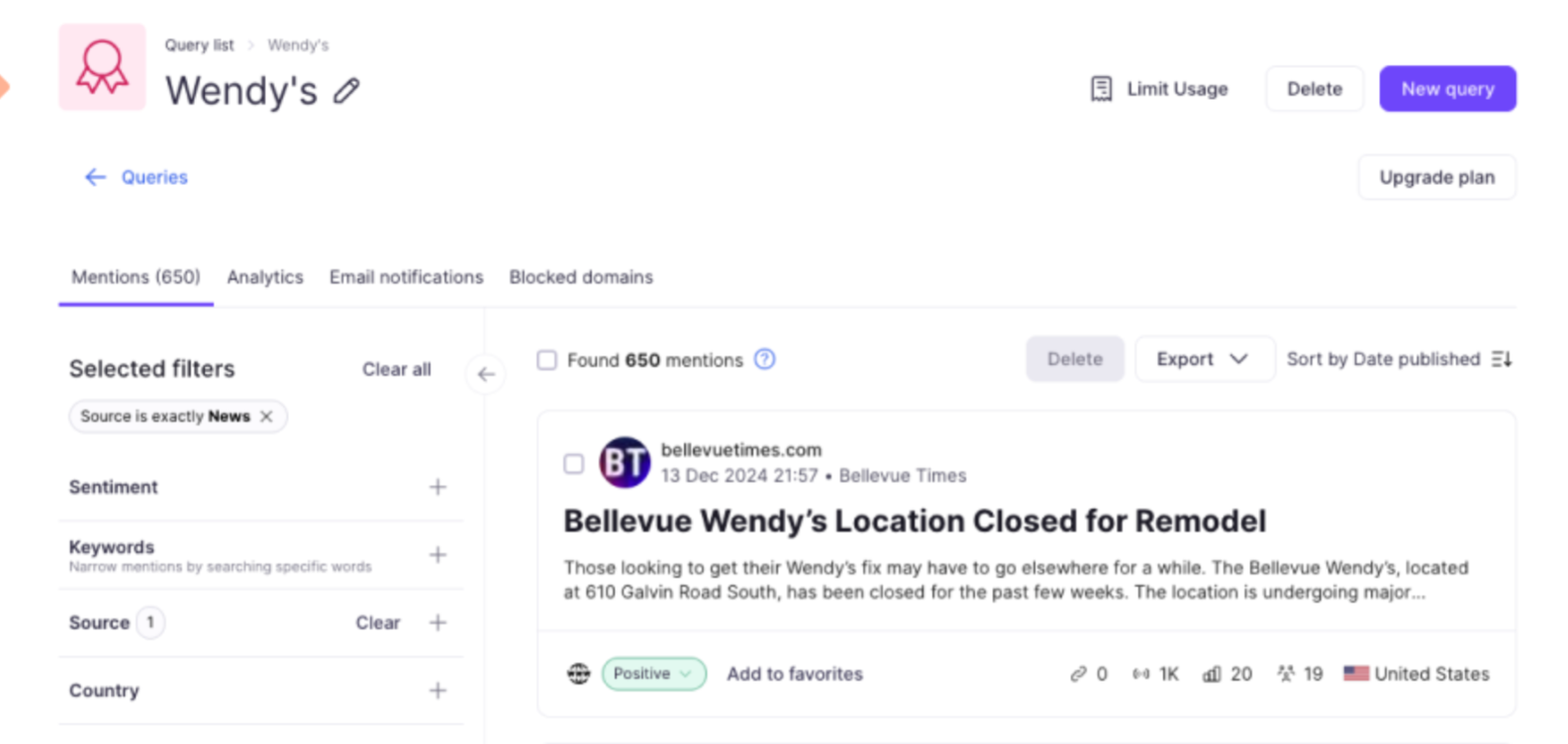
Semrush offers a rich Brand Monitoring tool that tracks web mentions and brand sentiment, helping you understand how others perceive your brand. It also lets you convert unlinked mentions into citable credits on reputable pages to boost your authority and make it more likely for AI platforms to stumble upon your brand.
You can set up email alerts for specific mentions to stay on top of them more easily. You're not limited to website mentions—you can also track appearances on:
- Media outlets
- Social media posts
- Forums and discussion communities
If set up and used correctly, Brand Monitoring can give you a bird's-eye overview of your brand's online visibility and sentiment, which you can use to refine your content strategy and optimize for AI answers.
4. Similarweb
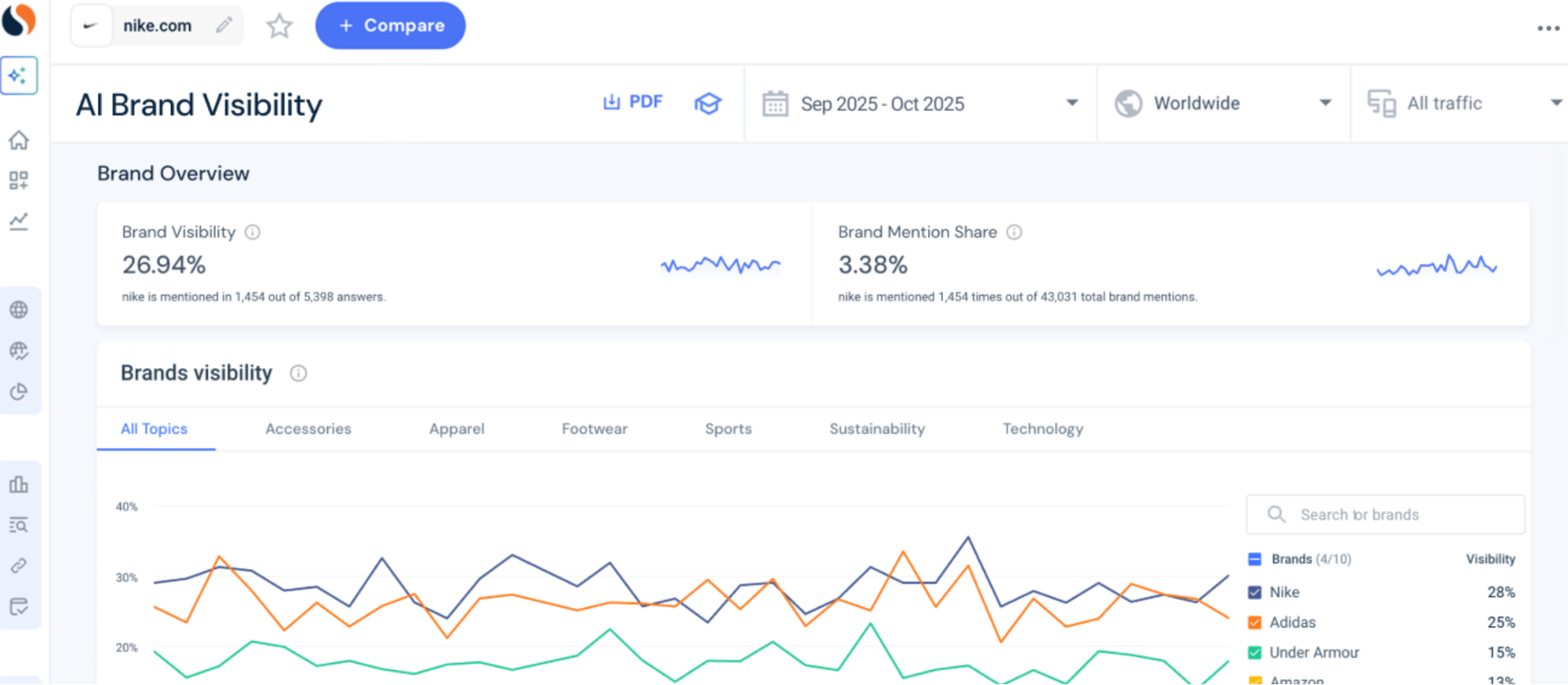
Initially designed for website data analysis, Similarweb now ships an AI optimization and tracking toolkit that lets you monitor your site's visibility and referrals from LLMs.
You can monitor the AI traffic of any website to scout the competition and see how you compare to other websites. You'll also get an overview of how topics trend across generative surfaces and which domains already win attention, which you can use to:
- Size content demand
- Identify lucrative prompts
- Prioritize the content you can optimize and repurpose for AI answers
Thanks to its massive database, Similarweb creates reports based on actual user data, so you don't need to worry about accuracy.
3 examples of AI content optimization
If you want to see successful AI optimization strategies in action, you can check out what these sites are doing:
1. Mayo Clinic

Mayo Clinic is a leading consumer-health reference with physician-reviewed guidance on conditions, symptoms, and treatments. Despite being in a fiercely competitive industry, AI engines cite it often in healthcare answers.
There are many reasons for this, including:
- Clear, scoped entities per condition (Definition > Symptoms > Causes > Risk factors > Treatment) in predictable sections.
- High-signal trust markers (medical reviewers, update dates) that assistants can display or infer.
- Rich internal linking across related conditions/tests, which results in a strong topical graph.
- Stable, citable URLs with clean headings and summary boxes that can be easily extracted.
2. TechRadar
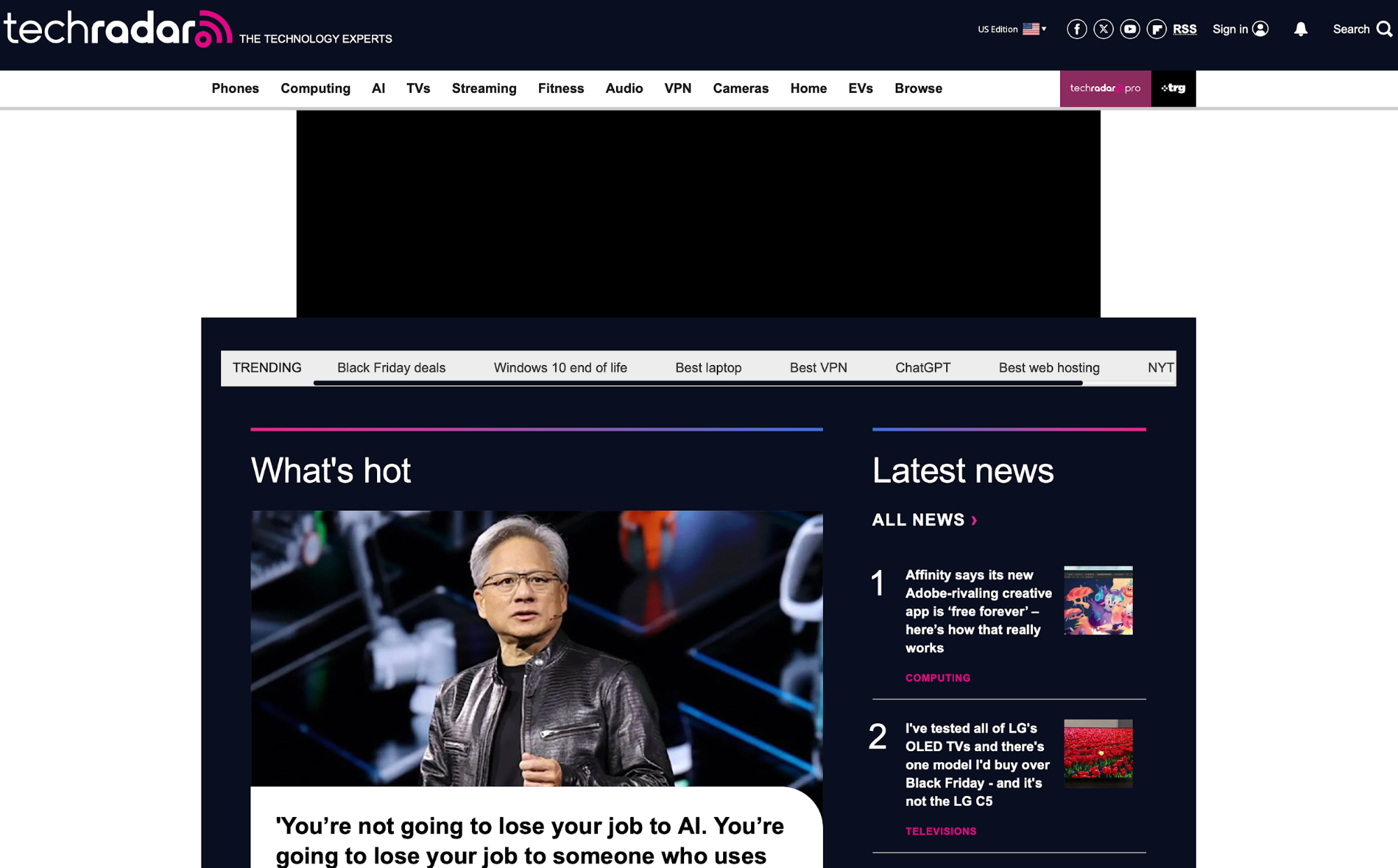
TechRadar is a consumer tech website with reviews, how-tos, and plenty of other content that serves as the go-to resource for tech enthusiasts. If you give different AI platforms tech-related prompts, you'll almost surely see it cited more than a few times.
One of the key reasons for this is the clear intent of each page, which aligns with search intent for the given queries and prompts. TechRadar has distinct templates for reviews, how-tos, and comparisons, and they're aligned with how AI assistants outline the related information.
Other boxes that TechRadar checks well include:
- Specification tables and pros/cons blocks: The site provides structured facts that extract cleanly.
- Freshness cadence: Frequent updates on fast-moving tech keep pages eligible for recency-weighted retrieval.
- Topical clusters: The site has numerous internal links between models, generations, and accessories, which form a machine-navigable product graph.
3. NerdWallet
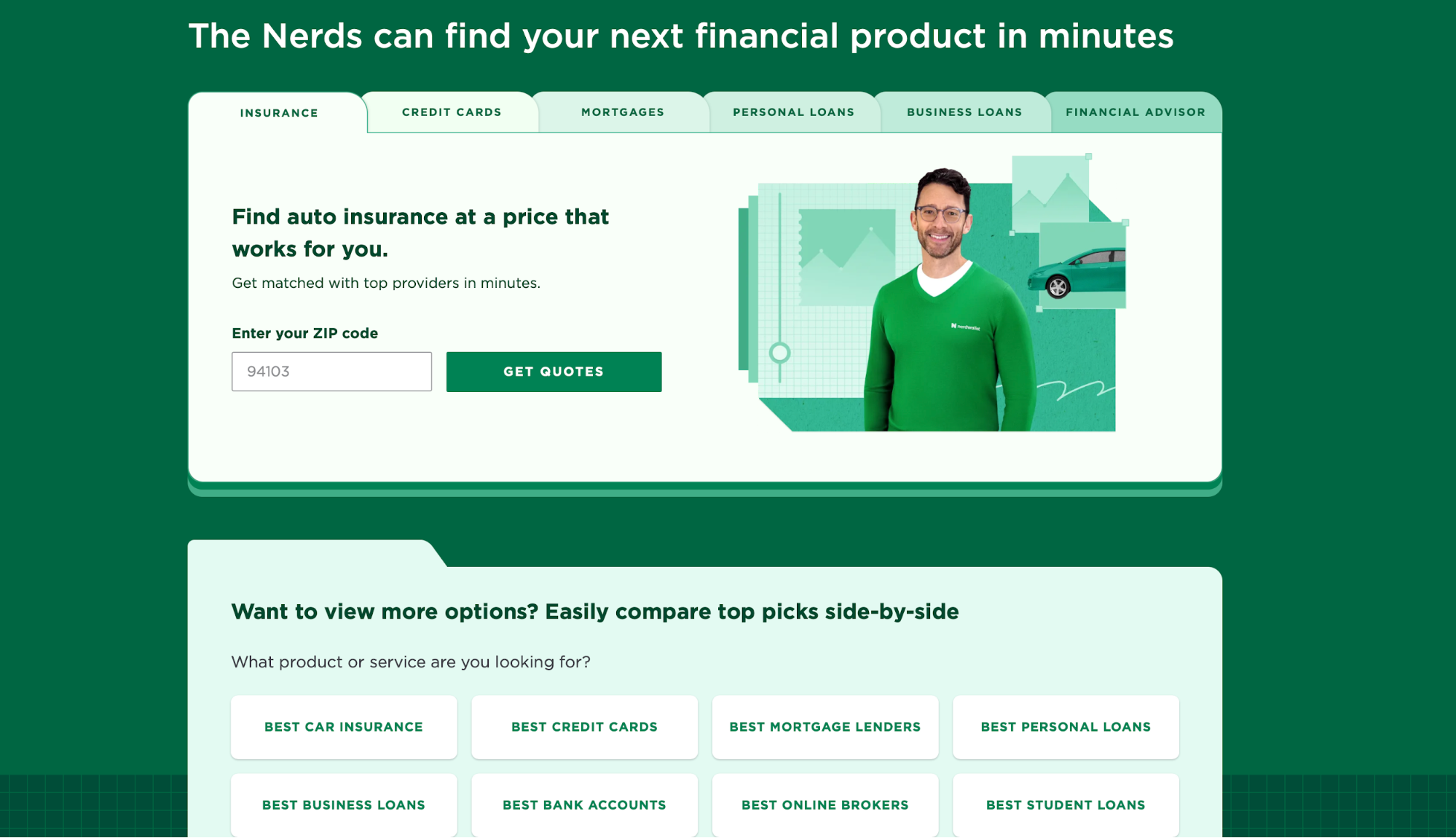
NerdWallet shares finance guides, comparisons, and calculators that AI engines often cite for definitions, product criteria, and how-to steps. Besides a high authority in the finance space and a unique brand identity, this is because most of the site's content maps perfectly to common answer shapes in AI models.
If you open pretty much any article, you'll see easily extractable data in different formats (tables, lists, bullet points, etc.), as well as direct answers to users' questions that directly tie content to the corresponding prompts.
NerdWallet's content is also rigorously fact-checked, which enhances trust and makes AI tools more confident when citing it. The site is also transparent about monetization and any conflict of interest, which sends another trust signal and helps assistants reconcile recommendations with incentives.
What to do next with AI content optimization
AI content optimization is about making your pages easy for AI systems to retrieve, trust, and cite. Since AI answers rely on retrieval and evidence, factual accuracy, strong sourcing, and clean structure are what determine whether your content gets selected.
Publish citable insights, surface them in TL;DR sections, tables, and lists, and keep high-value pages updated so recency doesn’t work against you. Finally, track mentions, citations, and AI-driven traffic over time, and reinforce the same ideas across your site and external channels to build stronger visibility signals everywhere.
How is AI content optimization different from SEO?
AI content optimization is the process of adapting your content’s relevance, structure, and trust signals so it’s more likely to be cited in AI-generated answers across platforms like Google AI Overviews, ChatGPT, and Perplexity. It’s an extension of SEO—not a replacement.
Traditional SEO is mainly about rankings and clicks in search results. AI content optimization is about making your pages easy for AI systems to retrieve, understand, and quote as evidence.
How do AI search engines decide what content to cite?
AI search engines often use retrieval systems to pull relevant sources, then generate answers based on the evidence they find. Pages that are accurate, well-structured, and authoritative tend to be easier to retrieve and cite.
In practice, AI systems favor content that answers questions directly, uses consistent terminology, and includes supporting facts. Strong author signals, transparent sourcing, and a clear information hierarchy can all increase the likelihood of being selected as a reference.
Why does content structure matter so much for AI content optimization?
Content structure matters because AI systems need to quickly extract key information and reuse it in generated answers. Clear headings, concise definitions, and scannable sections make it easier for AI to parse and quote your content.
If your page is organized with predictable sections like “What it is,” “How it works,” and “Examples,” it becomes more extractable. Adding TL;DR boxes, tables, and labeled visuals can also increase the chances that AI tools lift your facts accurately.
What is entity optimization and why does it improve AI visibility?
Entity optimization is the practice of making it extremely clear what your page is about by using consistent naming, relevant entities, and connected supporting topics. It helps AI systems resolve your content to the right “thing” in their knowledge graphs.
Instead of optimizing only for keywords, you optimize for topics and their relationships. When you include canonical names, common aliases, and internal links to related concepts, AI systems can understand context better—and retrieve your page more confidently as a trusted source.
What types of “citable” content help AI engines trust your pages?
AI engines are more likely to cite content that includes verifiable statistics, primary sources, and clear supporting evidence. The easier it is to ground claims in facts, the safer it is for AI systems to quote your content.
Citable content doesn’t have to mean massive research projects. Even small surveys, expert interviews, and well-sourced comparisons can help. The key is to surface important numbers near the top and present them in structured formats like tables, lists, and labeled charts.
How often should I refresh content for AI content optimization?
Refreshing content regularly improves AI visibility because AI systems tend to prefer newer, recently updated sources—especially for fast-changing topics like pricing, benchmarks, and product updates. Recency can make your page more eligible to be retrieved and cited.
A simple approach is to build an update calendar for high-value pages, re-verify every stat, and add visible “updated on” signals. Updating examples, screenshots, and source links also helps prevent AI from pulling outdated information into its answers.
How do I measure whether AI content optimization is working?
You can measure AI content optimization by tracking AI-driven referrals and monitoring whether your pages are being cited in AI-generated answers. This helps you quantify visibility beyond traditional rankings.
One way is to check AI traffic sources in GA4 (like chatgpt.com or perplexity.ai). For deeper visibility tracking, tools like Surfer AI Tracker can show how often your brand is mentioned, which platforms cite you most, and how your AI visibility changes over time compared to competitors.